TL;DR:
- Malta’s limited land supply drives high demand, increasing property values and rental rates annually.
- Buying office space involves significant upfront costs but offers long-term asset building and rent security.
- Renting provides flexibility for growing or changing businesses but exposes them to rising costs and lease risks.
Most business owners in Malta assume renting is the safer, more flexible option. It preserves capital, avoids long-term commitment, and keeps the balance sheet light. But Malta’s commercial property market operates under conditions that challenge this assumption directly. With 3-7% annual price growth and a structurally constrained supply of quality office space, the financial calculus is more nuanced than it first appears. This guide breaks down the real costs, risks, and strategic trade-offs of renting versus buying office space in Malta, so you can make a well-informed choice about rent vs buy in Malta grounded in data rather than assumption.
Table of Contents
- Why the Malta office market is different
- Cost breakdown: Renting vs buying an office
- Key benefits and risks: Rent vs buy
- How to choose: Decision-making framework for Maltese businesses
- Why the right answer depends on your strategy
- Find your next office space in Malta
- Frequently asked questions
Key Takeaways
| Point | Details |
|---|---|
| Malta’s tight office market | Limited availability and rising prices make every rent vs buy decision more strategic in Malta. |
| Renting offers flexibility | Leasing makes sense for agile, fast-growing, or capital-conscious businesses unsure of their long-term needs. |
| Buying secures long-term value | Ownership can build equity and shield your company from rent hikes if you’re established and plan to stay put. |
| Break-even comes long-term | Commercial ownership only outperforms renting if you remain for 10+ years and the property appreciates. |
| Choose based on business strategy | The best option depends on your company’s stability, risk appetite, and future plans. |
Why the Malta office market is different
Malta occupies roughly 316 square kilometres. That physical constraint shapes everything about its commercial property market. There is simply less land available for development, fewer office buildings in prime locations, and a limited pipeline of new-build commercial stock. For businesses seeking quality office space, this creates a market that behaves differently from larger European economies.
Demand, meanwhile, continues to grow. Financial services, iGaming, technology, and professional services firms have expanded their footprints on the island over the past decade. The result is a tight market where vacancy rates in prime districts remain low and landlords hold considerable negotiating leverage.
On the purchase side, large prime offices exceed €3 million in total value, with prices rising at 3-7% per year. That appreciation rate is not incidental. It reflects the structural imbalance between supply and demand that characterises Malta’s office sector.
Key market dynamics to understand:
- 🔴 Limited supply: New commercial developments are constrained by land availability and planning regulations
- 🟡 Rising values: Annual price growth of 5-7% means delayed purchases become progressively more expensive
- 🟢 Rent escalation: Scarcity pushes rental rates upward, eroding the cost advantage of leasing over time
- 🔴 Prime location premium: Grade A offices in Valletta, Sliema, and St Julian’s command the highest premiums
“In a market defined by limited supply and consistent appreciation, the conventional wisdom that renting is always cheaper deserves careful scrutiny.”
For a broader view of how these dynamics play out across different districts, the Malta office guide provides detailed locality-by-locality analysis. Understanding market pricing trends is equally important before committing to either route.
Cost breakdown: Renting vs buying an office
The numbers matter. Before making any decision, you need a clear picture of what each option actually costs, both upfront and over time.
Rental costs in Malta currently range from €120 to €350 per sqm per year, depending on location, specification, and lease terms. A 200 sqm office in a prime area could therefore cost between €45,000 and €60,000 annually in rent alone. Lease terms typically run three to five years, with rent review clauses that can push costs higher at renewal.
Purchasing an office involves a different cost structure entirely. Beyond the acquisition price, buyers face stamp duty, notary fees, agency commissions, and ongoing maintenance responsibilities. Commercial yields in Malta sit at 4-6% annually, which means break-even against renting typically occurs after ten or more years, assuming the property appreciates at the historical rate.

| Cost element | Renting | Buying |
|---|---|---|
| Upfront capital | 2-3 months deposit | 10-20% deposit + fees |
| Stamp duty | None | 5% of purchase price |
| Notary fees | Minimal | 1-2% of purchase price |
| Annual cost | €150-€350/sqm/year | Mortgage + maintenance |
| Flexibility | High | Low |
| Equity building | None | Yes |
Additional transactional costs to factor in:
- Renting: Agency fees (typically one month’s rent), legal review of lease, fit-out costs
- Buying: Agency fee (typically 5% + VAT), survey costs, insurance, sinking fund contributions
- Both: VAT considerations depending on property use and registration status
For a detailed breakdown of what tenants pay in practice, the renting office costs guide and office rental prices Malta data provide current benchmarks.
Pro Tip: Buying suits businesses with a stable long-term outlook and sufficient cash flow to absorb upfront costs without compromising operational liquidity. If your capital is better deployed in the business itself, renting may preserve more value in the short term.
Key benefits and risks: Rent vs buy
Costs alone do not tell the full story. The strategic implications of each option extend well beyond the monthly outgoing.
| Factor | Renting | Buying |
|---|---|---|
| Capital preservation | ✅ Preserves working capital | ❌ Requires significant upfront outlay |
| Flexibility | ✅ Easier to upsize or relocate | ❌ Illiquid asset, harder to exit |
| Equity building | ❌ No equity accumulation | ✅ Builds asset value over time |
| Rent exposure | ❌ Subject to market rent hikes | ✅ Insulated from rent escalation |
| Maintenance | ✅ Landlord responsibility | ❌ Owner bears all maintenance costs |
| Location security | ❌ Lease non-renewal risk | ✅ Permanent tenure |
For established firms with a long-term horizon, buying builds equity and captures appreciation in a tight market. The security of knowing your location is permanent, and that rent increases cannot affect you, has real operational value. It also converts a cost centre into an asset on your balance sheet.
Renting, by contrast, keeps your options open. If your headcount doubles in three years, you can move to a larger space without the friction of selling a property. If your sector contracts, you are not locked into a depreciating asset.
When it makes sense to buy rather than rent:
- Your business has operated profitably for five or more years
- You have a clear long-term location strategy with no anticipated need to relocate
- You have sufficient capital reserves to absorb upfront costs without straining operations
- Your sector is stable and not subject to rapid structural change
- You want to convert occupancy costs into a long-term investment
Understanding the full implications of renting in Malta’s current market is essential before assuming that leasing is the lower-risk path.
Pro Tip: Firms anticipating significant headcount growth or needing to scale their floor plate within two to three years are generally better served by renting. Ownership locks you into a specific space at a specific time.
How to choose: Decision-making framework for Maltese businesses
A structured approach to this decision reduces the risk of choosing based on short-term conditions rather than long-term strategy.
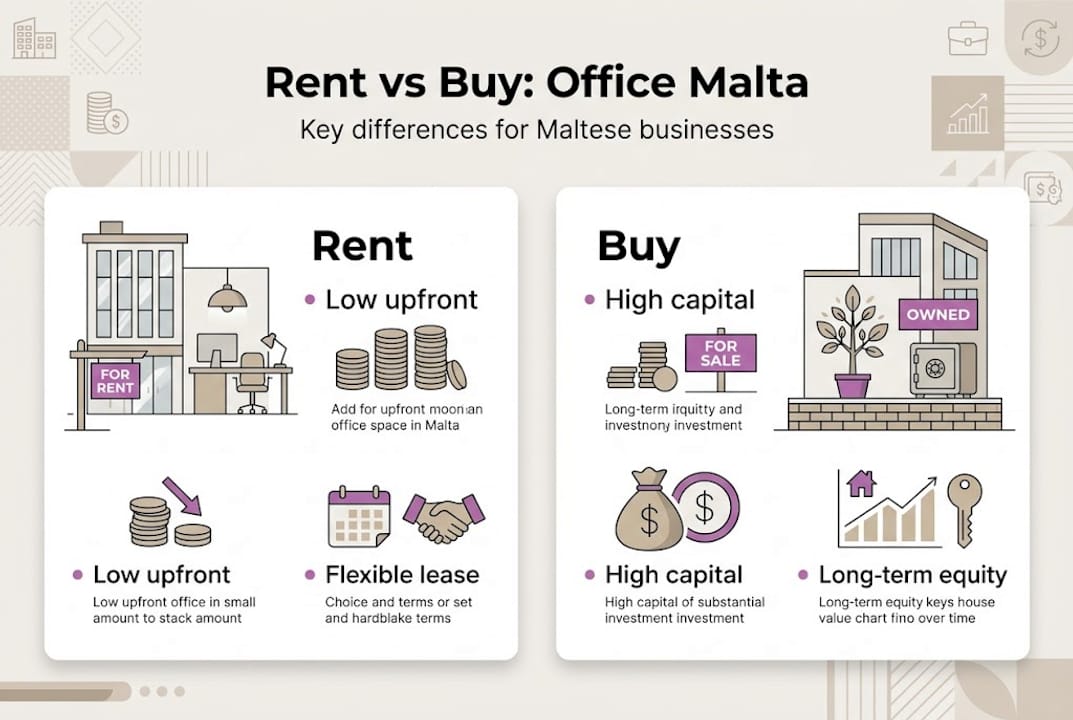
Step 1: Assess your business longevity and stability. How long has the business been operating? Is revenue predictable? Lenders and advisors will scrutinise this, and so should you. A business with two years of trading history faces different risks from one with fifteen.
Step 2: Model your cash flow under both scenarios. Run a ten-year projection comparing total occupancy costs under a rental scenario against a purchase scenario. Include rent escalation assumptions of 3-5% per year for the rental model. With yields at 4-6%, break-even against renting typically requires ten or more years of appreciation to materialise.
Step 3: Evaluate growth plans honestly. Ask yourself these questions before committing:
- Do you expect to grow your team by more than 30% in the next five years?
- Is your current space requirement likely to change significantly?
- Are you considering expanding to additional locations?
- Could a change in sector regulation alter your office requirements?
- Do you have the management bandwidth to handle property ownership responsibilities?
Step 4: Work with qualified advisors. A commercial property solicitor and an independent financial adviser familiar with Malta’s market can model scenarios specific to your situation. Do not rely solely on agents who have a transactional interest in the outcome.
For guidance on evaluating total occupancy costs in practice, assessing rental costs in Malta offers a practical methodology.
Pro Tip: Stress-test your preferred option against a 2% interest rate increase and a 12-month vacancy period. If buying still works under those conditions, your decision is robust. If it does not, reconsider the timing.
Why the right answer depends on your strategy
The rent versus buy debate often gets reduced to a financial comparison. But the more important variable is strategic fit, and that is something no spreadsheet can fully capture.
We have seen well-capitalised businesses buy offices at exactly the wrong moment, locking themselves into locations that no longer suited their growth trajectory three years later. We have also seen firms rent indefinitely, paying steadily rising rates, when ownership would have delivered both stability and asset value. Neither outcome is inevitable. Both are avoidable with clear thinking.
The businesses that make the right call tend to share one characteristic: they treat the office as a strategic decision, not an administrative one. They connect their property choice to their five-year vision, their hiring plans, and their sector outlook. They consult local office expertise rather than relying on general market commentary.
For context on how this plays out in practice, real office case studies from Malta’s market illustrate the range of outcomes businesses have achieved. The right answer is not universal. It is specific to your business, your risk tolerance, and your vision for where the company is going.
Find your next office space in Malta
Whether you are weighing a long-term purchase or searching for a flexible lease, OfficeSpace.Rent provides the market data, property listings, and expert guidance to support your decision. You can rent or buy offices in Malta through a single platform built specifically for the Maltese commercial market. Browse Malta offices for sale to assess current purchase opportunities across prime and secondary locations. If you need flexible arrangements, explore desk-based office solutions suited to growing teams. Our local advisers are available to discuss your specific requirements and help you model the right option for your business.
Frequently asked questions
What are typical office rental rates in Malta?
Most offices in Malta rent for €120-€200 per square metre per year, with prime locations in Valletta, Sliema, and St Julian’s commanding the upper end of that range.
How long does it take to break even on an office purchase in Malta?
With commercial yields at 4-6%, break-even versus renting typically occurs after ten or more years, provided the property appreciates at the historical rate of 5-7% annually.
Is office supply in Malta really as limited as reported?
Yes. Malta’s compact geography and planning constraints mean prime offices exceed €3M in value, with vacancy rates in key districts remaining persistently low.
What are the main risks of buying office space as a business?
High upfront capital requirements, limited liquidity, ongoing maintenance costs, and exposure to property market cycles are the primary risks. Buying requires significant capital and long-term commitment that may not suit every business stage.
Does buying protect against rising rents?
Yes. Ownership eliminates rent escalation risk entirely. In Malta’s growing market, where buying secures location and insulates against rent increases, this protection has measurable long-term financial value for stable, established businesses.
Recommended
- Why Rent Office Space Malta for European Expansion
- Pricing Structure for Office Rentals: Key Insights
- Rent Office Malta €7000 to €10000: What to Expect – Offices in Malta To Let & For Sale
- Office rental negotiation guide: Secure the best deal in Malta
- Agent roles in Singapore commercial leasing: unlock value