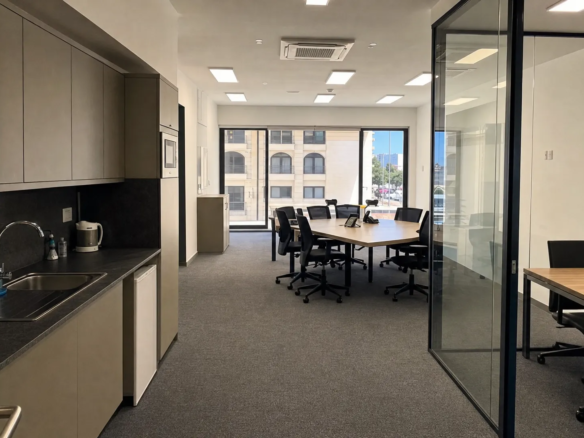
Businesses exploring European expansion face a common challenge: balancing operational costs with strategic location benefits. Malta stands out by offering office rental rates 40-60% lower than London, Paris, or Dublin, whilst maintaining full EU market access and a thriving English-speaking business ecosystem. Whether you’re launching a startup, scaling an iGaming operation, or establishing a regional headquarters, Malta’s flexible office rental market provides turnkey solutions tailored to diverse growth trajectories. This guide explores why rent office space Malta is a strategic choice for businesses seeking cost-effective, adaptable office space in a jurisdiction that actively supports international commerce.
Table of Contents
- Key takeaways
- Malta’s competitive office rental market explained
- Flexible leasing options tailored to your business needs
- Why Malta’s business environment supports your office rental decision
- How to choose and rent the best office space in Malta
- Explore Malta office space options with OfficeSpace.Rent
- Frequently asked questions about renting office space in Malta
Key Takeaways
| Point | Details |
|---|---|
| Lower rents versus hubs | Malta offers prime office rents between €180 and €450 per square metre per year, substantially cheaper than London, Paris and Dublin. |
| Flexible leasing options | The market supports a range from serviced offices to long term leases, enabling agility for startups and expanding firms. |
| EU access and English workforce | Malta provides full EU market access together with a thriving English speaking business environment. |
| Cost stability and predictability | Average occupancy costs hover around €550 per square metre per year, with modest annual increases. |
Malta’s competitive office rental market explained
Malta has quietly positioned itself as one of Europe’s most affordable business locations without sacrificing quality or connectivity. Prime office rents across Malta’s main business districts range from €180 to €450 per square metre annually, creating a stark contrast with traditional European hubs. London commands over €1400 per square metre, Paris exceeds €800, and even Dublin reaches €450 at the lower end. This pricing differential translates to substantial savings for businesses requiring 100-500 square metres of professional workspace.
The rental landscape varies by district. Sliema and St Julian’s, Malta’s premium coastal business zones with sea views and lifestyle amenities, command the higher end of the spectrum at €350-€450 per square metre. Mriehel and other industrial-commercial areas offer excellent value at €180-€250 per square metre whilst maintaining modern facilities and good transport links. Average total occupancy costs, including service charges and utilities, hover around €550 per square metre annually, still representing exceptional value compared to continental alternatives.
Malta office market features:
- Transparent pricing with minimal hidden premiums
- Wide range of property types from heritage buildings to Class A developments
- Competitive supply across multiple business districts
- Professional property management standards aligned with EU norms
- Active market with regular new developments and refurbishments
Pro Tip: Always calculate total occupancy costs beyond headline rent. Request detailed breakdowns of service charges, utilities, parking fees, and maintenance contributions. Some landlords bundle these costs transparently, whilst others present them separately. Understanding the full financial picture prevents budget surprises and enables accurate comparisons between properties.
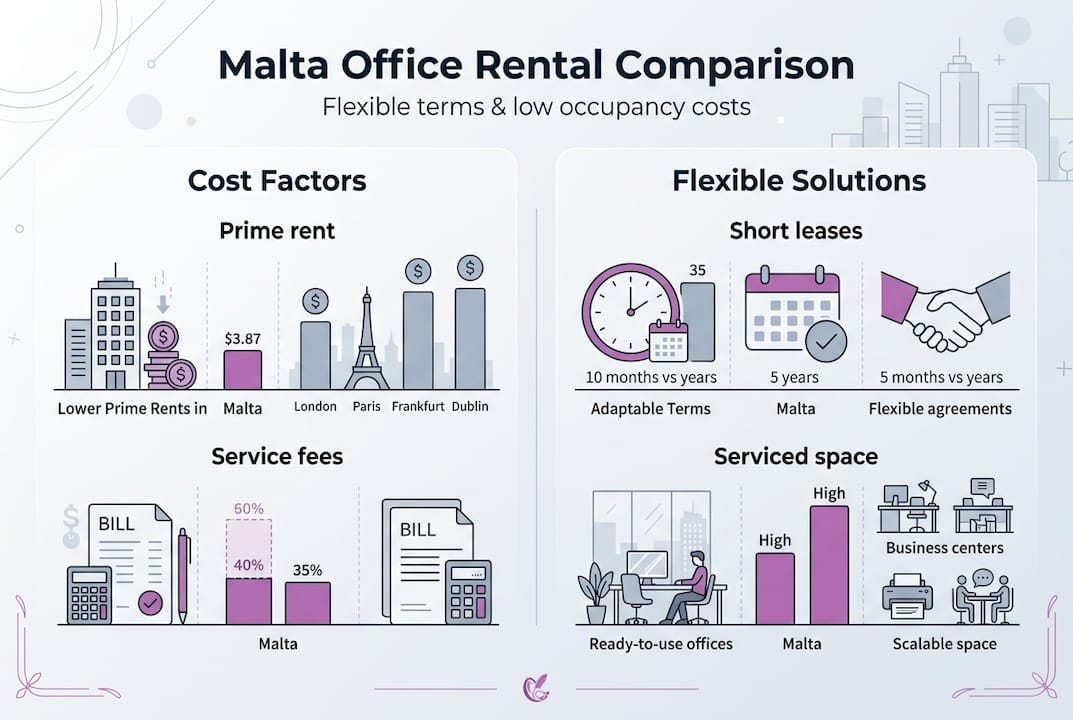
The table below illustrates how Malta compares to major European office markets:
| City | Prime rent (€/sqm/year) | Total occupancy cost (€/sqm/year) |
|---|---|---|
| Malta (Sliema/St Julian’s) | €260-€550 | €550 |
| Malta (Mriehel) | €180-€250 | €380 |
| London (City) | €1400+ | €1800+ |
| Paris (CBD) | €800+ | €1100+ |
| Dublin | €450+ | €650+ |
This affordability extends beyond simple cost savings. Lower occupancy expenses free capital for talent acquisition, technology investment, and market development. Startups can secure professional premises without depleting runway, whilst established firms can maintain larger teams or multiple locations for the same budget allocated to a single office in pricier markets. The office rental prices Malta landscape remains stable, with modest annual increases reflecting controlled inflation rather than speculative bubbles. For businesses planning multi-year commitments, this stability provides valuable financial predictability. Understanding Malta office market pricing trends helps companies time their leasing decisions strategically.
Flexible leasing options tailored to your business needs
Malta’s office market has evolved to accommodate diverse business models and growth stages. Unlike traditional European markets where rigid long-term leases dominate, Malta offers a spectrum of arrangements designed for agility. This flexibility proves particularly valuable for businesses navigating uncertain growth trajectories, testing new markets, or managing seasonal fluctuations.

Serviced offices cost €300-€800 per desk monthly, providing fully furnished, immediately operational workspace with reception services, meeting rooms, and utilities included. These turnkey solutions eliminate setup delays and capital expenditure, making them ideal for companies establishing initial presence or requiring temporary expansion capacity. Coworking spaces start at €150 per month for hot desks, scaling to €400 for dedicated desks with 24/7 access. Traditional leases typically span 2-5 years with annual rent reviews, offering the lowest per-square-metre costs for businesses confident in their space requirements.
| Lease type | Duration | Cost range | Best for |
|---|---|---|---|
| Coworking | Month-to-month | €150-€400/desk/month | Freelancers, very small teams, testing market |
| Serviced office | 12-24 months | €300-€800/desk/month | Startups, project teams, rapid scaling |
| Traditional lease | 2-5 years | €170-€450/sqm/year | Established operations, stable headcount |
| Hybrid arrangements | 12-24 months | Variable | Growing companies needing flexibility |
Key advantages of flexible leasing:
- No long-term commitment risk during market validation phases
- Turnkey spaces reduce time-to-operation from months to days
- Scalability up or down without lease break penalties
- Predictable monthly costs simplify financial planning
- Professional addresses enhance business credibility immediately
Pro Tip: Negotiate for shorter initial lease terms with renewal options rather than committing to maximum duration upfront. Many landlords accept 12-month terms with annual renewals for quality tenants, providing flexibility without sacrificing space security. This approach lets you test locations, adjust space as teams evolve, and maintain leverage in rent negotiations.
The distinction between these models extends beyond pricing. Serviced offices Malta typically include high-speed internet, cleaning, utilities, and shared amenities in monthly fees, eliminating administrative overhead. Traditional leases transfer these responsibilities to tenants, requiring separate contracts and management attention. For international companies unfamiliar with Maltese service providers, the all-inclusive model reduces friction during establishment phases.
Hybrid arrangements have emerged as a middle path. Some landlords offer 6-18 month leases for unfurnished spaces, providing cost benefits of traditional leases with reduced commitment. Others allow phased expansion, where tenants secure core space with options to absorb adjacent areas as teams grow. These creative structures reflect Malta’s pragmatic business culture and landlord willingness to accommodate diverse tenant needs. Exploring the complete guide to office space Malta reveals numerous case studies of businesses leveraging these flexible arrangements. The office space in Malta market continues adapting to support both traditional enterprises and modern digital-first companies.
Why Malta’s business environment supports your office rental decision
Renting office space represents just one component of location strategy. Malta’s broader business ecosystem amplifies the value of establishing operations here, transforming competitive rents into comprehensive competitive advantage. The jurisdiction combines tangible fiscal benefits with intangible quality-of-life factors that enhance talent retention and operational efficiency.
Malta’s effective corporate tax rate can reach as low as 5-10% after refunds for qualifying international businesses. The headline rate of 35% applies initially, but shareholders of companies engaged in trading activities outside Malta can claim refunds of 6/7ths of the tax paid, reducing the effective burden dramatically. This structure has attracted thousands of international companies across sectors, creating a vibrant business community and robust professional services ecosystem.
Malta’s tax refund system, combined with full EU market access and treaty networks spanning 70+ countries, creates a fiscal environment that materially improves net profitability compared to higher-tax European jurisdictions whilst maintaining full regulatory compliance and reputational standing.
Strategic business advantages:
- Full European Union membership enabling passporting rights for financial services
- English as primary business language eliminating translation barriers
- Mediterranean timezone facilitating communication with European, Middle Eastern, and African markets
- Political stability with transparent legal system based on English common law principles
- Modern digital infrastructure with multiple submarine cable landings
- International airport with direct connections to 100+ European cities
Thriving sectors driving office demand:
- iGaming and online entertainment (over 300 licensed operators)
- Financial technology and payment processing
- Blockchain, cryptocurrency, and digital assets
- Aviation and aircraft leasing
- Pharmaceuticals and life sciences
- Professional services supporting international business
The workforce quality deserves particular attention. Malta produces graduates from multiple universities, with strong emphasis on technology, finance, and business disciplines. English proficiency is universal, and many professionals speak Italian, French, or German as additional languages. The island’s lifestyle appeal attracts international talent seeking Mediterranean climate, safety, and cultural richness, creating a diverse talent pool that supports scaling operations.
Quality of life factors directly impact employee satisfaction and retention. Malta offers 300+ days of sunshine annually, extensive coastline with beaches and water sports, rich historical heritage, and vibrant social scene. Healthcare standards meet Western European norms, international schools serve expatriate families, and cost of living remains moderate compared to northern European capitals. These elements reduce compensation pressures and turnover rates.
Practical constraints exist. Large floorplate availability (5000+ square metres on single floors) remains limited compared to major cities, though adequate for most mid-sized operations. Island logistics mean certain goods and services cost slightly more than continental equivalents. However, for knowledge-based businesses where talent and connectivity matter more than physical logistics, these limitations prove minor. Understanding the why relocate to Malta proposition helps businesses evaluate whether the jurisdiction aligns with their strategic priorities. The implications of renting in Malta extend beyond simple cost savings to encompass regulatory, tax, and lifestyle considerations.
How to choose and rent the best office space in Malta
Navigating Malta’s office market efficiently requires systematic approach balancing immediate needs with future flexibility. The abundance of options can overwhelm newcomers, but following a structured evaluation process ensures optimal outcomes whilst avoiding common pitfalls.
Step-by-step office rental process:
- Assess current and projected space requirements. Calculate team size today and 12-month projections. Allow 10-15 square metres per person for open plan, 15-20 for mixed layouts with meeting rooms. Factor in growth buffer of 20-30% to avoid premature relocation.
- Verify permit and licensing requirements. Confirm your business activity qualifies for Class 4A office use permits, which apply to most professional services, technology, and administrative functions. Specialised activities may require additional approvals.
- Research listings across multiple platforms. Compare properties by location, price, amenities, and lease terms. Digital marketplaces aggregate hundreds of options with filtering tools that streamline initial screening.
- Conduct physical inspections. Never commit without visiting properties. Assess natural light, noise levels, building condition, parking availability, and proximity to amenities. Test internet connectivity if your operations depend on bandwidth.
- Negotiate terms strategically. Request shorter initial terms with renewal options. Clarify which costs are included versus additional. Negotiate rent-free periods for fit-out if undertaking improvements. Confirm exit clauses and subletting rights.
- Review legal documentation carefully. Engage local legal counsel to review lease agreements. Maltese leases follow standard structures but contain jurisdiction-specific clauses regarding maintenance, insurance, and dispute resolution.
Critical evaluation considerations:
- Location accessibility for staff and clients via public transport or parking
- Budget alignment including all occupancy costs, not just headline rent
- Space size with growth buffer to avoid disruptive moves
- Lease flexibility enabling scaling or exit without punitive penalties
- Hidden costs such as service charges, utilities, parking fees, fit-out requirements
- Building quality including HVAC, lifts, security, accessibility features
- Landlord reputation and responsiveness to maintenance issues
Pro Tip: Use digital marketplaces with abundant listings to compare multiple properties efficiently. Platforms offering desk-based searches let you specify team size and receive matched properties with per-person costs calculated automatically, simplifying budget planning. This approach reveals better value options that might be overlooked in traditional square-metre searches.
Class 4A permits cover most office activities but exclude retail, manufacturing, and certain regulated services. Verify your specific use case with planning authorities during property evaluation to avoid compliance issues post-signing. Most landlords can provide guidance, but ultimate responsibility rests with tenants.
Negotiating shorter lease terms provides valuable flexibility, particularly for growing businesses or those establishing initial presence. Whilst landlords prefer longer commitments, many accept 12-24 month terms for quality tenants willing to pay modest premiums. This trade-off proves worthwhile when business trajectory remains uncertain. The guide to office size and layouts helps translate headcount into space requirements accurately. The office space Malta calculator provides instant estimates based on team size and layout preferences.
Explore Malta office space options with OfficeSpace.Rent
Finding the ideal office space requires local expertise and comprehensive market visibility. OfficeSpace.Rent specialises in connecting businesses with flexible office solutions across Malta, offering curated listings that span serviced offices, coworking spaces, and traditional leases. The platform combines extensive property database with market insights and professional support to streamline your search.
Platform benefits:
- Comprehensive listings covering all major business districts
- Advanced filtering by location, size, price, amenities, and lease type
- Desk-based search tools that match team size to suitable properties automatically
- Expert local agents providing market guidance and negotiation support
- Transparent pricing with total occupancy cost breakdowns
Whether you need immediate hot desk access for a remote team member or a 500-square-metre headquarters for 40 staff, the platform provides tailored options with detailed specifications and imagery. The desk based office search feature simplifies budgeting by presenting per-person costs upfront, eliminating manual calculations. For businesses requiring turnkey solutions, serviced offices Malta listings include all-inclusive pricing and availability calendars.
Pro Tip: Register for personalised notifications on properties matching your criteria. Malta’s office market moves quickly, particularly for well-priced serviced offices and prime locations. Automated alerts ensure you see new listings immediately, providing competitive advantage in securing optimal space. Start exploring offices in Malta to let & for sale today.
Frequently asked questions about renting office space in Malta
What types of office leases are most common in Malta?
Traditional leases of 2-5 years dominate for conventional office space, with annual rent reviews tied to inflation. Serviced offices offer 3-12 month agreements with monthly billing, whilst coworking spaces provide month-to-month flexibility. Hybrid arrangements of 6-18 months have emerged for businesses seeking middle ground between commitment and flexibility.
Are there size limits for office spaces available for rent?
Malta offers office spaces from single coworking desks to multi-floor buildings exceeding 2000 square metres. However, single-floor plates above 5000 square metres remain rare compared to major cities. Most businesses find suitable options between 100-1000 square metres across multiple districts.
How does the corporate tax refund affect office rental budgeting?
The tax refund system reduces effective corporate tax to 5-10% for qualifying international businesses, improving net profitability substantially. This fiscal benefit often offsets occupancy costs entirely. Furthermore, making Malta’s already competitive rents even more attractive from a total-cost-of-operation perspective. Budget planning should incorporate tax savings when evaluating overall location economics.
Can international companies easily rent offices in Malta?
Yes, international companies rent offices in Malta routinely. The process requires establishing a local legal entity, obtaining necessary business licences, and verifying activity compliance with Class 4A office use permits. Most landlords welcome international tenants, and professional services providers specialise in supporting foreign company establishment. The entire process typically completes within 4-8 weeks.
What are typical hidden costs beyond headline rent?
Service charges covering building maintenance, common area upkeep, and management fees typically add 10-20% to headline rent. Utilities (electricity, water, internet) cost €50-150 per person monthly depending on usage. Parking fees range €50-150 per space monthly in premium locations. Fit-out costs for unfurnished spaces vary widely based on requirements. Always request itemised total occupancy cost projections before committing.