TL;DR:
- Expanding into Malta offers strategic advantages for foreign companies due to its central location, English-speaking workforce, and favorable tax regime. Setting up involves choosing between a branch or subsidiary, with clear documentation, office, and banking requirements, often taking 6 to 12 weeks to complete. Proper local guidance prevents costly mistakes, such as rushing office leases before securing banking approval or neglecting ongoing compliance obligations.
Expanding into Malta is a strategically sound decision for foreign companies seeking a foothold in the European Union. If you are looking to set up an office in Malta, the island’s English-speaking workforce, favourable tax framework, and central Mediterranean location offer genuine commercial advantages. Yet many firms arrive underprepared, underestimating the precise documentation trail, compliance obligations, and local real estate expectations they will encounter. This guide walks you through each stage methodically, from entity registration at the Malta Business Registry through to signing a lease and budgeting your first year of operations, so your market entry is efficient and cost-controlled.
Table of Contents
- Key requirements for foreign companies
- Step-by-step process to register your Malta entity
- Finding and securing your office space
- Budgeting for your Malta office setup
- Our perspective: What foreign companies usually get wrong
- Next steps: Secure your ideal office space in Malta
- Frequently asked questions
Key Takeaways
| Point | Details |
|---|---|
| No minimum capital | You do not need to deposit capital to register a branch office in Malta. |
| Documentation is vital | Accurate paperwork and certified translations are critical to a smooth setup. |
| Office space is a must | A physical address, not a PO box, is mandatory for both registration and leasing. |
| Timelines depend on banking | While registration is quick, banking due diligence may stretch the full setup to 6-8 weeks. |
| All-in launch costs | First-year total costs typically run €3,000–10,000 including legal, audit, and rent. |
Key requirements for foreign companies
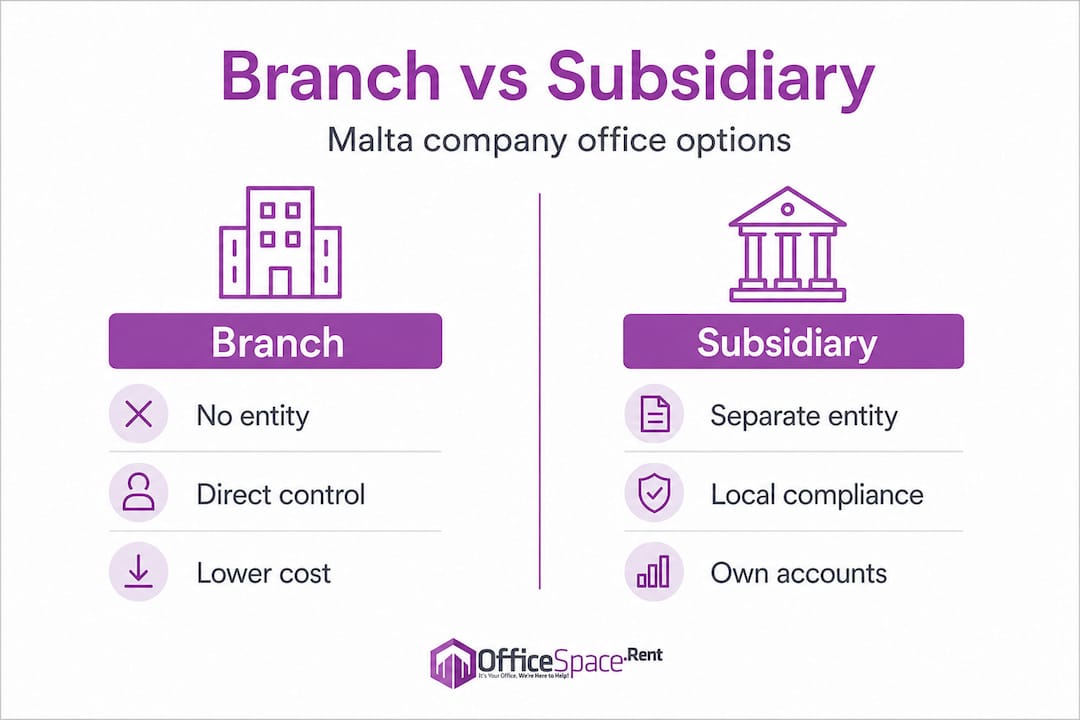
Before committing resources, you need to understand whether a branch or a subsidiary best serves your operational model. Each carries distinct legal, tax, and commercial implications.
| Criterion | Branch | Subsidiary (Ltd) |
|---|---|---|
| Legal entity | No separate entity | Separate legal entity |
| Liability | Parent company liable | Liability limited to subsidiary |
| Minimum capital | None required | €1,165 (25% paid up) |
| Local representative | Required | Director required |
| Tax filing | Parent’s consolidated | Independent tax return |
| Commercial perception | Extension of parent | Standalone Maltese company |
As the plan makes clear, foreign companies can register a branch with the Malta Business Registry (MBR) without creating a separate legal entity, which is often the fastest route to establishing a local presence. The trade-off is that the parent company carries full liability for branch activities.
The core requirements are straightforward. Key branch registration requirements include a physical registered office address in Malta (PO boxes are not accepted), appointment of a local representative or secretary, and no minimum capital requirement. For a subsidiary, you will additionally need to appoint at least one director and prepare a Memorandum and Articles of Association specific to Malta.
Essential documents for both structures:
- Certified and apostilled copy of the parent company’s Certificate of Incorporation
- Memorandum and Articles of Association of the parent
- Valid passport copies and proof of address for all directors and the local representative
- Completed MBR registration form (Form T or relevant equivalent)
- Physical registered office address confirmation (lease agreement or equivalent)
For office setup essentials and guidance on what constitutes a qualifying registered address, the requirements are stricter than many foreign firms expect.
Pro Tip: Appointing a local representative who is familiar with Maltese regulatory culture does more than satisfy the legal minimum. It accelerates bank account opening, eases communication with the MBR, and signals substance to regulators, which matters increasingly in a post-ATAD compliance environment.
Step-by-step process to register your Malta entity
With your requirements checked off, here is how to bring your Malta office entity to life. The process is sequential, and delays at any stage typically compound into broader timeline overruns.
- Gather and certify parent company documents. Obtain apostilled copies of your Certificate of Incorporation and constitutional documents. If they are not in English or Maltese, certified translations are mandatory.
- Prepare the branch or subsidiary formation documents. Required documents include certified copies of the parent company’s Memorandum and Articles of Association, the apostilled Certificate of Incorporation, passport and professional references for the branch representative, and the completed branch registration form.
- Secure a registered physical address. This must be in place before MBR submission. A serviced office or business centre address is commonly used at this stage. Visit renting office space to explore qualifying premises across Malta.
- Submit to the Malta Business Registry. Lodge all documents with the MBR, either directly or via a local legal firm. At this stage, the MBR will review for completeness and compliance.
- Obtain your MBR number and VAT registration. Once approved, apply for a VAT number through the Commissioner for Revenue. This is required before commercial activity commences.
- Open a corporate bank account. This is frequently the most time-consuming step. Maltese banks conduct thorough AML (Anti-Money Laundering) due diligence, requesting source-of-funds documentation, business plans, and projected financials.
⚠️ Critical: Do not underestimate the banking stage. AML checks can stall your entire operation if documentation is incomplete. Prepare a detailed business plan, three to five years of parent company financials, and clear source-of-funds evidence before approaching any bank.
Timeline reference: Branch or simple Ltd incorporation takes 5 to 10 days when documents are ready. However, the full process including banking and compliance typically runs 6 to 12 weeks. Factor this into your market entry schedule.
For a more granular breakdown of the post-registration process, the detailed office rental steps guide provides sector-specific context particularly useful for financial services firms.
Finding and securing your office space
Once your company is registered, the physical address requirement means it is time to select your actual workspace. Malta’s commercial office market is concentrated primarily in four districts: Valletta (CBD), Sliema, St Julian’s, and the emerging Ta’ Xbiex and Gzira corridor. Each carries different rent levels, commuter profiles, and floor plate availability.

| Standard lease requirement | Typical landlord expectation |
|---|---|
| Proof of director identity | Certified passport copy |
| Certificate of Incorporation | Apostilled and translated if non-English |
| VAT number or MBR reference | Required for corporate tenants |
| Source of funds / financials | Mandatory for rents exceeding €10,000/month |
| Security deposit | Typically 2 to 3 months’ rent |
| Lease term | Minimum 1 year; 3 to 5 years preferred |
Lease documentation requirements include proof of ID for directors, a certificate of incorporation or VAT number for a local entity, and financial evidence for leases valued above €10,000 per month. Agency fees are set at 10% of annual rent plus VAT, payable by both the tenant and the landlord in most market transactions.
Documents and costs to prepare before approaching landlords:
- Certified corporate documents (Incorporation Certificate, Articles of Association)
- Director identification and proof of address
- Company financials (last 2 to 3 years, audited where possible)
- Bank references or letters of comfort
- Agency fee budget (one time fee 10% of annual rent plus 18% VAT)
- Security deposit liquidity (2 to 3 months’ rent)
Review current Malta office rental costs by district before you approach landlords, so your offer is calibrated to market reality. Understanding where office lease negotiation is possible, and where landlords hold firm, will strengthen your position considerably.
Pro Tip: In competitive prime locations such as Valletta CBD or Portomaso, landlords receive multiple enquiries for quality floor space. Submitting a complete documentation pack with your initial offer, rather than after negotiation, signals seriousness and can secure preference over a higher bid from a less-prepared tenant.
See the full breakdown of agency fees explained to avoid any surprises at heads-of-terms stage.
Budgeting for your Malta office setup
Budgeting correctly from the outset helps ensure your office launch goes smoothly. Foreign companies frequently underestimate total first-year cost because they focus solely on rent, omitting the constellation of professional fees and statutory obligations that accumulate alongside it.
| Cost category | Typical range (EUR) |
|---|---|
| MBR registration fee | €300 to €700 |
| Legal / formation fees | €1,000 to €2,900 |
| Registered office address (annual) | €1,200 to €1,900 |
| Company secretary (annual) | €400 to €800 |
| Audit and accounting (annual) | €2,000 to €5,000 |
| Office rent per sq m per year | €180 to €450 |
| Agency fee (one-off) | 10% of annual rent + VAT |
| Security deposit | 2 to 3 months’ rent |
First-year total costs for a foreign company entering Malta typically range from €3,000 to €12,000 excluding rent, with prime area office space priced between €200 and €400 per square metre per year. A 100 sq m office in St Julian’s at €300/sq m/year costs €30,000 annually, with an agency fee of approximately €3,000 plus VAT.
Recurring costs that foreign companies frequently overlook:
- Annual MBR filing and compliance fees
- Registered office renewal (if using a service provider)
- Directors’ and Officers’ (D&O) liability insurance
- Data protection officer fees if processing EU personal data
- Utilities and building service charges (not always included in headline rent)
- IT infrastructure and fit-out amortisation
For current and historical pricing context by location and grade, review Malta office pricing trends before finalising your budget assumptions.
Our perspective: What foreign companies usually get wrong
Having covered the step-by-step procedures, here is our take on what the official guides do not tell you when you want to set up an office in Malta.
The most common misstep is treating the branch versus subsidiary decision as purely a cost question. In practice, Maltese banks and many local commercial landlords view a subsidiary more favourably than a branch because it signals long-term commitment and financial independence. Companies that register a branch to save time and money sometimes find themselves renegotiating lease terms or facing additional bank requirements later, because the parent liability structure raises questions about local financial substance.
The second persistent error is underestimating compliance as an ongoing obligation. Many foreign entrants treat AML, GDPR, and annual MBR filings as a checklist to complete once. In reality, Maltese regulators and banking partners conduct periodic reviews. A company that was compliant at registration but has since changed directors, added revenue streams, or shifted its operational model may face requests for updated documentation at precisely the wrong commercial moment.
Local experts are also undervalued. Foreign companies often engage a legal firm for incorporation and then manage everything else centrally from their home jurisdiction. The result is a disconnect between what is happening on the ground in Malta and what the parent believes is in order. A local company secretary, accountant, or adviser who attends to MBR deadlines, utility registrations, and landlord correspondence is not an optional extra. It is risk management.
Finally, there is a tendency to lease too quickly. Companies rushing to demonstrate substance sometimes commit to office space before their banking relationship is confirmed. If the bank account opening fails or is delayed, the company is paying rent on premises it cannot yet operationally use. A short-term serviced office or business centre arrangement, explored through comprehensive office setup advice, is a sound interim solution that preserves both cash and optionality.
Next steps: Secure your ideal office space in Malta
Navigating Maltese company registration and commercial real estate simultaneously is manageable when you have the right local knowledge behind you. OfficeSpace.Rent provides the market intelligence, verified listings, and professional connections that foreign companies need to move efficiently from decision to keys in hand. Whether you are looking at commercial properties for sale, premium offices to let in the CBD district, or flexible business centres for rent, the platform gives you direct access to Malta’s most active commercial property market with full pricing transparency and agent support throughout the leasing process.
Frequently asked questions on How to Set Up an Office in Malta
Do I need to appoint a local Maltese director for my branch office?
A local director is not strictly required for a branch, but it is strongly recommended for substance, banking ease, and day-to-day compliance responsiveness.
How long does it take to set up a foreign office in Malta?
Registration can take as little as 5 to 10 days if documents are ready, but banking and AML compliance typically extends the full process to 6 to 8 weeks.
What is the minimum capital required to set up a Malta branch?
There is no minimum capital required for a Maltese branch office, making it the lower-barrier entry route for foreign companies.
What documents are needed to lease office space as a foreign company?
You will need proof of director identity, a certificate of incorporation or VAT number, and financial evidence for leases exceeding €10,000 per month.