
TL;DR:
- Malta offers attractive tax incentives and investment schemes for businesses, but compliance involves strict registration and payroll procedures.
- International companies must carefully sequence company registration, employer registration, and payroll compliance to avoid costly errors and penalties.
Malta’s reputation as a business-friendly jurisdiction is well-earned, but it masks a layered set of regulatory requirements that catch international executives off-guard. Setting up an office in Malta with correct tax and hiring processes in place is not simply a matter of filing paperwork. The sequence matters, the deadlines are strict, and the cost of getting payroll wrong compounds quickly. This guide cuts through the surface-level guidance and gives you the precise information you need on Malta business registration, employer obligations, and the tax incentives in Malta that your competitors may already be using.
Table of Contents
- Registering your company and employer profile in Malta
- Understanding Maltese tax and payroll compliance for new hires
- Applying Maltese 2026 income tax rates and social security to payroll
- Leveraging Malta’s investment incentives linked to office setup and employment
- Practical tips for smooth office setup and hiring compliance in Malta
- What most executives get wrong about Maltese tax and hiring compliance
- Finding your ideal office space in Malta to complement your setup
- Frequently asked questions
Key Takeaways
| Point | Details |
|---|---|
| Mandatory employer registrations | Register your company with Maltese authorities to obtain a Permission to Employ number before hiring. |
| Accurate payroll withholding | Apply Malta’s updated 2026 progressive tax bands and social security rates for lawful payroll compliance. |
| Employee registration timing | Register employees promptly via Jobsplus and submit FS4 tax forms on hire and de-registration. |
| Leverage tax incentives | Align office investment and hiring plans to access Malta’s tax credits and grants effectively. |
| Use practical compliance workflows | Implement disciplined onboarding and record-keeping processes to avoid payroll errors and penalties. |
Registering your company and employer profile in Malta
Before you can hire a single employee or sign a lease, your Maltese legal entity must exist. The Malta Business Registry (MBR) handles company incorporation through its BAROS system, which requires a specific set of documents: the Memorandum and Articles of Association (M&A), beneficial ownership information, proof of share capital, and a registered office address in Malta.
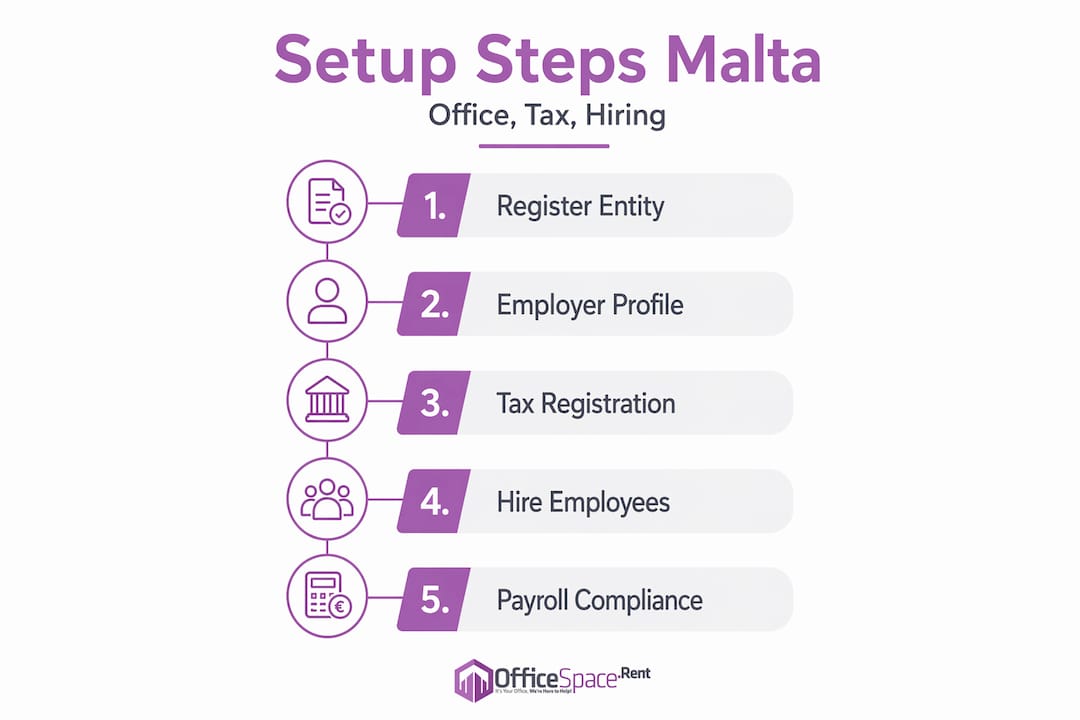
The cost of setting up a business in Malta via the BAROS system is tiered by authorised share capital. Incorporation fees start at €245 for share capital up to €1,500, rising progressively with capital levels. Most international companies incorporate with a standard share capital of €1,165, which places them in the lower fee bracket while satisfying regulatory minimums.
Pro Tip: Maltese law requires that at least 20% of authorised share capital is paid up at the point of incorporation. Failing to satisfy this condition before submission delays registration and resets your timeline for obtaining employer status.
Once incorporated, your next obligation is registering as an employer. This involves two parallel registrations: with the Commissioner for Revenue (the Maltese tax authority) and with Jobsplus, the national employment authority. Refer to our office registration essentials guide for a fuller picture of what this means in practice for businesses taking on physical premises.
Key incorporation documents required
| Document | Purpose |
|---|---|
| Memorandum and Articles of Association | Establishes company structure and governance |
| Beneficial ownership declaration | Anti-money-laundering compliance |
| Share capital proof | Confirms paid-up capital meets 20% minimum |
| Registered office confirmation | Provides legal address in Malta |
Our office space setup guide covers how choosing the right registered office address affects your entity’s positioning in Malta’s commercial districts.
Understanding Maltese tax and payroll compliance for new hires
With employer registration complete, it is crucial to grasp how Malta’s income tax system affects your hiring and payroll processes. The tax implications for businesses in Malta begin the moment you process your first salary payment, not when you file annually.
Employers must register with both the Commissioner for Revenue and Jobsplus before processing any payroll. The employer registration number / PE reference used for payroll and employment reporting. Employers are expected to complete payroll and employer registrations before processing salaries to ensure lawful PAYE and social security compliance. This is not a technicality; it is a hard legal requirement.
Each new employee must be registered via the Jobsplus online portal and an FS4 Payee Status Declaration form must be submitted. The FS4 determines which tax band applies to that individual. Getting it wrong at the start means reconciling overpaid or underpaid tax later, which affects both payroll budgets and employee trust.
Statutory reporting obligations include:
- Monthly FS5 submissions: Employers report PAYE (Pay As You Earn) tax withheld and social security contributions each month.
- Annual FS3 statements: Issued to each employee summarising total pay and deductions for the year.
- Annual FS7 reconciliation: Employer-level reconciliation submitted to the Commissioner for Revenue.
Payroll compliance demands this cycle runs without interruption from your first hire onwards. Missing a monthly FS5 triggers penalties.
“Employers who treat payroll filing as an administrative afterthought rather than a core compliance function regularly face cumulative shortfalls that require costly corrections and attract regulatory scrutiny.”
Pro Tip: Build a compliance calendar before your first payroll run. Map FS5 deadlines, FS4 collection dates, and annual filing windows into your HR and finance workflows from day one.
Applying Maltese 2026 income tax rates and social security to payroll
After understanding tax rates and contributions, consider how Maltese investment incentives can complement your office and hiring strategy. But first, you need to apply the rates accurately.
Malta operates a progressive income tax system with rates ranging from 0% to 35%, and the applicable band depends entirely on each employee’s personal tax status: single, married, or parent. This distinction is not trivial. A single individual earning €30,000 and a parent earning the same amount will be taxed at different effective rates, meaning the FS4 form each employee submits directly determines your withholding liability.
2026 income tax bands by taxpayer category
| Annual income (€) | Single rate | Married rate | Parent rate |
|---|---|---|---|
| 0 to 9,100 | 0% | 0% | 0% |
| 9,101 to 14,500 | 15% | 0% | 0% |
| 14,501 to 19,500 | 25% | 15% | 15% |
| 19,501 to 60,000 | 25% | 25% | 25% |
| Over 60,000 | 35% | 35% | 35% |
Source: Indicative 2026 tax bands based on current published payroll calculators and prevailing thresholds.
Employer social security contributions sit at approximately 10% of the employee’s basic wage, in addition to the employee’s own contribution. Both amounts are remitted monthly alongside FS5 payroll data. These contributions are tax-deductible as a business expense, which partially offsets the cost of hiring employees in Malta for international companies.

Pro Tip: Use payroll software that handles cumulative annual tax calculations rather than a simple monthly percentage. Malta’s PAYE system is cumulative, meaning tax withheld in January affects the correct withholding rate in December. Static monthly calculators routinely produce year-end discrepancies.
Leveraging Malta’s investment incentives linked to office setup and employment
Malta’s Invest scheme, administered by Malta Enterprise, offers tax credits, cash grants, and wage subsidies for qualifying capital investments, including investments in tangible and intangible assets. Wage costs of new employees hired within three years of project completion can also qualify. The scheme runs until 31 December 2026.
Aid intensity ranges from 10% to 35%, depending on project size and whether the investment is located within a designated assisted area. Larger projects receive proportionally lower aid intensity, while smaller enterprises operating in assisted zones can access the upper end of the range.
Qualifying incentive types:
- Tax credits on capital expenditure for plant, equipment, and property fit-out
- Cash grants for approved investment in specified sectors
- Wage cost subsidies for new employees created as a direct result of the project
Steps to secure investment support:
- Conduct an eligibility check with Malta Enterprise before committing capital expenditure.
- Gather supporting documentation: business plan, investment schedule, projected employment figures.
- Submit a formal application prior to project commencement (retrospective applications are not accepted).
- Maintain compliance monitoring records throughout the project and three-year employment window.
- Align office lease start dates and hiring milestones with project completion timelines to ensure wage costs qualify.
Review our Maltese tax incentives overview and consider how aligning hiring with incentives from the outset can materially improve your return on the office launch investment.
Practical tips for smooth office setup and hiring compliance in Malta
Understanding incentives helps frame your office launch in Malta. Now, practical execution matters just as much as knowledge.
One decision you need to make early is whether to hire directly via your Maltese entity or through an Employer of Record (EOR) service. Many international companies use EOR providers to employ staff legally while their entity registration and PE number acquisition is still in progress. It is a legitimate and cost-effective route for the first one to three months of operations.
Practical compliance checklist:
- Initiate tax and social security registrations immediately after incorporation, not after you have identified candidates.
- Collect FS4 forms from all employees before processing their first salary to avoid applying a default, higher tax rate.
- Register each new hire on the Jobsplus portal within the required timeframe to avoid late registration penalties.
- Record all employment start and termination events accurately, as these feed directly into statutory payroll filings.
- Maintain a clear audit trail of payee status changes throughout the year.
Accurate record-keeping of employment registrations and status changes prevents mismatches in FS3 and FS7 filings at year-end. Mismatches attract queries from the Commissioner for Revenue and can trigger formal audits.
Pro Tip: Treat employee onboarding as a compliance workflow, not a HR formality. Assign a specific owner for payroll registration steps and build in a checklist sign-off before each new hire’s first payroll date. Refer to our guidance on sequencing entity registration and hiring for a practical sequencing framework.
What most executives get wrong about Maltese tax and hiring compliance
The most common mistake international companies make in Malta is treating payroll compliance as a static monthly process. It is not. Malta’s PAYE system is cumulative, which means every payroll run recalculates tax based on the employee’s total earnings to date in the tax year, not just that month’s salary.
When an employee changes tax status mid-year, for example following a marriage or the birth of a child, their FS4 must be updated and the cumulative calculation restarts on the new basis. Most standard payroll processes flag this only at year-end, producing a mismatch that requires retroactive adjustment. That correction costs money, time, and, in some cases, employee goodwill.
The second overlooked issue is strategic. Executives focus on compliance as a cost centre and miss its role as a value driver. Hiring decisions that are timed and documented correctly can qualify wage costs under Malta’s Invest scheme, directly generating tax credits. A company that hires two senior staff members three months before project completion and documents this against the investment application can access substantial aid. One that hires without this alignment receives nothing.
“Underestimating Malta’s cumulative tax withholding complexity regularly produces incorrect deductions and late payroll corrections that affect both staff and auditors.”
Pro Tip: Invest in payroll software and training that handle dynamic employee status changes and cumulative recalculations. The cost is minimal compared to the exposure of a year-end shortfall. Review our complete guide to office space in Malta for how your physical office setup connects to broader compliance and operational decisions.
Finding your ideal office space in Malta to complement your setup
As you move from understanding compliance to securing physical space, expert support smooths your Malta office launch. Once your company registration, employer profile, and payroll framework are in place, your office location becomes the final piece of the operational structure.
OfficeSpace.Rent provides direct access to Malta’s commercial property market, with listings filtered by size, location, lease type, and sector suitability. Whether you are looking at commercial properties in Mriehel, one of Malta’s primary business districts, or offices to rent in Attard for a quieter operational base, the platform connects you with verified listings and local agents who understand lease terms relevant to international tenants.
For companies considering long-term commitment, browsing commercial properties for sale in Malta may offer better value against leasing over a five-year horizon.
Working with OfficeSpace.Rent gives you:
- 🟢 Access to Malta’s most current commercial listings with transparent pricing data
- 🟢 Guidance on lease structures suited to your compliance and operational requirements
- 🟢 Direct connection to local agents with experience supporting international business set-up
Frequently asked questions
What is the Permission to Employ (PE) number and why is it important?
The PE number is a unique identifier issued when an employer registers with Malta’s tax authority, and it is legally required before any employee salary can be processed.
How do Malta’s 2026 income tax rates affect payroll withholding?
Employers must apply progressive rates from 0% to 35% based on each employee’s declared tax status via the FS4 form, with monthly submissions to the Commissioner for Revenue.
Can new companies use third-party services to hire employees before entity setup completes?
Yes. Many foreign companies use an Employer of Record model to hire legally while their Maltese entity’s registrations are still being processed.
What are the key social security contributions employers must make?
Employers must pay social security contributions. Employers generally contribute around 10% of the employee’s basic wage, subject to statutory weekly contribution caps and classifications. These are remitted monthly alongside income tax deductions, and these are tax-deductible business expenses.
How can Malta’s investment incentives support office setup and hiring?
Malta’s Invest scheme provides up to 35% aid intensity through tax credits and grants tied to qualifying capital investment and new employment created within three years of project completion.