Securing the right office space in Malta at the right price is rarely straightforward. Many businesses, both local firms and international companies setting up operations on the island, enter lease negotiations without a clear strategy and end up overpaying or locking themselves into unfavourable terms. This office rental negotiation guide will help you navigate the process and secure the best terms. Traditional office leases in Malta typically run for 1, 2, 5, 6, or 9 years, and the length you commit to directly affects your negotiating position. This guide walks you through every stage of the process, from understanding the market to finalising your contract, so you can secure terms that genuinely work for your business. Updated on 30th March 2025.
Table of Contents
- Understand the Maltese office market
- Prepare your negotiation strategy
- Key elements to negotiate in your offer
- Executing negotiation: Step-by-step process
- Common mistakes and how to avoid them
- Find your ideal office with expert support
- Frequently asked questions
Key Takeaways
| Point | Details |
|---|---|
| Longer leases offer leverage | A longer di fermo period boosts your negotiating power, but reduces flexibility. |
| Know your negotiables | Many lease points are open to discussion except set costs like agency fees and CAM. |
| Budget for all costs | Consider rent, escalation, deposits, agency fees, and fit-out in your total budget. |
| Seek legal protection | Always get independent legal advice before signing an office rental contract. |
| Work with experts | Commercial agents help secure better terms and avoid costly mistakes. |
Understand the Maltese office market & The Guide To Office Rental Negotiations
Before you approach a lessor or engage an agent, you need a clear picture of how Malta’s commercial office market operates. The island offers a range of office types, from traditional leased spaces and serviced offices to Class 4A grade-A buildings in prime business districts such as Valletta, Sliema, St Julian’s and the Mrieħel Business District. Each category carries different cost structures, lease lengths, and negotiation dynamics.
The complete guide to office space in Malta provides a detailed breakdown of current pricing and availability across these districts. Understanding where vacancy rates are higher gives you immediate leverage at the negotiating table.
One of the most important things to recognise is that commercial leases allow far greater flexibility in negotiation than residential agreements. This is a significant advantage for tenants who come prepared. The key negotiable elements in any offer typically include the rent amount, the lease start date, the di fermo period (ranging from 1 to 10 years), and the overall lease term.
| Element | Negotiable? | Notes |
|---|---|---|
| Rent amount | ✅ Yes | Room for negotiation depending on market demand |
| Lease start date | ✅ Yes | Earlier start dates are preferred by lessors |
| Di fermo period | ✅ Yes | Longer periods attract better rates |
| CAM charges | ❌ No | Fixed at approximately €20/sqm |
| Agency fee | ❌ No | Standard 10% of first year’s rent |
For a broader view of negotiation essentials specific to Malta, it is worth reviewing current market data before making any approach.
Key factors that influence your negotiating position:
- Current vacancy rates in your preferred district
- Length of lease term you are willing to commit to
- Speed of your decision (lessors value certainty)
- Whether the space requires significant fit-out investment
- Your company’s financial standing and references
Pro Tip: A longer lease term generally improves your negotiating position for a lower monthly rent, but weigh this carefully against your business growth plans. A 5-year commitment in a space that no longer fits your team in year three is a costly error.
Prepare your negotiation strategy
Strategic preparation is the single biggest factor separating businesses that secure strong lease terms from those that do not. Before you contact any agent or lessor, clarify the following internally.
- Define your space requirements. Calculate the square metreage you need now and project 12 to 24 months ahead. Overpaying for unused space is a common and avoidable cost.
- Set a firm budget. Include not just monthly rent but also fit-out costs, service charges, and escalation over the full lease term.
- Choose your preferred locations. Rank your preferred districts by priority. Flexibility on location often unlocks better pricing.
- Decide on office type. Understand the trade-offs between serviced vs traditional offices before committing to either path.
- Determine your di fermo tolerance. Longer di fermo commitments give tenants leverage for lower rent or concessions, but must be balanced against business flexibility needs.
| Factor | Serviced office | Traditional lease |
|---|---|---|
| Lease length | 12 months | 1/2 to 9 years |
| Fit-out cost | Included | Mix of options |
| Flexibility | High | Low to medium |
| Monthly cost | Higher per sqm | Lower per sqm |
| Negotiation scope | Limited | Broad |
For businesses new to Malta’s market, reviewing what makes Malta’s office market leader stand out can help calibrate expectations before entering discussions.

Pro Tip: Build a total lease cost projection before any negotiation. Add monthly rent multiplied by lease term, plus fit-out costs, plus annual escalation. This single number often reveals that a slightly higher monthly rent with no fit-out contribution is more expensive than a lower rent with a landlord fit-out allowance.
Common preparation mistakes include approaching negotiations without comparable market data, failing to account for rent escalation in your budget, and not having a clear walk-away point before discussions begin. Know your limits before you sit down.
Key elements to negotiate in your offer
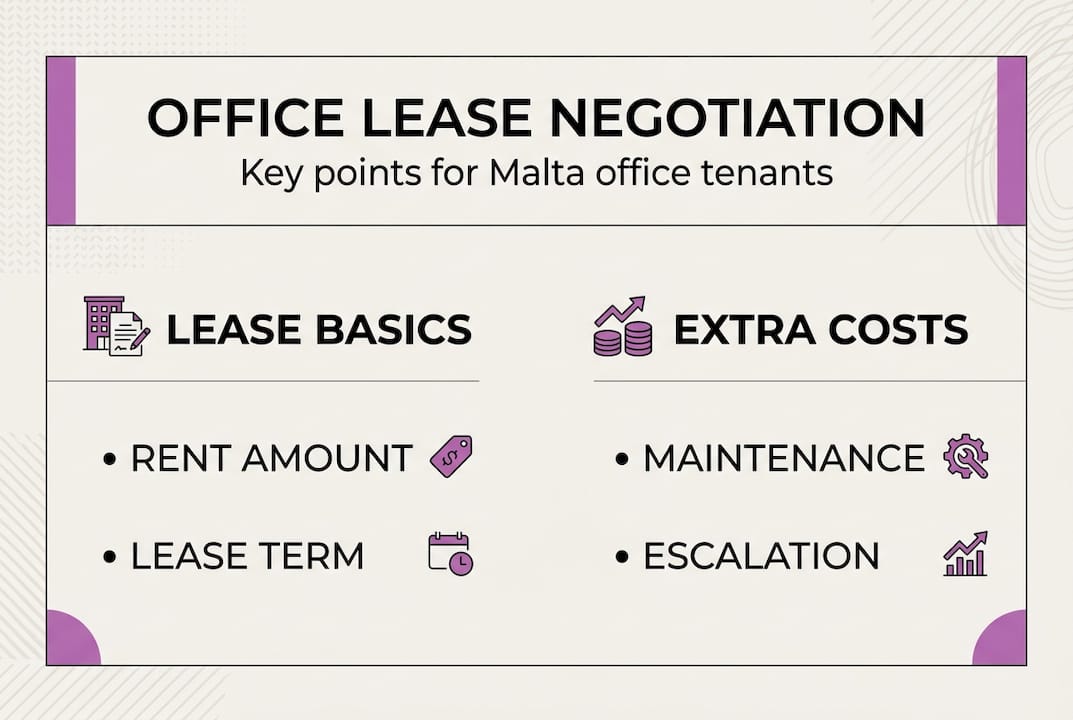
With preparation complete, focus on what is actually open for discussion. Not everything in a lease is moveable, and knowing the difference saves time and protects your credibility with the lessor. In this guide on office rentals and negotiation the following and negotiable and non negotiable factors to consider.
Negotiable elements:
- Rent amount. This is the primary lever. Use current market data and comparable listings to justify your counter-offer.
- Rent-free period. Particularly relevant if the space requires fit-out. A 1 to 2 month rent-free period is not uncommon in slower markets.
- Fit-out contribution. Lessors may offer a fit-out allowance in exchange for a longer di fermo commitment.
- Lease start date. Aligning this with your current lease expiry avoids double-rent periods.
- Escalation clause terms. Rent escalation is typically CPI-linked or set at a fixed 3 to 4% annually. Modelling the full-term impact of each option is essential before agreeing.
- Break clauses. Not always available, but worth requesting on longer leases.
- Security deposit size. For many standard office leases, security deposits commonly fall around 1–3 months’ rent. Larger, institutional or higher-risk transactions may require a higher cash deposit, guarantee or bank guarantee. Confirm the requirement before commitment.
- Notice Period. Usually 3-6 months, usually negotiable.
Non-negotiable elements:
- CAM (communal area maintenance) charges, fixed at approximately €20 per sqm
- Standard agency fees of 10% of the first year’s rent, paid by both tenant and landlord
- Statutory legal requirements embedded in Maltese commercial law
Always instruct an independent legal adviser to review the full lease before signing. Restrictive clauses around permitted use, subletting, and non-compete provisions can significantly limit your operational flexibility and are easy to miss without professional review.
Malta’s office rental costs remain competitive by European standards. Malta office rents range from €120 to €550 per sqm per year, compared to €450 to €750 in Dublin. This cost advantage, combined with shorter 2 to 5 year lease options, makes Malta particularly attractive for international businesses. For a full breakdown of what to include in your offer, the guide on how to negotiate an office lease in Malta covers each clause in detail. You should also review standard office rental agreements to understand what a typical contract contains before you begin.
Executing negotiation: Step-by-step process
Understanding each phase keeps you in control from the initial enquiry through to occupancy. The full office rental negotiation guide and process typically takes 1 to 5 weeks, depending on deal complexity and how quickly both parties respond.
- Initial enquiry. Contact the agent or lessor to confirm availability, pricing, and key terms. Request a full information pack.
- Site visit and assessment. Inspect the space thoroughly. Note condition, fit-out requirements, and any issues to raise in negotiation.
- Submit your offer. Put your offer in writing. Include proposed rent, lease term, di fermo period, start date, and any conditions.
- Negotiation phase. Expect at least one round of counter-offers. Stay focused on total cost, not just monthly rent.
- Legal review. Instruct your legal adviser to review the draft lease. Do not skip this step.
- Contract signing and deposit. Once terms are agreed and the lease is reviewed, sign and pay the security deposit.
- Handover. Confirm the condition of the space at handover in writing, with photographs.
| Stage | Typical duration | Key action |
|---|---|---|
| Initial enquiry to offer | 3 to 7 days | Gather data, prepare offer |
| Negotiation | 5 to 14 days | Counter-offers, concessions |
| Legal review | 5 to 10 days | Independent legal check |
| Signing to handover | 3 to 7 days | Deposit, documentation |
Using a licensed commercial agent with experience in Malta’s office market is strongly recommended. Review the agency fee breakdown before engaging, and consult the ultimate guide to office rental in Malta for additional process detail.
Common mistakes and how to avoid them
Even well-prepared businesses, without a guide, make avoidable errors during office rental negotiations in Malta. These are the most frequent, and how to prevent them.
- Ignoring non-negotiable charges. CAM charges of approximately €15-60/sqm and standard agency fees are fixed costs. Failing to budget for them leads to unpleasant surprises after signing.
- Overcommitting on lease length. A long di fermo period secures better rates but removes flexibility. If your business model is evolving, a shorter initial term with renewal options is often the wiser choice.
- Overlooking escalation clauses. A 4% annual increase on a 5-year lease adds up considerably. Always model the total cost over the full term, not just year one.
- Failing to vet restrictive clauses. Use restrictions, subletting prohibitions, and non-compete clauses can severely limit what you can do in the space. Read every clause carefully.
- Signing without legal review. This is the single most costly mistake. Always instruct an independent solicitor before committing. Review the rental agreement advice available to understand what to look for.
- Accepting the first offer. Lessors expect negotiation. Accepting the initial asking rent without a counter-offer leaves money on the table.
Pro Tip: Watch for overly broad restriction clauses in commercial leases. Some agreements limit the type of business activity permitted on the premises in ways that could conflict with your operations or future growth plans. Flag any such clauses to your legal adviser before signing.
Find your ideal office with expert support
Negotiating an office lease in Malta requires market knowledge, preparation, and the right professional support. OfficeSpace.Rent provides all three. Whether you are searching for a serviced office in St Julian’s or a traditional grade-A space in the Mrieħel Business District, the platform gives you access to verified office listings in Malta with transparent pricing and detailed lease information. The desk-based office search tool allows you to filter by size, location, and budget, connecting you directly with experienced local agents who can support your negotiation from first enquiry to contract signing. With current market data, legal guidance, and a comprehensive property database, OfficeSpace.Rent is the most efficient starting point for any business seeking office space in Malta.
Frequently asked questions & A Guide On Office Rental Negotiations
What is a di fermo period and why does it matter?
The di fermo period is a fixed lease commitment, typically between 1 and 10 years, during which neither party can exit the agreement. A longer di fermo period gives tenants leverage to negotiate lower rent but reduces operational flexibility.
What are standard agency fees for office rentals in Malta?
The standard agency fee is 10% of the first year’s rent, paid separately by both the tenant and the landlord. This is a fixed cost and is not negotiable.
How long does the office rental negotiation process take?
The negotiation process typically lasts between 2 and 6 weeks, depending on the complexity of the deal and the responsiveness of both parties.
Are rent escalation clauses negotiable?
Yes, most rent escalation clauses are open to negotiation. They are commonly structured as either a CPI-linked adjustment or a fixed annual increase of 3 to 4%, and the method can often be agreed between both parties.
Can I negotiate the communal maintenance costs (CAM)?
No. CAM charges are usually fixed. These would vary between €15-60 per square meter per annum and are considered a non-negotiable element of commercial leases in Malta. The price of these varies depending on the venue and the amenities it offers. The more amenities it has, the more the price for the cam charges.