TL;DR:
- Most Maltese businesses overpay for office space by accepting fixed space arrangements without scrutiny or negotiation.
- Understanding key variables like floor area, lease costs, and occupancy rates enables accurate per-employee cost calculation and optimization.
Knowing exactly what your office costs per employee is one of the most practical tools available to any Maltese business owner or operations manager. Using an office cost estimator per employee can help break down these expenses in detail. Yet many companies treat rent as a fixed overhead and leave it at that. With occupancy costs sometimes reaching €200-550 per sqm annually in Malta, failing to break that figure down to a per-person rate means accepting expenditure you may not be able to justify, negotiate, or reduce. This guide walks through the methodology, real examples, and planning strategies that put you back in control of one of your largest recurring costs.
Table of Contents
- What determines office cost per employee?
- How to estimate office cost per employee: step-by-step
- Practical scenarios: Office cost estimation examples
- How to use cost estimates to improve efficiency and plan ahead
- Why most Maltese businesses overpay for office space (and what to do instead)
- Explore office space options to fit your budget
- Frequently asked questions
Key Takeaways
| Point | Details |
|---|---|
| Benchmark for Malta | Typical office occupancy cost is about €200-550 per sqm annually according to reliable research. |
| Calculation method | Divide your total office cost by employee headcount for an accurate per-person expense estimate. |
| Impact of office design | Workspace layout and sqm per person dramatically affect your cost efficiency. |
| Practical applications | Use per-employee cost data to inform smarter office size, location, and lease negotiations. |
| Efficiency opportunities | Regular review and adaptation of your workspace can help control and reduce costs. |
What determines office cost per employee?
Several variables work together to produce your true per-employee office expenditure. Understanding each one gives you the levers to adjust costs without compromising productivity.
The core inputs are:
- Floor area per employee (measured in sqm): The amount of usable workspace allocated to each person, which varies widely by industry, layout, and workplace policy.
- Lease cost per sqm per year: The annual rent, expressed per square metre, negotiated with your landlord or building manager.
- Occupancy rate: The proportion of seats actually used on a given day, which matters more in hybrid or shift-based environments.
- Hidden costs: Service charges, utilities, building insurance, and common area maintenance fees, which routinely add 15 to 25 per cent on top of base rent.
The office rental prices guide for Malta places the market firmly in a range where location, building grade, and fit-out quality all shift costs meaningfully. Grade A offices in business hubs such as Ta’ Xbiex or Swieqi command premium rates, while secondary locations deliver more competitive figures.
Key benchmark: The average occupancy cost of €200-550 per sqm annually is a widely cited reference point for Malta. Use it as your baseline when modelling costs, and adjust up or down based on building grade and location.
Workspace design decisions also carry significant financial weight. Dedicated desks in private offices typically require 10 to 14 sqm per person. Open-plan arrangements bring that down to 6 to 8 sqm. Hot-desking schemes, common in flexible and hybrid environments, can reduce the allocation to as little as 4 to 5 sqm per workstation by assuming not everyone attends simultaneously. Each reduction in sqm per person produces a proportionate reduction in per-employee cost.
Reviewing Malta office market trends regularly also helps, because lease rates and vacancy conditions shift year on year. Benchmarking your current deal against live market data is one of the simplest checks any tenant can run.
Pro Tip: Audit how many desks are actually occupied on your busiest day. If your peak occupancy is 80 per cent, you are effectively paying for 20 per cent of your floor space on a continuous basis without use. That excess is directly recoverable through a smarter lease or layout revision.
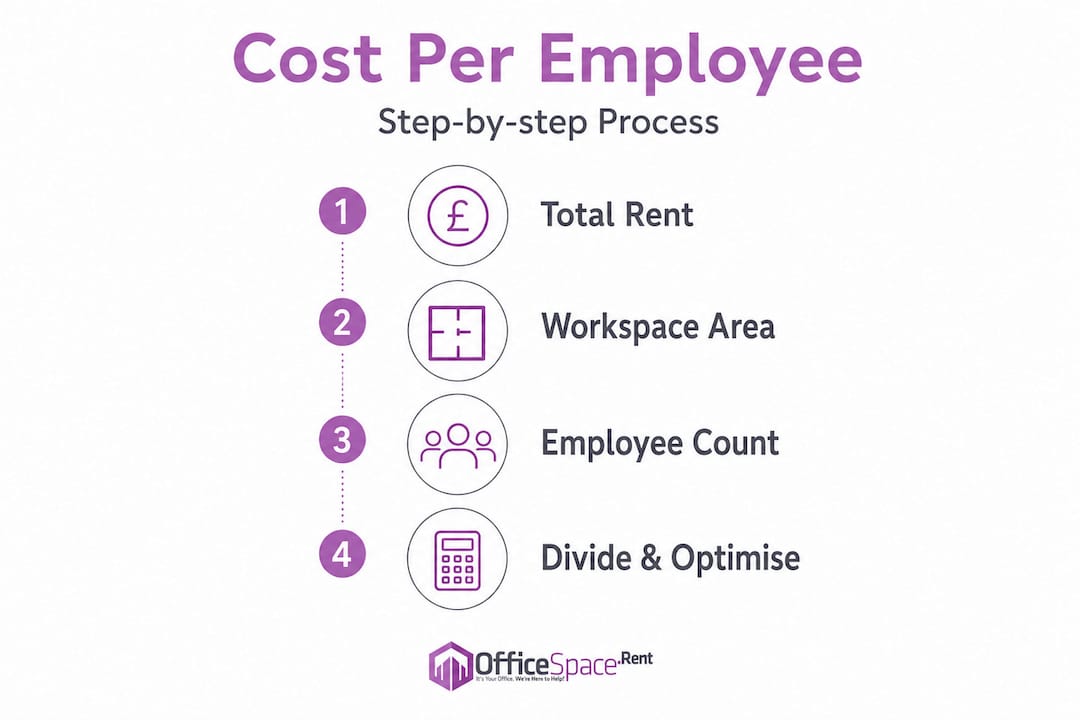
How to estimate office cost per employee: step-by-step
With the key drivers clarified, here is how to apply them to get the true cost per head for your workspace.
- Measure your total usable floor area in sqm. This is the net internal area, excluding communal corridors, reception, and shared building facilities you do not control.
- Multiply by the annual cost per sqm. Using the €200-550 per sqm benchmark as a starting point: a 200 sqm office costs approximately €40,000 per year in base occupancy expenses.
- Add service charges and utilities, typically 15 to 25 per cent of the base rent figure. On €40,000, that brings total occupancy cost to between €46,00 and €50,000.
- Divide by your headcount. For a 20-person team in that 200 sqm office, the per-employee cost falls between €2,250 and €2,500 per year.
- Adjust for occupancy rate. If only 16 of those 20 desks are used on any given day, your effective cost per working position rises to around €2,875 to €3,125.
The Malta office cost guide provides further context on how lease structures, fit-out contributions, and rent-free periods can all influence the true annual figure.
| Office model | Sqm per employee | Annual cost per employee (at €200/sqm) |
|---|---|---|
| Traditional private offices | 12 sqm | €2,400 |
| Open-plan | 7 sqm | €1,400 |
| Traditional private offices | 10 sqm | €2,000 |
| Serviced / flexible workspace | Varies | €4,000 to €8,000 (all-inclusive) |
These figures exclude service charges for the first three models. For a fuller breakdown of how pricing compares across contract types, rental pricing insights provide a structured comparison.
Pro Tip: Revisit your workspace arrangement every 12 months. Headcount changes, remote working policies, and shifts in lease terms can each move your per-employee cost by 10 to 20 per cent in either direction.
Practical scenarios: Office cost estimation examples
Let us see how the numbers work in practice for different business setups in Malta.
The following table applies the €550/sqm annual occupancy cost to three common business profiles. Service charges of 20 per cent are included.
| Business type | Headcount | Total sqm | Annual base cost | With 20% charges | Cost per employee/year |
|---|---|---|---|---|---|
| Tech startup (open-plan) | 8 | 56 sqm | €12,800 | €14,336 | €1,792 |
| Law firm (private offices) | 12 | 144 sqm | €36,200 | €43,440 | €3,620 |
| Call centre (high density) | 50 | 200 sqm | €40,000 | €48,000 | €960 |
Key assumptions behind these figures:
- Tech startup: 7 sqm per employee, open-plan layout, no dedicated meeting rooms.
- Law firm: 12 sqm per employee, individual offices, formal client-facing spaces included.
- Call centre: 4 sqm per employee, shift-based rota, near-full desk utilisation at all times.
📊 Cost callout: A small eight-person startup in Malta can expect to spend approximately €12,000 to €18,000 per year on office space, translating to roughly €1,500 to €1,900 per employee. A 50-person call centre operating at high density may bring that figure down to under €960 per person.
These examples reinforce why density assumptions matter as much as the lease rate itself. Before signing any lease, it is worth taking the time to assess Malta rental costs against your specific headcount projections and layout plans.
How to use cost estimates to improve efficiency and plan ahead
With the numbers and examples at hand, here is how you can use these insights for better business decisions.
A clear per-employee cost figure does more than satisfy financial reporting. It becomes a planning instrument across three areas: growth modelling, space reduction, and lease negotiation.
- Growth modelling: If you know your cost per employee today and plan to hire 10 additional staff over the next 18 months, you can forecast the incremental space and cost requirement before signing any new agreements.
- Identifying wasted space: When the €200-550 per sqm benchmark is applied to desk utilisation data, low-occupancy areas become visible and quantifiable in financial terms. A 20 per cent utilisation gap on a 300 sqm office costs approximately €15,000 annually in unused space.
- Lease negotiation leverage: Landlords respond to tenants who arrive with data. Presenting a per-employee cost analysis alongside vacancy rate comparisons strengthens your position when renewing or renegotiating a lease.
- Benchmarking for hybrid models: As hybrid working becomes standard across Malta, understanding the baseline cost per head allows you to model the financial impact of reducing physical desk count while maintaining operational capacity.
- Forecasting budget accurately: A per-employee metric integrates more cleanly into headcount-based financial planning than a lump-sum lease cost.
For businesses considering whether their current space represents genuine value, reviewing Malta office rent expectations by budget band provides a useful external reference.
Why most Maltese businesses overpay for office space (and what to do instead)
The €200-550 per sqm benchmark gets treated as an unavoidable cost of doing business in Malta. That perception is worth challenging directly. The figure reflects market averages, not fixed pricing. Lease terms, fit-out contributions, rent-free periods, and break clauses all carry negotiable value that many tenants never pursue.
The more common error, however, is not the rate paid. It is the space arrangement accepted without scrutiny. Businesses frequently design their office for headcount peaks that occur two or three days per week at most, then pay 52 weeks a year for that capacity. Flexible layouts, shared meeting rooms, and activity-based working zones can reduce per-employee floor space requirements by 20 to 35 per cent without reducing staff satisfaction.
A second misstep is the absence of employee input. The people using the space daily know which areas are unused, which facilities are redundant, and what would genuinely improve their workday. Neglecting that intelligence leads to expensive refits or, worse, expensive leases extended without justification.
The full cost guide outlines the components of a well-structured lease review, which is worth conducting before any renewal decision.
Pro Tip: When efficiency improvements reduce your space requirement, reinvest a portion of those savings into talent or technology. That multiplier effect is where office cost optimisation creates lasting competitive advantage, not simply in the reduced bill.
View office costs not as a fixed overhead but as an adjustable input. The businesses that approach their workspace strategically consistently outperform those that renew leases on autopilot.
Explore office space options to fit your budget
Understanding your per-employee cost is the first step. Finding the right space to match it is the next. OfficeSpace.Rent lists a wide range of properties across Malta, from flexible business centre options suited to growing teams to established Mriehel office leases in one of Malta’s most active commercial zones. For businesses considering ownership alongside tenancy, Malta commercial property for sale is also searchable by size, location, and price. Whether you are planning for a team of eight or fifty, the listings and market data available on the platform allow you to compare real options against your calculated per-employee budget before committing to any lease.
Frequently asked questions
What is the average office occupancy cost per employee in Malta?
Using the €200-550 per sqm annual benchmark, most typical setups in Malta spend between €960 and €5,500 per employee each year, depending on the floor area allocated per person and the inclusion of service charges.
How much space should I budget per employee in Malta?
A common guideline is 8–12 sqm/person efficient open plan; 12–15 including meeting/breakout; 15–20 cellular/private; 20–30 executive/premium, which balances comfort and efficiency; flexible or hot-desking workspaces may require as little as 4 to 5 sqm per person.
How can I lower office cost per employee in Malta?
Optimising layouts, adopting hot-desking, and conducting an annual review of desk utilisation data can significantly reduce per-employee costs, often by 15 to 30 per cent without reducing headcount.
Are there hidden costs beyond rent in calculating per-employee office cost?
Yes, maintenance fees, utilities, building insurance, and common area charges typically add 15 to 25 per cent on top of base rent and must be included in any accurate per-employee cost calculation.
Recommended
- Calculator: Estimate Your Office Space Requirements – Offices in Malta To Let & For Sale
- Desk Based Office Search to Maximise Your Budget – Offices in Malta To Let & For Sale
- Best for Your Office Space: Key Considerations – Offices in Malta To Let & For Sale
- Guide to Office Size and Layouts: Finding Your Space – Offices in Malta To Let & For Sale