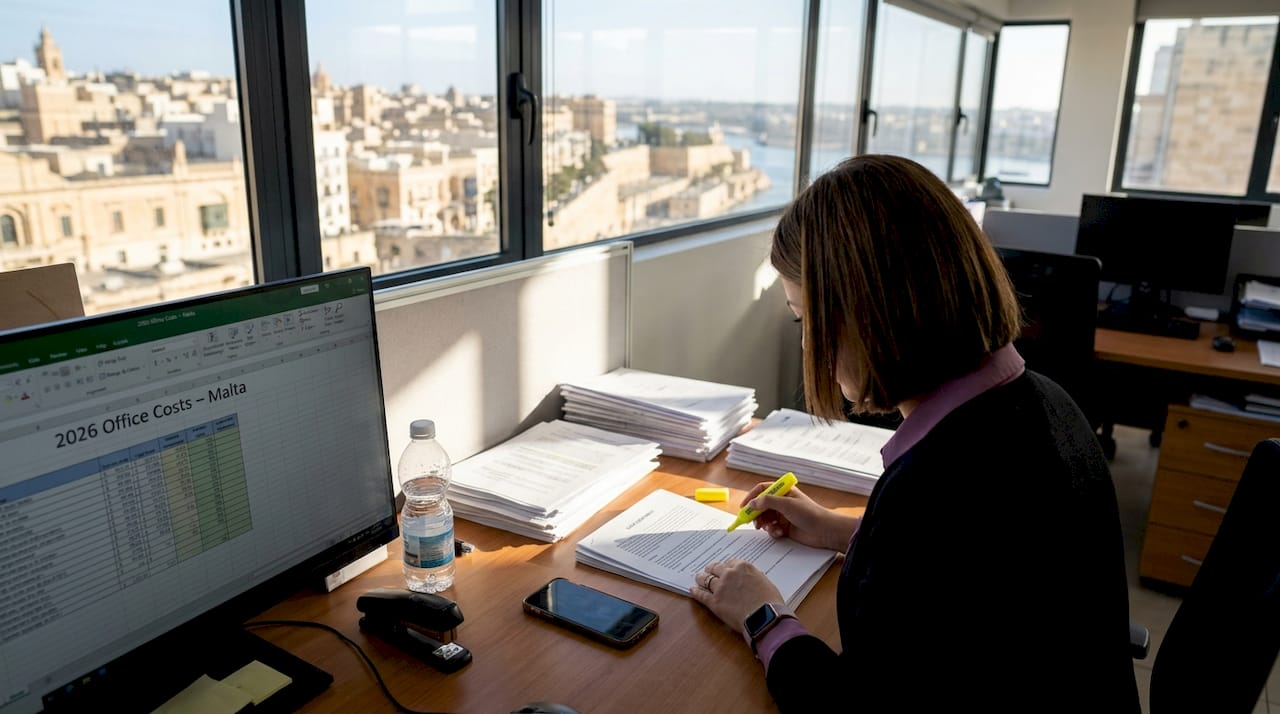
Estimating office rental costs in Malta goes far beyond the headline rent figure you see advertised. Business owners and managers often underestimate the true total occupancy cost by overlooking service charges, fit-out expenses, agency fees, VAT, parking, and utilities. This comprehensive guide walks you through how to assess office rental costs, including every cost component, comparison methods, lease term considerations, and negotiation strategies to help you make informed leasing decisions that optimise your budget and operational requirements in Malta’s 2026 commercial property market.
Table of Contents
- Key takeaways
- Understanding total occupancy costs and key expense components
- Preparing to assess office rental costs: defining needs and benchmarking
- Executing the assessment: comparing lease types and negotiating terms
- Verifying your assessment and making informed leasing decisions
- Explore office rental options with OfficeSpace.Rent
- How to assess office rental costs: frequently asked questions
Key Takeaways
| Point | Details |
|---|---|
| Total occupancy cost | The total occupancy cost captures all expenses beyond base rent, including service charges, utilities, fit-out, furniture, insurance, agency fees, parking and VAT. |
| Cost components breakdown | Request an itemised cost breakdown from landlords to compare true total costs rather than headline rent figures. |
| Upfront versus ongoing costs | Traditional offices often require substantial fit-out upfront while serviced offices typically include fit-out in the monthly rate. |
| VAT and agency fees impact | VAT at 18 per cent applies to commercial rents and agency fees are typically 10 per cent of the first year’s rent, so clarify whether quotes include VAT. |
| Benchmarking and comparisons | Define needs and benchmark by location and grade, then compare at least three properties to inform a sound decision. |
Understanding total occupancy costs and key expense components
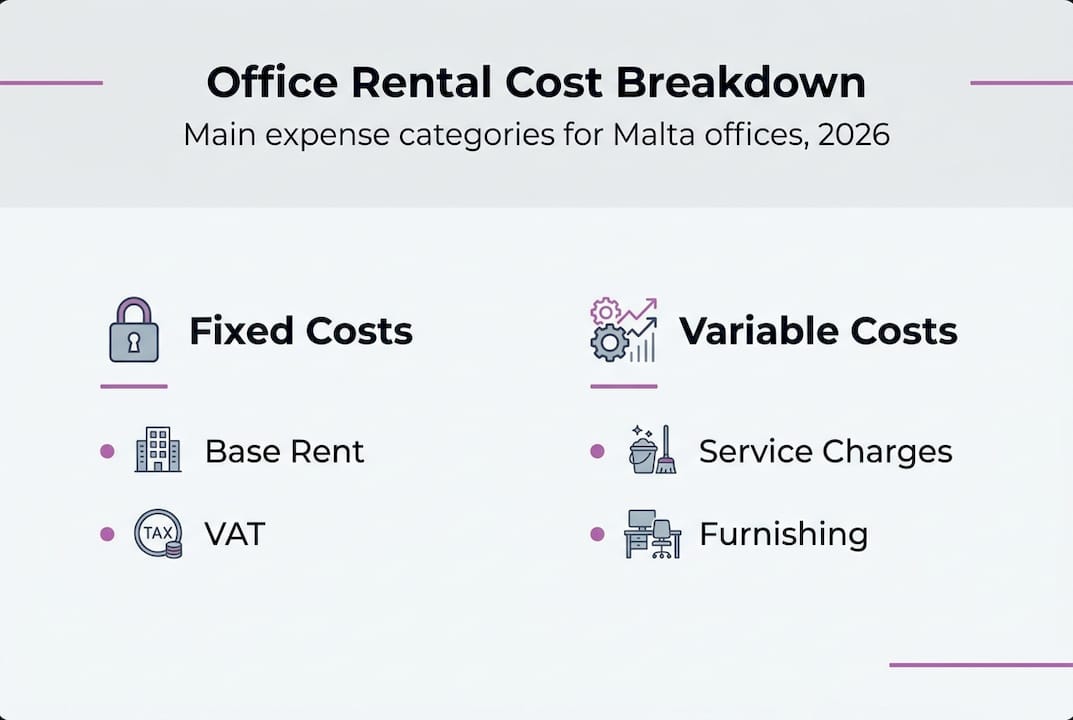
Calculating your true office rental cost starts with understanding Total Occupancy Cost. This comprehensive figure captures every expense you will incur, not just the base rent. Business owners should calculate Total Occupancy Cost including base rent, service charges, utilities, fit-out, furniture, insurance, agency fees, parking, and VAT. Missing even one component leads to budget shortfalls and unexpected cash flow pressure.
Base rent forms your foundation cost, typically quoted per square metre annually in Malta. Service charges cover building maintenance, common area cleaning, security, and shared utilities. These charges vary significantly between buildings and landlords, so always request a detailed breakdown. Fit-out costs transform an empty shell into a functional workspace with partitions, flooring, lighting, and cabling. Traditional offices often require substantial fit-out investment upfront, whilst serviced offices include this in the monthly rate.
Furnishing your office adds desks, chairs, storage, meeting room equipment, and kitchen facilities. Insurance protects your business assets and covers liability, typically costing 1-2% of total property value annually. Agency fees in Malta are standard at 10% of the first year’s rent, payable by the tenant and the landlord upon lease signing. Parking spaces command premium rates in central business districts, often €80-200 per space monthly. Utilities including electricity, water, internet, and phone services add ongoing operational costs that fluctuate with usage.
VAT at 18% applies to commercial rent in Malta, significantly increasing your actual payment versus the advertised base rent. When reviewing office rental prices Malta, always clarify whether quotes include or exclude VAT to avoid confusion. Here is a summary of typical cost components and ranges for a 100 square metre office in a mid-range location:
| Cost component | Typical range (annual) | Notes |
|---|---|---|
| Base rent | €15,000-25,000 | Varies by location and grade |
| Service charges | €2,000-4,000 | Building dependent |
| VAT (18%) | €3,060-5,220 | Mandatory on rent and service charges |
| Agency fee | €1,500-2,500 | One-time, 10% first year rent |
| Fit-out | €5,000-15,000 | One-time, traditional offices only |
| Furniture | €3,000-8,000 | One-time or monthly rental |
| Insurance | €500-1,200 | Annual policy |
| Parking (2 spaces) | €2,400-4,800 | If not included |
| Utilities | €1,800-3,600 | Usage dependent |
Pro Tip: Request itemised cost breakdowns from landlords before viewing properties. This transparency helps you compare true total costs rather than being swayed by attractive headline rent figures that hide expensive service charges or parking fees.
Preparing to assess office rental costs: defining needs and benchmarking
Effective cost assessment begins with clear requirements. Define your office needs by size, location preferences, and office grade before researching market rates. Size requirements depend on headcount, with Malta typically allocating 8-12 square metres per employee including shared spaces. Location choice balances prestige, accessibility for staff and clients, and cost. Central business districts like Sliema, St Julian’s, and Valletta command premium rates, whilst emerging areas like Mriehel or Qormi offer better value.
Office grade matters significantly for both cost and image. Class A offices in prime locations with modern amenities cost substantially more than Class B or C spaces in secondary areas. Define requirements, benchmark against market rates per square metre annually by location and grade, then compare at least three properties for better cost evaluation. Benchmarking involves researching current market rates for comparable properties in your target area and grade.
Use these preparation steps systematically:
- Calculate space requirements based on current and projected headcount over lease term
- Identify priority locations considering staff commutes, client access, and business image
- Determine acceptable office grade and amenity requirements
- Research market rates per square metre for your target specifications
- Create a comparison spreadsheet to track properties against benchmarks
- Schedule viewings for at least three properties meeting your criteria
- Use an office space calculator to estimate total occupancy costs for each option
Benchmarking gives you negotiating power and prevents overpaying. Malta’s 2026 office market shows rates ranging from €120-180 per square metre annually in emerging areas to €250-400 in prime CBD locations. Serviced offices command €300-600 per desk annually depending on location and services included. Always verify whether quoted rates include or exclude VAT and service charges.
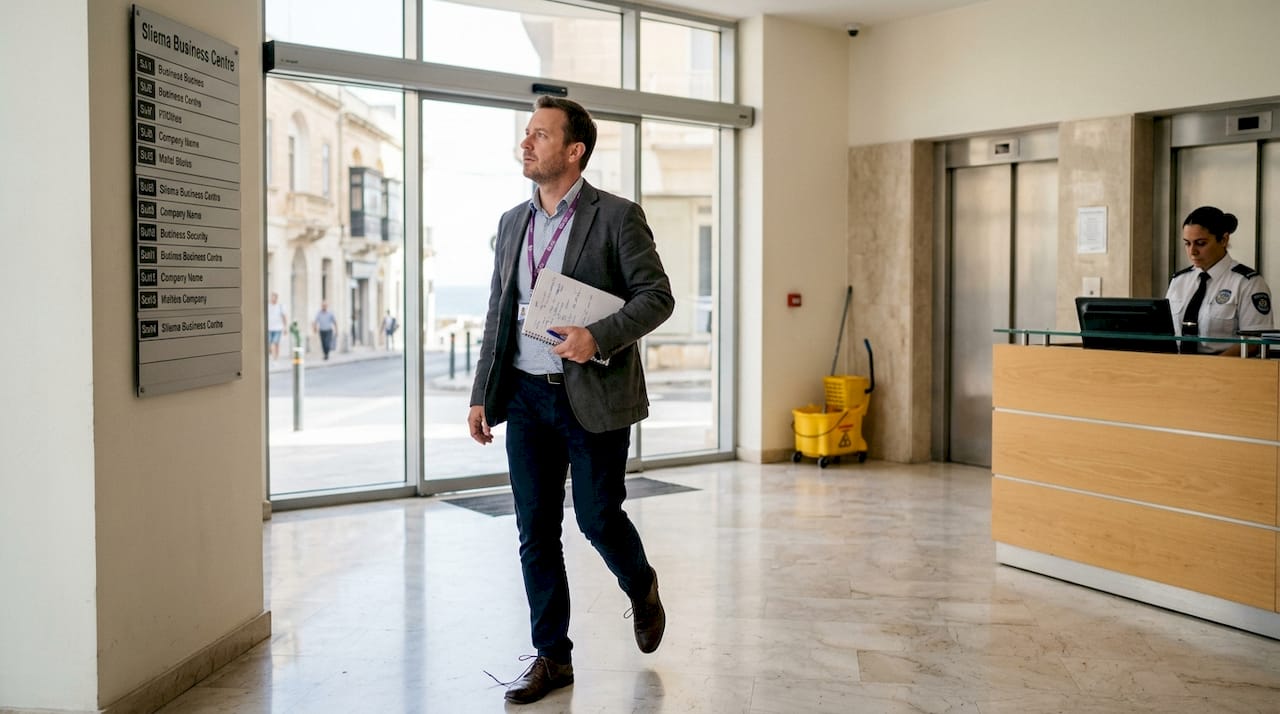
Site visits reveal hidden costs that listings omit. Check parking availability and costs, assess building condition affecting service charges, evaluate natural light reducing electricity needs, and confirm internet infrastructure quality. Visiting multiple properties helps you recognise good value versus overpriced offerings.
Pro Tip: Create a detailed requirements checklist before viewing properties, including must-haves like parking spaces, meeting rooms, kitchen facilities, and accessibility features. This disciplined approach prevents emotional decisions based on impressive but unnecessary amenities that inflate costs without adding operational value.
Executing the assessment: comparing lease types and negotiating terms
Malta offers two primary office lease structures with dramatically different cost profiles. Traditional leases provide bare or fitted space where you control fit-out and operations but require a Class 4A permit and substantial upfront investment. Serviced offices include everything from furniture to reception services in a higher monthly rate but eliminate upfront costs and permit hassles. Traditional leases require Class 4A permit and have upfront fit-out costs, whilst serviced offices include all-in costs but at higher per desk price.
Comparing lease types requires analysing total costs over your intended occupancy period:
| Factor | Traditional lease | Serviced office |
|---|---|---|
| Upfront costs | High (fit-out, furniture, deposits) | Low (typically 1-2 months deposit) |
| Monthly cost | Lower base rent plus separate charges | Higher all-inclusive rate |
| Flexibility | Fixed term, typically 2-6 years | Flexible terms from 1 month rolling |
| Permit requirement | Class 4A permit needed | Included in operator’s licence |
| Best for | Established businesses, longer occupancy | Startups, uncertain growth, short term |
Lease negotiation directly impacts your total costs and operational flexibility. Malta’s stable 2026 market favours tenants in secondary locations but landlords retain power in prime CBD areas. Focus negotiations on these key terms:
Di fermo represents the initial fixed period where neither party can terminate, typically 2-5 years in traditional leases. Negotiate shorter di fermo if you need flexibility, though landlords often require longer terms for better rates. Di rispetto is the notice period after di fermo expires, usually 3-6 months. Break clauses allow early termination under specific conditions, providing valuable flexibility worth negotiating even at slightly higher rent.
Service charge components merit detailed scrutiny. Request itemised breakdowns and challenge any unreasonable elements. Some landlords include discretionary spending in service charges, inflating your costs. Rent increase mechanisms should be clearly defined, typically linked to retail price index or fixed percentage caps. Negotiate caps on annual increases to protect against unexpected cost escalation.
Prioritise layout efficiency, parking, accessibility over headline rent when comparing properties. A slightly higher rent with included parking and efficient layout often costs less than cheaper rent requiring separate parking and wasted space. Longer leases secure discounts of 10-20% compared to shorter terms, whilst serviced offices simplify budgeting by bundling all costs into one predictable monthly payment.
Legal review is essential before signing any lease in Malta. Commercial lease agreements contain complex clauses affecting your obligations and costs. Engage a lawyer experienced in Maltese commercial property to review terms, particularly around maintenance responsibilities, permitted use restrictions, and termination conditions. This investment of €500-1,000 prevents costly mistakes and strengthens your negotiating position.
Pro Tip: Request a draft lease early in negotiations to identify problematic clauses before investing time in detailed discussions. This approach saves time and signals professionalism to landlords, often resulting in more favourable terms as they recognise you are a serious, informed tenant.
Verifying your assessment and making informed leasing decisions
Once you have calculated Total Occupancy Cost for shortlisted properties, verification prevents costly errors. Compare your figures against published market benchmarks and seek expert analysis. Malta’s 2026 office market shows average occupancy costs of €450-550 per square metre annually across all locations and grades, with premium CBD spaces reaching €700-900 per square metre.
Common cost underestimations include:
- Underestimating fit-out costs by 30-50% due to unforeseen building complications
- Ignoring furniture replacement cycles requiring capital expenditure every 5-7 years
- Overlooking technology infrastructure costs for cabling, servers, and telecommunications
- Forgetting annual cost increases from inflation and service charge escalation
- Neglecting relocation costs when lease terms expire
Market trends affect both availability and pricing. Malta’s 2026 market is stable with iGaming and technology sectors driving demand for flexible leases and value-driven decisions. Supply in secondary locations exceeds demand, creating tenant-favourable conditions for negotiation. Prime CBD space remains constrained, maintaining landlord pricing power.
The strategic choice between leasing and buying deserves consideration for established businesses. Buy versus lease decisions depend on market appreciation, available capital, and long-term business plans. Leasing preserves capital for operations and provides flexibility, whilst buying builds equity and eliminates rent escalation. Current commercial property yields in Malta range from 4-6%, making purchase attractive for businesses with strong balance sheets and long-term local commitment.
Consider these factors when deciding:
- Financial position and access to capital for property purchase
- Business growth trajectory and space requirement certainty
- Market conditions and property appreciation potential
- Tax implications of ownership versus leasing
- Operational flexibility needs over the next 5-10 years
“Successful office leasing in Malta requires understanding total occupancy costs beyond headline rent, comparing lease structures systematically, and negotiating terms that balance cost with operational flexibility. The 2026 market rewards informed tenants who verify calculations and leverage professional expertise.”
Pro Tip: Engage a commercial property specialist from OfficeSpace.Rent early in your assessment process. Their market knowledge helps verify your calculations, identifies properties you might miss, and strengthens negotiating positions through established landlord relationships. This professional support typically saves 10-15% on total costs whilst reducing time spent searching and negotiating.
Explore office rental options with OfficeSpace.Rent
Now that you understand how to assess office rental costs comprehensively, finding the right property becomes your next priority. OfficeSpace.Rent has specialised in Malta’s commercial property market since 2015, offering the island’s most extensive database of offices in Malta to let and for sale. Our platform provides detailed listings with transparent pricing, comprehensive specifications, and filtering tools to match your exact requirements.
Our desk based office search tool simplifies finding serviced offices by calculating costs per employee rather than per square metre, helping you compare traditional and serviced options accurately. Beyond listings, we provide expert support throughout your leasing journey, from initial search through lease negotiation and signing. Our team’s deep market knowledge and landlord relationships help secure better terms and identify opportunities before they reach public listings.
Whether you need a small serviced office for a startup team or a large traditional space for an established operation, our specialists guide you through cost assessment, property comparison, and lease negotiation to optimise your investment. Pro Tip: Contact OfficeSpace.Rent at the start of your office search, ideally 3-6 months before you need to move. Early engagement provides time to find the perfect property, negotiate favourable terms, and complete fit-out if required, ultimately saving money and avoiding rushed decisions that inflate costs.
How to assess office rental costs: frequently asked questions
What is included in total occupancy cost for office rent in Malta?
Total Occupancy Cost includes base rent, service charges, VAT at 18%, agency fees, fit-out and furniture costs, insurance, parking, and utilities. Traditional offices require separate budgeting for each component, whilst serviced offices bundle most items into monthly rates. Always request itemised breakdowns to compare properties accurately.
How can I compare serviced versus traditional office leases?
Calculate total costs over your intended occupancy period including all upfront and ongoing expenses. Traditional leases have lower monthly costs but require substantial upfront investment in fit-out, furniture, and deposits. Serviced offices cost more monthly but eliminate upfront expenses and include flexibility. For occupancy under two years, serviced offices typically prove more economical.
Are agency fees negotiable in Malta office leases?
Agency fees follow a standard 10% of first year’s rent structure in Malta, paid by both the tenant and the lanlord.
What is di fermo and how does it affect my lease duration?
Di fermo is the initial fixed period in Maltese leases where neither landlord nor tenant can terminate the agreement, typically lasting 2-5 years. After di fermo expires, either party can terminate by providing notice during di rispetto period. Shorter di fermo provides flexibility but often commands higher rent, whilst longer terms secure better rates.
Should I consider buying instead of leasing an office in Malta?
Buying suits established businesses with strong balance sheets, long-term local commitment, and certainty about space requirements. Property ownership builds equity, eliminates rent escalation, and provides asset appreciation potential. Leasing preserves capital for operations and offers flexibility for growing businesses. Analyse your financial position, growth trajectory, and market conditions before deciding. How to assess office rental costs versus those of buying, this is another story altogether. Having said that, Malta offers very little for those who are looking to invest in their own offices. Options are quite hard to find.
How do Class 4A permits affect office rental costs?
Class 4A permits are required for traditional office leases in Malta, costing €500-1,500 depending on space size and taking 2-3 months to obtain. Application requires lease agreements, company documentation, and sometimes architectural plans. Serviced offices include permits in their operator licences, eliminating this cost and administrative burden for tenants. Factor permit costs and timing into traditional lease assessments.
Recommended
- Malta Office Market Pricing Trends for 2026 – Offices in Malta To Let & For Sale
- Cost of Renting Offices in Malta: A Complete Guide – Offices in Malta To Let & For Sale
- Office Rental Prices in Malta Explained – Offices in Malta To Let & For Sale
- Office Rental Malta: Your Complete Guide – Offices in Malta To Let & For Sale