TL;DR:
- Malta’s office rental market offers cost-effective options with flexible lease terms, ideal for small to medium-sized businesses expanding in Europe. Demand for Grade A and flexible spaces is rising, driven by regulatory improvements and hybrid work trends, while overall costs remain lower than major European hubs. Strategic location choice and understanding total occupancy costs are key to leveraging Malta’s advantages for business growth.
Malta’s office rental market offers a striking proposition for businesses looking at European expansion. While London, Dublin, and Paris command eye-watering rents, Malta’s cost position sits well below the European mainstream, without sacrificing EU membership, English-language operations, or access to skilled professionals. Office rental trends in Malta in 2026 are shaped by a combination of rising demand, regulatory change, and shifting occupier preferences. Understanding these dynamics gives businesses a genuine edge when planning their next space acquisition.
Table of Contents
- Key takeaways
- Office rental trends in Malta: rates and demand by location
- Economic factors and regulatory environment
- How Malta compares to European business hubs
- Emerging trends shaping occupier decisions
- Our perspective on Malta’s office market
- Find your next office with Officespace
- FAQ
Key takeaways
| Point | Details |
|---|---|
| Rental rates vary by district | Prime rents range from €180 to €450 per sqm annually, depending on location and office grade. |
| Lease flexibility is a market advantage | Malta’s typical 2 to 5-year lease terms compare favourably to the 10-plus-year commitments common in major European cities. |
| Regulatory changes are reshaping stock quality | Fibre-ready and energy-efficient building incentives will gradually improve available office stock. |
| Hybrid work is influencing demand | Flexible and serviced office solutions are growing in demand as companies manage uncertain space requirements. |
| Total occupancy costs matter | Fit-out, utilities, and IT infrastructure add meaningfully to base rent and must be factored into budget planning. |
Office rental trends in Malta: rates and demand by location
Understanding what you will pay depends heavily on where you look and what specification of space you need. Malta’s office rents range from approximately €180 to €450 per sqm annually, a spread that reflects significant variation between districts and office grades.
| Area | Office grade | Annual rent (per sqm) |
|---|---|---|
| Sliema | Grade A / prime | €240–€450 |
| St Julian’s | Grade A / prime | €250–€450 |
| Mriehel | Grade B / business park | €190–€350 |
| Valletta fringe | Mixed stock | €180–€280 |
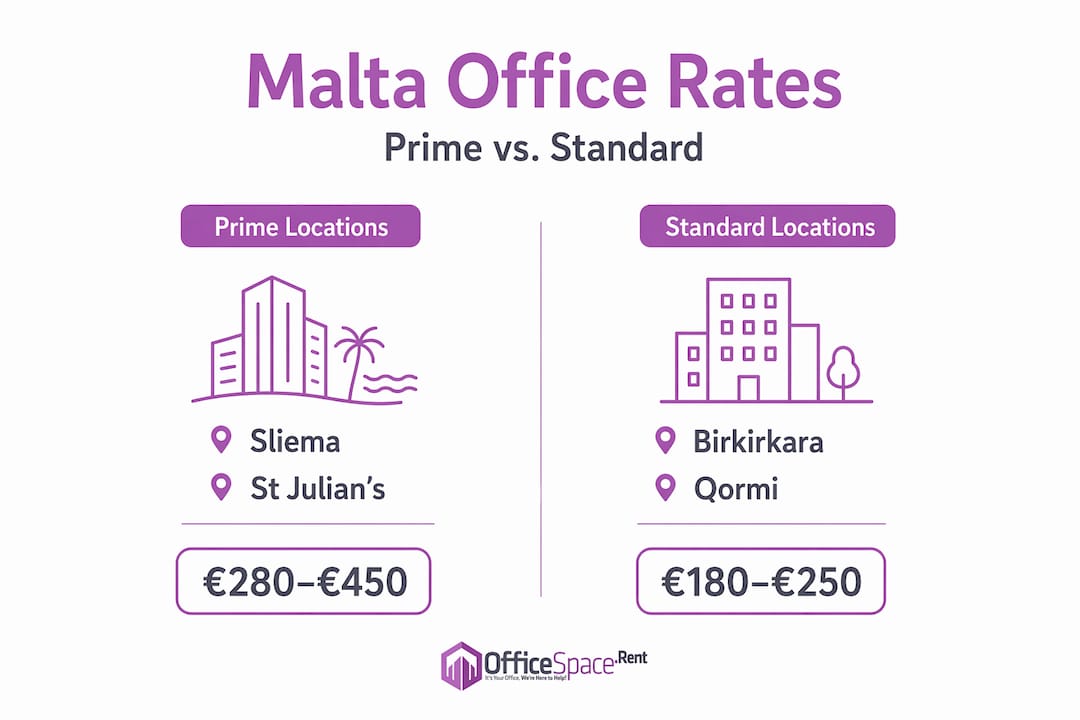
Sliema and St Julian’s attract the highest rents due to their concentration of financial services firms, iGaming operators, and professional services businesses. These areas offer prestige addresses, good transport links, and proximity to amenity-rich environments. Mriehel functions as Malta’s primary business park district, offering larger floor plates and more competitive rates, making it particularly attractive for back-office operations and technology companies.
The key distinctions in the Malta office space market break down as follows:
- Grade A offices: Modern, full-specification buildings with raised floors, VRF air conditioning, and high-speed connectivity. Predominantly found in Sliema, St Julian’s, and newer Mriehel developments.
- Serviced offices: All-inclusive, short-licence arrangements suited to businesses requiring immediate occupation and operational flexibility.
- Smaller traditional offices: Older stock in mixed-use buildings, lower cost but variable in quality and specification.
Demand for Grade A space currently outpaces supply in prime locations, putting upward pressure on rents for the best-quality stock. For businesses with flexibility on specification, Mriehel offers a practical alternative without compromising on professional environment. You can review current pricing structures in detail on the Officespace platform.
Economic factors and regulatory environment
With Malta’s inflation rate sitting at 2.3% in early 2026, operating cost pressures are relatively contained compared to other EU markets. For businesses budgeting multi-year lease commitments, this level of price stability offers reasonable predictability for fit-out and operational expenditure planning.
Regulatory developments are also beginning to influence commercial real estate trends in Malta. Proposals currently under consideration include:
- Fibre-ready building requirements: Incentivising landlords to upgrade infrastructure, which will increase the availability of tech-ready office stock across all price segments.
- Energy efficiency tax breaks: Designed to reduce running costs for occupiers in certified buildings, with potential savings on utility bills over the lease term.
- Build quality standards: Efforts to raise minimum specifications for new commercial developments, gradually improving the baseline quality of available stock.
These regulatory proposals are not yet fully enacted, but they signal the direction of travel. Landlords investing in upgrades now are positioning their assets for premium rents as tenant expectations rise.
Pro Tip: Many businesses focus entirely on headline rent when assessing office leasing rates in Malta, but fail to check whether a building meets fibre-ready standards. A lower-rent building requiring costly IT infrastructure upgrades can quickly erode any initial cost advantage.
How Malta compares to European business hubs
For businesses evaluating multiple locations, the commercial real estate trends in Malta look notably different from those in comparable European cities. Consider the following comparison:
| City | Prime office rent (per sqm/year) | Typical lease term | Official business language |
|---|---|---|---|
| London | €1,100–€1,500 | 10–15 years | English |
| Dublin | €600–€850 | 5–10 years | English |
| Lisbon | €300–€500 | 5–7 years | Portuguese |
| Malta | €180–€450 | 2–5 years | English / Maltese / Italian |
The cost differential with London and Dublin is substantial. A 500 sqm Grade A office in St Julian’s at €450/sqm costs roughly €225,000 per year. The equivalent space in central London would cost €550,000 to €750,000.
Malta’s competitive advantages extend beyond price. The island offers English as an official language alongside Maltese, removing the operational friction that comes with relocating to Lisbon or Warsaw. EU membership provides access to European frameworks for financial services, iGaming licensing, and professional qualifications. Lease terms in Malta typically run between 2 and 5 years, offering considerably more flexibility than the 10-plus-year commitments standard in London.
The limitations are real, however. Malta does not offer the very large floor plates that major international firms sometimes require. The local workforce, while skilled in finance and iGaming sectors, is finite in size. Businesses requiring 5,000 sqm or more under one roof will find options considerably more restricted than in larger markets. For the benefits of relocating to Malta, the sweet spot is small-to-medium sized operations where cost efficiency and operational simplicity outweigh scale requirements.
Emerging trends shaping occupier decisions
The future of office rentals in Malta is being shaped by the same forces transforming markets across Europe, but with some local characteristics worth understanding.

Flexible workspace solutions are growing in demand as companies manage hybrid working models and resist committing to large fixed-cost leases during a period of business uncertainty. Serviced offices and premium coworking spaces allow businesses to right-size their footprint quarter by quarter, which is particularly attractive for businesses entering Malta for the first time.
Total occupancy costs are also receiving more scrutiny. Beyond base rent, businesses are accounting for fit-out costs, furniture, IT infrastructure, utilities, cleaning, and service charges when assessing total spend. A serviced office at a higher headline rate can still come out cheaper on a total-cost basis than a bare shell requiring substantial fit-out investment.
When choosing between office types in Malta, consider the following factors in order of priority:
- Lease term commitment: How long can you confidently commit? Flexible licences suit businesses in early growth phases; conventional leases suit established operations.
- Specification requirements: Does the space meet your IT, power, and cooling requirements without additional capital expenditure?
- Location and talent access: Is the address accessible for your intended workforce, particularly if recruiting locally in financial services or tech?
- Fit-out timeline: Serviced offices allow immediate occupation; traditional offices sometimes may require 3 to 8 weeks of fit-out before staff can move in.
- Exit provisions: Understand break clauses and dilapidations obligations before signing, as these significantly affect the true cost of a lease.
For a structured approach to assessing office rental costs across these dimensions, Officespace provides detailed guidance tailored to the Malta market.
Our perspective on Malta’s office market
I’ve spent years watching businesses approach Malta with the wrong assumptions. The most common mistake is treating it purely as a cost-saving exercise, securing the cheapest space and expecting everything else to fall into place.
What I’ve found is that the businesses that perform well here treat the cost advantage as a starting point, not the whole strategy. They choose locations that support talent recruitment. They negotiate sensible break clauses rather than locking in for five years on the first deal they see. And they factor in total occupancy cost rather than comparing headline rents in isolation.
My honest take on the future of office rentals in Malta is that Grade A stock in prime locations will continue to tighten. The regulatory push towards fibre-ready and energy-efficient buildings is real, but new supply takes time. Businesses that act now on lease negotiation while vacancy rates are still workable are in a better position than those who wait.
Malta rewards businesses that understand its specific constraints and plan accordingly. It is not a market where large-scale, rapid expansion is straightforward. But for firms that fit its profile, the value proposition remains one of the strongest in the EU.
— OfficeSpace.Rent
Find your next office with Officespace
Officespace provides Malta’s most detailed database of office listings across all major commercial districts. Whether you are exploring a Mriehel commercial property for a back-office operation or searching for a business centre office with flexible licence terms in Sliema or St Julian’s, the platform covers the full range of budget levels and office specifications. Every listing includes transparent pricing, location analysis, and direct access to local agents with deep market knowledge. Officespace also provides lease support from initial search through to final signature, including guidance on negotiation and legal terms. Start your search today and match the right space to your operational requirements.
FAQ on Office rental trends in Malta
What are the office rental prices in Malta?
Office rental prices in Malta range from approximately €180 to €450 per sqm annually. Prime locations such as Sliema and St Julian’s sit at the higher end, while Mriehel business park offers more competitive rates for similar-quality stock.
How do Malta’s lease terms compare to other EU markets?
Lease terms in Malta typically run from 2 to 5 years, which is considerably shorter than the 10-plus-year standard commitments common in cities like London. This flexibility is a notable advantage for businesses managing growth uncertainty.
Is demand for serviced offices growing in Malta?
Yes. Flexible and serviced office solutions are increasingly sought after, driven by hybrid working models and occupier reluctance to commit to long leases. These options also reduce upfront fit-out costs, making them attractive for market entrants.
How does Malta’s inflation rate affect office rental budgets?
Malta’s inflation rate of 2.3% in early 2026 provides relative operating cost stability. For businesses on multi-year leases, this moderate inflation environment supports more reliable budget forecasting compared to higher-inflation European markets.
What should businesses look for beyond headline rent in Malta?
Beyond base rent, businesses should assess fit-out requirements, IT infrastructure readiness, service charges, utility costs, and exit provisions. Total occupancy cost rather than headline rate provides a more accurate basis for comparing office options.