
TL;DR:
- In Malta, Class 4A is a land-use designation by the Malta Planning Authority for professional, financial, and administrative office activities, not a quality rating. This classification impacts zoning, permits, lease terms, and compliance, especially for businesses like law firms, healthcare providers, and consultancies. Mistaking Class 4A for other standards can lead to permit issues, legal exposure, and operational disruptions.
If you are evaluating office space in Malta, the term “what is a class 4A office” will come up quickly. Yet many business professionals mistake this classification for a quality rating, or confuse it with how other countries use the same label. In Malta, Class 4A is a formal land-use designation defined by the Malta Planning Authority, and getting it wrong can lead to permit refusals, lease disputes, or operating a business from a space that is not legally fit for purpose. This guide explains exactly what Class 4A means, how it differs from other classifications, and why it matters for your office decision.
Table of Contents
- Key takeaways
- What is a class 4A office under Malta’s planning rules?
- Class 4A vs Class 4B: key differences explained
- Advantages of Class 4A office spaces
- Examples of businesses that use Class 4A offices
- My take on choosing the right office classification
- Find Class 4A office space in Malta
- FAQ
Key takeaways
| Point | Details |
|---|---|
| Malta-specific classification | Class 4A is a Malta Planning Authority land-use designation, not a quality grade or international standard. |
| Financial and professional use | Class 4A covers law firms, financial services, consultancies, and healthcare professionals operating from office premises. |
| Distinct from Class 4B | Class 4B applies to retail and display spaces, making the two categories fundamentally different in permitted activity. |
| Compliance implications | Operating from the wrong permit class can invalidate your lease and create legal and regulatory exposure. |
| Leasing considerations | Class 4A classification directly affects contract terms, rental rates, and your obligations as a tenant. |
What is a class 4A office under Malta’s planning rules?
Class 4A is a land-use category established by the Malta Planning Authority to define premises used for financial, professional, and administrative office purposes. It is not a quality rating like the Grade A or Grade B office classifications used in international property markets. In Malta, the classification tells you what activities are legally permitted on the premises, not how modern or well-fitted the space is.
Class 4A covers offices used primarily for financial and professional administrative purposes, which distinguishes them from retail outlets, warehouses, or light industrial units. The permit class determines the planning category of the building for zoning and compliance purposes.
Typical business types that occupy Class 4A premises include:
- Law firms and legal practices conducting client consultations and casework
- Financial services companies including investment advisers, insurance brokers, and accountancy firms
- Professional consultancies such as management, HR, and IT advisory firms
- Doctors, dentists, and other healthcare professionals operating private clinics or consulting rooms
- Administrative offices for companies across most regulated sectors
One point worth clarifying: the term “Class 4A” has entirely different meanings in other jurisdictions. In New Jersey, for example, “Class 4A” refers to commercial properties broadly across retail and office buildings for property tax purposes. Malta’s classification is specific to its own planning system, so advice from other markets does not transfer directly.
Class 4A vs Class 4B: key differences explained
The distinction between Class 4A and Class 4B is one of the most practically important for anyone choosing commercial premises in Malta. Both fall within the broader Class 4 commercial category, yet their permitted uses are fundamentally different.
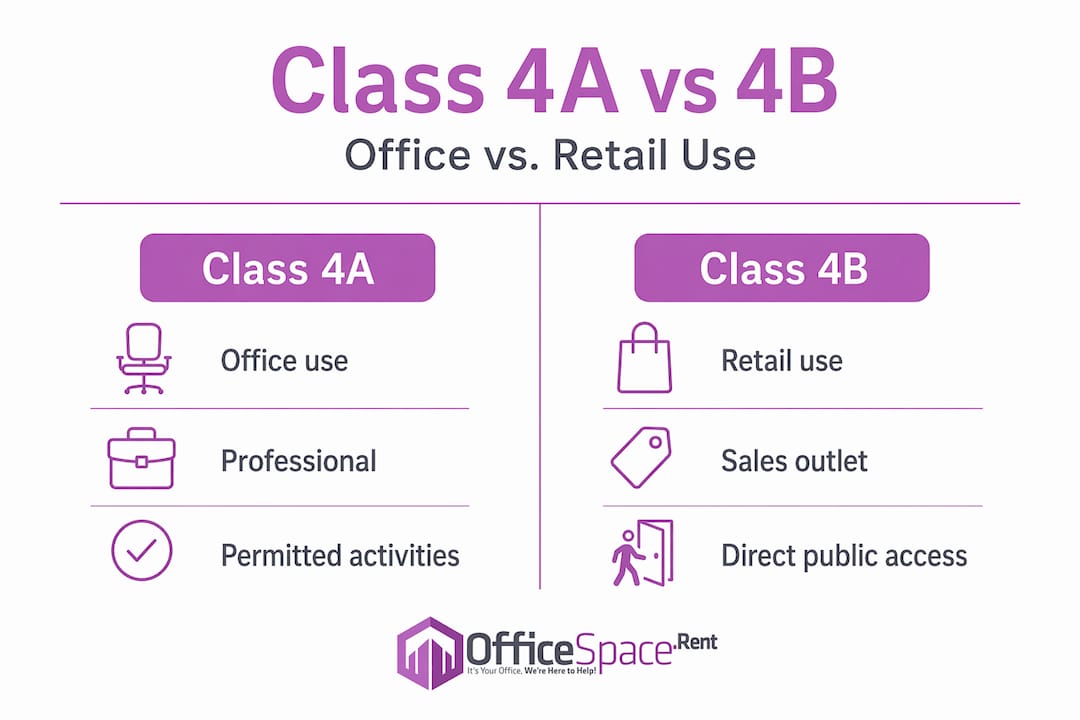
Class 4B permits apply to retail outlets, showrooms, and direct sales environments. These are high-street spaces where goods or services are sold directly to the public across a counter or display floor. A furniture showroom, a mobile phone shop, or a fashion boutique would typically hold Class 4B permits.
The table below summarises the core distinctions:
| Feature | Class 4A | Class 4B |
|---|---|---|
| Primary use | Financial, professional, administrative | Retail, showroom, direct public sales |
| Typical occupants | Law firms, accountants, consultancies, doctors | Shops, showrooms, display outlets |
| Customer interaction | Appointment-based or invited visitors | Walk-in members of the public |
| Location norms | Business districts, mixed-use zones | High streets, retail parks, shopping centres |
| Zoning implications | Office-zoned or mixed commercial | Retail-zoned or commercial high street |
Classification directly affects zoning, the permits you need to operate, and the activities you are legally allowed to conduct on the premises. A business operating under a Class 4A permit cannot simply begin retail sales without obtaining a change of use permission. The regulatory context matters from day one of your lease.
Understanding Malta’s office classifications before signing a lease is not optional for compliance-conscious businesses. Getting this wrong is one of the most common and costly mistakes professionals make when entering the Maltese commercial property market.

Advantages of Class 4A office spaces
Choosing a correctly classified Class 4A office gives your business a clear operational and compliance foundation. The advantages extend beyond simply avoiding permit problems.
From a regulatory perspective, leasing a Class 4A space means your contract terms, permitted activities, and operational obligations are defined and predictable. Landlords of Class 4A properties understand their tenant profile, which typically means premises are fitted with the infrastructure professional services businesses require: reliable connectivity, meeting room provisions, reception areas, and adequate floor plate for administrative work.
The practical benefits of Class 4A office space include:
- Legal certainty: your business activity aligns with the planning permit, reducing the risk of enforcement action or lease disputes
- Professional presentation: Class 4A premises are typically located in business districts and designed for client-facing professional use
- Market credibility: operating from a properly classified office matters to regulators, clients, and counterparties in financial and legal sectors
- Leasing clarity: office rental market trends show that Class 4A classifications carry specific compliance and professional suitability requirements, which are reflected in leasing terms and pricing
There is also a practical consideration around future flexibility. A Class 4A permit gives you a solid base if your business grows. Scaling staff numbers or adding service lines within financial or professional categories generally does not require a change of use, provided the core activity remains consistent with the classification.
Pro Tip: Before signing a lease, ask the landlord or agent to confirm the current planning permit class in writing. If the permit is anything other than Class 4A, seek a formal change of use before committing, as operating from an incorrectly classified space can expose you to enforcement action by the Malta Planning Authority.
Examples of businesses that use Class 4A offices
Understanding which businesses use Class 4A offices is the clearest way to assess whether this classification fits your own needs. Law firms, financial services companies, professional consultancies, and healthcare professionals are the primary occupants of Class 4A premises across Malta.
Here are four practical scenarios that illustrate the fit:
- A boutique law firm in Valletta leases two floors in a converted townhouse. The premises hold a Class 4A permit, allowing client consultations, file management, and administrative operations. A change to retail or public-facing sales would require a new permit class entirely.
- A licensed financial advisory firm in Sliema takes on Class 4A office space to meet Malta Financial Services Authority requirements. The classification supports the regulated environment the MFSA expects from its licensees.
- A management consultancy expanding from London sets up a Malta base and specifically searches for Class 4A-classified premises to satisfy both local planning rules and client due diligence requirements.
- A private GP or specialist consultant rents a consulting room within a shared Class 4A office building. The classification is appropriate for healthcare professionals operating private practices, provided the specific clinical activities meet additional health authority requirements.
Businesses often misunderstand classification, which leads to suboptimal office choices and permit problems. If your business model involves receiving clients by appointment for professional advice, Class 4A is almost certainly the correct designation to seek.
My take on choosing the right office classification
From working with businesses across Malta’s commercial property market, I have seen the same mistake repeated more often than it should be. A company finds a space it likes, the price fits, and the location works. Then, weeks into the lease, it becomes clear the premises hold a Class 4B or retail permit, and the business needs to either negotiate a change of use or absorb the cost of relocating.
What I have learned is that classification is not just a paperwork concern. It reflects whether the space was built, positioned, and maintained for the type of work you actually do. A Class 4A office in a proper business district carries credibility that a converted retail unit often cannot replicate, regardless of how well it is fitted out.
My advice to any entrepreneur or professional setting up in Malta: treat the permit class as a non-negotiable filter before you even view a property. It saves time, money, and considerable regulatory headache. Compliance is far easier to maintain from day one than to retrofit after the fact.
— OfficeSpace.Rent
Find Class 4A office space in Malta
Officespace is Malta’s specialist commercial property platform, covering office listings, leasing guides, and permit resources across the island. Whether you are a financial services firm, a law practice, or a growing consultancy, the platform connects you with premises that match both your operational requirements and your planning classification needs.
Browse the Mriehel commercial property lease listings for professionally classified office spaces in one of Malta’s key business hubs. For a broader search, explore commercial property for sale across Malta, including Class 4A-suitable premises for businesses ready to invest rather than rent. Contact a local agent directly through Officespace to confirm planning permit details before committing.
FAQ
What does Class 4A mean in Malta?
Class 4A is a Malta Planning Authority land-use designation for premises used for financial, professional, and administrative office purposes. It covers businesses such as law firms, accountants, consultancies, and healthcare professionals.
What is the difference between Class 4A and Class 4B offices?
Class 4A covers professional and financial office use, whilst Class 4B applies to retail outlets, showrooms, and direct public sales environments. The two categories have different zoning requirements and permit obligations.
Can a retail business operate from a Class 4A office?
No. A Class 4A permit does not permit retail or direct public sales activity. A business wishing to conduct retail operations from the same premises would need to obtain a Class 4B permit or a change of use approval from the Malta Planning Authority.
Which businesses are best suited to Class 4A offices?
Law firms, financial advisers, accountants, management consultants, and private healthcare professionals are the most common occupants of Class 4A offices in Malta. Any business delivering professional services by appointment is typically a strong fit.
Does Class 4A affect my lease terms?
Yes. Classification directly influences contract terms, permitted uses, and tenant compliance obligations. Leasing a correctly classified Class 4A space gives you legal certainty and reduces the risk of enforcement action or lease disputes.