OfficeSpace.Rent | Practical leasing advice for businesses in Malta Renting an office in Malta involves more than choosing a location and arranging a viewing. The right premises should support your team, fit your working practices and give your business room to develop. However, a promising office can become a poor fit when parking, permitted use, lease conditions or running costs are overlooked.
This practical checklist explains ten decisions worth making before you commit to a traditional or serviced office. For current rental benchmarks by locality, consult our Malta Office Market Guide. For available properties, start with our office space in Malta page.
1. Define how your team will use the office
Start with the people and activities the office must accommodate. Headcount alone rarely tells the whole story. A team that works mostly at individual desks has different needs from one that regularly hosts clients, conducts confidential calls or runs training sessions.
List your current and expected headcount, meeting room requirements, private offices, collaboration areas, storage and IT needs. Consider whether everyone attends on the same days. This helps you judge usable space rather than relying only on an advertised square-metre figure.
2. Decide between a traditional and serviced office
A traditional office lease usually gives your company greater control over layout, branding and day-to-day operation. Depending on the premises, you may need to organise furniture, internet, cleaning and maintenance separately.
A serviced office is typically furnished and managed, often with shared meeting facilities and reception services. It can suit companies entering Malta, project teams or businesses that need a shorter commitment. However, the level of privacy, branding freedom and included services differs by operator.
Neither format is automatically better. Compare the flexibility, operational responsibilities and actual facilities before deciding.
3. Choose a location that supports your business
Malta’s office districts serve different needs. Sliema and St Julian’s offer established commercial addresses, hospitality amenities and coastal settings. Gżira and Ta’ Xbiex can appeal to companies seeking access to the harbour-side business community. Meanwhile, Mrieħel, Birkirkara, Naxxar and San Ġwann may suit businesses prioritising central access or a different building format.
Valletta can be attractive to firms that value proximity to public institutions and a distinctive capital-city address. Yet building layouts and access can vary considerably, especially in older properties.
Rather than selecting an area for prestige alone, compare where your staff live, how clients arrive and which services your business needs nearby. For pricing context across these locations, use our office market guide.
4. Check transport, parking and accessibility
A well-presented office can still be difficult to operate from if staff and visitors struggle to reach it. During your search, check public transport connections, loading access, nearby amenities and the availability of parking.
Ask whether parking spaces are allocated to the unit or merely available somewhere in the vicinity. Also inspect lift access, entrance arrangements and accessibility for visitors with mobility needs. These details can affect recruitment, punctuality and the experience of visiting clients.
5. Verify that the property can lawfully be used as an office
Before committing, confirm that the premises have the appropriate planning authorisation for your intended use. General office use in Malta is commonly associated with Class 4A, but the correct position depends on the property’s planning history and the specific activity you intend to carry out.
Request the relevant permit documentation and have your adviser check any conditions or limitations. If your business carries out regulated activities, separate operating licences or approvals may also be required. Do not assume that a property advertised as an office automatically meets every legal requirement.
6. Compare total occupancy costs, not only headline rent
Two offices with similar advertised rents can have very different overall costs. A traditional lease may involve additional spending on utilities, service charges, parking, insurance, furnishings, fit-out and ongoing maintenance. A serviced office may bundle some of these items into one recurring payment, although exclusions can still apply.
Ask for a written breakdown of what is included, what is billed separately and what is payable at the beginning of the lease. Consider how future rent revisions affect the full commitment.
For rental benchmarks: We keep location-by-location rental guidance on our Malta Office Market Guide, rather than repeating figures across individual blog posts.7. Inspect the office beyond the photographs
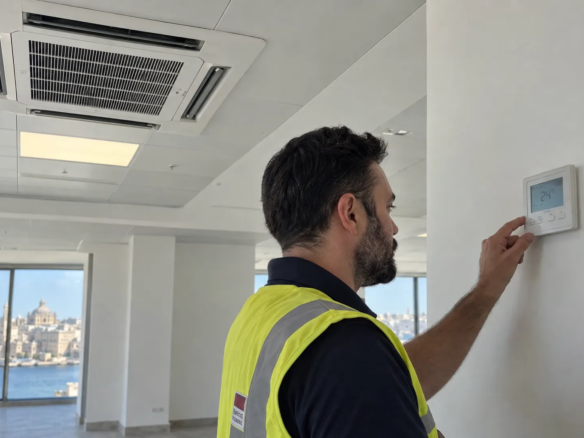
Photographs and floor plans help build a shortlist, but an in-person viewing reveals how a space works. Check natural light, noise, air conditioning, ventilation, internet provision, bathrooms and the condition of common areas.
Ask practical questions: Is the floor ready to occupy? Can partitions be changed? Is backup power available, and what does it actually cover? Who maintains the lift and shared facilities? Where will visitors wait? If a fit-out is needed, confirm the scope of works and who must approve them.
8. Understand the lease before negotiating the final terms
Commercial lease agreements in Malta can differ significantly. Review the overall term, any di fermo and di rispetto periods, renewal rights, rent revisions, deposit requirements and payment frequency. Pay particular attention to early termination, repairs, reinstatement obligations, assignment and subletting.
Make sure the contract clearly states which party is responsible for structural works, internal maintenance, insurance and building services. Verbal understandings should be reflected in the written agreement.
Have an independent Malta-based legal professional review the lease before signing. Commercial terms that appear routine can have important consequences if your company’s requirements change.
9. Allow enough time for viewings, negotiations and fit-out
The time needed to secure an office depends on availability, the complexity of the lease and the condition of the premises. A furnished serviced office may be ready relatively quickly, while a traditional office needing alterations can take considerably longer.
Work backwards from your desired move date. Allow time for shortlisting, viewings, due diligence, negotiations, approvals, furniture and IT installation. If you are moving from an existing office, check your notice obligations before committing to a new start date.
10. Use specialist advice to make a better shortlist
A focused search is usually more productive than viewing every available property. Share your preferred localities, approximate size, team structure, parking requirements, desired move date and any features you cannot compromise on.
OfficeSpace.Rent specialises in Malta’s office rental market and can help you compare traditional and serviced offices, arrange viewings and discuss commercial terms. Search and viewings do not require an upfront brokerage payment; any applicable agency fee should be explained before a transaction proceeds.
Frequently asked questions
Is a serviced office better than a traditional lease?
It depends on your priorities. Serviced offices can offer convenience and flexibility, while traditional leases often give established teams more control over their workspace. Compare the actual services, lease conditions and ability to expand.
Do I need to check the office permit before signing?
Yes. Confirm the property’s authorised use and any conditions relevant to your business. Where necessary, seek planning and legal advice before entering into a binding agreement.
What should I ask about parking?
Confirm how many spaces are allocated, whether they form part of the lease, how access works and whether additional spaces may be available. Nearby public parking is not the same as reserved parking.
Where can I compare office rental prices in Malta?
Visit the Malta Office Market Guide for rental benchmarks and market context. Actual asking rents vary according to location, size, specification and lease conditions.
Can an international company rent an office in Malta?
International businesses can generally enter into office rental arrangements in Malta, subject to their legal and operational circumstances. Company registration, regulated activities and immigration requirements may need separate professional advice.
Planning an office move in Malta?
Tell us how many people you need to accommodate, your preferred areas and when you want to move. We can help you build a shortlist based on your operational requirements.
Practical leasing advice for businesses in Malta