Backup Generator in Malta Offices: What Tenants Need to Know in 2026
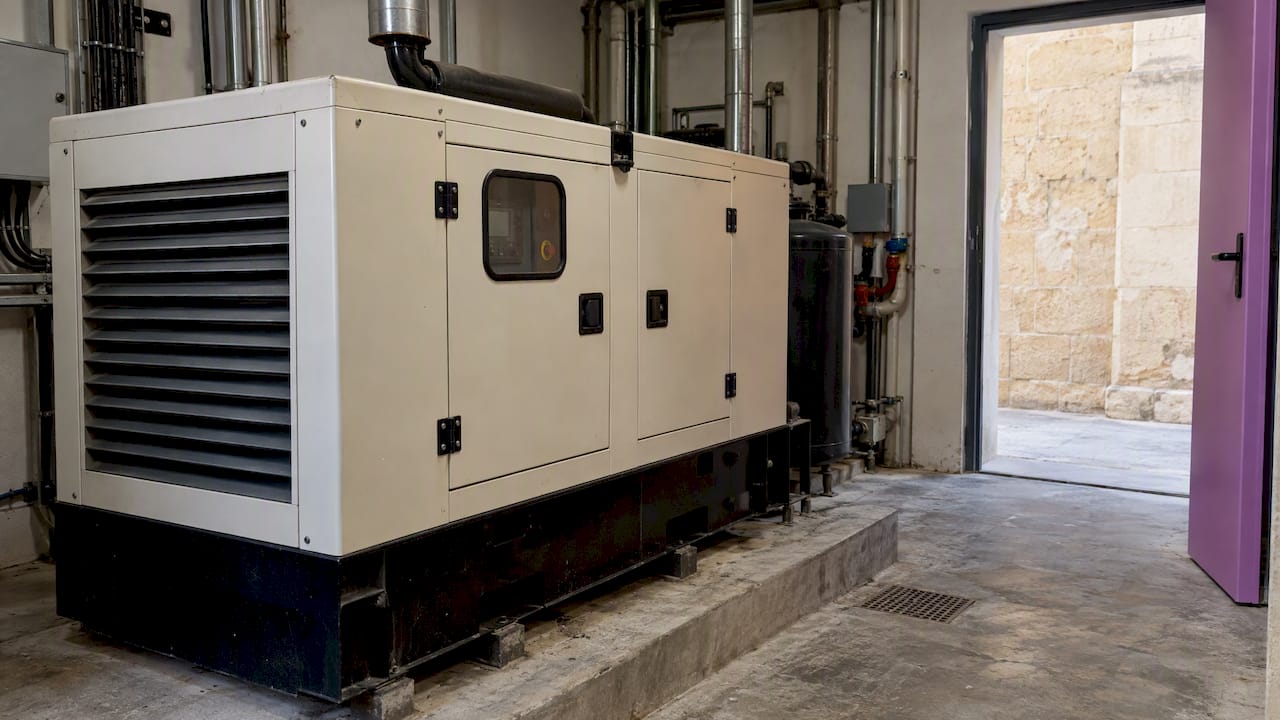
A backup generator in a Malta office building is a standby power system, commonly diesel-powered, designed to supply electricity to selected circuits when the grid fails. Depending on the installation, it may support emergency lighting, essential building services, lifts, communications equipment and designated office circuits. However, actual coverage depends on the generator’s capacity and the building’s electrical distribution system.
Whether you need one depends on how long your business can afford to stop operating. Before signing a lease, confirm who owns the generator, what it powers, how long it can run and who maintains it. A generator listed in an advert is only a starting point.
TL;DR
- Grid failures do happen. On 8 October 2026, power cuts hit large parts of Malta and Gozo shortly after 8am, according to MaltaToday.
- Ask four questions about any building: what the generator covers, how much fuel it holds, whether an automatic transfer switch (ATS) is fitted, and who services it.
- For servers and trading systems, a generator alone is not enough. A UPS bridges the gap while the generator starts.
- If you install your own unit, local retail pricing ranges from approximately €1,500 to over €6,000 for diesel generators with outputs of around 5kW to 16kW. Silent models generally cost more, and installation may be extra.
- We can shortlist Malta offices with backup power and check the details for you.
Table of Contents
- Why office tenants in Malta ask about backup power
- What a building generator should cover
- Autonomy: how long can it actually run?
- Generator, ATS and UPS: three different things
- If you install your own generator
- Keeping the system dependable
- What tenants should verify before signing
- Our view
- Finding offices with backup power in Malta
- FAQ
- Sources
Why office tenants in Malta ask about backup power
Malta is a small island electricity system, and many tenants are international firms: gaming operators, financial services providers and remote-first teams. Their clients expect continuous service. A short outage that a retailer shrugs off can interrupt a payment platform, a live support line or a regulated trading process.
The 8 October 2026 event is a recent example. MaltaToday reported that Enemalta restored supply progressively after an automatic protection system was activated to safeguard the national network. Enemalta subsequently identified human error during circuit-breaker works at the Magħtab Terminal Station as the trigger. For an office, the cause matters less than the effect: staff, phones and systems may stop working for as long as supply is unavailable.
The practical question is therefore not whether a building advertises a generator. It is what that generator keeps alive, and for how long.
What a building generator should cover
Generators in commercial buildings are often sized for shared services first, and tenant loads second. Ask for the answer in writing, because the wording of an advert rarely settles it.
| Item | Questions to ask |
|---|---|
| Common areas | Are corridors, stairwells and emergency lighting on backup? |
| Lifts | Do they run normally, or do they only return to a designated floor? |
| Tenant power | Is your floor on the backed-up circuit, and what load is allocated to you in kW? |
| Air conditioning | Is cooling covered? In summer, an office without it may be difficult to use even with lights on. |
| Connectivity | Is the building’s fibre or telecoms room on backup, and does the provider’s external network have suitable resilience? |
Commercial backup systems often prioritise life-safety equipment and essential building services. Engineering suppliers describe large commercial installations covering selected fire-protection systems, emergency lighting, lifts, climate control and communications, sometimes connected to a building management system.
However, not every office building offers this level of coverage. Some generators only support emergency lighting and common areas, while others provide backup electricity to tenant workstations and essential equipment.
Connectivity also requires attention. Keeping a router powered does not guarantee uninterrupted internet access if equipment elsewhere in the provider’s network loses power. Businesses requiring continuous connectivity should consider a secondary connection using an independent provider or technology.
Use these considerations as a benchmark for what a well-managed office building should explain to prospective tenants.
Autonomy: how long can it actually run?
A generator with a small tank is a short-term fix. Germany’s federal civil protection office (BBK) advises in its guidance on emergency power for businesses and authorities that critical operations should plan for at least 72 hours of autonomy.
That is a German recommendation, not a Maltese legal requirement. It can provide a useful reference for businesses with critical operations, although the appropriate backup duration should depend on each company’s business continuity requirements.
The same guidance stresses that reliability depends on the whole system: fuel supply, filtering and load management, not just the engine.
Many office outages are far shorter than three days, so you may not need that level of autonomy. Nevertheless, ask the landlord:
- What is the tank capacity, and how many hours does it provide at the expected building load?
- Who refuels it, and is there a supply contract?
- When was it last load-tested, and are the test records available?
- Is there a maintenance contract, and what is the response time for a fault?
A retail example shows why. A Simka analysis of supermarkets after a blackout explains that generators are necessary but not always sufficient. Autonomy, fuel management and reliability determine whether a business can continue operating.
The same applies to a trading floor or a support centre.
Generator, ATS and UPS: three different things
Tenants often treat these as one system. They are not.
- Generator: Produces electricity over a longer period but normally needs time to start and stabilise.
- Automatic transfer switch (ATS): Detects a grid failure and automatically transfers the connected electrical load to the generator once suitable backup power is available. Without automatic transfer, manual intervention may be needed, even if the generator starts automatically.
- UPS (uninterruptible power supply): A battery-based system that supplies electricity to sensitive equipment during the gap before the generator takes over.
For IT-heavy offices, a properly sized UPS is essential for maintaining power to sensitive equipment during generator start-up and transfer.
Power-protection engineers at Piller explain the importance of uninterrupted power systems for critical electrical loads. Standard standby generators may not respond quickly enough to prevent sensitive IT equipment from shutting down during the initial moments of an outage.
If your servers are on site, consider a suitable UPS in your own rack or server room, regardless of what the building provides.
If you install your own generator
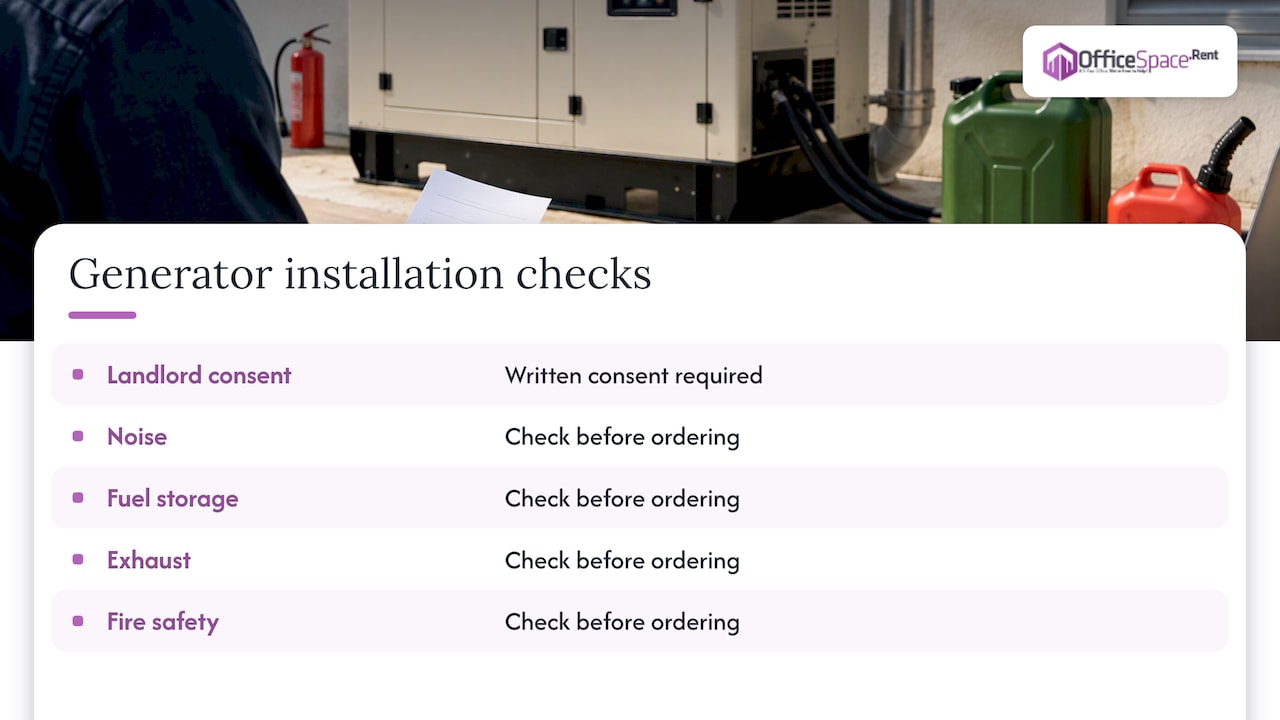
Some tenants add a unit of their own, particularly in small offices or ground-floor premises with outdoor space. You will need the landlord’s written consent, and you should check noise, fuel storage, exhaust and fire-safety implications before ordering anything.
Depending on the installation, you may also need to assess Planning Authority requirements, electrical certification, building restrictions and applicable fire-safety obligations.
A generator must never be operated inside an enclosed office, garage or poorly ventilated space because exhaust fumes can cause dangerous carbon monoxide exposure.
Key checks before installing an office generator
For budgeting, Maltese retailers publish indicative prices. A local diesel generator range includes smaller open-type models from approximately €1,500, with silent 5kW units around €2,000 and 16kW models around €5,800.
Another Maltese supplier lists standby units with an ATS panel, including an 11kW silent three-phase diesel model.
Treat these as indicative retail prices rather than complete installation costs. Automatic transfer equipment, electrical works, certification, fuel and servicing may add to the budget, and prices can change.
Also, a generator sized for a small office will not necessarily run a full floor of air conditioning. Have a qualified electrical professional calculate your essential electrical load before selecting a unit.
Keeping the system dependable
A generator that has never been tested is a hope, not a system. Whether it belongs to the landlord or the tenant, it needs scheduled maintenance, operational checks, appropriate load testing, filter changes and fuel quality checks.
Many property managers outsource this work to specialist facilities contractors.
If you want to see what a structured commercial facilities maintenance scope looks like, that page outlines recurring building-systems services worth discussing with your landlord, although it describes a provider in the United States.
However, a generator starting successfully during a routine test does not necessarily prove that it can support the required building load during an actual power failure.
Ask whether the generator has been tested under a representative electrical load, including the circuits assigned to tenants.
What should tenants verify before signing an office lease with backup power?
Not every Malta office advertised with a backup generator offers the same level of protection. Some buildings provide emergency power to shared facilities only, while others support designated tenant circuits, essential IT equipment and selected air-conditioning systems.
Before signing an office lease, businesses should request written confirmation of the following:
- Generator capacity: The generator’s rated output and the electrical load allocated to the tenant.
- Backup coverage: Whether workstations, lighting, lifts, air conditioning, servers and communications equipment are connected to backup circuits.
- Automatic transfer: Whether an ATS is installed and how long power restoration normally takes.
- Fuel autonomy: The estimated operating hours at the expected building load and the arrangements for refuelling.
- Maintenance records: Evidence of routine servicing, operational testing and load testing.
- UPS compatibility: Whether sensitive IT equipment requires additional battery backup during the transfer period.
- Responsibility for costs: Whether generator maintenance, fuel and repairs are included in service charges or billed separately.
Pro Tip: If backup power is essential to your operations, ask for the agreed level of service and the landlord’s maintenance responsibilities to be documented in the lease. A generator mentioned in a property listing should not be treated as a contractual guarantee of uninterrupted electricity.
Our view
We see backup power treated as a bonus feature, when for many Malta tenants it is an important condition of the lease. Gaming, financial services and support operations often prioritise it, and for good reason.
The mistake we see most often is accepting the word “generator” in a listing without asking what it covers.
Our advice is to request the load allocation, tank autonomy and last test date before you view the unit, and to put any agreed commitments into the lease rather than leaving them in an email.
A building with a modest generator that is tested and maintained may be a safer choice than one with a larger unit that has not been properly serviced or tested.
The important factor is not simply the generator’s size. It is whether the complete backup power system can reliably support the operations your business needs to maintain.
— OfficeSpace.Rent
Finding offices with backup power in Malta
OfficeSpace.Rent provides access to thousands of commercial property listings across Malta, including offices with backup power facilities. Our team can build a shortlist around your power requirements, verify the relevant details with the landlord and help negotiate suitable lease terms.
Start with our office search and negotiation service, try the advanced search filters, or read how the agency fee works.
If you are still weighing districts and budgets, our guide to office space for rent in Malta covers areas, costs and options.
Team size also shapes the power you need, so see offices for 5 to 15 people or for 15 to 30 people.
FAQ
What does a backup generator cost in Malta?
Local retail prices for diesel generators with outputs of approximately 5kW to 16kW range from around €1,500 to over €6,000, depending on capacity and specifications. One Maltese retailer advertises silent 5kW units at approximately €2,000 and 16kW units at around €5,800. Automatic transfer equipment, electrical installation and ongoing servicing may cost extra.
Do supermarkets have backup generators?
Some larger supermarkets use backup generators, particularly to protect refrigerated and frozen stock. Simka’s review of a supermarket blackout explains how spoilage, fuel costs and disposal labour can follow an outage without adequate backup power. Smaller shops may rely on batteries or have no standby generation.
Do hotels typically have backup generators?
Many large hotels have backup power arrangements. Engineering suppliers describe commercial installations that can support selected fire-protection systems, emergency lighting, lifts and climate control, sometimes with dedicated fuel storage. However, actual backup coverage varies between buildings.
What companies make backup generators for data centres?
Data centre systems are specialist projects. Cummins supplies generator systems for data centres, while Piller specialises in critical power protection and UPS technology.
Most Malta offices need a much smaller arrangement, typically involving a suitable building generator, automatic transfer equipment and a UPS for sensitive IT systems.
Sources
- MaltaToday: Power cuts hit large parts of Malta and Gozo on Thursday morning
- BBK: Notstromversorgung in Unternehmen und Behörden
- Simka: Supermärkte nach dem Stromausfall
- Simka: Einkaufszentren und Einzelhandel projects
- Piller Power Systems
- Cummins: Generators for data centres
- Moto Garage Malta: Diesel generators
- CC Technik: Standby generators