Good office acoustics in Malta come from three decisions, made in this order: choosing a unit whose shell suits your noise profile, zoning the layout by activity, and only then specifying absorption and insulation. Panels bought before those steps are often the wrong product in the wrong place. This guide explains the legal noise limits that apply in Maltese workplaces, the reverberation targets designers use, and what to check before you lease.
TL;DR
- Malta’s workplace noise rules set hearing-protection thresholds (80 and 85 dB(A)). They are not comfort standards, and a normal office sits far below them.
- The occupational noise regulations are not an office-comfort standard. For room acoustics, designers may refer to international guidance, including a maximum 0.6-second reverberation time for open-plan offices under German ASR A3.7.
- Separate two problems: echo inside a room (absorption) and sound travelling between rooms (insulation). Panels fix only the first.
- Map who talks, who concentrates and who collaborates before you place a single partition.
- Check ceiling height, floor construction, air conditioning and neighbours during the viewing, not after the fit-out.
Table of Contents
- What the Maltese rules actually cover
- Reverberation targets designers use
- Two different problems: room acoustics and building acoustics
- Plan by activity before you buy anything
- Acoustic checks to make when viewing a Malta office
- When to hire an acoustic consultant
- Our view
- Finding a unit that suits your noise profile
- FAQ
- Sources
What the Maltese rules actually cover
The main legal instrument is the Work Place (Minimum Health and Safety Requirements for the Protection of Workers from Risks resulting from Exposure to Noise) Regulations. Originally numbered S.L. 424.28, they are now S.L. 646.20 under the Health and Safety at Work Act (Cap. 646). The Occupational Health and Safety Authority lists them among current OHS legislation, so cite the newer number in any lease or fit-out documents.
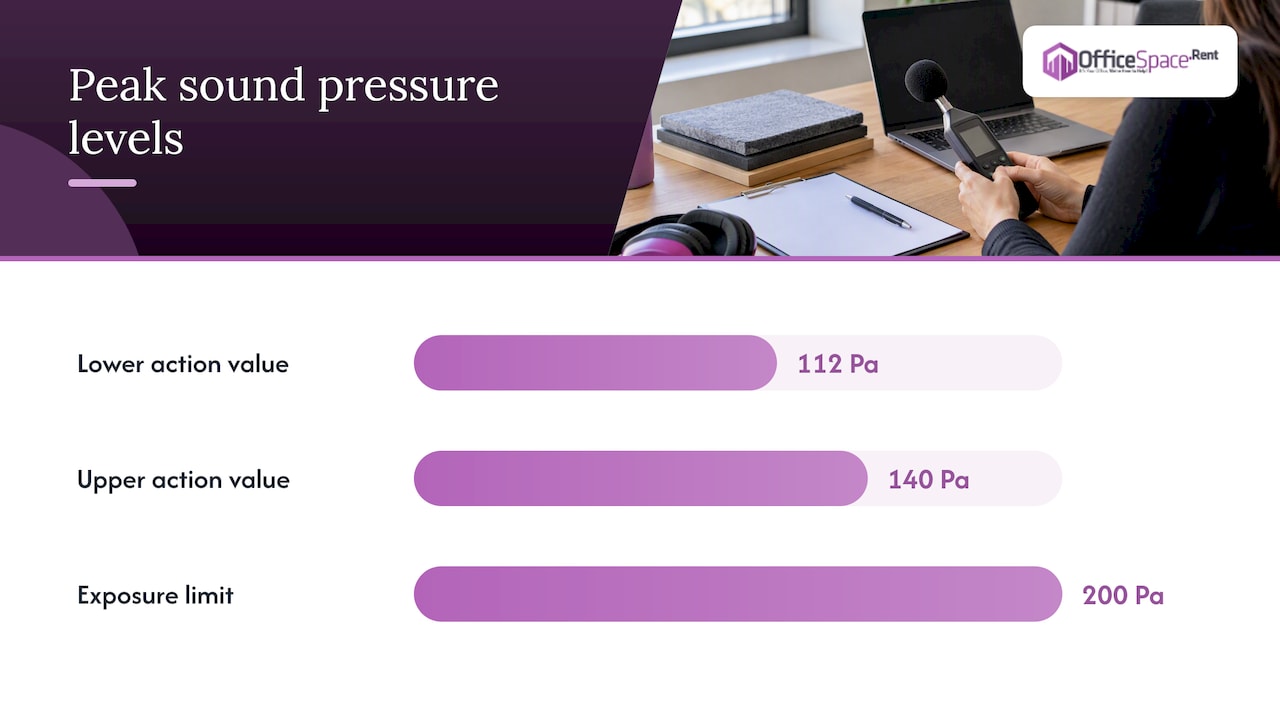
The regulations set three levels:
| Level | Daily exposure | Peak sound pressure |
|---|---|---|
| Lower exposure action value | 80 dB(A) | 112 Pa |
| Upper exposure action value | 85 dB(A) | 140 Pa |
| Exposure limit value | 87 dB(A) | 200 Pa |
Where the applicable exposure thresholds are exceeded, the employer must mark and, where feasible, restrict access to the area. The regulations also expect noise to be reduced at source first, through quieter equipment, maintenance and enclosures, with hearing protection as the fallback. Staff rest facilities must have noise levels compatible with their purpose.
For a typical office, this has a practical meaning. Routine office noise is generally below the occupational hearing-protection action values, but individual exposure should be assessed where headsets, equipment or other significant noise sources are present. Comfort, speech privacy and concentration will. Those are governed by good practice, not by a Maltese statute. Exceptions are call-handling floors with headsets, server rooms, plant rooms and workshops attached to offices, where it is worth measuring.
Reverberation targets designers use
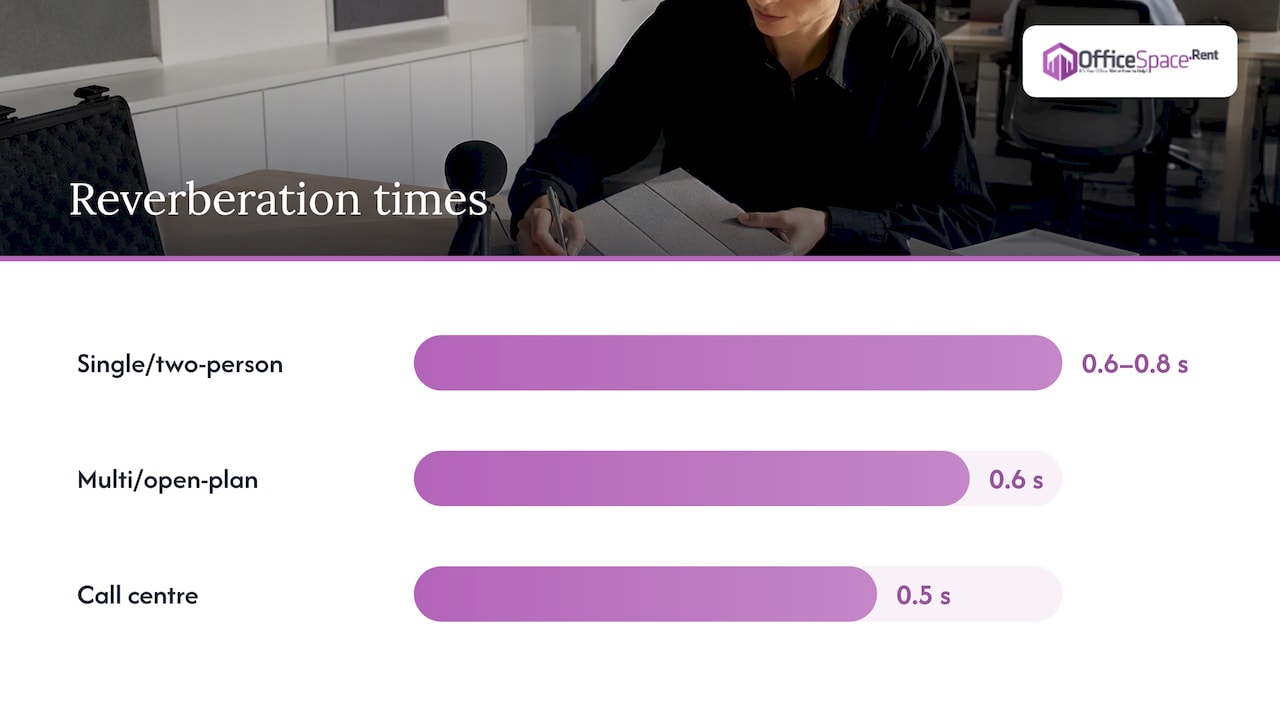
The cited Maltese occupational noise rules do not prescribe office reverberation times. Designers may therefore use relevant international room-acoustics guidance, while checking any project-specific requirements. One widely cited example is Germany’s technical rule ASR A3.7. It specifies maximum reverberation times, measured in the unoccupied room across 250 Hz to 2,000 Hz:
| Space type | Reverberation time (T) |
|---|---|
| Single or two-person office | Maximum 0.8 s |
| Multi-person and open-plan office | Maximum 0.6 s |
| Call centre | Maximum 0.5 s |
Treat these as benchmarks, not Maltese legal requirements. The VDI 2569 guideline, “Sound protection and acoustical design in offices”, is another reference that acoustic consultants use for this type of project. It is available in English.
Ceiling height matters more than most tenants expect. Austrian guidance explains that the move to time-based metrics links requirements more closely to room height. A scheme that works in a standard-height floor plate can fail in a high-ceilinged converted building, which is common in older Maltese townhouse and industrial conversions.
Two different problems: room acoustics and building acoustics
Acousticians separate room acoustics from building acoustics, and the distinction decides where your budget goes.
- Room acoustics concerns echo and how sound spreads inside one space. Ceiling tiles, wall absorbers, carpet, soft furniture and screens address it.
- Building acoustics concerns sound passing between spaces through walls, floors and ducts. Heavier partitions, sealed junctions, full-height walls and damping address it.
The second is the costly one to correct late. Austrian labour inspectorate guidance notes that structure-borne noise, such as footsteps or machine vibration, needs isolation and damping and cannot be fixed with wall or ceiling panels. Absorption reduces echo; it does not stop a neighbour’s meeting reaching your desk.
Plan by activity before you buy anything
German accident-insurance research (IFA) recommends starting with an activity analysis: where people talk, collaborate and concentrate. The layout is then zoned so that high-communication teams are not placed beside focused work.
A workable sequence:
- List activities per team. Phone-heavy sales, quiet analysis, client meetings, video calls, informal collaboration.
- Assign zones. Put noisy teams together and away from focus areas. Place support spaces such as print points and kitchenettes as buffers.
- Choose enclosure types. Full-height meeting rooms for confidential talks, phone booths for calls, open benches for collaborative work.
- Specify finishes last. Absorption is then sized to a measured or modelled need.
This last point is where money is saved. Consultants caution that panels work only when specified and placed against calculated room requirements. Without an evaluation, a business can overspend on material and still miss its reverberation target.
Acoustic checks to make when viewing a Malta office
A viewing is the cheapest moment to find acoustic problems. Listen for echo, background noise and sound transmission, then check:
- Ceiling height and finish. Exposed concrete soffits and tall ceilings produce long reverberation. Suspended ceilings help, but check the void for sound leaking over partitions.
- Floor and slab. Hard floors raise impact and echo. Ask what lies above and below.
- Party walls. Ask what the neighbouring tenants do, and whether walls run to the slab or stop at the ceiling.
- Air conditioning. Split units and ducted systems each add background noise and can carry speech between rooms. You can explore offices advertised with air conditioning, but you should still hear the system running.
- Glazing and street noise. Busy areas such as Sliema, St Julian’s and Msida bring traffic, so test with windows closed.
- Fit-out rights. Confirm in the lease whether you may add partitions, ceilings or floor finishes, and what must be reinstated at exit.
Different formats start from different places. A serviced or plug-and-play office arrives with partitions and finishes already chosen, so test what is there. A shell unit lets you design the acoustics from zero, which costs more but gives control. A furnished or open-plan office may sit in between, depending on its existing finishes.
Headcount shapes the problem too. A smaller team may benefit from a quiet room or call booth, depending on its activities; our pages for offices for 5 to 15 people and offices for 15 to 30 people show how floor areas typically scale. Above that size, zoning becomes essential.
When to hire an acoustic consultant
Bring one in when any of these apply: the unit has a high ceiling or an industrial shell, you handle confidential conversations such as legal, financial or HR work, you run a call floor, or you share walls with a noisy neighbour. Specialist acoustic consultants can provide noise and vibration assessments, and an early acoustic assessment can help avoid expensive rework after the fit-out. We list no consultant fees, as we do not sell acoustic services.
Our view
Most acoustic complaints we see described in the market trace back to selection and layout, not to a lack of panels. Tenants often choose a unit on rent, location and appearance, then discover the noise profile after the fit-out. Our view is simple: ask acoustic questions during the search, not the build. Check ceiling height, party walls and air conditioning at the viewing, tell the agent which teams are phone-heavy, and keep fit-out rights in the lease negotiation. A unit with a slightly higher rent but suitable existing acoustic conditions may cost less overall than one requiring extensive corrective work.
— OfficeSpace.Rent
Finding a unit that suits your noise profile
We list offices across Malta and can shortlist units against your headcount, location and fit-out needs, including the acoustic points above. Start with the advanced search filters, or use our desk-based office search if you want us to verify and shortlist for you. Details of how our fee works are on the agency fee page.
FAQ
Are there legal acoustic standards for offices in Malta?
Malta’s noise regulations, now S.L. 646.20, set exposure thresholds of 80 and 85 dB(A) to protect hearing. They do not set comfort or speech-privacy targets for ordinary offices. For those, consultants usually apply European guidance such as ASR A3.7 or VDI 2569.
What reverberation time should an open-plan office aim for?
German guidance ASR A3.7 recommends 0.6 seconds for multi-person and open-plan offices, and 0.5 seconds for call centres. These are benchmarks, not Maltese law. A consultant can confirm what is achievable in your specific unit.
Are acoustic panels enough on their own?
No. Panels reduce echo inside a room but do little to stop sound passing between rooms or structure-borne noise. A sound plan combines absorption, insulation and sensible zoning.
Should I ask the landlord about acoustics before signing?
Yes. Ask about ceiling construction, party walls, air-conditioning noise and whether you may add partitions or ceilings. Agree any permitted works and reinstatement duties in writing before you sign.
Note: International acoustic design benchmarks are provided for guidance and are not presented as mandatory Maltese office comfort standards. Specific workplace risks and fit-out requirements should be assessed by competent professionals.
Sources
- Current noise regulations, S.L. 646.20 (legislation.mt)
- OHSA Malta, legislation list
- ASR A3.7, room acoustic requirements
- VDI 2569, acoustical design in offices
- IFA, acoustics in multi-person offices
- Sichere Arbeit, room acoustics at work
- Arbeitsinspektion, room acoustics measures