
A change of use to Class 4A in Malta does not always require a full planning application. Changing a lawfully authorised Class 4B shop, Class 4C café or Class 4D restaurant to an office can qualify for the prior-notification procedure under the Development Planning (Use Classes) Order. Continuing an existing lawful Class 4A office use generally does not require a fresh development permit. Other conversions, including a flat to a standalone office, normally require separate planning assessment. This guide explains the main routes, documents, costs and checks before signing a lease.
TL;DR
- Class 4A covers financial, professional and other offices under the Development Planning (Use Classes) Order, S.L. 552.15.
- Changing from Class 4B, 4C or 4D to 4A requires prior notification. Same-class moves generally do not require a permit, subject to the Order’s exceptions.
- A notification needs the Authority’s form, a declaration of title, three sets of plans and elevations, and two colour site photographs. The fee is €250.
- The Planning Authority has 30 days after validating a complete notification to advise in writing if a development permit is required. Its written response, any applicable conditions and the Order’s exceptions must still be checked.
- Check the premises’ permitted use before you sign a lease, not after.
Table of Contents
- What Class 4A means
- How 4A differs from the neighbouring commercial classes
- When you need a permit and when notification is enough
- The notification procedure step by step
- Checks before you sign a lease
- What happens if you occupy without approval
- Our perspective
- Find an office with the right use already in place
- FAQ
- Sources
What Class 4A means
Malta groups land uses into classes that share similar impacts on neighbours and the surrounding area. The Planning Authority describes use classes as groupings of uses with similar amenity impacts, with separate treatment for uses that have unique impacts.
Class 4A is titled “Financial, Professional and Other Offices”. Under S.L. 552.15 of 2014, it covers financial services and professional services such as doctors, lawyers and dentists, plus comparable office functions. The same Use Classes Order places Class 4A and Class 4B in Category D, Commercial Uses.
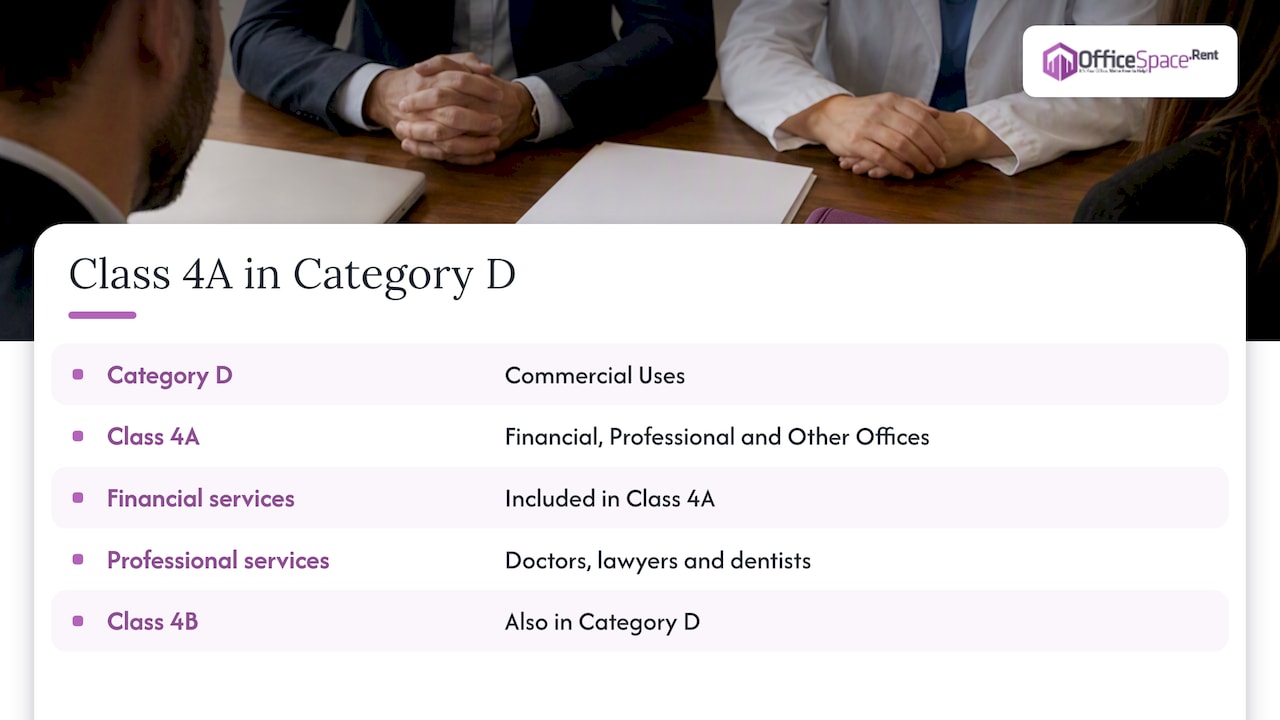
This matters because a lease can describe a unit as an “office” while its permit says something else. The planning class on the permit, not the marketing description, decides what you may lawfully do inside.
Important distinction: although Class 4A expressly mentions professional services provided by doctors and dentists, the same Order lists medical clinics under Class 2A. A perit should check the precise activity and approved use rather than assume all clinical premises fall under Class 4A.
How 4A differs from the neighbouring commercial classes
Category D contains four classes. The table summarises them as defined in the Order.
| Class | Use | Route into Class 4A |
|---|---|---|
| 4A | Financial, professional and other offices | Same-class moves generally need no permit |
| 4B | Retail outlets or display of goods for sale, excluding motor vehicles | Prior notification |
| 4C | Food and drink establishments where cooking is not allowed | Prior notification |
| 4D | Food and drink establishments where cooking is allowed | Prior notification |
The practical reading: a ground-floor shop or café can become an office through a lighter procedure than a full permit. The reverse direction is different. Published Planning Authority notices show applicants applying for full change of use from Class 4A office to Class 4B shop, or to a Class 2A medical clinic, so do not assume that leaving 4A is as simple as entering it.
When you need a permit and when notification is enough
Three situations cover most cases.
- Office to office (4A to 4A). Under the Order, a move within the same class is not development and does not need a development permit, subject to the Order’s exceptions. A new tenant taking over a lawful Class 4A office usually falls here.
- Shop, café or restaurant to office (4B, 4C or 4D to 4A). This is permitted development only through prior notification.
- Other conversions. Residential-to-office and industrial-to-office changes generally require a development permit or separate planning assessment. Limited home-based professional activities may qualify under the specific Class 1(d) conditions, but that is not the same as converting a dwelling into a standalone office.
External works are a separate question. A change of use that also alters a facade, adds signage or changes openings may need its own approval, and notices published by the Authority often combine use change with alterations or sanctioning of works “as built”.
The notification procedure step by step
- Confirm the lawful use. Obtain the existing permit or planning history for the premises and check which class it is in.
- Instruct a warranted perit (architect). The Order identifies a perit in charge and requires appropriate drawings. Have the perit verify the current procedure and any additional approvals before submitting.
- Prepare the file. Under S.L. 552.15, the notification must use the Authority’s form and include a declaration of title, three copies of the necessary plans and elevations, and two good-quality colour photographs of the site.
- Pay the fee. The Order sets a €250 notification fee.
- Wait for the 30-day window. The Authority has 30 days after validation to notify you that development permission is required. If it does, you proceed with a full application.
- Observe the one-year validity. Under the Order, the confirmation of permitted development, or the expiry of the 30-day period where applicable, starts a one-calendar-year validity period within which the change must be carried out.
Budget the architect’s fees separately from the Authority fee. They vary by the size and complexity of the premises, and we do not publish a figure because it depends on the professional you instruct.
Checks before you sign a lease
The most expensive mistakes happen before the notification, at the lease stage. Before committing, ask for:
- The permit or planning notice showing the lawful use of the exact unit, not just the building.
- Confirmation that any alterations carried out by the previous occupier were approved or sanctioned.
- A clause in the lease placing responsibility for the change of use on the landlord, or making the lease conditional on its outcome.
- Check your actual activity against the approved use: a medical clinic, call centre, customer-facing showroom and co-working space may raise different planning questions. In particular, medical clinics are also expressly listed under Class 2A, so a professional’s office should not automatically be treated as approval for every clinical use.
Our Class 4A office permit guide goes through the documents and typical questions in more detail. For the wider picture of lease types, including serviced and plug-and-play options that usually come with the right use already in place, read the Malta office market guide.
What happens if you occupy without approval
Using premises as an office without the required planning approval gives the Planning Authority the legal right to stop the activity and pursue enforcement under the Development Planning Act. For a business, the consequences are practical as well as legal: interrupted operations, difficulty in dealing with licensing bodies or insurers, and a weaker position if you later sublet or assign the lease. A tenant who relied on the landlord’s assurance and never saw the permit carries much of that risk.
Our perspective
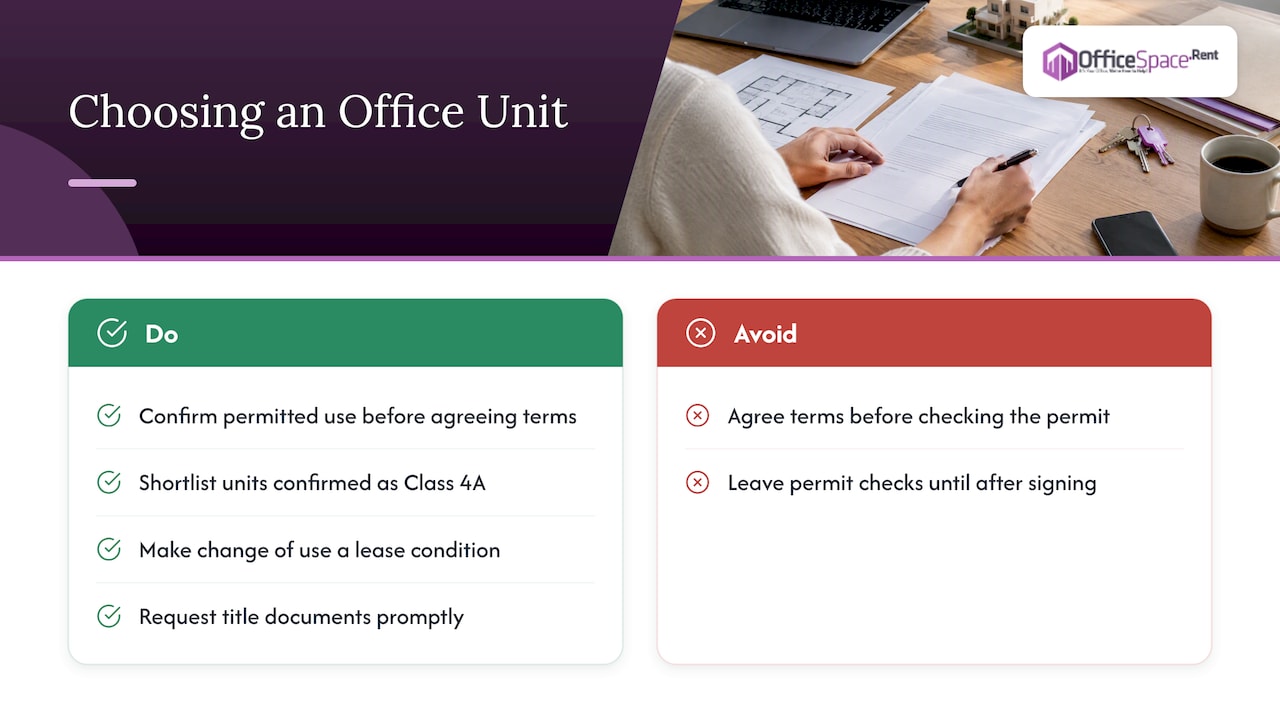
Most change-of-use problems we see are not about the rules, which are short, but about timing. Tenants fall in love with a unit, agree terms and only then ask whether the permit matches their activity. By that point the 30-day notification window, the architect’s drawings and the landlord’s cooperation all sit on the critical path to the move-in date.
Our advice is to reverse the order. Shortlist units whose permitted use is already confirmed as Class 4A, and treat a unit needing notification as a deliberate trade-off: usually a better location or rent in exchange for a few weeks of process. Where a change of use is unavoidable, it should be written into the lease as a condition, with the landlord supplying title documents promptly. Reviewing planning documents is an important part of preparing a shortlist, and we would rather remove an unsuitable unit early than let a client discover the issue after signing.
— OfficeSpace.Rent
Find an office with the right use already in place
If you would rather not manage the planning risk yourself, our office search, verification and negotiation service shortlists units against your activity and helps you request and review the relevant planning documents before you commit. If you want to review the market first, the desk-based office search gives you a curated list without site visits, and the agency fee page explains how our fee works. Browsing the platform is free; review the agency-fee page for any applicable transaction charges.
FAQ
Do I need a permit to move into an existing office in Malta?
Generally not, if the premises are lawfully Class 4A and you will also use them as an office. A move within the same class is not development under the Use Classes Order, subject to its exceptions. You should still see the permit to confirm the class.
How much does a Class 4A change of use notification cost?
The Order sets a notification fee of €250. Separate costs include your architect’s fees for plans and elevations, and these depend on the premises and the professional you appoint.
How long does the process take?
The Planning Authority has 30 days after validation to tell you that development permission is required. If it does not, the change proceeds by notification. Preparing the plans and documents beforehand adds time, so plan for it before your lease start date.
Can a shop or restaurant become an office?
Yes. Changes from Class 4B, 4C or 4D to Class 4A are permitted through prior notification rather than a full permit application. Check the premises’ permit first, and whether any external alterations need separate approval.
Sources
- Development Planning (Use Classes) Order, S.L. 552.15, legislation.mt
- Use Classes Order, L.N. 74 of 2014
- Planning Authority: Commercial and Development
- Planning Authority: Do I need a permit?