TL;DR:
- Malta’s low unemployment rate of 3.2% creates a highly competitive labor market demanding strategic talent planning.
- Skills shortages and structural mismatches mean companies must carefully select office locations and hiring methods to attract qualified professionals.
Malta’s unemployment rate stood at 3.2% in 2024, making it one of the tightest labour markets in the EU. For business leaders and HR managers looking to establish or grow operations on the island, this figure is both encouraging and sobering. If you are interested in hiring talent, location insights for Malta can be especially valuable. A healthy economy means a commercially active workforce, but it also means fierce competition for skilled professionals. Deciding where to locate your office and how to structure your hiring strategy are not independent decisions. In Malta’s current environment, they must be planned in tandem.
Table of Contents
- Understanding Malta’s labour market and talent supply
- Talent location insights: Where and how to hire in Malta
- Hiring models and compliance: What you need to know
- Latest hiring trends: What’s changing in 2026
- Our perspective: Balancing talent location and office strategy for lasting success
- Find the right office for your talent strategy in Malta
- Frequently asked questions
Key Takeaways
| Point | Details |
|---|---|
| Tight labour market | Malta’s low unemployment rate and high skill demand make competition for talent intense. |
| Rely on international talent | A significant portion of Malta’s workforce comes from abroad, requiring smart location and permit strategies. |
| EOR and compliance speed hiring | Employer of Record solutions allow rapid, compliant onboarding in 1–2 weeks. |
| Office location impacts hiring | Central, accessible offices help attract both local and international talent. |
| Flexible, skills-based hiring | Leveraging hybrid work and focusing on skills, not just credentials, can widen your talent pool. |
Understanding Malta’s labour market and talent supply
Malta’s economy has grown steadily, and employment has followed. However, quantity does not equal availability. Employment growth is forecast at 1.8 to 2.1% per annum to 2035, with 47% of job openings requiring medium-level skills and 53% requiring high skills. Shortages are already visible in skilled manual work, elementary occupations, agriculture, and health associate roles.
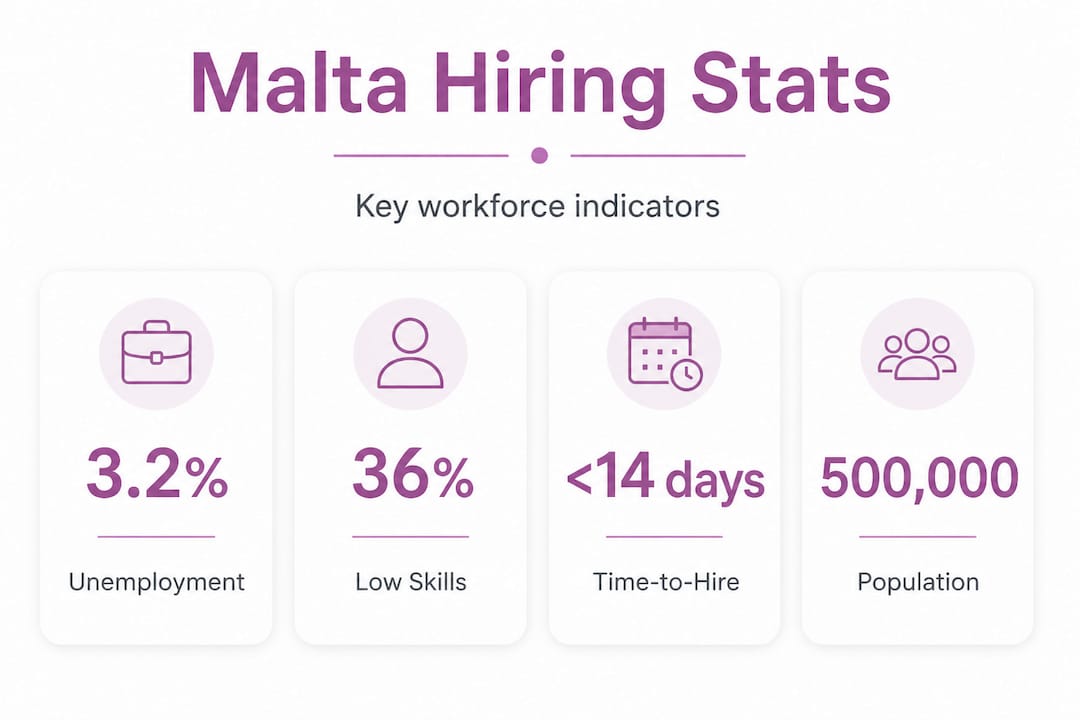
The skills gap is compounded by a structural challenge: 36% of Maltese adults have low foundational skills, compared to the EU average of 25%. Skills mismatches persist across sectors, which means even when candidates are available, they do not always meet the requirements of growing industries such as iGaming, fintech, and technology services.
Key labour market indicators at a glance:
| Indicator | Malta (2024) | EU Average |
|---|---|---|
| Unemployment rate | 3.2% | ~6.0% |
| Adults with low skills | 36% | 25% |
| Forecast employment growth (to 2035) | 1.8–2.1% pa | Varies |
| Job openings requiring high skills | 53% | Varies |
The Maltese government has responded with a National Skills Strategy for 2026 to 2035, which prioritises coordination across education and industry, lifelong learning, and training in digital and sustainability competencies. This is a positive long-term signal, but the benefits will take years to materialise fully.
For companies planning office space today, the practical implication is clear. You cannot assume local talent will fill your roles quickly. Understanding Malta office market trends in relation to your workforce needs is a foundational part of any location decision.
The labour market data signals one important truth: businesses that plan their talent supply chain in advance, rather than hiring reactively, will outperform those that do not.
Talent location insights: Where and how to hire in Malta
Malta’s total population is approximately 500,000, which places a hard ceiling on the local talent pool. Foreign nationals currently make up 28% of the workforce, a proportion that reflects both the island’s openness to international talent and the practical necessity of drawing skills from abroad. However, concerns around overpopulation and infrastructure strain have prompted caution around non-EU inflows, adding a policy dimension to hiring decisions.
For EU nationals, free movement means recruitment is relatively straightforward. For non-EU candidates, the employer must sponsor the work permit, demonstrate that no suitable local or EU candidate was available, and comply with regulatory timelines. Digital nomad permits provide a third route for remote or location-independent roles, offering flexibility that suits certain tech and creative positions.
Comparing talent sourcing channels in Malta:
| Talent source | Speed | Regulatory complexity | Best for |
|---|---|---|---|
| Local Maltese candidates | Moderate | Low | Customer-facing, local market roles |
| EU nationals | Fast | Low | Technical, professional, managerial |
| Non-EU nationals | Slower | High | Specialist, hard-to-fill roles |
| Digital nomads (remote) | Fast | Low | Tech, creative, project-based |
Office location plays a direct role in talent access. Malta’s office locations vary considerably in terms of transport connectivity, amenity quality, and proximity to residential hubs. Central business districts such as Sliema, St Julian’s, and Mriehel consistently attract the highest concentration of working-age professionals, both local and international. If your target talent pool includes experienced professionals accustomed to European urban environments, locating your office in a well-serviced, accessible district significantly increases your appeal as an employer.

Hybrid and remote working readiness is no longer optional. Offices that are configured to support video conferencing, flexible desk arrangements, and cross-border team collaboration are increasingly what skilled candidates expect. When building a talent strategy for Malta, your workspace infrastructure is part of your employer brand.
Pro Tip: When shortlisting office locations, map your target candidate pool’s residential areas against commute times. In a small island with persistent traffic congestion, a 15-minute commute difference can be the deciding factor for a senior hire.
Hiring models and compliance: What you need to know
Once you have identified where to source talent and where to locate your office, the next question is how to structure the employment relationship. Malta’s employment law is comprehensive, and non-compliance carries meaningful risk.
The four key steps to compliant hiring in Malta:
- Choose your hiring model. Direct employment, Employer of Record (EOR), or contractor engagement each carry different obligations. EOR enables compliant hiring within one to two weeks, without requiring you to establish a local entity, which is considerably faster and lower in cost than setting up a Maltese company from scratch.
- Issue a written contract within 8 days. Maltese law requires employment contracts to be in writing and signed within eight days of the start date, detailing role, remuneration, working hours, and notice terms.
- Understand probation rules. Standard probation is six months. For high earners and managerial roles, this extends to 12 months. Probation periods cannot be unilaterally extended by the employer once set.
- Know your redundancy obligations. Malta follows a last-in-first-out (LIFO) principle for redundancy decisions. Misclassification of workers is assessed against an eight-criteria test, and the burden of proving non-discrimination shifts to the employer in contested cases.
Misclassifying an employee as a contractor is one of the most common and costly mistakes international firms make when entering Malta. The legal consequences extend well beyond back-pay obligations.
Integrating compliance planning with office setup is practical and efficient. Companies that handle both simultaneously, rather than treating them as separate workstreams, move faster and encounter fewer operational disruptions. Using transparent hiring workflows from the outset also reduces legal exposure and strengthens your employer brand during the recruitment process.
When you are ready to establish a physical presence, renting office space in Malta is well-supported by the local commercial property market, with options ranging from serviced offices for early-stage operations to larger, long-term leases for established teams.
Latest hiring trends: What’s changing in 2026
The Maltese recruitment market is not static. Several trends are reshaping how companies attract and assess candidates in 2026, and they have direct implications for your location and workspace decisions.
Current recruitment trends in Malta include:
- AI-powered recruitment tools are reducing screening time and enabling faster shortlisting, contributing to the expectation that time-to-hire should be under 14 days.
- Skills-based hiring is replacing credential-led selection for many roles, particularly in tech and fintech, where demonstrable ability outweighs formal qualifications.
- Flexibility and wellness benefits are now baseline expectations for mid-to-senior candidates. Offices without ergonomic environments, quiet zones, or wellbeing facilities face a competitive disadvantage.
- DEI (Diversity, Equity, and Inclusion) commitments and pay transparency are increasingly expected. Candidates actively scrutinise company culture before accepting offers.
- Hybrid workspace demand continues to grow, placing pressure on businesses to offer both a compelling physical office and a credible remote-working infrastructure.
📊 Key stat: Time-to-hire expectations in Malta have compressed to under 14 days for competitive roles, meaning slow recruitment processes directly result in losing candidates to faster-moving competitors.
For companies considering relocating an office or opening a new site in Malta, these trends reinforce the need to choose a workspace that communicates cultural values, supports flexible working, and is located where talent wants to be.
Our perspective: Balancing talent location and office strategy for lasting success
Most firms entering Malta focus first on cost. Rent per square metre, fit-out budget, and employment taxes dominate the initial planning. These are legitimate concerns, but they consistently overshadow a more consequential variable: how visible and credible your physical presence is to the talent pool you need.
A well-located, well-designed office is not an overhead line. It is a recruitment asset. In a market as small and interconnected as Malta’s, professional communities are tight. Where you set up, and what that office communicates about your organisation, travels through networks faster than any job advert will.
The companies that struggle most are those that separate their office decision from their talent strategy. They find cheap space in an out-of-the-way location, then wonder why senior candidates decline offers or leave after six months. The workspace experience directly shapes retention. This is not speculation; it is a pattern visible across firms setting up in Malta across industries.
Our advice: treat your office specification as a hiring document. What does the location say about your investment in employee experience? Does the layout support the hybrid model your candidates expect? Can you point to it as evidence of your employer brand? Companies that answer yes to these questions are consistently better at attracting and retaining the talent that Malta’s tight market makes so hard to find.
Find the right office for your talent strategy in Malta
OfficeSpace.Rent provides Malta’s most detailed commercial property listings, structured specifically to support businesses making location decisions that affect both operations and talent attraction. Whether you are considering a Mriehel commercial lease in one of Malta’s most active business districts, or exploring a St Paul’s commercial property with strong connectivity and local amenity, the platform connects you directly with vetted options that match your headcount, growth trajectory, and budget. Explore current listings, use market pricing data to inform your negotiations, and engage local agents with direct knowledge of how each district performs for talent-dependent businesses.
Frequently asked questions on Hiring Talent Location & Insights
What are the main skill shortages in Malta?
Malta faces shortages in skilled manual and high-skill roles, including elementary occupations, health associates, agriculture, and technology-intensive positions across fintech and iGaming.
How long does it take to hire an employee in Malta?
Using an EOR, compliant hiring takes one to two weeks; time-to-hire under 14 days is now the market expectation for competitive roles.
What work permit options exist for international hires in Malta?
EU nationals have free movement rights; non-EU workers require employer sponsorship and proof that no local or EU candidate was available, while digital nomad permits cover remote-based roles.
Is remote or hybrid work common in Malta?
Hybrid and remote models are growing rapidly, and candidates increasingly expect offices to be equipped for flexible working arrangements that support both in-person and distributed teams.