
TL;DR:
- Malta offers a well-structured, accessible redomiciliation process suitable for SMEs, startups, and professional services. Companies can transfer their legal identity to Malta without dissolution if they meet jurisdictional and regulatory criteria, subject to creditor opposition periods. Securing compliant office premises with proper permits is essential for registration, operational legality, and smooth relocation.
Many foreign businesses assume that relocating a company to Malta is a process reserved for multinationals with dedicated legal teams and substantial resources. That assumption is wrong. Malta’s regulatory framework is structured, accessible, and well-suited to SMEs, fintech startups, and professional services firms alike. This guide is one of the most comprehensive relocation guides for foreign companies to Malta and walks you through every critical stage of the process: from understanding Malta’s redomiciliation mechanism and satisfying legal registration requirements, to selecting compliant office premises and navigating the current rental market. Whether you are exploring Malta for the first time or already committed to the move, the following steps will give you a clear, practical roadmap.
Table of Contents
- Understanding Malta’s company relocation process
- Key legal and regulatory requirements
- Choosing and securing compliant office premises
- Malta’s office rental market: Trends and practical options
- Why relocation success in Malta depends on asking the right questions
- Take the next step: Secure your Maltese office
- Frequently asked questions
Key Takeaways
| Point | Details |
|---|---|
| Eligibility matters | Not all foreign companies or jurisdictions qualify for Malta relocation; check requirements first. |
| Stepwise legal process | Company redomiciliation follows a set regulatory order with creditor protections and required public notices. |
| Office compliance essential | Premises must have Class 4A planning approval before being used for business activity. |
| Market insights help | Understanding Malta’s office rental market trends and areas supports better decision-making for office selection. |
| Expert support streamlines move | Working with local specialists reduces risk and ensures smooth legal and property transitions. |
Understanding Malta’s company relocation process
Malta provides a formal mechanism that allows an eligible foreign-registered company to transfer its registered domicile to Malta without dissolving the original entity. This is known as redomiciliation, or company continuation, and it operates under the Continuation of Companies Regulations administered by the Malta Business Registry. The key advantage is continuity: the company retains its legal identity, contracts, assets, and liabilities throughout the transfer.
Not every company qualifies. Eligibility depends on the company’s home jurisdiction and whether that jurisdiction permits outward continuation. Some jurisdictions do not allow companies to leave without dissolution, which makes redomiciliation impossible. In those cases, the alternative is to incorporate a fresh Maltese entity and migrate operations across.
Eligibility considerations include:
- The home country must legally permit outward redomiciliation
- The company type must be broadly equivalent to a Maltese limited liability company
- The company must not be in liquidation, insolvency, or subject to court-ordered restrictions
- All regulatory obligations in the home jurisdiction must be satisfied before departure
Once eligibility is confirmed, the Malta Business Registry requires a public notice to be published. Creditors then have a three-month opposition window during which they may file a sworn application in court to oppose the continuation. This creditor protection period is a key reason why the process takes several months to complete.
| Feature | Redomiciliation | Fresh incorporation |
|---|---|---|
| Legal continuity | ✅ Retained | ❌ New entity |
| Contracts and IP | ✅ Transferred automatically | ❌ Must be reassigned |
| Timeline | Longer (creditor window) | Shorter |
| Home jurisdiction dependency | High | None |
| Complexity | Higher | Lower |
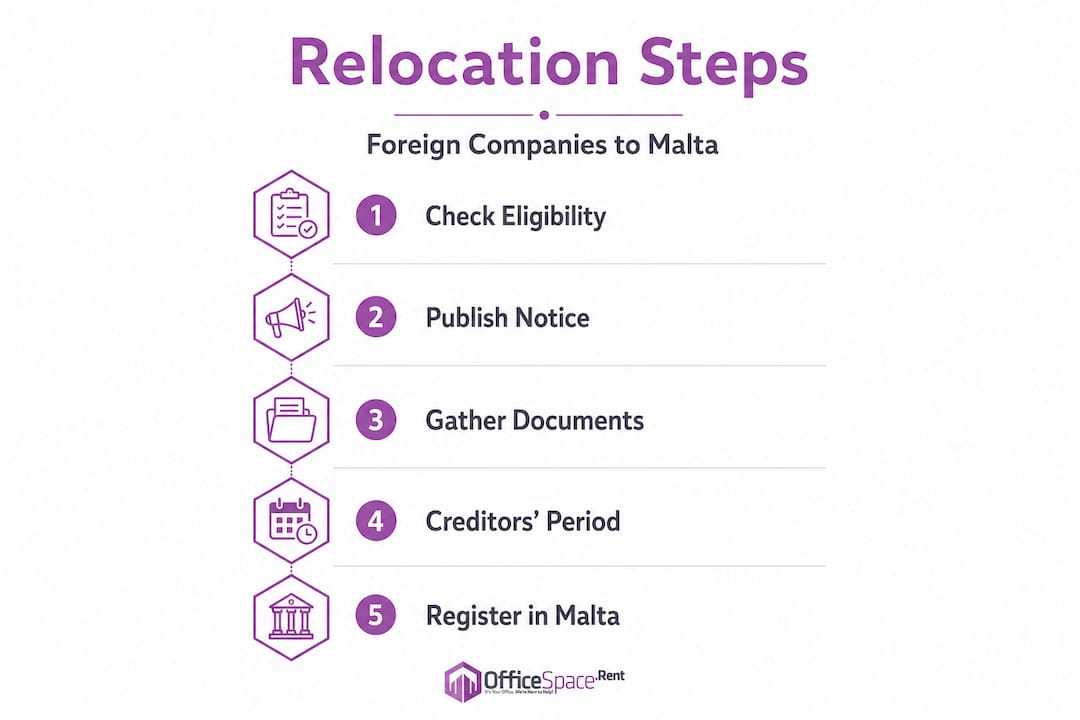
For businesses that want a faster start, fresh incorporation is often the more practical route. For those with significant contractual obligations or intellectual property tied to the existing entity, redomiciliation preserves far more value. Review our strategic relocation guide to assess which path fits your structure.
Pro Tip: Engage a Maltese corporate lawyer before initiating any redomiciliation steps. The home jurisdiction’s legal requirements can vary significantly and may affect your timeline.
Key legal and regulatory requirements
Once you know which path applies, the legal registration journey follows a defined sequence. Company registration steps in Malta include company name reservation, preparation of the Memorandum and Articles of Association, and formal submission to the Malta Business Registry. Much of this can now be handled online, which reduces delays for foreign applicants.
The core registration steps are as follows:
- Reserve the company name with the Malta Business Registry to confirm availability
- Draft the Memorandum and Articles of Association in accordance with Maltese company law
- Prepare due diligence documentation for all directors and shareholders (passport copies, proof of address, source of funds declarations)
- Submit AML and KYC documentation as required under Maltese anti-money laundering regulations
- Register a Maltese office address as a formal legal requirement for the company’s registered seat
- Confirm share capital details and deposit requirements based on company type
- Receive the Certificate of Registration from the Malta Business Registry
The AML and KYC requirements deserve particular attention. Malta operates under EU-level anti-money laundering directives, and the documentation threshold is high. Directors and beneficial owners must provide certified identification documents, proof of residential address, and in many cases a declaration of the source of funds used to capitalise the company.
| Document | Who provides it | Purpose |
|---|---|---|
| Certified passport copy | All directors and shareholders | Identity verification |
| Proof of address (utility bill or bank statement) | All directors and shareholders | Residency confirmation |
| Source of funds declaration | Beneficial owners | AML compliance |
| Memorandum and Articles of Association | Company / legal counsel | Constitutional document |
| Registered office confirmation | Maltese service provider or landlord | Legal seat requirement |
Understanding Class 4A permit requirements is also relevant at this stage, since the registered office address must be a premises legally authorised for office use. A residential address or an unlicensed space will not satisfy this requirement.
Pro Tip: Use a licensed Maltese company service provider to handle document certification and submission. This reduces the risk of rejection due to incomplete or non-compliant paperwork.
Choosing and securing compliant office premises
With company formation underway, your physical presence in Malta becomes a critical compliance matter. The premises you choose must carry the correct planning authorisation before you can legally operate as an office. In Malta, this is the Class 4A use permit, issued by the Planning Authority. Without it, a premises cannot function as a commercial office regardless of how it is marketed or presented.
Key factors to evaluate when selecting office premises:
- 🟢 Planning status: Confirm the Class 4A permit is current and valid before signing any lease
- 🟡 Location: Proximity to transport links, banking facilities, and client-facing accessibility
- 🟡 Utilities and infrastructure: Reliable broadband, air conditioning, and building management services
- 🔵 Size and scalability: Floor plate that accommodates your current headcount with room to grow
- 🔵 Lease flexibility: Break clauses and renewal options suited to a company in its early Maltese phase
Popular office districts for international firms include Valletta (prestige address, limited supply), Sliema and St Julian’s (high demand, strong amenities), Mriehel (purpose-built commercial park, competitive pricing), and Birkirkara (central location, mid-range pricing). Each district carries different rental levels, vacancy rates, and lease structures.
For a thorough overview of what to look for, the complete office guide covers building grades, planning classifications, and district comparisons in detail. You can also review office permit guidance to understand exactly what the Class 4A classification entails and how to verify a property’s status before committing.

Pro Tip: Never sign a lease before confirming the premises holds a valid Class 4A permit. Request the permit documentation directly from the landlord and cross-reference with the Planning Authority’s online records.
Malta’s office rental market: Trends and practical options
Understanding the compliance framework is one part of the equation. Knowing what the market actually looks like in 2026 is equally important for budgeting and decision-making. Demand for compliant Maltese office space has risen steadily as more international firms establish a registered Maltese presence, creating upward pressure on Grade A rental rates across the island’s prime districts.
| District | Typical yearly rate (per sq m) | Grade | Availability |
|---|---|---|---|
| Valletta | €200 to €350 | Grade A | Limited |
| Sliema / St Julian’s | €250 to €500 | Grade A/B | Moderate |
| Mriehel | €180 to €350 | Grade A | Good |
| Birkirkara | €160 to €190 | Grade B | Good |
| Qormi / Luqa | €140 to €180 | Grade B | High |
Market note: Grade A office rents in Valletta and Sliema have seen consistent upward movement in 2025 and into 2026, driven by demand from financial services, iGaming, and technology firms establishing EU-facing operations in Malta.
Lease terms for incoming international companies typically range from one to five years. Shorter leases with break clauses are increasingly available in serviced office formats, which suit companies that want to establish a presence quickly without committing to long-term fixed costs. Fully serviced offices also reduce the burden of fit-out expenditure, which can be substantial for raw shell spaces.
For current pricing data, the office pricing trends report provides district-level analysis updated for 2026. If you are comparing lease structures, the rental pricing insights breakdown covers costs, hidden charges, and what to negotiate. The benefits of relocating to Malta as a business hub are also well-documented for those still weighing the decision. For a full leasing walkthrough, the office rental guide is the most detailed resource available.
Why relocation success in Malta depends on asking the right questions
Most relocation guides focus on the sequence of steps. Fewer address the quality of the questions you ask before taking those steps. In our experience observing how international firms approach the Maltese market, the businesses that encounter the most friction are not those lacking resources. They are those that move too quickly past the details.
The most common oversight is treating office selection as an afterthought. Companies secure their corporate registration, appoint directors, and then scramble to find premises that meet the Class 4A requirement. This sequence creates real delays. The registered office address is needed during the registration process itself, not after it. Treating property compliance as a late-stage task adds weeks to an already structured timeline.
A second overlooked factor is the difference between a premises being marketed as an office and being legally classified as one. These are not the same thing in Malta. A landlord may advertise a space as a commercial office, but if the Class 4A permit has lapsed or was never granted, operating from that address carries regulatory risk. The full corporate office guide addresses this distinction clearly and is worth reviewing before any site visits.
Relocation success in Malta is less about company size and more about preparation quality. A 10-person fintech firm with thorough due diligence will outperform a 200-person enterprise that underestimates local compliance nuance. Ask the right questions early, and the process is far more manageable than most assume.
Take the next step: Secure your Maltese office
With a clear understanding of Malta’s relocation process, legal requirements, and rental market, the practical next step is finding premises that match your operational needs and compliance obligations. OfficeSpace.Rent specialises in connecting foreign businesses with verified, Class 4A-compliant office space across Malta’s key commercial districts. Browse Mriehel commercial property for purpose-built options with strong availability, or explore commercial property for sale if ownership suits your long-term strategy. The Malta office specialists at OfficeSpace.Rent offer direct consultation, verified listings, and local market expertise to guide your search from first enquiry to signed lease.
Frequently asked questions
Do all foreign companies qualify for redomiciliation to Malta?
No. Eligibility depends on the company’s home jurisdiction and whether that jurisdiction permits outward continuation, meaning not every company and jurisdiction combination qualifies.
How long does it take to complete a company relocation to Malta?
The process typically takes several months, largely because creditors have three months to oppose the continuation via a sworn court application after the public notice is published.
Is an office address in Malta mandatory for relocation?
Yes. A registered Maltese office address is a legal requirement for company registration and forms part of the AML and KYC compliance process.
What type of permit is needed for an office in Malta?
A Class 4A planning permit is required before any premises can legally operate as a commercial office in Malta.
Can the company formation process be handled online?
Yes. The Malta Business Registry supports online registration, allowing document submission, name reservation, and related steps to be completed remotely, though a registered Maltese office address is still required.