
TL;DR:
- Malta’s high headline corporate tax rate is effectively reduced to around 5% for qualifying trading companies due to a shareholder refund system. These incentives depend on proper profit classification, dividend distribution, and pre-approval, making strategic planning essential. Additional support schemes offer tax credits and grants for office space and investment costs, provided businesses align their structure and timing carefully.
Malta’s 35% headline corporate tax rate looks, at first glance, like a deterrent. However, thanks to various tax incentives Malta offers to businesses, many internationally owned trading companies may achieve an effective tax rate of around 5%, subject to proper structuring, substance, and compliance The reason lies in Malta’s full imputation system, where shareholders can reclaim a substantial portion of the tax already paid at the company level upon dividend distribution. This article breaks down how that system works in practice, outlines the additional incentive schemes available via Malta Enterprise, and explains what businesses seeking commercial office space need to know before making a move.
Table of Contents
- Understanding Malta’s headline rate and the real cost for businesses
- Additional tax and investment incentive schemes in Malta
- Nuances and eligibility: What most guides miss
- Applying Malta’s tax edge: Practical steps for office-based businesses
- What most businesses misunderstand about Malta’s tax landscape
- Explore Malta’s commercial property options with expert guidance
- Frequently asked questions
Key Takeaways
| Point | Details |
|---|---|
| Tax refund system | Malta’s 35% corporate tax can often be reduced to an effective 5% for qualifying companies via shareholder refunds. |
| Business incentives | Generous tax credits and grants may cover major expenses, including office rentals or acquisition for eligible firms. |
| Eligibility is crucial | Tax advantages require the right profit classifications, dividend distributions, and proper incentive scheme applications. |
| Strategic planning needed | Expert advice and early eligibility checks help businesses unlock the full value of Malta’s tax system. |
Understanding Malta’s headline rate and the real cost for businesses
Having introduced the complexity behind Malta’s tax appeal, let’s clarify what the numbers look like in practice.
Malta charges corporate tax at 35%. That is not a misprint. However, the rate that most trading companies actually bear is far lower, because Malta’s refund mechanism allows shareholders to reclaim up to 6/7ths of the tax paid at the corporate level once profits are distributed as dividends. On qualifying trading income, that results in an effective rate of approximately 5%.
“The most distinctive selling point in the tax conversation is the combination of a 35% charge and a shareholder-level refund and imputation mechanism.” — Trident Trust
This is not a loophole. It is a structural feature of Maltese tax law, built around full imputation to avoid economic double taxation. The critical point, however, is that refund eligibility is not automatic. Outcomes vary depending on how profits are classified, whether dividends are correctly distributed, and whether the refund mechanics are properly executed.
| Scenario | Headline rate | Shareholder refund | Effective rate |
|---|---|---|---|
| Trading income (6/7ths refund) | 35% | 30% | ~5% |
| Passive income (5/7ths refund) | 35% | 25% | ~10% |
| Immovable property income | 35% | None or limited | Up to 35% |
| Royalty income (qualifying) | 35% | Varies | Varies |
The table above illustrates why two businesses in Malta can pay vastly different effective rates. Trading companies with correctly structured dividend distributions benefit most. Passive or property-derived income often receives little or no refund, keeping the effective rate much closer to the headline figure.
Pro Tip: Businesses relocating offices in Malta should engage a Maltese tax adviser before incorporating to confirm that the primary income type qualifies for the 6/7ths refund. Getting this wrong at the outset can mean paying far more than anticipated.
The benefits of Malta’s system are well documented among businesses exploring office relocation strategies, but they require deliberate planning to realise fully.
Additional tax and investment incentive schemes in Malta
Beyond the core tax refund, Malta offers more direct business aids, especially relevant for those seeking office or industrial premises.
Malta Enterprise, the government’s economic development agency, administers a range of incentive programmes that go beyond the headline refund mechanism. These schemes provide tax credits and cash grants to eligible businesses investing in qualifying activities, often covering the costs of premises directly.
The main schemes include:
- Invest — targets capital investment projects, offering tax credits as a percentage of qualifying expenditure.
- Business Development — supports smaller and medium-sized enterprises expanding in Malta, with credits applicable to eligible operating costs.
- Research, Development and Innovation — incentivises innovation-driven businesses with enhanced credits.
- Skills Development — provides partial refunds on eligible training costs, indirectly supporting workforce expansion linked to new office hires.
| Scheme | Max support level | Eligible costs | Business size |
|---|---|---|---|
| Invest | Up to 35% tax credit | Capital expenditure, premises | Small to large |
| Business Development | Up to €300,000 cash grant | Office rental, operational costs | SMEs primarily |
| R&D and Innovation | Up to 45% of qualifying spend | Research, staff, facilities | All sizes |
| Skills Development | Up to 70% of training costs | Workforce training | All sizes |
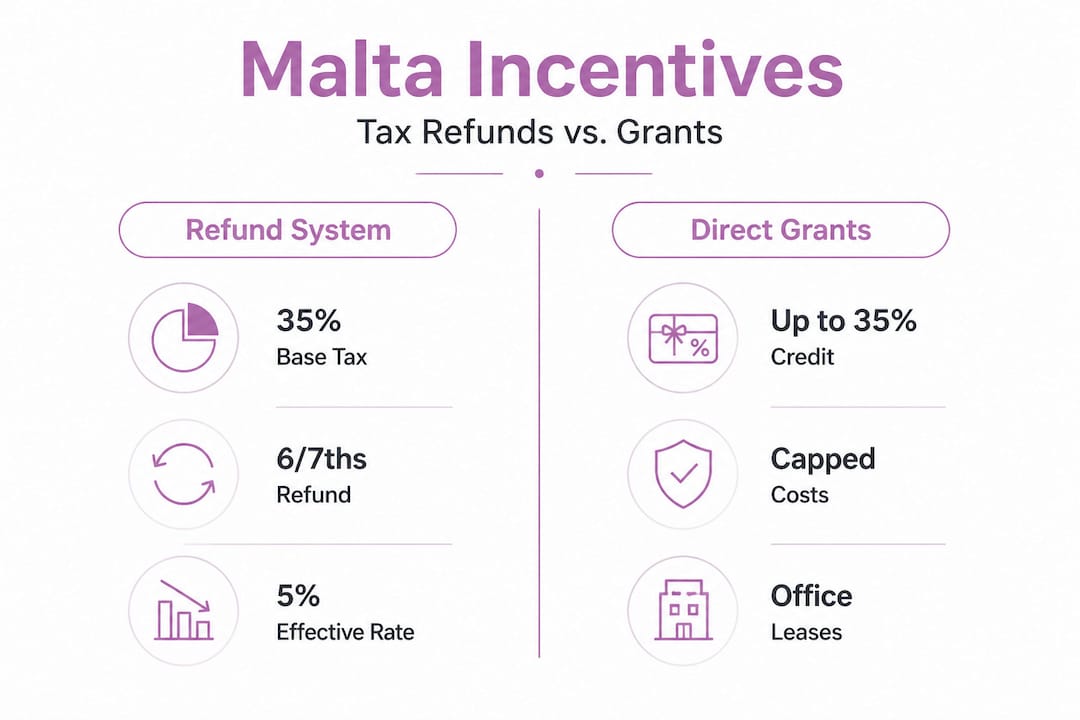
What makes these schemes particularly relevant for companies planning a physical presence is that eligible costs can include lease and rental of commercial properties, including office space and industrial premises. This is significant. It means that office rental costs, which represent one of the largest recurring overheads for businesses setting up in Malta, may qualify for direct financial support.

📊 Statistic: Tax credits under the Invest scheme can reach 35% of qualifying capital expenditure, while cash grants under the Business Development scheme can total up to €300,000 for eligible SMEs.
To qualify, businesses should follow this sequence:
- Confirm that the business activity falls within an eligible sector (manufacturing, advanced services, fintech, logistics, and others typically qualify).
- Engage Malta Enterprise early, ideally before signing a lease, as pre-approval may be required for expenses to qualify.
- Prepare a formal investment plan outlining projected employment, capital commitment, and premises requirements.
- Submit the application and await formal approval before committing expenditure.
- Maintain accurate records of all qualifying costs throughout the benefit period.
Pro Tip: Do not assume that signing a lease and claiming retrospectively will work. Malta’s incentive programmes are structured around pre-approval for most property-related costs. Review the complete office guide to understand what types of commercial space align with these schemes.
Nuances and eligibility: What most guides miss
While the incentives look attractive, there are critical details that determine real business tax outcomes.
The single most common misunderstanding among businesses arriving in Malta is that the tax benefits are automatic. They are not. The refund mechanism depends entirely on how profits are classified, how dividends are distributed, and whether the company’s structure aligns with the relevant provisions of Maltese tax legislation.
“The system is tied to distributed dividends and refund entitlements based on the underlying profit classification and income type.” — Wise
Here is a checklist of what to confirm with a Maltese adviser before planning your move:
- Profit classification: Confirm whether income will be classified as trading, passive, or property-derived. This determines refund eligibility and the applicable fraction.
- Dividend distribution mechanics: Understand the timeline and process for distributing profits from the right tax account, as Malta maintains five distinct tax accounts (Maltese taxed account, foreign income account, immovable property account, untaxed account, and the final tax account).
- Shareholder residency: Certain refund provisions differ depending on whether the ultimate shareholder is Maltese-resident or non-resident.
- Group structures: Holding company structures involving non-Maltese intermediaries can complicate refund claims and should be reviewed carefully.
- Incentive pre-approval: As noted above, property-related incentives require formal eligibility checks and pre-approval from Malta Enterprise.
Businesses relocating your office to Malta should treat these not as administrative obstacles but as a structured pathway. Those who engage advisers early tend to extract substantially more value from the system than those who retroactively try to fit their structure into the available schemes.
Applying Malta’s tax edge: Practical steps for office-based businesses
To act on this knowledge right now, here is how a business would typically move from interest to implementation.
- Engage a Maltese tax adviser and corporate services firm before registering a company. The structure you choose at incorporation determines which refund accounts apply and which incentive schemes are accessible.
- Identify your target office location and assess whether the premises type and lease terms are compatible with eligible costs under Malta Enterprise schemes. Grade A office space in areas such as Mriehel, Valletta, and St Julian’s typically meets the commercial standards required.
- Apply to Malta Enterprise for pre-approval on premises-related costs if your business activity qualifies. Tax credits and grants can substantially offset the cost of establishing a physical footprint.
- Plan your dividend distribution calendar with your accountant to ensure shareholder refunds are claimed promptly once profits are distributed from qualifying tax accounts.
- Review your position annually as Malta’s incentive landscape evolves. New schemes are introduced periodically, and existing ones are adjusted to reflect EU state aid rules.
Pro Tip: Aligning your Malta office space guide research with your tax strategy from day one is far more effective than treating them as separate decisions. Property costs can form part of your incentive claim, so the two are directly linked. For context, Malta sits within a broader competitive office market in Europe, and understanding how it compares helps frame your investment case.
What most businesses misunderstand about Malta’s tax landscape
Having addressed the practical steps, let’s offer some first-hand perspective on what really matters when targeting Malta.
The businesses that fare best in Malta are not those who chase the headline 5% effective rate. They are the ones who understand that Malta’s tax framework is a structured system, not a passive benefit. Every refund, credit, and grant exists within a legal and administrative architecture that rewards preparation and penalises assumptions.
Many first-time movers arrive focused entirely on the numbers. They read about the 5% effective rate and begin projecting savings without confirming whether their income type qualifies, whether their dividend timeline is commercially feasible, or whether their intended premises fall within eligible scheme parameters. The disappointment that follows is almost always avoidable.
Seasoned businesses, by contrast, plan their entire market entry around eligibility. They choose their office location partly based on which properties qualify for Malta Enterprise support. Furthermore, they time their incorporation to ensure that dividend distributions can be made within an optimal tax year. They treat relocating for EU access and tax efficiency as one integrated decision, not two separate exercises.
The contrarian view worth sharing is this: Malta’s tax system is genuinely powerful, but it is not plug-and-play. The businesses that extract the most value are those who invest time upfront in understanding the rules. That investment pays back quickly once the structure is in place and the refund machinery starts working correctly.
Explore Malta’s commercial property options with expert guidance
If you are ready to match your tax strategy with the right commercial space, OfficeSpace.Rent provides direct access to Malta’s leading commercial property listings. Browse office space in Malta across key business districts, compare serviced and traditional office options, and filter by size, price, and location to identify premises that align with your incentive eligibility requirements. For businesses targeting established commercial clusters, explore available commercial property in Mriehel, one of Malta’s most active office submarkets. If acquisition rather than rental better suits your long-term strategy, review Malta properties for sale and speak directly with local agents who understand both the property market and the incentive landscape.
Frequently asked questions on Tax incentives in Malta
What is the typical effective corporate tax rate for trading companies in Malta?
It is usually around 5% after the 6/7ths shareholder refund is applied to qualifying distributed profits from trading income.
Are all companies eligible for Malta’s tax refund mechanism?
No. The refund depends on profit type, the correct distribution of dividends from the appropriate tax account, and meeting specific eligibility criteria tied to the company’s structure.
Can office rental costs be covered by Malta’s incentive schemes?
Yes. Eligible lease and rental costs for office and industrial space can qualify for tax credits or cash grants under Malta Enterprise schemes, subject to activity and pre-approval requirements.
Is Malta’s low tax rate always guaranteed for foreign investors?
No. The effective rate is not automatic and depends on how the company’s income is classified, how dividends are distributed, and whether the shareholder refund mechanics are correctly executed.
Is pre-approval required for incentive schemes relating to property?
Yes. Most property-related incentives administered by Malta Enterprise require formal eligibility checks and pre-approval before expenditure is committed.
Recommended
- Set up Your Business – Why Malta?
- Complete Guide to Office Space in Malta for Corporations
- Benefits of Relocating Offices in Malta
- Strategic Office Relocation to Malta: A Guide – Offices in Malta To Let & For Sale
- Tax efficient structures for South African Corporate Assets in 2026 | Ready Accounting