TL;DR:
- Malta’s office spaces have high occupancy costs, requiring precise planning to optimize desk numbers.
- Different office layouts, such as open-plan, hybrid, or private offices, balance density, comfort, and compliance.
- Data-driven analysis and flexible furniture strategies help maximize efficiency and maintain productivity.
Malta’s commercial property market commands some of the highest occupancy costs in Southern Europe, with average office costs reaching €350 per square metre annually. For businesses, maximising desk space in Malta is a crucial way to ensure you are making the most of your investment. Every square metre you underutilize is money lost. Yet simply cramming in as many desks as possible creates a different problem: reduced productivity, potential health and safety issues, and higher staff turnover. The key is knowing precisely how many workstations your floor plate can realistically support, based on your layout, your workforce model, and Malta’s regulatory context. This guide walks you through the criteria, configuration options, and best practices to turn every available square metre into productive, compliant, and comfortable workspace.
Table of Contents
- Key criteria to calculate desk space in your office
- Desk configuration options for Maltese offices
- Comparing your options: efficiency, comfort, and compliance
- Best practices and insider tips for maximising desk space
- Why too many desks might cost you more in Malta
- Find the perfect Maltese office — expert support for your desk space
- Frequently asked questions
Key Takeaways
| Point | Details |
|---|---|
| Standard desk spacing | Each desk should allow around 5.5–6.5 sqm per person, plus space for circulation. |
| Flexible layouts win | Hybrid and hot-desking let you fit more people and adapt to changing needs. |
| No hard legal minimum | Malta relies on best practice and safety, so follow industry guidance for compliance. |
| Comfort boosts productivity | Balance density with staff wellbeing to avoid costly mistakes and boost output. |
Key criteria to calculate desk space in your office
Before you start measuring walls and ordering furniture, you need a clear framework. Calculating desk capacity is not simply a matter of dividing total floor area by a standard figure. Several interdependent factors shape the real number.
Core factors to evaluate:
- Desk dimensions: A standard desk runs 140–160 cm wide by 70–80 cm deep. Compact desks at 120 cm are possible but compromise ergonomic comfort for most workers.
- Workstation footprint: Each station requires space for the chair, movement, and immediate personal storage. Industry benchmarks indicate 5.5–6.5 sqm per workstation in open-plan settings, with high-density layouts at roughly 5 sqm and low-density at up to 8 sqm.
- Circulation and traffic: Walkways, access routes, and emergency egress must remain clear. Plan for 25–35% of your total area to serve circulation and communal functions.
- Storage and equipment: Filing cabinets, server racks, and printer stations consume floor space that many planners forget to account for upfront.
- Business model and working style: A call centre operates differently from a financial advisory firm. Your sector drives your density target.
- Natural light and ventilation: Overcrowding can block window access and reduce air quality, both of which affect wellbeing and long-term productivity.
Regarding legal standards, Malta’s OHS framework does not set an explicit minimum square meterage per employee. Instead, the Occupational Health and Safety Authority Act mandates that employers eliminate or minimise risk to workers, drawing broadly on EU principles. This means you must apply professional judgement and recognised office space guidelines rather than relying on a fixed legal figure.
Pro Tip: Always allocate 25–35% of your gross usable area for circulation, shared zones, and communal areas before calculating your net workstation count. Starting from gross area is the most common planning error in Malta office fit-outs.
Knowing which office layout approach suits your team’s working style is equally important. Density is only one dimension of an effective workspace.
Desk configuration options for Maltese offices
With the criteria established, the next step is choosing a configuration that matches your business model and space constraints. Each layout type carries distinct trade-offs between density, comfort, and cost.
Open-plan layout
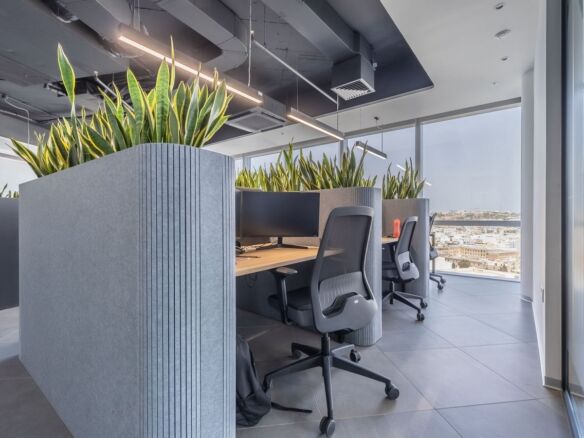
Rows of desks in a shared environment. High density, easy supervision, and low fit-out cost. The downside is noise and reduced privacy, which can affect concentration-heavy roles.
High-density or bench seating
Continuous bench surfaces with minimal partition. Maximises desk-based capacity per sqm, popular in tech start-ups and customer service environments. Noise management and acoustic panels become essential investments.
Hybrid or hot-desking layout
Not every desk is assigned to one person. Global research shows hybrid and hot-desking reduces per-employee space requirements to 5.5–11 sqm, saving 20–40% of space compared to traditional fixed-desk arrangements. Ideal for teams with frequent remote or field working.
Executive or private office layout
Individual offices or heavily partitioned zones. Low density but high privacy and perceived prestige. Best suited to senior roles, legal, financial, or confidential client-facing functions.
Configuration comparison for a 65 sqm office:
| Layout type | Approx. desks | Sqm per station | Key trade-off |
|---|---|---|---|
| Open-plan | 7–8 | 6.5 sqm | Noise vs. cost efficiency |
| High-density bench | 10–11 | 5.5 sqm | Acoustics need investment |
| Hybrid/hot-desking | 8–10 assignable | 6 sqm (shared) | Requires booking system |
| Executive/private | 4–5 | 12–13 sqm | High cost, high privacy |
For most Maltese SMEs and international entrants, an open-plan or hybrid model offers the best balance. Explore innovative layouts for Malta to see how local businesses are adapting these configurations to suit the island’s building stock, which often features irregular floor plates and split-level offices.
Comparing your options: efficiency, comfort, and compliance
Each configuration looks different on paper, but how do you systematically choose the right one for your business? A structured assessment avoids costly redesigns later.
Step-by-step selection process:
- Define your peak occupancy number and typical daily attendance rate separately.
- Determine your office size requirements based on role types, not headcount alone.
- Apply the space breakdown model: workstations should account for 55–65% of usable area, meetings for around 20%, communal zones for 15%, and quiet retreat space for the remaining 5%.
- Add the 25–40% circulation and traffic buffer to your workstation zone calculation.
- Cross-reference against Malta’s OHSA risk-avoidance principles.
- Stress-test the layout against projected 12-month headcount growth.
The recommended space breakdown reserves workstations for 55–65% of floor area, with the remainder split between meetings, communal, and circulation. This framework is applicable whether you are fitting out a 40 sqm serviced office in Sliema or a 300 sqm floor plate in Birkirkara.
Layout comparison: key metrics
| Layout | Stations per 100 sqm | Comfort rating | Malta compliance |
|---|---|---|---|
| Open-plan | 13–15 | Moderate | Compliant with buffers |
| High-density bench | 16–18 | Lower | Risk if no acoustic plan |
| Hybrid/hot-desking | 12–16 (shared) | High | Fully compliant |
| Executive | 6–8 | High | Fully compliant |
Industry consensus is clear: data-driven utilisation analysis consistently outperforms rules-of-thumb. Counting metres alone is not sufficient. Noise exposure, lighting access, thermal comfort, and collaboration flow all determine whether a layout sustains performance over time.
For call centres, high density may be acceptable because role requirements align with that environment. For financial advisory or legal services, hybrid office models offer better alignment between space use and client expectations. The sector context is decisive.
Best practices and insider tips for maximising desk space
Maximising desk space in Malta requires some best practices and insider tips. With the options and their trade-offs clear, refining your approach with proven tactics can yield significant gains without sacrificing quality of work life.
Practical best practices:
- Use modular furniture: Reconfigurable desks and movable partitions allow you to adapt the layout as your team evolves, without a full refurbishment.
- Go vertical: Wall-mounted shelving, overhead storage units, and high cabinets free up floor space that would otherwise house pedestal drawers.
- Install glass partitions: Where acoustic separation is needed, full-height glazed screens preserve natural light and the sense of space while maintaining division.
- Centralise shared equipment: Consolidate printers, filing, and meeting tech into dedicated zones rather than distributing them across the floor, which fragments usable desk area.
- Audit actual desk utilisation: Many offices run at 60–70% daily occupancy. Utilisation sensors or booking data can reveal genuine demand, which then informs how many fixed desks you actually need.
Pro Tip: Rethinking fixed desk assignments in favour of a hybrid hot-desk model can increase your effective seat count by 20–40% without any structural changes, purely by aligning desk allocation with real attendance patterns.
Experts consistently recommend data-driven utilisation analysis over rigid rules-of-thumb. Office needs shift as teams grow, contract, or change working patterns. Build in a formal review cycle. For quick practical guidance on fitting out and renting office space in Malta, reviewing current market norms ensures your layout stays aligned with both operational demands and lease terms.
Periodic re-evaluation is not optional. Malta’s commercial property market evolves, and a layout that worked well two years ago may now constrain your team’s output or inflate your cost per occupied desk.
Why too many desks might cost you more in Malta
The instinct to maximise desk count is understandable when you are paying premium rates per square metre. But the evidence suggests that over-densification often costs more than it saves.
Research on high-density office environments shows open-plan configurations can reduce meaningful face-to-face interaction by up to 70%, driving employees toward digital communication even when seated metres apart. High-density call centre settings risk noise-driven productivity loss and elevated absenteeism. Low-density private offices resolve the privacy issue but inflate cost per workstation, which is particularly acute given Malta’s premium pricing environment.
The smarter position is to target the density that matches your actual daily occupancy rate, not your theoretical maximum headcount. In Malta’s evolving workforce landscape, a hybrid model that reserves 15–20% of your floor area for flexible or collaborative use consistently outperforms both extremes. It supports compliance, reduces noise complaints, and retains the adaptability that the current market rewards. Fitting ‘just enough’ structured desks, supported by genuinely usable shared zones, frequently delivers higher output per square metre than fitting the absolute maximum.
Find the perfect Maltese office — expert support for your desk space
Maximising desk space in Malta and planning desk capacity is only half the challenge. Finding the right Maltese office that supports your target layout is where OfficeSpace.Rent adds direct value. Our desk-based office search tool lets you filter listings by workstation count, floor area, and location, matching space directly to your density requirements. Browse Malta office listings across Valletta, St Julian’s, Sliema, and beyond, with transparent pricing and full agent support. For video walkthroughs and market insights, visit the OfficeSpace.Rent YouTube channel, and follow us on LinkedIn for regular updates on the Maltese commercial property market.
Frequently asked questions
How do I calculate how many desks my Malta office can fit?
Divide your usable floor area by the standard workstation benchmark of 5.5–6.5 sqm per desk, then deduct 25–35% for circulation and shared zones to reach a realistic figure.
Is there a legal minimum desk space per employee in Malta?
Malta’s OHS legislation does not prescribe a fixed minimum square meterage per worker; employers must apply general risk-avoidance principles and recognised industry standards to demonstrate compliance.
How can flexible or hot-desking increase how many people I can accommodate?
Hybrid and hot-desking layouts align desk availability with real attendance patterns, and research confirms they reduce per-employee space needs to 5.5–11 sqm, saving 20–40% of space compared with fixed-desk arrangements.
What are the risks of fitting in more desks than recommended?
Exceeding recommended density raises noise levels and reduces productivity; evidence from open-plan studies indicates that interaction quality and output both decline in over-dense environments, making hybrid layouts a more sustainable choice.
How often should I review or replan my office desk layout?
Reassess your layout at least once per year, or whenever your team size, working patterns, or lease terms change materially to ensure your space continues to perform efficiently.
Recommended
- Innovative office space planning ideas for Malta businesses
- Guide to Office Size and Layouts: Finding Your Space – Offices in Malta To Let & For Sale
- Office Space in Malta: Your Guide to Renting
- Strategic Office Space Design: Enhance Your Culture – Offices in Malta To Let & For Sale
- Office Art Inspiration: Elevate Your Workplace Aesthetic