TL;DR:
- Location, office grade, and supply-demand directly impact Malta office rental costs.
- Lease terms, lease structures, and regulatory factors significantly influence total occupancy expenses.
- Technology, sustainability features, and human element considerations shape office cost justification and decision-making.
Two identical offices on the same street in Malta can carry rent quotes that differ by 30% or more. For business owners planning their 2026 workspace budgets, that kind of variance is not an anomaly — it is a direct result of seven identifiable forces that shape what you pay. In this article, we’ll look at the 7 Factors Shaping 2026 Office Costs and how they impact your business. Office rental costs vary significantly by location, specification, and timing. Understanding each factor gives you the analytical foundation to negotiate confidently and allocate resources without unpleasant surprises.
Table of Contents
- Location dynamics and market segmentation
- Supply, demand, and economic influences
- Lease terms and pricing structures
- Technology, sustainability, and workplace trends
- Regulatory changes and tax implications
- An overlooked factor: the human element behind cost decisions
- Find the right space with expert guidance
- Frequently asked questions
Key Takeaways
| Point | Details |
|---|---|
| Location is pivotal | Centrality and infrastructure dramatically impact Malta office expenses. |
| Lease structure matters | Flexible agreements and hidden costs can affect your long-term budget. |
| Technology and ESG add value | Modern, green, tech-enabled offices attract premiums and long-term savings. |
| Regulation is evolving | Keep up with tax incentives and compliance to avoid unnecessary spend. |
| Human needs drive strategy | Consider staff preferences and business goals beyond mere cost. |
Location dynamics and market segmentation
Location remains the single most powerful cost driver in any commercial property market, and Malta is no exception. Infrastructure quality, transport links, and the image your business projects to clients all feed into the premium you pay for a given postcode.
Central areas like Sliema and Valletta command substantially higher premiums due to sustained demand from financial services, legal firms, and international operators. Mriehel and the surrounding business park zones offer a measurable discount while still delivering professional environments. Outer regions such as Birkirkara and Qormi attract cost-conscious occupiers who prioritise floor-plate size over prestige address.
Malta’s office market also divides into clear grade segments, which directly correlates with achievable office rental prices:
| Office grade | Typical rent range (per sqm/year) | Key characteristics |
|---|---|---|
| Class A | €200 to €320 | Modern build, full amenities, prime location |
| Class B | €130 to €199 | Refurbished, functional, secondary locations |
| Class C | €70 to €129 | Older stock, limited facilities, peripheral areas |
- Class A space in Valletta or Sliema typically lets within weeks due to low vacancy rates.
- Class B stock in Mriehel offers the best value-to-specification ratio for mid-sized firms.
- Class C offices suit businesses prioritising square metreage over specification.
Pro Tip: If your client-facing activity is limited, consider Class B space in Mriehel rather than Class A in central Valletta. You may secure 25% to 35% more floor space for the same annual budget, with minimal operational disadvantage.
Supply, demand, and economic influences
Beyond location, supply and demand forces continue to shape how much businesses pay for space. When the development pipeline slows and tenant appetite strengthens, landlords gain pricing leverage. The reverse is equally true.
A shortage of top-tier space can accelerate rental hikes, particularly in post-pandemic recovery cycles where businesses are expanding headcount rapidly. Tenant preferences have also shifted, with occupiers now expecting open-plan flexibility, collaborative zones, and high-speed connectivity as standard rather than premium additions.
“Supply cycles in Malta tend to be compressed. When Grade A completions lag by even one or two years, the knock-on effect on asking rents for existing stock is immediate and measurable.” — Local commercial real estate market commentary, 2025.
Here is how an economic shift translates into your rent:
- External trigger — Economic growth increases business formation and headcount expansion.
- Demand spike — More businesses compete for the same available space.
- Vacancy compression — Time-to-let shortens and landlords withdraw concessions.
- Rent uplift — Achieved rents rise, often reflected in the next rent review cycle.
- Budget impact — Tenants renewing leases face higher costs than comparable rental pricing insights from prior years.
Broader economic conditions, including interest rate changes and inflation, also affect fit-out costs and service charge structures, compounding the total occupancy cost.
Lease terms and pricing structures
Now let us focus on how lease details and pricing mechanics can tip the cost scales considerably. Two businesses paying the same headline rent can face very different total occupancy costs depending on what their lease actually contains.
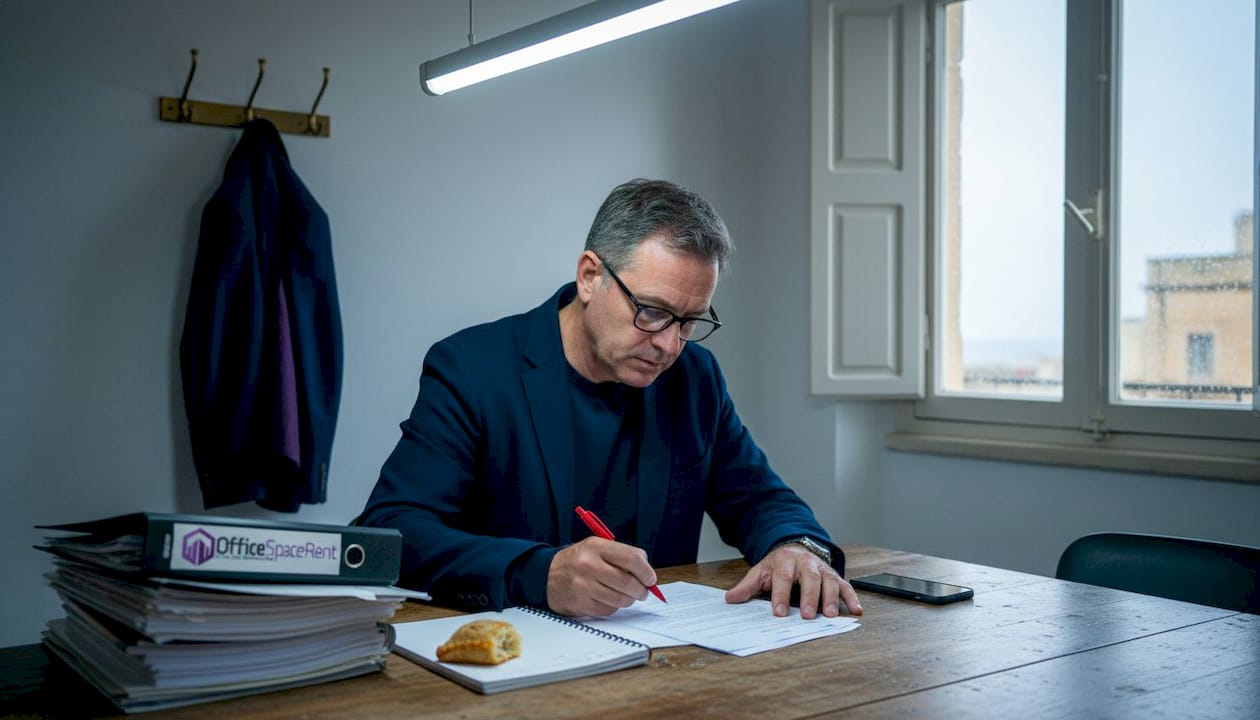
A typical Maltese office lease includes headline rent, service charge, insurance contribution, and maintenance obligations. The split between gross and net rent is particularly significant: a gross lease bundles most charges into one figure, while a net lease requires the tenant to fund operational costs separately — sometimes adding 15% to 20% on top of the stated rent.
| Lease type | Upfront flexibility | Monthly cost | Total cost over 5 years |
|---|---|---|---|
| Short-term (1 to 2 years) | High | Higher per sqm | Typically 10 to 15% more |
| Long-term (3 to 5 years) | Low | Lower per sqm | Potentially 10 to 15% less |
Flexible and short-term leases are gaining ground in Malta, reflecting post-pandemic caution and growth unpredictability. They suit scaling businesses but carry a premium. Review your office rental pricing structures carefully before committing.
Common pitfalls in rent review clauses:
- Upward-only rent reviews with no cap on percentage increases.
- Annual CPI-linked adjustments that compound significantly over a five-year term.
- Break clause restrictions that eliminate practical exit options.
Pro Tip: Always request a full schedule of dilapidations liability and maintenance responsibilities before signing. Fit-out contribution and reinstatement obligations can represent tens of thousands of euros in unlisted costs.
Technology, sustainability, and workplace trends
Beyond lease structures, technology and new priorities are playing a transformative role in how office costs are calculated and justified in 2026.
Smart building infrastructure — covering automated HVAC, access control, occupancy sensors, and integrated data cabling — is now a baseline expectation among quality tenants. Landlords investing in these upgrades pass costs through in higher headline rents, but the efficiency gains often offset the premium over time.
🟢 Key technology and sustainability factors affecting office costs:
- Energy performance certificates now influence achievable rent and tenant willingness to sign.
- BREEAM or LEED certified buildings typically command a 5% to 15% rent premium over non-certified equivalents.
- LED lighting, solar readiness, and rainwater harvesting features reduce service charges in the medium term.
- High-speed fibre connectivity and server room provisions are now standard lease requirements for tech-sector tenants.
The shift to hybrid working has also reshaped space planning. Businesses now require fewer fixed desks but more collaborative zones, which often means a higher cost-per-person even with a smaller overall floor plate. Reviewing workspace trends and best choices helps you match your headcount model to the right specification before committing to a lease. Detailed cost assessment strategies help quantify these trade-offs accurately.
Regulatory changes and tax implications
Government policies and tax structures always play a role in shaping end-costs for business occupiers. Malta has seen several policy updates in recent years that directly affect what companies pay to lease and operate an office.
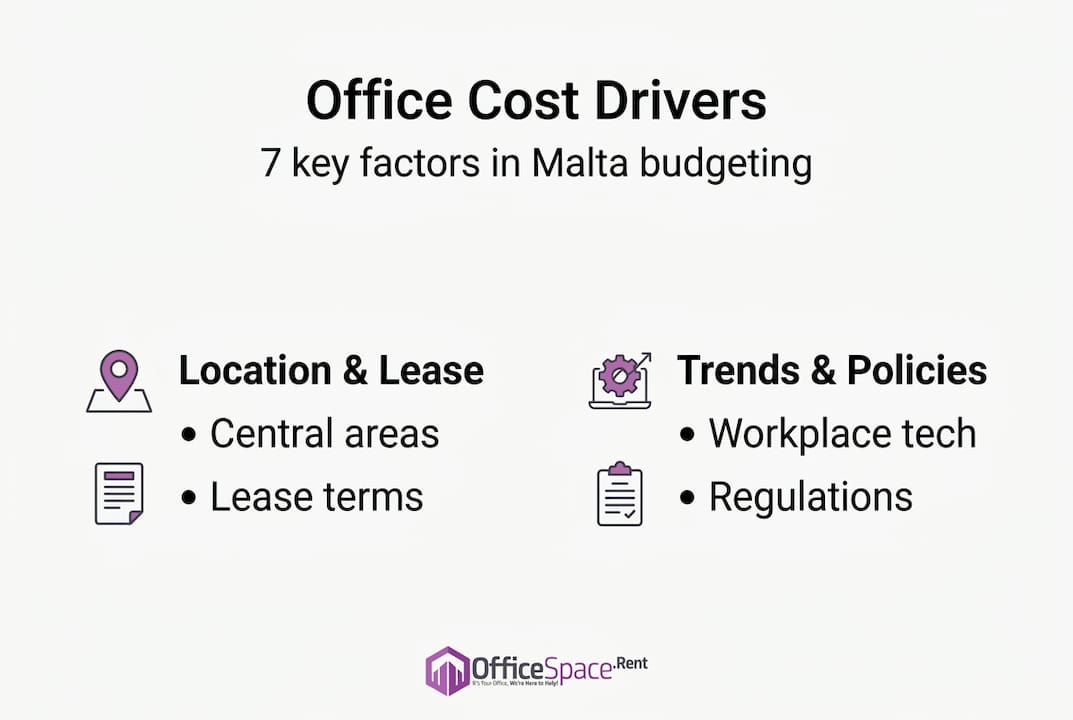
Property tax reliefs and grant updates may offset costs for qualifying businesses, particularly those investing in new premises or relocating from outside Malta under enterprise support programmes.
Key regulatory and policy considerations for 2026:
- Energy efficiency mandates — New minimum energy performance standards are being phased in, which may force landlords to upgrade older stock, increasing service charge contributions.
- Planning policy — Changes to permitted development rights in certain urban zones affect the supply of new office space, sustaining upward pressure on rents in restricted areas.
- Employment law compliance — Workspace requirements tied to headcount and health and safety legislation affect minimum space-per-person ratios, influencing your floor-plate requirements.
- Government grants — Enterprise Malta and related bodies offer selective incentives for businesses creating high-value jobs, which can partially subsidise fit-out or relocation costs.
Non-compliance carries real budget risk. Review your full obligations under the Malta office rental guide to ensure regulatory costs are properly accounted for in your planning.
An overlooked factor: the human element behind cost decisions
With these hard factors mapped out, here is an internal truth many decision-makers miss. Market data tells you the range; people determine where you land within it.
Consider a firm that chose the cheapest available Class B office to preserve budget, without consulting their team. Six months later, elevated staff turnover and reduced productivity eroded any cost saving. The real cost of the “cheaper” choice exceeded what a better-suited space would have delivered.
Numbers are vital but they only account for half the decision. Choosing what fits your culture, your team’s commute patterns, and your leadership’s ambitions for growth should carry equal weight. A space that energises your people has measurable ROI that no rent calculator captures.
Pro Tip: Before finalising any shortlist, run a structured staff survey covering commute time, space preferences, and collaborative needs. The data will sharpen your brief and reduce costly renegotiations later.
Find the right space with expert guidance
Ready to make cost factors work for your next office? Here is how our team can help.
OfficeSpace.Rent gives you direct access to Malta office listings across every grade, location, and budget tier. Whether you are evaluating a desk-based office search or comparing Mriehel commercial properties against central Valletta options, our platform combines live pricing data with expert local knowledge. Our team supports you through lease comparisons, cost modelling, and negotiation, ensuring the insights from this guide translate directly into better outcomes for your business.
Frequently asked questions
What are the main drivers of office rent increases in Malta for 2026?
Central areas and modern spaces see stronger upward rent pressure, driven by high demand, a constrained supply of Grade A stock, and updated regulatory requirements that raise operational standards.
How do lease lengths influence overall office rental cost?
Shorter leases offer greater flexibility but typically cost more per square metre each month, while longer leases can secure lower rates but reduce your ability to adapt quickly to changes in your business. Flexible and short-term leases are increasingly common in Malta as businesses weigh agility against cost.
Do green certifications impact rent in Malta?
Yes. Eco-certified offices achieve higher headline rents, typically a 5% to 15% premium, but reduced energy consumption and service charges can offset that differential over a standard lease term.
Are there government incentives for office tenants in 2026?
Property tax reliefs and grants are available for qualifying businesses, particularly those creating employment or investing in new premises under active enterprise support programmes in Malta.