TL;DR:
- Office location in Malta impacts employee satisfaction, retention, and operational efficiency.
- Amenities and proximity to transport and leisure areas are key factors influencing staff loyalty.
- Strategic location choices can reduce costs and enhance recruitment, client impressions, and compliance benefits.
Office location in Malta is about far more than shortening your morning commute. Research shows that amenities and coastal proximity directly boost employee satisfaction and retention, a finding that challenges how most business owners approach their search for rental space. Malta’s compact geography, chronic congestion, and surge in international firms have made location one of the most consequential decisions a business leader can make. The role of location in office rental is increasingly a strategic factor for Maltese businesses. This guide explains how location shapes recruitment, daily operations, and long-term business performance, and gives you a practical framework for choosing the right spot when renting office space in Malta.
Table of Contents
- Understanding the role of location in Malta office rental
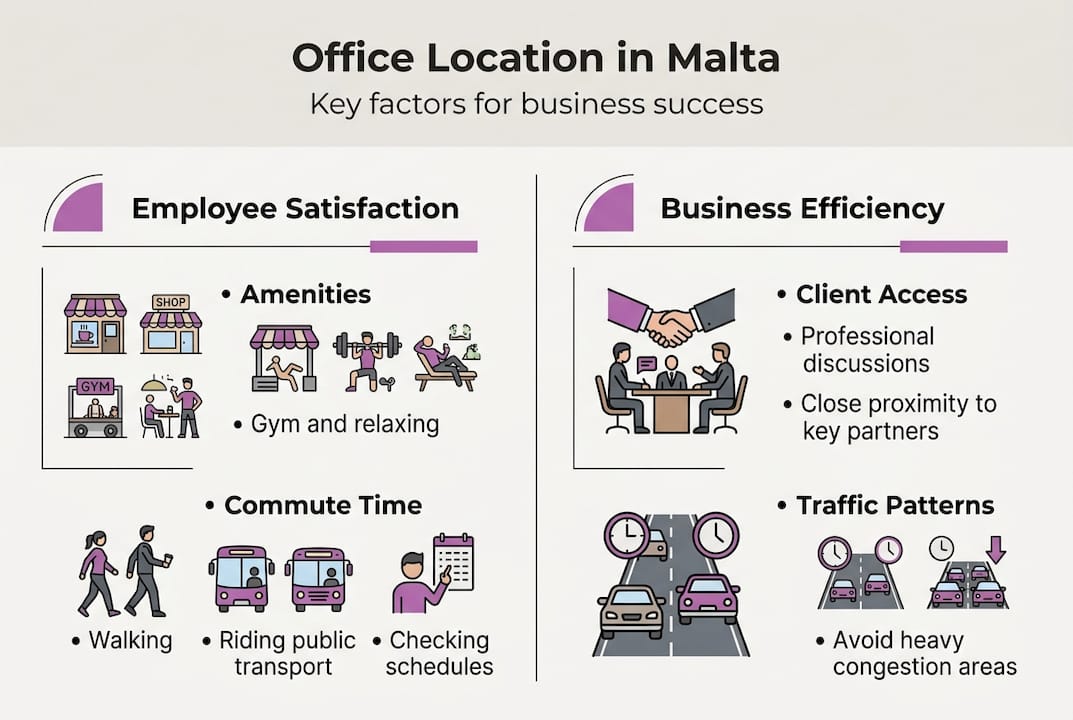
- How amenities and proximity drive employee satisfaction
- Operational efficiency and business advantages: Location’s hidden effects
- Applying location strategy: Practical tips for Malta office rentals
- An expert perspective: Location as the overlooked lever in Malta office rental
- Explore office locations in Malta with expert support
- Frequently asked questions
Key Takeaways
| Point | Details |
|---|---|
| Location drives retention | Choosing an office near amenities and transport boosts employee satisfaction and loyalty. |
| Malta’s unique constraints | Local congestion, parking and island geography make accessibility a top priority in office rental. |
| Hybrid models reshaping | Central prestige offices paired with satellite hubs optimise both prestige and cost in Malta. |
| Strategic value beyond cost | Office location impacts client access, compliance, and operational efficiency, not just rent price. |
| Application tips | Evaluate your needs, balance budget and prestige, and negotiate location-related lease terms. |
Understanding the role of location in Malta office rental
Location in the context of Malta office rental is not simply a postcode. It encompasses access to public transport, proximity to client-facing districts, the quality of nearby amenities, and how well the site supports your workforce’s daily routines. Get it right, and you gain a genuine competitive advantage. Get it wrong, and you absorb costs in turnover, logistics, and lost talent that rarely appear on any initial lease comparison.
Malta’s island geography amplifies these stakes. Because the road network is limited and heavily used, the island constraints around congestion and parking mean that even a few kilometres of difference between two office addresses can translate into significantly different employee experiences and operational outcomes. International firms recognise this. Many choose premium central locations specifically because EU compliance and tax incentives make those address-linked costs worthwhile.
Below is a summary of location factors and how they affect your business:
| Location factor | Impact on operations | Impact on employees |
|---|---|---|
| Proximity to transport links | Easier client and supplier access | Shorter, more predictable commutes |
| Coastal or marina setting | Enhanced brand perception | Higher daily satisfaction |
| Business district address | Client credibility and compliance | Professional environment |
| Suburban or satellite hub | Lower overheads | Reduced congestion stress |
| On-site or adjacent parking | Reliable logistics | Practical convenience |
Hybrid working has also reshaped how firms assess location. Rather than consolidating everything in one site, many businesses now operate a dual model. Explore the Malta office locations guide to understand which districts support each model. The key drivers for location decisions in 2026 include:
- Accessibility: Bus routes, ferry links, and proximity to major arterial roads
- Amenities: Restaurants, gyms, childcare, and retail within walking distance
- Prestige: Brand alignment with the surrounding business environment
- Cost efficiency: Balancing rental premium against productivity and retention gains
- Regulatory positioning: Proximity to government offices or compliance-relevant institutions
Understanding office leasing considerations specific to Malta will sharpen your ability to weigh these factors before signing any lease.
How amenities and proximity drive employee satisfaction
The link between office location and employee satisfaction is well established but frequently underestimated when budgets come under scrutiny. Offices positioned near gyms, quality dining, childcare facilities, and green space command higher staff loyalty than those isolated in purely functional zones. This is not simply a quality-of-life observation. It has measurable effects on absenteeism, performance, and retention rates.
A Harvard-linked proximity study from November 2025 reinforces this. Shorter commutes and physical proximity to colleagues enhance productivity, particularly for junior and newly hired staff who benefit most from informal mentorship and spontaneous collaboration. In a hybrid environment where in-office attendance is partly discretionary, location becomes a recruitment and retention tool in itself.
In Malta, this plays out in identifiable ways. Offices near the Sliema marina or St Julian’s waterfront consistently attract higher-calibre candidates and report stronger team engagement. The Mriehel business hub, while less scenic, offers well-connected infrastructure and affordable options that suit operational teams focused on logistics and back-office functions. These are not arbitrary preferences. They reflect how the surrounding environment shapes the working day.
“Offices near gyms, quality dining, and childcare facilities command higher staff loyalty, particularly in post-hybrid markets where employees actively compare location benefits before accepting offers.”
For businesses running a hub-and-spoke model, the logic is clear. A central office in Valletta or St Julian’s provides the prestige and training environment that benefits senior staff and client-facing teams. A satellite office in Mriehel or Qormi serves cost efficiency without compromising operational output. Explore the best office areas across Malta to compare how each district scores on these dimensions.
Pro Tip: When shortlisting office locations, ask prospective employees during interviews which areas they find most accessible. This data point is often more accurate than any commute-time calculator.
A useful comparison of Malta’s two most distinct office models:
| Model | Central office (e.g. Valletta, St Julian’s) | Satellite office (e.g. Mriehel, Qormi) |
|---|---|---|
| Rental premium | Higher | Lower |
| Talent attraction | Stronger for senior roles | Better for operational staff |
| Client impression | High prestige | Functional |
| Commute ease | Variable (congestion) | Generally better car access |
| Amenity access | Excellent | Moderate |
Operational efficiency and business advantages: Location’s hidden effects
Beyond employee satisfaction, office location shapes how efficiently your business runs day-to-day. Traffic patterns in Malta are predictable but severe during peak hours, meaning an office on or near major arterial roads directly affects delivery logistics, client punctuality, and the daily rhythm of your team. Location is not passive. It actively determines how much friction exists in your operations.

For international businesses, EU compliance and tax incentives tied to specific jurisdictions within Malta make prime address selection a genuinely strategic decision, not just a prestige play. Companies registered in designated areas may access preferential structures that offset the higher rental premium attached to Grade A commercial premises in central districts.
Here are five operational advantages driven by strategic location selection:
- Client accessibility: Central offices reduce friction for face-to-face meetings, which remain important for financial services, legal, and advisory firms.
- Logistics efficiency: Proximity to key delivery routes or the harbour improves supply chain reliability.
- Walk-in opportunity: Retail-adjacent offices in Valletta or Sliema generate passive footfall that adds commercial value.
- Emergency response: Well-connected locations reduce response time for time-sensitive operational decisions.
- Supplier proximity: Being close to your key suppliers reduces coordination overhead and transport cost.
📌 Statistic callout: Firms that factor strategic relocation criteria into their location decision report measurably lower turnover costs and stronger client retention within the first two years of a lease.
Understanding the full range of office types in Malta is essential before committing to a location, as the available formats vary considerably by district. Serviced offices, for instance, cluster in central areas, while traditional leasehold space is more common in suburban zones. Review the complete Malta office guide for a full breakdown of what each district offers.
Pro Tip: Before finalising a lease, map out your top five clients’ addresses and your key team members’ postcodes. A location that sits at the intersection of both groups will reduce friction across the board.
If you are still structuring your search process, the commercial property search workflow provides a step-by-step framework tailored to Malta’s market.
Applying location strategy: Practical tips for Malta office rentals
Knowing that location matters is one thing. Translating that knowledge into a clear decision process is another. The following checklist helps you evaluate any Malta office location against what your business genuinely needs, rather than what looks appealing in a brochure.
Malta office location checklist:
- Public transport access: Is there a reliable bus route within 300 metres? Does it connect to residential areas where your team lives?
- Parking provision: Does the building include dedicated parking, or is street parking realistic during business hours?
- Amenity proximity: Are there quality dining options, a gym, and essential retail within a 10-minute walk?
- Client-facing suitability: Does the address convey the right level of professionalism for your market segment?
- Road access: Can heavy vehicles access the site if you have any logistics requirements?
- Expansion potential: Does the building or area accommodate growth without requiring a full relocation within 24 months?
Hybrid trends in 2026 continue to support a dual-location model, so it is worth evaluating both a central prestige address and a cost-effective satellite before committing to either alone. Many firms find that splitting their footprint across two complementary sites produces better outcomes than optimising heavily for one.
When it comes to budget, the most common mistake is treating location premium as a pure cost. A central address in St Julian’s may carry a 20 to 30 percent rental premium over a suburban equivalent. But if that location reduces your average time-to-hire by two weeks per role and improves your first-year retention rate by 15 percent, the net cost picture changes substantially.
During lease negotiations, ask specifically about:
- Whether the landlord has plans for any nearby development that could affect parking or access
- The history of rent reviews for the specific site
- Any fit-out contributions or rent-free periods that might offset location-driven premiums
Review the Malta lease negotiation tips for a detailed guide on what to raise at the table. You can also browse Malta office rentals filtered by location and size to build a realistic comparison set before entering any negotiation.
An expert perspective: Location as the overlooked lever in Malta office rental
Most office rental guides lead with cost per square metre. That is useful data. But it risks reducing a strategic decision to a single financial variable, and in Malta’s market, that approach regularly produces poor outcomes.
The real cost of a wrong location decision shows up in recruitment difficulty, elevated turnover, reduced productivity among newer hires, and weakened client impressions. These costs are real but diffuse. They do not appear on any invoice, so they are easy to dismiss until the pattern becomes undeniable.
Research from a Harvard proximity study published in late 2025 is instructive here. Physical proximity to colleagues measurably improves training outcomes and productivity for junior staff, which means your office location directly affects how quickly new hires become effective contributors. In Malta, where the talent pool is finite and recruitment competitive, that matters.
Malta’s geography also amplifies the stakes in a way that does not apply in larger markets. Moving an office five kilometres in London is a minor inconvenience. In Malta, the same move can double commute times for a significant portion of your team. Use the location strategy guide and expert relocation advice to pressure-test any location decision before you commit.
Location is not a background variable. It is one of the most active levers you have.
Explore office locations in Malta with expert support
Finding the right office location in Malta requires more than a map and a budget. OfficeSpace.Rent provides a dedicated platform built specifically for Malta’s commercial property market, with filtering tools that let you search by location, amenities, size, and price. You can use the desk-based office search to shortlist locations based on your team’s actual needs. Our local agents provide guidance across the full leasing process, from initial location scoping through to lease negotiation and fit-out planning, so your location decision is grounded in current market intelligence.
Frequently asked questions
How does office location affect employee retention in Malta?
Offices near amenities such as dining, gyms, and coastal areas boost employee satisfaction and loyalty, making location a direct input into retention rates rather than just a logistical convenience.
What are key location factors to consider for office rental in Malta?
Accessibility, parking, local amenities, and proximity to business districts are the primary factors, with Malta’s island-specific congestion challenges making transport links particularly important.
Does a central office location confer advantages for international operations?
Yes. Central Malta addresses attract international firms not only for prestige but because EU compliance and tax benefits are often linked to specific jurisdictions, making prime locations financially justifiable.
Can hybrid work arrangements affect Malta office location strategy?
Hybrid models favour a split approach: a central prestigious hub for leadership and client events, paired with a cost-efficient satellite location for operational and back-office teams.