TL;DR:
- Malta offers competitive office rents, strategic EU location, and an English-speaking workforce.
- Compliance requires obtaining a Class 4A permit, with a straightforward application process and recommended planning buffers.
- Flexible leases and quality locations like Sliema and Gzira support diverse business needs and talent access.
Malta has a reputation for complex red tape and steep commercial rents, yet the reality for office tenants is far more encouraging. Malta’s office rents are genuinely competitive against EU averages, and the regulatory framework, once understood, is manageable for businesses of all sizes. This case study provides valuable insights for Malta businesses, cutting through the noise, covering permit requirements, location choices, cost structures, and contract terms so you can move forward with confidence rather than guesswork.
Table of Contents
- Why Malta attracts business renters
- Cost and contract structures: A closer look
- Navigating office permits and compliance
- Prime locations: Case study on Sliema and beyond
- What most guides miss: The human factor in office rentals
- Office rentals in Malta: Your next steps
- Frequently asked questions
Key Takeaways
| Point | Details |
|---|---|
| Malta offers value | Office rental rates in Malta are highly competitive within the EU, making it attractive for businesses. |
| Simple permit process | Setting up a professional office requires a Class 4A permit, and the process is relatively clear. |
| Flexible lease terms | Most offices in Malta are available on 2-5 year leases, giving businesses greater adaptability. |
| Location variety | Top commercial hubs like Sliema and Gzira offer diverse office options to suit different needs. |
Why Malta attracts business renters – Insights for Malta businesses
Malta sits at the crossroads of Europe, North Africa, and the Middle East, giving businesses a genuinely strategic base within the EU single market. That geography, combined with a stable political environment and a highly educated English-speaking workforce, makes the island a compelling choice for both local operators and international firms relocating their European headquarters.
Several factors underpin Malta’s appeal:
- EU membership with full access to European regulatory frameworks and funding programmes
- English as an official language, removing language barriers for international teams and legal documentation
- Competitive vacancy rates across key districts, giving tenants real choice in location and floor plate size
- Flexible lease terms, with 2-5 year leases and Class 4A permit requirements that are well-documented and consistently applied
- Lower operating costs compared to Western European capitals, stretching office budgets further
For companies exploring Malta office relocation benefits, the combination of talent availability and affordable commercial space is a recurring theme in decision-making.
“Malta’s regulatory clarity and English-language environment make it one of the most accessible EU jurisdictions for businesses establishing a commercial presence.”
Pro Tip: If you are an international firm, English as Malta’s official business language means contracts, permits, and negotiations proceed without translation costs or ambiguity, a practical advantage that is easy to underestimate until you experience it elsewhere.
Cost and contract structures: A closer look
With the market appeal established, it is time to break down the actual costs and typical contracts. Pricing in Malta varies considerably by district and building grade, but it remains well below comparable EU office markets.
| Location | Annual rent (€/sqm/year) | Typical lease term |
|---|---|---|
| Sliema (prime) | €270-380 | 2-5 years |
| Gzira | €220-310 | 2-5 years |
| Msida | €190-270 | 2-5 years |
| Dublin (comparison) | €673 | 5-10 years |
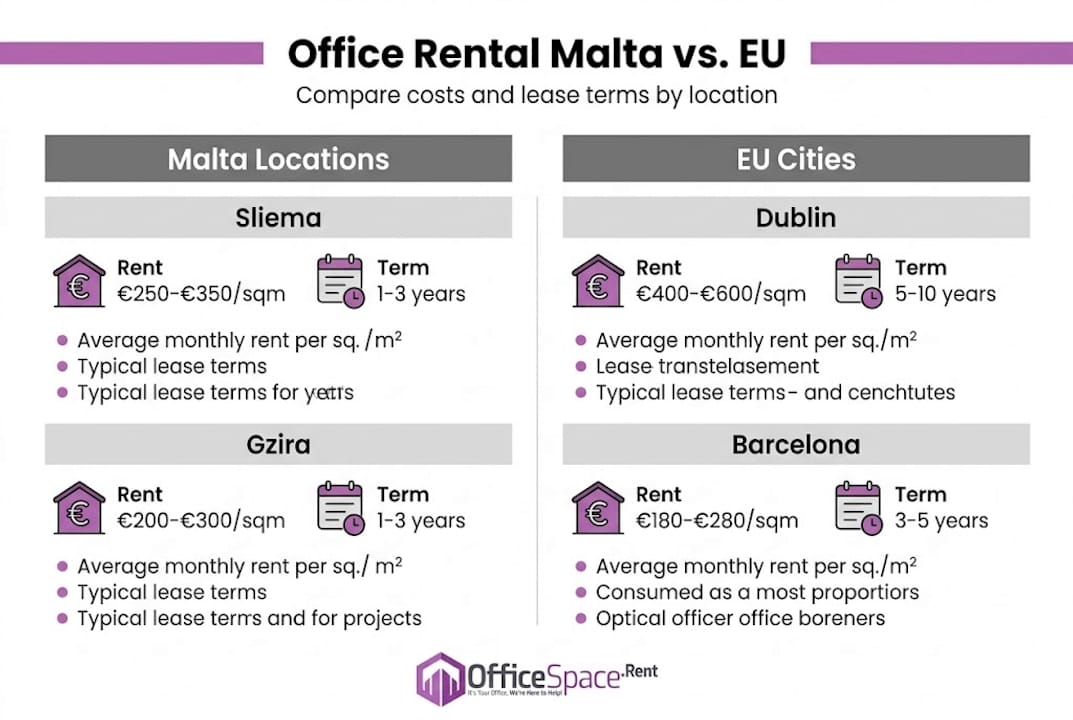
Sliema office rents sit at €270-380 per sqm per year, a figure that looks striking when placed alongside Dublin’s €673 per sqm. For a 200 sqm office, that difference can mean savings exceeding €50,000 annually before fit-out is even considered.
For a thorough understanding of the full cost picture, reviewing office price comparisons across districts is a sensible starting point. Key cost components to factor in include:
- Base rent quoted per sqm per year
- Service charges for shared facilities and building maintenance
- Stamp duty on lease agreements, typically borne by the tenant
- Fit-out contribution, often negotiable with landlords in softer markets
Pro Tip: When reviewing lease negotiation tips, prioritise rent-free periods and fit-out contributions. A skilled negotiator can secure two to three months rent-free on a new lease, materially reducing your first-year occupancy cost.
Navigating office permits and compliance
Understanding costs is only part of the equation. Meeting Malta’s office regulations is equally vital. Every commercial office in Malta must hold the correct development permission before operations begin, and the most relevant category for professional services firms is the Class 4A use permit.
A Class 4A permit is a legal requirement for professional offices in Malta. Operating without one exposes the business to enforcement action, lease invalidation, and reputational risk. The application process, while straightforward, requires careful preparation.
The standard steps are:
- Confirm the existing use class of the property with the landlord before signing any heads of terms
- Engage a warranted architect to assess whether a full planning application or a minor amendment is required
- Submit the application to the Planning Authority with the required drawings and documentation
- Allow adequate processing time, typically eight to twelve weeks for standard applications
- Obtain written confirmation of the permit before fit-out work begins or staff occupy the space
“Underestimating the Planning Authority’s processing timelines is the single most common mistake businesses make when setting up offices in Malta. Build in buffer time.”
For detailed Class 4A permit guidance, including documentation checklists and common application errors, the OfficeSpace.Rent resource hub provides step-by-step support.
Prime locations: Case study on Sliema and beyond
More Insights for Malta businesses: With compliance sorted, location choices become the next critical decision for businesses. Malta is a small island, but the commercial office market is concentrated in a handful of districts, each with distinct characteristics.

| District | Price range (€/sqm/year) | Key advantages |
|---|---|---|
| Sliema | €270-380 | Premium profile, seafront visibility, retail amenities |
| Gzira | €220-310 | Central, transport links, growing tech cluster |
| Msida | €190-270 | University proximity, talent pipeline, lower cost |
Sliema prime office space at €270-380 per sqm per year suits firms that need a prestigious address and access to hospitality and retail for client-facing operations. For a wider view of where businesses are setting up, the Malta office location guide covers emerging and established districts in detail.
Factors that typically drive location decisions include:
- Transport connectivity, including proximity to bus routes and parking
- Talent pool access, particularly relevant near the University of Malta in Msida
- Amenity provision, covering restaurants, banks, and professional services
- Building specification, from Grade A fitted space to shell-and-core refurbishments
For an accurate picture of what you will actually pay in each area, the Malta office rental costs breakdown is an essential reference before shortlisting properties.
What most guides miss: The human factor in office rentals
Conventional market analysis focuses almost entirely on price per sqm, lease duration, and location rankings. Those metrics matter, but they consistently underweight the human dimension of an office move, and that is where many relocations quietly fail.
Staff commute times, team culture, access to local amenities during the working day, and the psychological signal that a new office sends to employees all influence productivity and retention in ways that a cost table cannot capture. Shorter, more flexible leases are gaining traction in Malta precisely because businesses recognise that workforce needs evolve. Locking into a ten-year lease to save €20 per sqm per year is rarely the sound decision it appears on paper.
The most successful office moves we observe are those where leadership treats location and space design as a talent and culture decision first, and a financial one second.
Office rentals in Malta: Your next steps
With clarity on the essentials, moving from research to reality requires reputable partners and reliable information. OfficeSpace.Rent provides access to verified listings across Malta’s most active commercial districts, including offices in the CBD district and a broader selection of commercial properties in Malta for firms considering ownership alongside rental. For businesses that want a real-world reference before committing, the off-market office case study illustrates how the process works in practice from search through to signing.
Frequently asked questions
What is a Class 4A office permit, and do I need one in Malta?
A Class 4A permit is legally required for all professional office spaces in Malta and must be confirmed before the premises are occupied or operations begin.
How do Malta’s office rents compare to other EU cities?
Malta offers significantly lower rents, with Sliema at €270-380/sqm/year compared to Dublin’s €673 per sqm per year, making it one of the more cost-efficient EU office markets.
What is the usual lease length for office rentals in Malta?
Most commercial leases in Malta run on flexible 2-5 year terms, which suits businesses that want room to scale or restructure without long-term exposure.
Which areas in Malta are best for office rentals?
Sliema, Msida, and Gzira are established hotspots, each offering different trade-offs between prestige, cost, transport access, and proximity to talent.