TL;DR:
- For 20 to 30 desks in Malta, plan for 240 to 432 sqm with a 20% buffer.
- Prime locations like Sliema command around €5,000 to €9,000 monthly for a 30-desk office.
- Choose between traditional leases, serviced offices, or hybrid options based on flexibility and budget.
Securing office space for a team of 20 to 30 people in Malta is one of the most consequential decisions a growing SME or startup will make in 2026. If you are searching for office space for 20 30 desk teams, demand is intensifying: a Sliema duplex office sized for 30 to 40 desks commands €8,500 per month, illustrating just how competitive the market has become. Many businesses underestimate their space requirements, misread lease terms, or choose a location that hinders rather than helps their growth. This guide delivers a practical framework covering sizing, locations, lease structures, and the end-to-end workflow, so your team lands in the right space at the right cost.
Table of Contents
- Sizing and planning for 20–30 desks in Malta
- Prime, inland, and emerging office locations: What’s best for your team?
- Leasing options: Traditional, serviced, and hybrid offices explained
- The leasing workflow: Search, due diligence, and securing your space
- Our take: Hidden pitfalls medium teams miss when leasing in Malta
- Find and secure the right office in Malta with confidence
- Frequently asked questions
Key Takeaways
| Point | Details |
|---|---|
| Right-size your office | Use 8–12 sqm per person plus a 20% buffer to ensure comfort for 20–30 desks. |
| Compare locations smartly | Balance cost, prestige and accessibility when choosing between prime and inland areas. |
| Weigh lease vs serviced | Match contract terms and flexibility to your team’s growth and cashflow needs. |
| Never skip due diligence | Always check Class 4A permits and calculate total occupancy cost, not just headline rent. |
Sizing and planning for 20–30 desks in Malta
Having set out what makes the search challenging, let’s break down exactly how much space you need and what options exist.
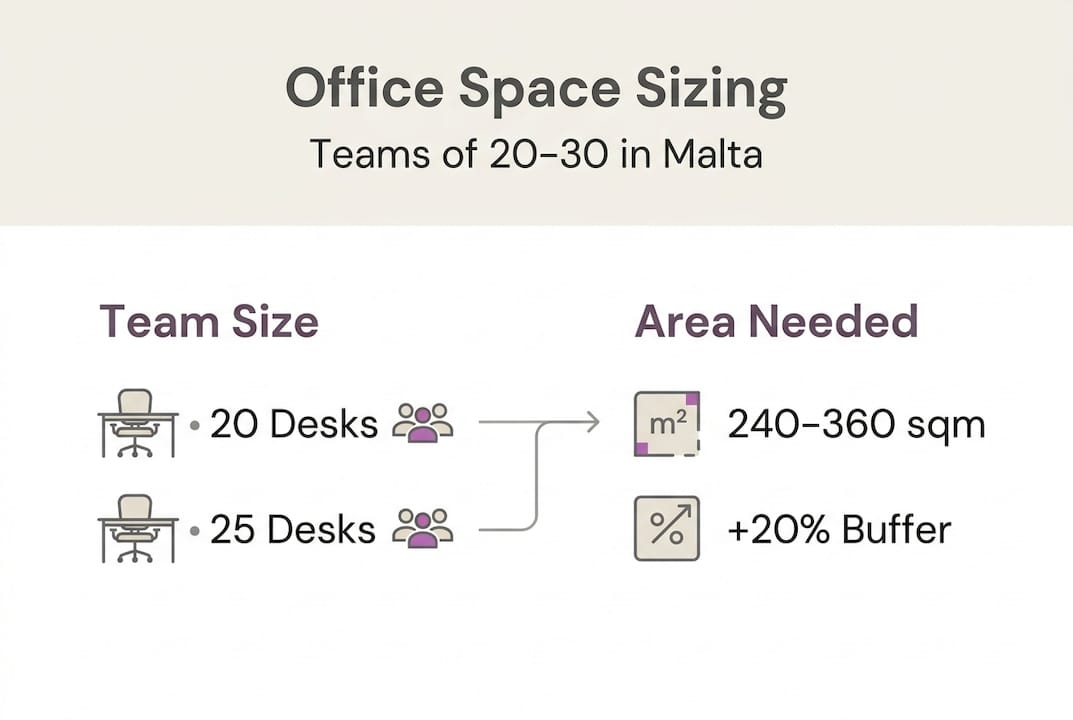
The standard planning benchmark for renting an office in Malta is 8 to 12 square metres per person. Add a 20% buffer for circulation, shared areas, and future headcount growth, and you arrive at the following practical ranges:
| Team size | Base area (10 sqm/person) | With 20% buffer |
|---|---|---|
| 20 desks | 200 sqm | 240 sqm |
| 25 desks | 250 sqm | 300 sqm |
| 30 desks | 300 sqm | 360 sqm |
As Office Space in Malta guidance confirms, applying a 20% buffer to the 8 to 12 sqm per person formula is the industry standard for avoiding overcrowding. A real-world illustration: the Sliema duplex referenced above sits at precisely 350 sqm and comfortably accommodates 30 to 40 desks, validating this formula in practice.
Beyond raw square metres, you need to decide on your floor plate configuration:
- Open-plan: Maximises desk density but reduces acoustic comfort. Suits collaborative, fast-moving teams.
- Hybrid (open with meeting rooms): The most popular choice for SMEs; balances collaboration with focused work zones.
- Cellular/closed offices: Higher cost per desk but preferred by firms requiring confidentiality, such as legal or financial services companies.
Pro Tip: Build headcount growth of at least 12 months into your sizing calculation. Relocating a 25-person team 18 months into a 3-year lease because you outgrew the space is far costlier than taking an extra 30 to 40 sqm at the outset.
Common pitfalls at this stage include ignoring ancillary space (server rooms, storage, reception) and failing to account for hybrid working patterns. If 30% of your team works remotely on any given day, your actual peak occupancy may be closer to 20 desks, which changes your sizing target significantly. Explore Malta office locations early, as the building type and floor plate shape can constrain your configuration options as much as the headline square metre figure.
Prime, inland, and emerging office locations: What’s best for your team?
Once you know your ideal size, the next big decision is where in Malta to locate your office.
Malta’s office market divides broadly into prime coastal and prestige districts versus inland value locations. Each carries a distinct cost profile, talent attraction dynamic, and practical consideration for a team of 20 to 30 people.
| Location | Typical rent (sqm/year) | Parking | Best for |
|---|---|---|---|
| Sliema / St Julian’s | €250–€400 | Limited, costly | Prestige, fintech, iGaming |
| Valletta CBD | €180–€320 | Very limited | Financial services, legal |
| Mriehel / Birkirkara | €170–€300 | Abundant, often free | Operations, back-office, SMEs |
| Msida / Ta’ Xbiex | €220–€380 | Moderate | Professional services, startups |
According to Malta Office Market Pricing Trends, the Mriehel corridor offers rents from €170 to €300 per sqm per year, making it a compelling alternative for SMEs that prioritise operational costs over coastal address prestige. Meanwhile, vacancy rates in prime areas sit below 8%, compared to a 12% average market-wide, which means quality Grade A space in Sliema or Paceville moves quickly.
A key data point for internationally minded businesses: Malta vs EU office markets research shows Malta’s prime rents are broadly comparable to Lisbon, and significantly below London, Paris, or Amsterdam. For businesses relocating or expanding from larger EU markets, Malta represents genuine value even at the top end of its pricing range.
When evaluating business district choices, consider these factors:
- Talent attraction: Sliema and St Julian’s appeal to younger, international hires; inland hubs are more car-dependent.
- Wellbeing amenities: Coastal locations offer walkable dining and green space; inland parks and gyms vary considerably.
- Connectivity: Fibre availability and building age are critical, particularly for tech firms.
- Parking: A team of 25 to 30 people needs practical commuting solutions; Mriehel’s surface car parks are a genuine asset.
Leasing options: Traditional, serviced, and hybrid offices explained
Your ideal location chosen, it’s time to tackle the options for actually occupying your new space.
The Malta office market offers three principal occupancy models, each with a distinct cost structure and suitability profile for growing teams.
Traditional leases involve a direct agreement with the landlord, typically for one to five years. A critical term to understand is the di fermo period: as leasing considerations for 2026 explain, this is a fixed non-breakable commitment of one to three years, after which a break clause or rolling renewal may apply. Rent reviews are typically linked to the Consumer Price Index or a fixed annual uplift of 3 to 4%. Traditional leasing generally offers the lowest cost per sqm over a full term, but requires upfront capital for fit-out, deposits (typically two to three months’ rent), and furniture.
Serviced offices provide fully furnished, managed space on flexible terms. All-inclusive desk pricing ranges from €300 to €800 per desk per month, covering utilities, cleaning, reception, and often IT infrastructure. Contract lengths run from three to 24 months. For a 20-desk team, this represents €6,000 to €16,000 per month all-in, which is higher per sqm than traditional leasing but eliminates fit-out capital and operational complexity.
Hybrid options blend private, dedicated office suites within a managed building, offering more identity and control than a hot-desk co-working arrangement but less capital commitment than a full traditional lease. These suit teams with fluctuating headcounts or those in the early stages of Malta establishment.
A simple comparison:
| Factor | Traditional lease | Serviced office | Hybrid/managed suite |
|---|---|---|---|
| Monthly cost (25 desks) | €4,500–€8,000 | €7,500–€20,000 | €6,000–€12,000 |
| Fit-out required | Yes | No | Partial |
| Contract flexibility | Low | High | Medium |
| Best for | Established SMEs | Startups, scale-ups | Growing teams |
For a balanced view, explore the serviced vs traditional offices breakdown, and check current Malta office rental prices before committing to either route.
Pro Tip: If your headcount could swing by 30% or more over the next 18 months, start with a serviced or hybrid arrangement and convert to a traditional lease once your space needs stabilise.
The leasing workflow: Search, due diligence, and securing your space
You understand your options—now here’s a blueprint for managing the whole process smoothly.
The commercial property search workflow in Malta typically runs 2 to 6 weeks from initial search to lease signing, though prime spaces in low-vacancy districts can be agreed within days of viewing.
Follow this structured process:
- Define your requirements — Confirm sqm range, must-have amenities (fibre connectivity, parking bays, air conditioning), preferred location, and maximum headline rent.
- Search on and off market — Use platforms with live listings, filter by size and location, and engage a local agent for off-market or pre-lease opportunities.
- Shortlist and view — Physically inspect at least three properties. Check building condition, floor plate shape, natural light, and lift access for a multi-floor team.
- Verify planning permission — Every traditional office in Malta requires a Class 4A permit from the Planning Authority. Confirm this before progressing any negotiation; using a property without the correct permit exposes your business to enforcement action or eviction.
- Model total occupancy cost — Include rent, service charges, utility estimates, fit-out amortisation, and agency fees. Agency fees in Malta are typically half to one month’s rent, payable by both landlord and tenant.
- Negotiate and finalise — Agree lease length, di fermo period, rent review mechanism, and any landlord fit-out contribution. Engage a local lawyer for lease review before signing.
Critical reminder: Never sign a lease on a commercial property in Malta without independently confirming the Class 4A planning permit. This single step protects your business from significant legal and operational risk.
Start your office search steps early, and review negotiating your lease guidance before entering any landlord discussions.
Our take: Hidden pitfalls medium teams miss when leasing in Malta
Beyond the practical checklist, here’s what our experience says most guides gloss over.
The headline rent figure is, frankly, the least informative number in any Malta office negotiation. Total occupancy cost, which includes service charges, rates, car parking, fit-out amortisation, and legal fees, can run 25 to 40% above the quoted rent. Most SMEs budget for the headline and absorb the shock later.
A second overlooked issue is hybrid working’s effect on sizing. Hybrid team planning in Malta research shows that a 10-person peak-day occupancy team needs only 60 to 72 sqm of desk space, but many businesses still lease for nominal headcount rather than actual peak usage. Oversizing by 30% is common, and expensive.
Finally, older building stock carries connectivity and compliance risk. Pre-2010 buildings frequently lack adequate fibre infrastructure and may not meet current energy performance expectations. For regulated firms, particularly those under MFSA oversight, substance requirements around signage and dedicated staffed space add further specification demands that older buildings cannot always satisfy. The implications of renting in Malta deserve careful attention before signing.
Find and secure the right office in Malta with confidence
Armed with these insights, here’s how to move forward and make your office move a success.
OfficeSpace.Rent provides Malta’s most detailed database of office space in Malta, with over 3,800 active listings filterable by size, location, price, and office type. Whether you’re comparing office rental prices across Sliema and Mriehel or trying to understand total occupancy cost for a 25-desk suite, our platform delivers the data and market context you need. Our local agents are available to support viewings, due diligence, and lease negotiations. Explore current listings, use our pricing benchmarks, and access practical lease negotiation tips to secure the right space with confidence and clarity.
Frequently asked questions On An Office Space for 20 30 desk
How much office space do I need for 20–30 desks in Malta?
Plan for 10 to 12 square metres per person plus a 20% buffer for shared areas and growth; for a team of 20 to 30, that equates to roughly 240 to 432 sqm of usable floor area.
What is the average rent for a 30-desk office in a prime Malta location?
In Sliema and comparable prime areas in 2026, expect to pay €8,000 to €9,000 per month for modern, well-specified space, excluding service charges and VAT.
Should I choose a serviced office or traditional lease?
Serviced offices offer all-inclusive pricing and short-term flexibility from €300 to €800 per desk per month, making them well-suited to startups, while traditional leases deliver lower long-term costs for established SMEs with stable headcounts.
How long does the leasing process take for offices in Malta?
The typical timeline runs 2 to 6 weeks from initial search to signed lease, though high-demand prime locations can move considerably faster, so starting your search early is strongly advised.
Recommended
- Office Space in Malta: Your Guide to Renting
- Desk Based Office Search to Maximise Your Budget – Offices in Malta To Let & For Sale
- Complete Guide to Office Space in Malta for Corporations
- Guide to Office Size and Layouts: Finding Your Space – Offices in Malta To Let & For Sale
- Commercial relocation explained: move offices efficiently