TL;DR:
- Modern office space in Malta averages 8–10 sqm per person in open-plan layouts.
- Hybrid working can reduce space requirements by 20–30%.
- Additional costs include VAT, CAM charges, fit-out expenses, and permit requirements.
Calculating office space for 15 employees sounds straightforward until you account for hybrid rotas, meeting rooms, breakout zones, and Malta’s specific regulatory requirements. A team of 15 could justifiably need anywhere from 90 to 230 square metres depending on how and where they work. Modern work patterns, driven by hybrid models and open-plan design, have significantly reduced the traditional per-person allocation. This Malta SME guide gives you the specific figures, local benchmarks, and practical steps to make a confident, well-informed decision for your growing business.
Table of Contents
- Understanding modern office space requirements
- Calculating space for 15 employees: Malta benchmarks
- Hidden factors and common pitfalls
- Practical steps to secure the right space in Malta
- The real challenge: Matching growth with flexibility
- Find your ideal office space with expert help
- Frequently asked questions
Key Takeaways – Malta SME guide
| Point | Details |
|---|---|
| Modern benchmarks matter | Office space needs should follow current workspace models, not outdated headcounts. |
| Factor in hybrid work | Hybrid arrangements allow you to reduce space by at least 20 percent for a 15-person team. |
| Plan for hidden extras | Account for fit-out, VAT, and regulatory compliance when budgeting for your office. |
| Prioritise flexibility | Build in room for growth and evolving work patterns to avoid expensive mistakes. |
Understanding modern office space requirements
The rule of thumb for Malta SME’s guide from the 1990s placed each employee at roughly 250 square feet (approximately 23 sqm) of office space. That figure assumed dedicated desks, enclosed offices, filing cabinets, and little shared infrastructure. Today, the picture looks quite different.
By 2026, open-plan layouts and hybrid working have pushed the average allocation down to 100–150 sq ft per person, roughly 9–14 sqm, according to GSA occupancy reporting standards. The shift reflects both cost pressure and changing work behaviour. Fewer employees need a permanent desk when they are only present three days a week.
Here is a breakdown of typical workspace standards you will encounter in Malta:
| Workspace type | Sqm per person | Notes |
|---|---|---|
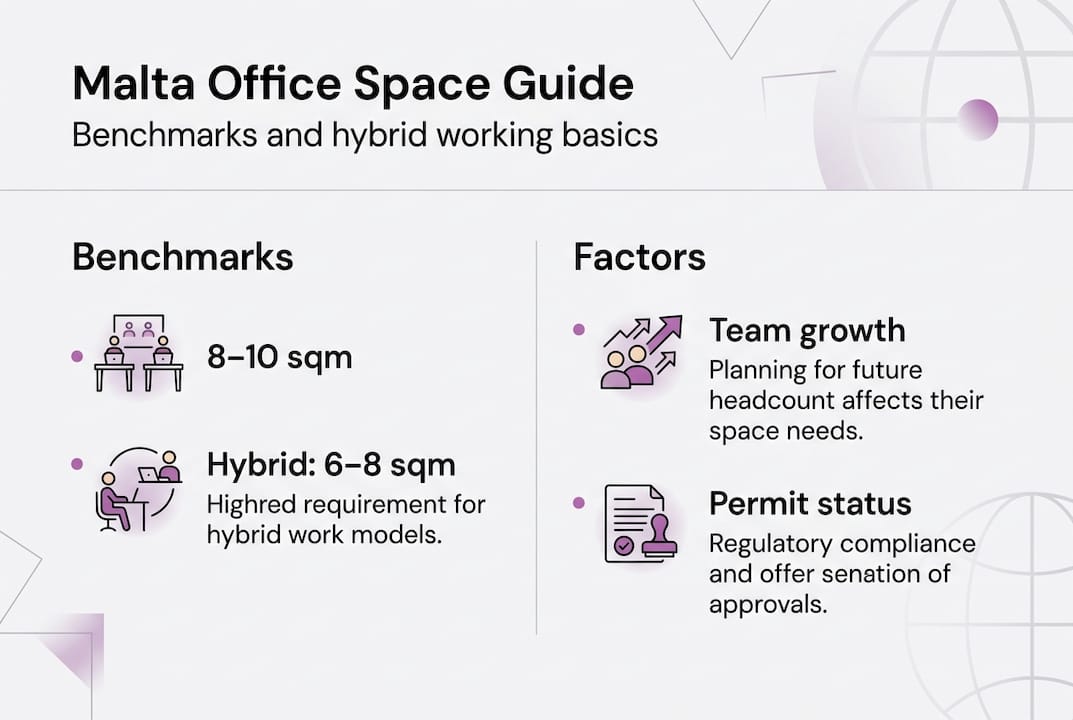
| Open plan (standard) | 8–10 sqm | Most common in Maltese SME offices |
| High-density open plan | 6–8 sqm | Tech firms, call centres |
| Hybrid (hot-desking) | 5–7 sqm | 0.6–0.8 desk-to-employee ratio |
| Executive/private offices | 15–20 sqm | Directors, senior managers |
| Serviced offices | 8–12 sqm | Inclusive of shared amenities |
Standard benchmark: BOMA and GSA guidance consistently points to 9–14 sqm per person as the current functional range for modern commercial offices. Requirements above this typically reflect sector-specific needs or high-end fit-outs.
For a practical starting point, use the office space calculator on OfficeSpace.Rent to model different scenarios before committing to a viewing. Getting the numbers right early avoids expensive corrections later.
Calculating space for 15 employees: Malta benchmarks
With updated benchmarks in mind, let us see what this means for your 15-person team.
A base of 150 sqm is a solid starting point for 15 employees in a standard open-plan Malta office. Hybrid working can reduce that by 20–30%, bringing you to approximately 105–120 sqm if a portion of staff work remotely on a rotational basis.

Model comparison for 15 employees:
| Office model | Core desk area | Add-ons | Total estimate |
|---|---|---|---|
| Full open plan | 120–150 sqm | Meeting rooms, kitchen | 155–185 sqm |
| Hybrid (60% occupancy) | 90–105 sqm | Collaboration zones | 125–150 sqm |
| Executive/mixed | 150–180 sqm | Private offices, lounge | 190–230 sqm |
To build your actual space requirement, follow these steps:
- Calculate core desks. Multiply your daily peak occupancy by 9–10 sqm per workstation.
- Add meeting space. Budget 15–25 sqm for a mid-sized meeting room. Larger teams may need two.
- Include shared areas. A kitchen and breakout zone typically requires 10–15 sqm.
- Account for circulation. Corridors, reception, and storage usually add 15–20% on top of the net working area.
- Apply a growth buffer. Add 10–20% to accommodate new hires within the lease term.
Pro Tip: If your headcount is likely to increase within 18 months, target the upper end of your calculated range. Re-fitting or relocating mid-lease is costly and disruptive. Check the office rental pricing guide to understand how size affects cost across Malta’s key districts.
Hidden factors and common pitfalls
Even with the maths right, it is easy to overlook these crucial extras.
One of the most common errors SMEs make is confusing usable area with rentable area. Rentable area includes a proportionate share of shared building spaces such as lobbies, stairwells, and corridors. The difference, often called the loss factor or load factor, typically sits between 15–25% in Maltese commercial buildings. A unit listed at 180 sqm rentable may provide only 145 sqm of genuinely usable workspace.
Beyond the floor area, you need to verify the following before signing:
- Class 4A permit. All commercial offices in Malta must hold a valid Class 4A development permit. Fit-out costs, CAM charges, and permit compliance can add significantly to your total outlay.
- Fit-out costs. Budget approximately €300–€600 per sqm for standard commercial fit-outs in Malta, depending on specification and contractor. Most of the offices are offered finished in an open plan layout.
- VAT. Commercial leases in Malta are typically subject to 18% VAT, which is not always quoted upfront in listings.
- Common Area Maintenance (CAM). Charges for shared building services can add €20–€50 per sqm annually.
- Service charges. Some managed buildings include costs like cleaning and security; others do not.
It is equally important to plan for future headcount. Many SMEs sign a lease based on current staff numbers and find themselves cramped within 12 months. The Malta office space guide provides a thorough reference for navigating both permit requirements and lease negotiations.
Pro Tip: Always confirm permit status, fit-out scope, and all additional charges directly with your broker and legal adviser before exchanging documents.
Practical steps to secure the right space in Malta
Once you know your space range, here is how to make a confident property decision.
Start by building a clear requirements checklist before you approach any agent or platform:
- Minimum and maximum usable sqm (based on your calculation above)
- Preferred location: Valletta, Sliema, Gzira, St Julian’s, or other districts
- Budget per sqm per year (Gzira, for example, ranges from €150–€250/sqm annually)
- Essential amenities: car parking, broadband infrastructure, air conditioning
- Lease length flexibility: break clauses, extension options
Once you have your criteria, follow these steps:
- Shortlist three to five properties across your preferred locations using verified listings.
- Visit in person at your busiest working hour to assess noise, ventilation, and access.
- Confirm permit status with the Malta Environment and Planning Authority (MEPA) records.
- Request floor plans showing both rentable and usable area for every shortlisted option.
- Negotiate terms including fit-out contribution, rent-free periods, and break clauses.
- Check growth capacity. Can the space accommodate an additional three to five staff without full relocation?
Reviewing the costs of renting offices across different localities will help you prioritise which districts offer the best value for your size and sector.
The real challenge: Matching growth with flexibility
Numbers and checklists only tell part of the story. Many SMEs lock themselves into rigid spaces that made perfect sense at signing but became a constraint within two years. A lease for 150 sqm feels right for 15 people today but can quickly become limiting when headcount reaches 20.
Collaboration-focused design, including hot-desking zones, shared project tables, and bookable meeting rooms, protects against both over- and under-utilisation. Open-plan layouts boost collaboration but require careful acoustic and zoning management to avoid productivity losses from noise and distraction.
The most pragmatic approach is to revisit your space needs annually, not just at renewal. Work patterns in Malta, as across Europe, are still adjusting. Businesses that build annual space reviews into their operational planning stay ahead of shifting cost and utilisation trends rather than reacting to them.
Find your ideal office space with expert help
If you are ready to put this knowledge into action, OfficeSpace.Rent provides the tools and local expertise to move quickly and confidently. Use the platform to estimate your space requirements, browse live office listings in Malta, and access up-to-date rental data across all major districts. For teams actively scaling, the expert advisory service covers fit-out costing, permit checks, and lease negotiation in one place. Start your search for renting office space in Malta with a clear brief and the right support behind you.
Frequently asked questions
What is the standard office space per person in Malta?
The common standard is 8–10 sqm per person for open-plan offices in Malta. Hybrid arrangements typically reduce this to 5–7 sqm per allocated desk, using a 0.6–0.8 desk-to-employee ratio.
How does hybrid working affect office space needs?
Hybrid work reduces required office space by 20–30% because not all staff are present simultaneously, allowing for shared desk arrangements rather than one-to-one allocation.
Are there extra costs apart from rent when renting an office in Malta?
Yes. Expect VAT at 18%, common area maintenance charges, and fit-out costs of €300–€600 per sqm. Verifying that the premises hold a valid Class 4A office permit is also essential before signing. Agency fees are one time and amounting to 10% of the first years rent plus 18% VAT.
What if our team grows unexpectedly after signing a lease?
Planning for 10–20% additional space at the time of signing is a reliable safeguard. Alternatively, opt for a serviced or flexible workspace that allows you to expand without relocating.
Recommended
- Calculator: Estimate Your Office Space Requirements – Offices in Malta To Let & For Sale
- Office Space in Malta: Your Guide to Renting
- Guide to Office Size and Layouts: Finding Your Space – Offices in Malta To Let & For Sale
- Office Rental Prices in Malta Explained – Offices in Malta To Let & For Sale
- Büroräume flexibel mieten Tipps für Startups & KMU | ProOffice Business Center Blog