TL;DR:
- Office fit-out transforms empty shells into functional workspaces with customized partitions, lighting, and infrastructure.
- Proper planning, clear briefing, and understanding responsibilities are crucial to avoid delays and cost overruns.
- Costs in Malta range from €300 to €900 per square meter, influenced by design complexity and materials quality.
Many businesses in Malta sign an office lease believing the hard work is done, only to discover that transforming an empty shell into a productive workspace is a project in its own right. Fit-out is the process of customising a leased commercial space from a basic structure into a fully functional office tailored to a tenant’s operational needs. Underestimate it, and you face budget overruns, delayed move-ins, and a workspace that simply does not support how your team works. This guide cuts through the complexity and gives Malta-based businesses a clear, practical framework for getting fit-out right.
Table of Contents
- What does fit-out mean in office leasing?
- The step-by-step fit-out process explained
- Who pays for what? Landlord and tenant fit-out responsibilities
- How much does office fit-out cost in Malta?
- Local nuances and expert tips for Malta office fit-outs
- The overlooked truths about fit-out for Maltese businesses
- Finding the right office space and fit-out solution in Malta
- Frequently asked questions
Key Takeaways
| Point | Details |
|---|---|
| Fit-out transforms your office | A professional fit-out customises the leased space for your workflow and branding needs. |
| Responsibilities are split | Landlords give a blank slate; tenants fund and design their own workspaces. |
| Typical Malta costs | Expect to pay €300–900 per sqm for a standard office fit-out in Malta. |
| Hybrid work changes strategy | Flexible working can greatly lower space needs and fit-out expenses. |
| Expert briefing prevents overruns | Clear early planning and requirements gathering controls time and cost surprises. |
What does fit-out mean in office leasing?
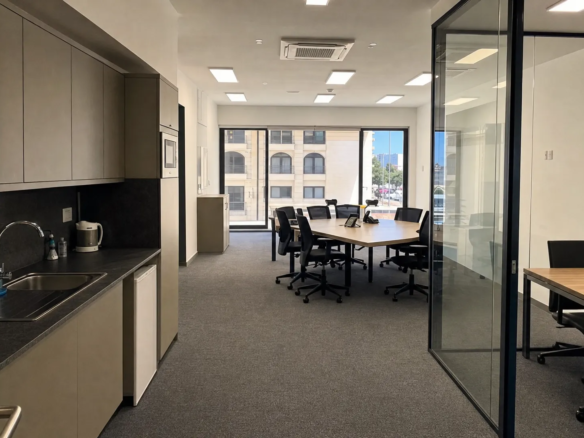
Fit-out is far more than painting walls and installing desks. In commercial leasing, fit-out transforms a shell into a workspace by incorporating partitions, flooring, lighting, furniture, IT infrastructure, and branding elements. The distinction between two categories shapes every negotiation and budget conversation.
Category A (Cat A) refers to the base build delivered by the landlord. This typically includes raised floors, suspended ceilings, basic mechanical and electrical services, and fire safety systems. The space is functional but entirely generic.
Category B (Cat B) is where the tenant takes over. This layer adds everything that makes the office specific to your business: meeting rooms, branded reception areas, collaborative zones, server rooms, and custom lighting schemes. Understanding office size and layouts is essential at this stage, because the layout you choose will directly determine your Cat B scope and cost.
Key elements typically covered in a Cat B fit-out
- Internal partitions and glazed walls
- Flooring finishes (carpet tiles, LVT, polished concrete)
- Bespoke lighting design and controls
- IT cabling, server rooms, and AV systems
- Kitchen and breakout areas
- Branded signage and reception features
- Furniture, storage, and acoustic panels
A well-executed Cat B fit-out does more than improve aesthetics. It directly shapes staff productivity, client perception, and your ability to attract and retain talent.
The commercial relocation process is closely linked to fit-out planning, and businesses that coordinate both workstreams simultaneously tend to achieve smoother transitions with fewer costly surprises.
The step-by-step fit-out process explained
Every fit-out project, regardless of size, follows a structured lifecycle. The fit-out process moves through briefing, survey, design, approvals, procurement, installation, and handover. Skipping or rushing any stage is the single most common cause of cost and time overruns.
- Briefing — Define your operational requirements, headcount, working styles, and technology needs. Involve department heads and HR from the outset.
- Survey — A detailed measured survey of the leased space identifies structural constraints, existing services, and any compliance issues.
- Design — Architects and interior designers produce concept drawings, space plans, and technical specifications.
- Approvals — In Malta, planning permission or building regulation consent may be required, particularly in older buildings or mixed-use developments.
- Procurement — Contractors, suppliers, and specialist subcontractors are appointed. Lead times for furniture and bespoke joinery can run to 12 weeks or more.
- Installation — Works are carried out, typically in a phased sequence to manage disruption and quality control.
- Handover — Snagging, testing, and commissioning confirm the space meets the agreed specification before occupation.
📊 Statistic callout: Poor briefing at stage one is the leading cause of budget overruns across EMEA fit-out projects, with scope changes mid-project adding an average of 15 to 25 per cent to original cost estimates.
Pro Tip: Run a structured requirements workshop with all key stakeholders before appointing a designer. Document decisions formally. A clear brief is the single most effective cost-control tool available to any Maltese business undertaking a fit-out.
Reviewing office lease negotiation tips before signing is equally important, because the lease itself should reflect fit-out timelines, landlord obligations, and any agreed contributions before you commit.
Who pays for what? Landlord and tenant fit-out responsibilities
Financial responsibility in a fit-out is rarely straightforward. Responsibilities are typically split so that landlords deliver Cat A, while tenants fund Cat B. However, lease negotiations in Malta often produce more nuanced arrangements.

| Element | Typically landlord | Typically tenant |
|---|---|---|
| Base structure and shell | ✅ | |
| Cat A mechanical and electrical | ✅ | |
| Cat B partitions and finishes | ✅ | |
| Furniture and IT | ✅ | |
| Tenant Improvement Allowance | Negotiable | |
| Reinstatement at lease end | ✅ |
Several important mechanisms are worth understanding before you sign:
- Tenant Improvement Allowance (TIA): A landlord contribution towards Cat B costs, typically offered on longer leases of five years or more. In Malta’s current market, TIAs are negotiable but not universal.
- Rent-free fit-out period: Landlords may grant a period of free occupation while works are carried out, commonly two to four weeks for smaller spaces and up to three months for larger floor plates.
- Reinstatement obligations: Most Maltese leases require tenants to return the space to its original Cat A condition at lease end. This cost, often around €130 per square metre, should be factored into your total occupancy budget from day one.
Pro Tip: Always clarify reinstatement obligations in writing before signing the lease. Some landlords will waive reinstatement in exchange for a higher TIA or a longer lease commitment. Understanding your tenant rights and obligations before entering negotiations gives you a stronger position.
How much does office fit-out cost in Malta?
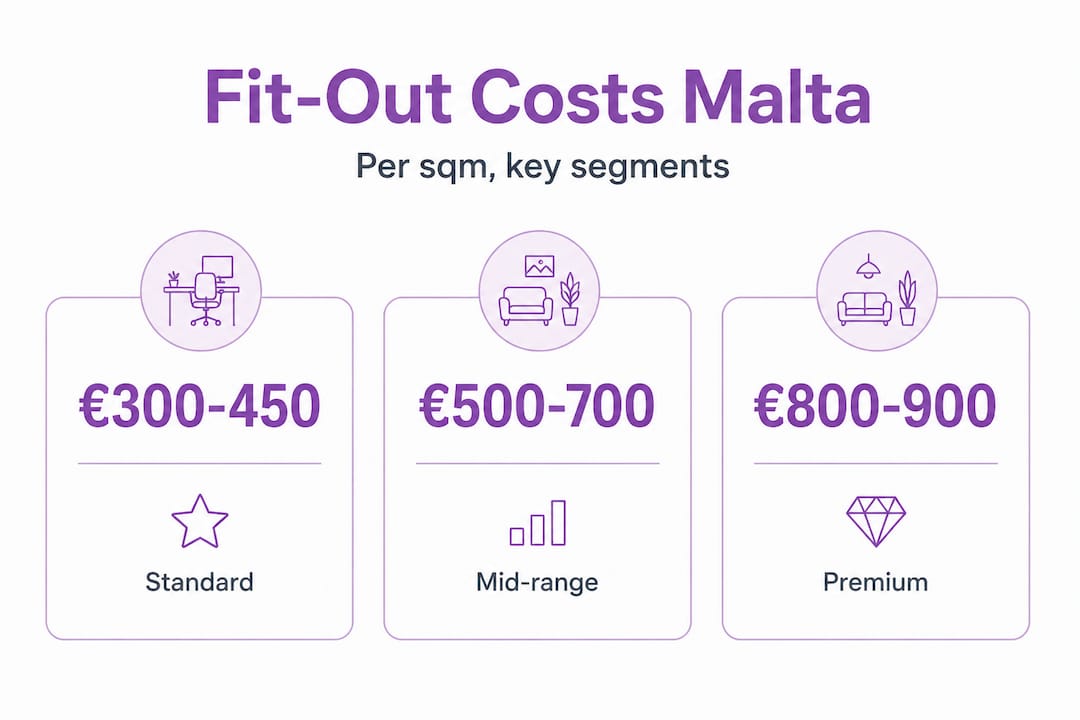
Cost is the question every business asks first. Malta office fit-out typically costs between €300 and €900 per square metre, depending on the complexity of the design, the quality of materials, and the level of technology integration required.
| Fit-out specification | Cost per sqm (Malta) | Typical use case |
|---|---|---|
| Basic/standard | €300 to €450 | SMEs, back-office functions |
| Mid-range | €450 to €650 | Professional services, tech firms |
| High specification | €650 to €900+ | Financial services, Class 4A offices |
For businesses considering serviced offices as an alternative, all-inclusive costs typically range from €350 to €800 per desk per month, which removes the capital expenditure of fit-out entirely but limits customisation.
Key cost drivers in Malta include:
- Labour costs: Malta’s construction labour market is tight, and skilled trades command premium rates, particularly for specialist joinery or glazed partition systems.
- Material sourcing: Most high-specification materials are imported, adding lead times and freight costs that do not apply in larger markets.
- Space complexity: Open-plan layouts cost less per square metre than cellular office configurations with multiple meeting rooms and acoustic requirements.
- Regulatory compliance: Finance sector tenants subject to MFSA requirements face additional compliance costs for data security, access control, and fire separation.
Reviewing current Malta office rental prices alongside fit-out benchmarks gives a complete picture of total occupancy cost. For a fuller breakdown of how fit-out interacts with rental commitments, the office rental pricing Malta guide and the detailed analysis of the cost of renting offices in Malta provide current market data across all major commercial districts.
Local nuances and expert tips for Malta office fit-outs
Malta’s office market has characteristics that can significantly affect fit-out planning and cost. Knowing them in advance avoids expensive surprises.
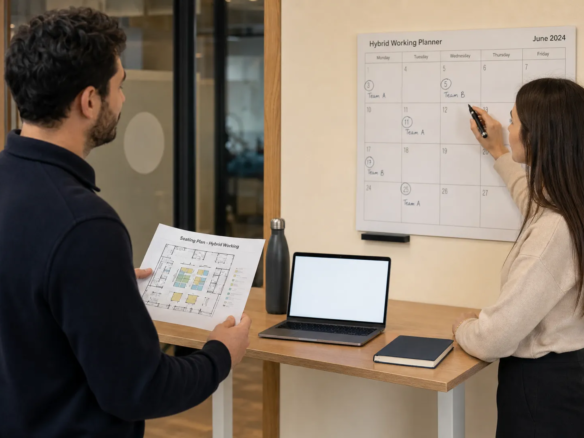
- Hybrid working is reshaping space requirements. Hybrid working reduces office space needs by 20 to 40 per cent, meaning many businesses can achieve the same operational capacity in a smaller, better-fitted space rather than a larger, generic one.
- Listed buildings and conservation areas add planning complexity. Several commercial properties in Valletta and the Three Cities require heritage authority approval for any structural changes, which extends timelines by weeks or months.
- Finance sector compliance is non-negotiable. MFSA-regulated businesses must meet specific requirements for data room security, visitor access segregation, and record storage, all of which affect fit-out design from the outset.
- ESG and sustainability are rising priorities. Tenants in newer Grade A buildings are increasingly expected to specify low-energy lighting, sustainable materials, and waste management provisions as part of their fit-out.
Future-proofing your fit-out by designing for flexibility, not just current headcount, is the most cost-effective decision a Maltese business can make in 2026.
Pro Tip: Build a 20 per cent contingency into your fit-out budget from day one. In Malta’s supply-constrained market, material delays and trade availability issues are common, and a contingency prevents a minor disruption from becoming a major cost event.
Tracking Malta office market trends helps businesses time their fit-out investment to align with broader market conditions, particularly when planning a relocation or expansion.
The overlooked truths about fit-out for Maltese businesses
Most businesses focus on the aesthetics of fit-out and underestimate the strategic and regulatory dimensions. Having worked across Malta’s commercial office market, the pattern is consistent: the businesses that experience the worst outcomes are those that treated fit-out as an afterthought rather than a core part of their leasing decision.
Poor briefing leads to overruns more reliably than any other single factor. A business that spends two weeks on a thorough brief will almost always spend less overall than one that rushes into design and makes changes mid-construction. In Malta’s small contractor market, change orders are expensive and slow.
The regulatory complexity is also consistently underestimated. Planning approvals, heritage consents, and sector-specific compliance requirements can add months to a project timeline. A business that signs a lease assuming it can occupy in eight weeks may find itself waiting five months if it has not done the regulatory groundwork first.
Finally, hybrid working is not a temporary trend. It is reshaping how Maltese businesses should think about space. A well-designed fit-out for 40 people working flexibly will outperform a poorly designed fit-out for 60 people working full-time, both in cost and in staff experience. The off-market fit-out case study on the OfficeSpace.Rent platform illustrates precisely how a structured approach to space planning and fit-out delivered measurable operational gains for a Malta-based business.
Finding the right office space and fit-out solution in Malta
OfficeSpace.Rent supports businesses at every stage of the office leasing and fit-out journey across Malta. Whether you are evaluating a traditional leased office or a serviced solution, the platform provides current listings, pricing benchmarks, and direct access to local agents who understand fit-out requirements and lease structures. Properties such as Mriehel commercial office space and Attard commercial property rental represent the range of options available across Malta’s key commercial hubs. From initial space search through to lease negotiation and fit-out planning, OfficeSpace.Rent connects businesses with the right spaces and the expertise to make informed decisions. Explore current listings or contact a local agent to discuss your specific requirements.
Frequently asked questions
What is included in a typical office fit-out?
A typical office fit-out covers partitions, flooring, lighting, ICT infrastructure, furniture, and branding, transforming a shell into a fully operational and tailored workspace.
How long does an office fit-out usually take in Malta?
A standard fit-out can range from several weeks for small offices to several months for larger or more complex spaces, with best practices including stakeholder workshops and early regulatory engagement to avoid delays.
Who pays for the fit-out in an office lease?
Tenants typically fund Cat B fit-out, while landlords provide Cat A. Lease negotiations may include a Tenant Improvement Allowance or a rent-free fit-out period, particularly on longer lease commitments.
What does reinstatement mean at the end of a lease?
Reinstatement means returning the office to its original Cat A condition. In Malta, this obligation costs approximately €130 per square metre and should be budgeted from the start of any lease.
How can hybrid working trends affect fit-out needs?
Hybrid working typically reduces required office space by 20 to 40 per cent, allowing businesses to invest in a higher-quality, smaller fit-out rather than a larger but less functional one.
Recommended
- Office rental negotiation guide: Secure the best deal in Malta
- Office Lease Negotiation Malta: Essential Tips – Offices in Malta To Let & For Sale
- Guide to Office Size and Layouts: Finding Your Space – Offices in Malta To Let & For Sale
- Complete Guide to Office Space in Malta for Corporations
- Commercial relocation explained: move offices efficiently