TL;DR:
- Maltese office leases often contain hidden escalation clauses and ambiguous maintenance responsibilities.
- Understanding ‘di fermo’ and ‘di rispetto’ periods is crucial to avoid costly early exit penalties.
- Proper preparation, legal review, and negotiation strategies can significantly reduce lease risks and disputes.
Signing an office lease in Malta without thorough preparation is one of the costliest mistakes a business can make. Tenants regularly discover hidden rent escalation clauses, ambiguous maintenance responsibilities, and unfavourable notice periods only after the contract is signed and operational costs begin to mount. When searching for an office, it’s crucial to be aware of lease traps to avoid in Malta. This guide is structured to change that outcome. You will learn to identify the most common leasing traps in Malta, use a practical pre-signing checklist, apply proven negotiation strategies, and understand your legal protections under Maltese law, so you can secure office terms that genuinely serve your business.
Table of Contents
- Common lease traps in Malta
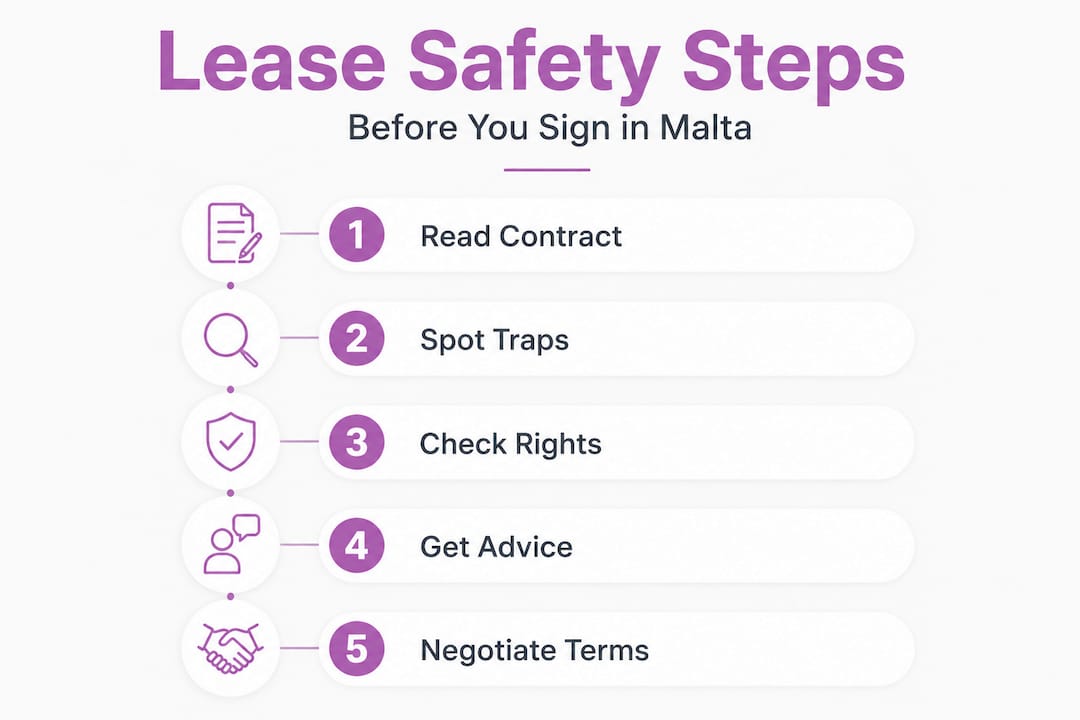
- Checklist: what to review before signing
- How to negotiate a safer lease
- Protected leases and dispute resolution
- Why smart lease preparation beats last-minute fixes
- Find safe office lease options in Malta
- Frequently asked questions
Key Takeaways
| Point | Details |
|---|---|
| Spot hidden lease traps | Review rental rises, ambiguous terms, and maintenance clauses to avoid costly surprises. |
| Checklist before signing | Use a comprehensive checklist to verify documents, compensation rights, and lease periods. |
| Negotiate for protection | Clarify terms and use expert tips to secure safer, tenant-friendly contracts in Malta. |
| Know your legal rights | Protected leases under Maltese law offer compensation—understand di fermo and di rispetto periods. |
Common lease traps in Malta
Malta’s commercial office market is competitive, and landlords often present contracts weighted in their own favour. Understanding where the risks lie is the first line of defence for any prospective tenant.
The most frequently encountered traps include:
- Hidden rent escalation clauses: Leases may include automatic annual rent increases tied to the Retail Price Index or a fixed percentage. Check that these are within the normal limits of 3-5% yearly.
- Long notice periods: Some contracts specify notice periods as six months or one year! These are very hard to exit should you need to relocate office as most offices have a 3 months notice period. You would have to give termination without finding your next office. Leaving your business at risk.
- Termination notice by both Lessor and Lessee, can leave landlords free to repossess the space with minimal warning.
- Ambiguous maintenance responsibilities: Lease agreements sometimes fail to define clearly who is responsible for structural repairs, HVAC servicing, or common area upkeep, which can lead to costly disputes.
- Undefined permitted use clauses: Restrictions on how the premises can be used may block you from expanding your operations or subleasing unused space.
- Deposit terms lacking transparency: Some leases do not specify conditions under which the deposit will be returned, leaving tenants exposed.
Understanding the structure of a office rental agreement Malta is essential before you even begin comparing properties.

Two legal concepts specific to Malta’s commercial leasing framework require particular attention. A di fermo period is the minimum commitment phase during which neither party can terminate the agreement without penalty. A di rispetto period follows immediately after, during which either party may terminate the lease by giving the agreed notice. Misunderstanding the distinction between these two periods is a common source of tenant disputes. Under the Commercial Leases Act, protected leases carry rights to compensation, making it critical for tenants to identify whether their lease qualifies.
| Lease term | What it means | Tenant risk if misunderstood |
|---|---|---|
| Di fermo period | Minimum fixed commitment phase | Early exit penalties and breach of contract |
| Di rispetto period | Termination notice window post-di-fermo | Loss of compensation rights if notice is wrong |
| Protected lease | Lease governed by Commercial Leases Act | Missing entitlements to compensation |
| Rent escalation clause | Automatic rental increases per term | Unexpected budget overruns year on year |
Key insight: Many businesses in Malta sign leases without realising the di fermo and di rispetto distinction until they attempt to exit early. At that point, the financial penalties can be severe. Reading the lease in full, with legal guidance, is not optional.
For broader context on how lease negotiation tips Malta apply at a strategic level, reviewing market-specific guidance is highly recommended. It is also worth noting that similar patterns of long-term leasing complexity appear in other Mediterranean markets, as seen in this long-term lease explanation Mallorca, where clarity on commitment periods is equally critical.
Pro Tip: Request a plain-English summary of every clause from your solicitor before signing. Do not rely on verbal assurances from a landlord or agent.
Checklist: what to review before signing
Now that you have identified potential traps, equip yourself with this checklist before moving forward. Every item here represents a real point of failure that businesses have experienced in the Maltese market.
Premises inspection:
- Inspect the physical condition of the office, including ceilings, flooring, electrics, and plumbing.
- Confirm the air conditioning system is functional and clarify who covers maintenance costs.
- Check for any existing damage and ensure it is documented and excluded from your liability.
Lease document scrutiny:
- Confirm the exact duration of the di fermo and di rispetto periods.
- Identify any automatic rent review clauses and understand the calculation mechanism.
- Check whether the lease is classified as a protected lease under Maltese law.
- Verify permitted use clauses match your intended business operations precisely.
- Review the deposit terms, including conditions for full return.
Legal and administrative checks:
- Request authenticated copies of the landlord’s title deed to confirm ownership.
- Verify there are no outstanding charges or disputes registered against the property.
- Confirm that the premises hold the relevant planning permits for commercial office use.
| Review area | Document or action required | Priority level |
|---|---|---|
| Di fermo and di rispetto periods | Read lease clauses carefully with legal counsel | 🔴 Critical |
| Rent escalation | Identify and negotiate or cap increase mechanism | 🔴 Critical |
| Protected lease status | Verify with solicitor under Commercial Leases Act | 🔴 Critical |
| Maintenance obligations | Define responsibilities in writing within the lease | 🟠 High |
| Deposit return conditions | Ensure conditions are explicit in the contract | 🟠 High |
| Permitted use | Match exactly to your operational requirements | 🟠 High |
| Title deed verification | Request authenticated copy from landlord | 🟡 Standard |
As part of your commercial search workflow Malta, building these verification steps into your property evaluation process will save significant time and cost. The office rental negotiation Malta guide provides further practical detail on structuring your approach. Comparable due diligence requirements exist in other markets, such as those outlined for commercial property buying Mallorca.
Understanding rights to compensation under protected leases is a non-negotiable part of this checklist. Many tenants overlook this until a dispute arises.
Pro Tip: Use a two-column checklist format during your site visit: one column for what you observed, one for what the lease states. Discrepancies are your negotiation leverage.
How to negotiate a safer lease
Use these negotiation strategies to improve your position and minimise risks in your contract. Negotiation is not confrontational; it is a structured dialogue aimed at producing a fair, clearly defined agreement.
- Define all ambiguous terms in writing. If a clause references “reasonable maintenance,” ask for a precise definition. Vague language always favours the party with more resources to litigate. Usually we specify ordinary and extraordinary maintanance.
- Negotiate a break clause. A break clause allows you to exit the lease at a defined point before the di fermo period ends, subject to agreed penalties. This provides operational flexibility without breaching the contract. Not many owners accept this, however you can ask for the option to find a replacement tenant at your own cost taking on the same terms at the owners discretion and acceptance.
- Cap rent escalation. If the lease includes an annual rent review, negotiate a ceiling, for example, no more than four percent per year, regardless of index movements. Standard terms are 3-5% yearly increases.
- Specify repair and maintenance responsibilities by category. Separate structural repairs from cosmetic maintenance and from mechanical systems, and assign responsibility to each party in writing.
- Agree on a reinstatement schedule. Define what condition you are required to return the premises in at lease end, and document the starting condition with photographs.
- Request a rent-free period. Particularly in longer leases, landlords in Malta will often agree to one to 1-2 weeks to one month of rent-free occupation at the start, in exchange for a firm commitment on the di fermo period.
The guidance on how to negotiate office lease Malta provides a structured framework for applying these steps in real negotiations. Reviewing essential negotiation tips before entering discussions will help you prioritise which terms carry the most value for your specific business profile.
Under the Commercial Leases Act, protected lease tenants hold statutory rights that strengthen their negotiating position considerably. Knowing your rights before the negotiation begins is a material advantage.
Pro Tip: Never negotiate on rental price alone. The most experienced tenants in Malta focus on lease structure, break rights, and maintenance terms, which often carry more financial impact than a five percent rent reduction.
Protected leases and dispute resolution
Understanding legal rights is essential as you finalise your lease and prepare for possible disputes. Not all commercial leases in Malta are protected, but those that qualify offer tenants a meaningful layer of legal security.
Key features of a protected lease under Malta’s Commercial Leases Act include:
- Compensation rights on termination: If a landlord terminates a protected lease without grounds, the tenant may be entitled to compensation for loss of business.
- Security of tenure: Protected tenants cannot be evicted without due process and proper notice in compliance with the Act.
- Di fermo obligations: Both parties are bound to honour the minimum commitment period; early exit triggers financial liability.
- Di rispetto notice requirements: Correct notice during the di rispetto period is mandatory. Incorrect notice can nullify your termination rights.
- Dispute resolution route: Commercial lease disputes in Malta are typically resolved through the Rent Regulation Board, which has jurisdiction over protected lease matters.
Legal note: Protected lease rights under Maltese law are not automatic. Your lease must explicitly qualify, and the terms must comply with the Act’s requirements to trigger these protections.
For a detailed reference on Maltese lease law as it applies to commercial tenants, the lease law reference Malta resource provides a reliable starting point. Lease security frameworks in other Mediterranean jurisdictions, such as those reviewed in lease security Mallorca, illustrate how structured legal frameworks consistently produce better outcomes for commercial tenants.
Why smart lease preparation beats last-minute fixes
Here is a view that is not commonly stated but is well supported by what we observe in Malta’s office market and Lease traps to avoid in Malta. Most lease problems are not legal problems. They are preparation problems.
Businesses rush the lease process. They find a space they like, they want to occupy it quickly, and they treat the legal and contractual review as a formality rather than as a strategic exercise. By the time a dispute arises, whether over maintenance costs, early exit penalties, or a misunderstood di rispetto notice, the contract is already signed and the options are limited. Legal remedies exist, but they are costly, time-consuming, and rarely produce the outcome the tenant originally wanted.
Proactive preparation changes this equation entirely. A tenant who has reviewed the negotiation guide Malta before entering discussions, engaged a local solicitor during the due diligence phase, and understood the distinction between di fermo and di rispetto periods before signing holds a fundamentally stronger position. Not just legally, but commercially. Landlords respond differently to tenants who demonstrate informed engagement with the contract.
The uncomfortable reality is that most landlords in Malta are experienced parties to commercial leasing. They have signed dozens of these agreements. For a first-time or infrequent commercial tenant, the information asymmetry is significant. The only credible way to close that gap is through preparation, not negotiation skill alone.
Short-term thinking, driven by urgency to secure space, produces contracts that create long-term operational constraints. The businesses that thrive in Malta’s office market are those that treat lease review as a business investment, not an administrative burden.
Find safe office lease options in Malta
OfficeSpace.Rent provides business owners and managers with verified listings, market pricing data, and expert leasing guidance across Malta’s key commercial districts. Whether you are searching for your first commercial space or renegotiating an existing arrangement, the platform connects you with options that match your operational and contractual requirements. Browse Mriehel commercial leases for one of Malta’s most active office corridors, or explore Attard office rentals for more flexible leasing options with competitive terms. Each listing is supported by transparent pricing information and access to local agents who understand the specific legal requirements of Maltese commercial leases.
Frequently asked questions about Lease traps to avoid in Malta
What is a ‘di fermo’ period in Malta leases?
A ‘di fermo’ period is the minimum commitment phase in a Maltese commercial lease, during which the tenant must remain in the premises or face financial penalties for early exit. Under the Commercial Leases Act framework, this period is legally binding for both parties.
How do I check if my lease is protected under Maltese law?
A protected lease must comply with the Commercial Leases Act and explicitly include compensation rights provisions; review your contract with a local solicitor to confirm your lease qualifies and that all statutory conditions are met.
Can I negotiate notice periods in office leases?
Yes, notice periods in Maltese commercial leases are negotiable, but both the di rispetto duration and the required notice method must be clearly defined in the contract to prevent disputes at the point of termination.
What compensation am I entitled to if my lease is terminated early?
Compensation entitlement depends on whether your lease is classified as protected and on the specific di fermo period remaining. Under Maltese law, protected tenants may claim compensation for loss of business following unlawful termination by the landlord.