TL;DR:
- Preparing a clear brief and gathering necessary documents prevent costly mistakes when renting in Malta.
- Malta’s districts vary in cost, amenities, and suitability; choosing the right location depends on business needs.
- Negotiating lease terms and understanding legal requirements ensure long-term security and operational efficiency.
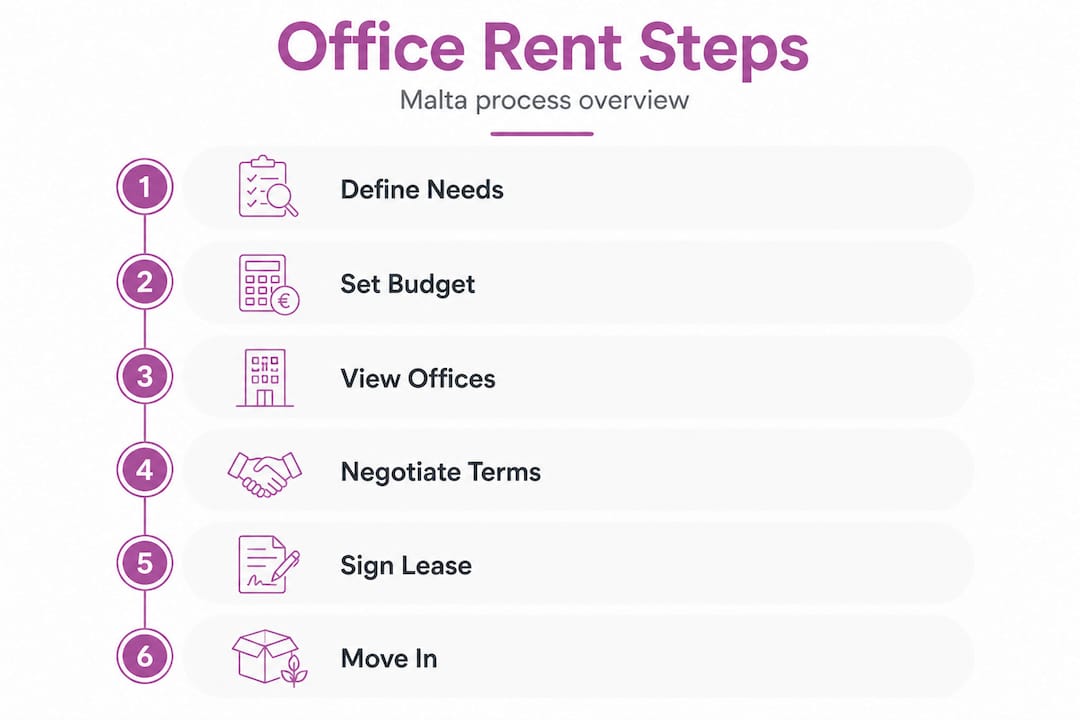
Renting office space in Malta can feel like navigating unfamiliar terrain, particularly for businesses entering the market for the first time or relocating from abroad. The local commercial property landscape has its own conventions, pricing structures, and legal requirements that differ meaningfully from other European markets. Get the process wrong and you risk overpaying, signing an inflexible lease, or ending up in a space that limits your growth. This guide walks you through every stage, from initial preparation to move-in day, so you can secure the right office with confidence. Below, you’ll find advice on How to Rent an Office in Malta Step-by-Step to ensure you make the best decisions for your business.
Table of Contents
- How to prepare for your office search
- Where to find the best office spaces in Malta
- Step-by-step: viewing, selecting, and negotiating your office
- Finalising your lease: legal checks and move-in process
- A seasoned view: mistakes most businesses make when renting in Malta
- Find your ideal office space in Malta today
- Frequently asked questions
Key Takeaways
| Point | Details |
|---|---|
| Plan before searching | Clear requirements and budgets make the office hunt more efficient and successful. |
| Choose location wisely | Different districts cater to different industries and budgets, so compare options carefully. |
| Negotiate smartly | Understanding lease terms and sticking to your priorities secures better deals. |
| Review contracts | Thoroughly checking legal documents and building management details avoids future problems. |
| Seek expert help | Local specialists can streamline the process and help you avoid costly mistakes. |
How to prepare for your office search
To start the process confidently, you must be well-prepared before any viewings. Rushing into the market without a clear brief is one of the most common and costly mistakes businesses make.
Begin by defining your core requirements. How many workstations do you need today, and how many will you need in 12 to 24 months? What is your preferred style: a traditional leased floor plate, a serviced office with flexible terms, or a co-working suite? Location preferences and commute patterns for your team also matter considerably. A company in iGaming, financial services, or tech may prioritise proximity to St Julian’s or the Central Business District, while a professional services firm may prefer a Valletta address for prestige.
Documents to prepare before approaching landlords or agents:
- Certificate of business registration (Memorandum and Articles of Association for companies)
- Directors’ or principals’ proof of identity and address
- Two years of audited financial statements or management accounts
- Bank reference letter or recent bank statements
- Trade references from existing suppliers or clients
- VAT registration number and MFSA registration where applicable
Budget clarity is equally essential. Cost of renting offices in Malta varies by district, size, and specification, and upfront costs typically include a security deposit of two to three months’ rent, agency fees, and any fit-out or reinstatement costs. Understanding these figures before you begin prevents you from falling in love with a space that exceeds your viable budget.
| Cost component | Typical range |
|---|---|
| Security deposit | 2 to 3 months’ rent |
| Agency/finder’s fee | 50% to 100% of one month’s rent |
| First month’s rent | Payable on signing |
| Fit-out or reinstatement | Varies by condition and size |
| Building maintenance contribution | Often charged separately |
Pro Tip: Before viewing a single property, spend time reading up on choosing the right office type. Serviced offices carry lower upfront commitment but higher monthly costs per square metre. Traditional leases offer more control and often better value at scale.
Where to find the best office spaces in Malta
Once your needs are clear, it is time to focus your search on Malta’s top office locations. The island is compact, but the differences between business districts are significant in terms of prestige, pricing, and practical suitability.
Malta office locations each carry distinct advantages depending on your sector and operational priorities. Here is how the main districts compare:
| District | Best suited for | Key advantage | Relative cost |
|---|---|---|---|
| St Julian’s | Tech, iGaming, financial services | Modern Grade A stock, high footfall | High |
| Sliema | Professional services, retail-facing | Established business community, transport links | High to medium |
| Valletta | Legal, government, finance | Prestige address, heritage buildings | Medium to high |
| Gzira | Startups, cost-conscious tenants | Value for money, growing infrastructure | Medium |
| Central Business District (CBD), Pembroke | Corporate headquarters, regulated sectors | Purpose-built Grade A offices, ample parking | High |
| Msida | Pharma, health, academic-adjacent | Proximity to University, lower cost | Low to medium |
Key factors to weigh when choosing a locality:
- Talent access: Central areas attract a wider pool of candidates who can commute without a car.
- Client perception: A Valletta or CBD address carries more prestige than a peripheral location for client-facing businesses.
- Vacancy rates: Gzira and Msida tend to have higher availability, which gives tenants more negotiating leverage.
- Transport infrastructure: Sliema and St Julian’s are well-served by bus routes and are walkable for many employees.
- Parking provision: The CBD and business parks outside the main urban core generally offer structured parking, which central areas often cannot.
Serviced offices in central areas such as St Julian’s and Sliema provide immediate occupancy with minimal setup cost, making them particularly attractive for international companies establishing a presence in Malta before committing to a longer-term leased space.
Step-by-step: viewing, selecting, and negotiating your office
With your target districts in mind, you can now start visiting offices and engage in practical steps. The viewing and negotiation stage determines not only the price you pay but the conditions under which you will operate for years.
Follow these steps during your search:
- Book at least three to five viewings across your shortlisted areas before forming any preference. Comparing properties directly sharpens your judgement considerably.
- Assess the floor plate carefully. Check natural light, ventilation, column positions that restrict desk layouts, and the condition of raised floors or ceiling void for cabling.
- Ask the agent or landlord specific questions. Who manages the building? What is included in the service charge? Has there been any recent flooding, structural work, or disputes with previous tenants?
- Review the building’s common areas. Lifts, stairwells, lobby presentation, and shared toilets all reflect management standards.
- Evaluate connectivity. Confirm available fibre providers, whether the building has a dedicated riser, and backup power arrangements.
- Use a structured property evaluation guide to score each property against your defined criteria rather than relying on gut feeling alone.
Once you have shortlisted two or three options, the negotiation begins. Refer to lease negotiation tips to understand what landlords in Malta typically accept and where there is genuine room to move. Negotiating office lease terms effectively can save your business thousands of euros annually.
“The most effective negotiation position is one built on market knowledge. Knowing the vacancy rate in your target district and the average time-to-let for similar spaces gives you factual grounds to push on rent, incentives, and lease flexibility.”
What is typically negotiable in Malta:
- Rent-free fit-out period (commonly one to three months on longer leases)
- Break clauses at year two or three for leases of three years or more
- Rent review mechanisms and caps
- Landlord contributions to fit-out costs
- Car parking spaces included in the headline rent
Pro Tip: Never accept the asking rent as fixed. In districts with higher vacancy, landlords often prefer to hold the headline rent and offer incentives such as rent-free periods or a fit-out contribution rather than reduce the quoted figure, which affects their property’s valuation.
Finalising your lease: legal checks and move-in process
After negotiating your chosen space, getting the lease right is crucial for long-term security and hassle-free operations. Malta operates under a specific legal framework for commercial tenancies, and it differs from residential property law in important respects.
Legal checks before signing:
- Confirm the landlord has valid title to let the property. Request a copy of the deed of ownership or a notarial certificate.
- Verify planning permits confirm the space is approved for commercial use, specifically Class 4A office use.
- Review the lease for alienation clauses, which govern your ability to sublet or assign.
- Clarify the reinstatement obligation: are you required to return the space to its original condition at lease end?
- Ensure the office lease agreements clearly specify who is responsible for structural versus internal maintenance.
| Pre-move-in requirement | Detail |
|---|---|
| Utility transfer | Register electricity, water, and internet accounts in your company’s name |
| Insurance | Obtain public liability and contents insurance before occupation |
| Security deposit lodgement | Confirm receipt of deposit acknowledgement in writing |
| Inventory check | Document the condition of all fittings and fixtures with photographs |
| Key and access handover | Confirm number of sets provided and costs for additional copies |
If issues arise after signing, raise them promptly in writing and refer to the relevant clause in the lease. Delays in notifying the landlord of defects can weaken your legal position under Maltese contract law.
A seasoned view: mistakes most businesses make when renting in Malta
Now you have seen the process, here are insights that most standard guidance skips entirely.
The most predictable mistake is viewing too few properties before committing. Businesses in a hurry often view two or three spaces, choose one, and later discover they paid above-market rates because they lacked a genuine comparison point. View broadly, even if one option seems perfect early on.
Equally damaging is failing to clarify all costs in writing before signing. Service charges, building maintenance contributions, and air-conditioning charges can add 15 to 25% on top of the quoted rent. Understanding the cost realities for office rentals before you sign protects your operating budget from unwelcome surprises.
Many businesses also assume that a longer lease term is always strategically sound. In Malta’s current market, where Grade A supply is increasing and demand from certain sectors has moderated, a three-year lease with a break clause at year two can be significantly more valuable than a five-year fixed commitment, particularly for businesses in growth or transition phases.
Finally, the quality of building management is rarely specified in Maltese commercial leases with any precision. Who responds to HVAC failures? What are the response times for lift breakdowns? These operational details directly affect your staff experience and should be agreed upon before signing, not assumed.
Find your ideal office space in Malta today
Armed with actionable steps and expert insight, you can confidently move forward with your office search in Malta. OfficeSpace.Rent provides access to the island’s most current and detailed commercial property listings, covering every budget and location. Browse serviced offices Malta for flexible, immediately available workspaces, or explore dedicated offices in CBD for Grade A corporate options. The platform also connects you directly with experienced local agents who can support negotiations, legal checks, and fit-out coordination. Start your search across the full Malta office listings to find a space that genuinely fits your operational needs.
Frequently asked questions on How to Rent an Office
What are the average costs to rent an office in Malta?
Office rental costs vary by area and specification, but expect €150 to €400 per square metre annually for central locations, with serviced offices typically priced at the higher end of that range.
Which areas in Malta are most popular for business offices?
Sliema, St Julian’s, Valletta, Gzira, and the Central Business District attract the highest demand due to their amenities, connectivity, and concentration of professional services.
What documents do I need to rent an office in Malta?
Landlords typically require business registration documentation, proof of identity for directors, recent financial statements, and a bank reference letter before proceeding with a tenancy application.
How can I negotiate better lease terms?
Research vacancy rates in your target district, clarify all charges upfront, and negotiate lease flexibility such as break clauses or rent-free periods rather than focusing solely on the headline rent figure.