TL;DR:
- Implementing sustainable office practices in Malta reduces environmental impact, lowers operational costs, and enhances employee wellbeing.
- Key strategies include upgrading to LED lighting, applying passive design principles suited to Malta’s climate, and using circular economy materials for fit-outs.
Sustainable office space ideas are design choices and operational practices that reduce environmental impact while improving employee wellbeing and cutting long-term costs. The most effective approaches combine LED lighting upgrades, passive design principles adapted to Malta’s Mediterranean climate, circular economy materials, and smart building controls. Together, these strategies lower energy bills, reduce embodied carbon, and create healthier workplaces. For business owners and office managers in Malta, the payoff is measurable: lower overheads, stronger ESG compliance credentials, and staff who perform better in well-designed environments.
1. Start with LED lighting and smart controls
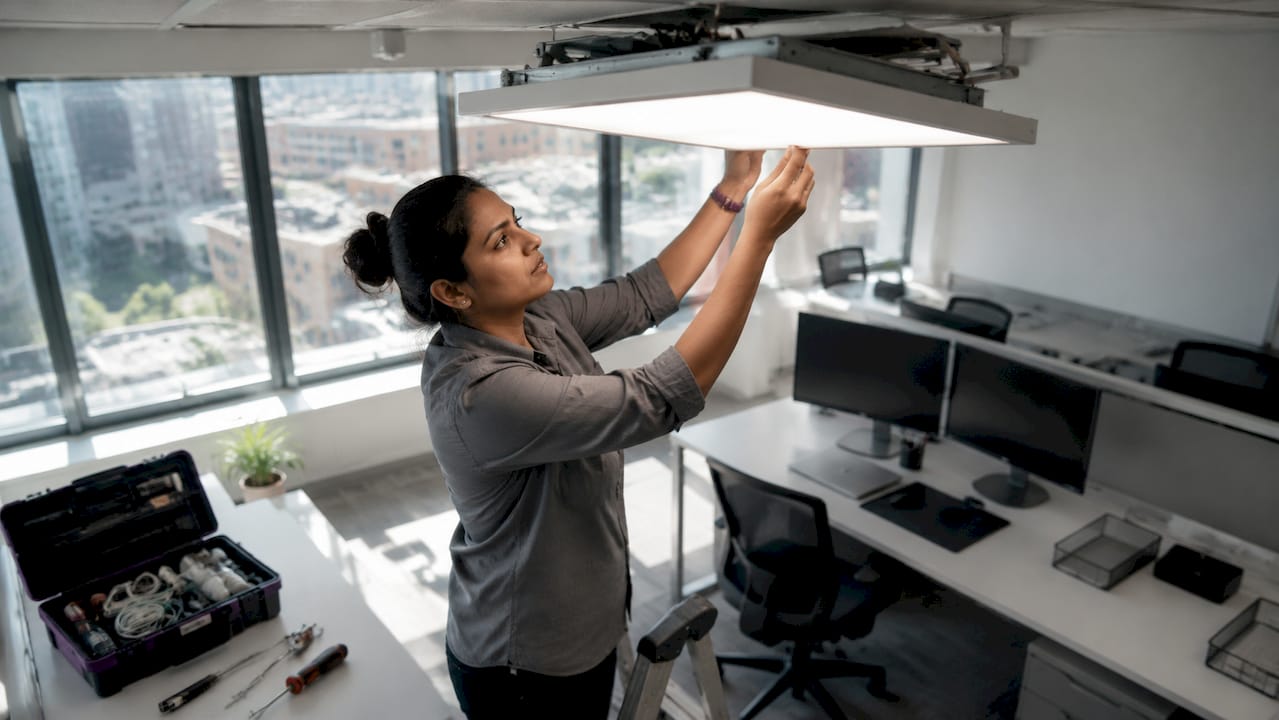
LED lighting is the single fastest-return upgrade in any office sustainability plan. Switching to LED saves 50 to 75% of energy compared to fluorescent alternatives, with payback periods of one to three years. A medium-sized Malta office running 200 LED panels for ten hours daily can generate annual energy savings that justify the capital outlay for most businesses within the first year or two — particularly relevant given Malta’s high electricity costs under the ARMS Non-Residential tariff.
Pairing LEDs with occupancy sensors and daylight harvesting controls amplifies the benefit further. Lighting energy reductions of 60 to 80% are achievable when sensors detect both presence and available natural light. Malta’s high annual sunshine hours — among the highest in Europe — mean daylight harvesting delivers above-average returns compared to northern European markets. Lights dim or switch off automatically in unoccupied zones, removing the reliance on staff behaviour to achieve savings.
Pro Tip: Install occupancy sensors in meeting rooms, corridors, and break-out areas first. These spaces are most frequently left lit when empty, so the payback is fastest there. In Malta’s business centres and older commercial stock, corridors are a particular source of unnecessary consumption.
2. Apply passive design strategies suited to Malta’s climate
Passive design is the practice of using a building’s physical characteristics to regulate temperature without mechanical systems. Passive strategies can reduce heating and cooling demand by 75 to 95%, making them the most structurally impactful item on any sustainable office features list. In Malta’s context, the primary challenge is solar gain and summer overheating rather than winter heat loss — the design priority is the inverse of most northern European offices.
Building orientation, thermal mass, shading, and insulation work together to stabilise internal temperatures year-round. For Malta specifically, external shading from louvres or deep window reveals is more effective than internal blinds at blocking solar gain before it enters the building. Reflective roof finishes and light-coloured external surfaces reduce heat absorption on sun-exposed elevations. Maltese limestone, used extensively in older commercial buildings, provides natural thermal mass that moderates temperature swings when combined with good ventilation.
For office managers working within an existing building, practical interventions include external blinds or perforated screens on south and west-facing glazing, reflective window film, and improved door seals to reduce air conditioning leakage. These are low-cost measures with measurable impact on summer energy bills — the period when ARMS electricity costs peak most sharply for commercial tenants.
If specifying a new fit-out, work with your designer on window placement and shading from the outset. Decisions made at design stage lock in the majority of a building’s long-term energy performance in Malta’s climate, where air conditioning accounts for the largest share of commercial electricity consumption.
3. Install smart building management systems
Smart building management systems (BMS) adjust energy use dynamically based on real-time occupancy and environmental conditions. These systems use sensors for occupancy, daylight levels, and temperature to automate lighting and HVAC operations without manual intervention. The result is energy consumption that tracks actual demand rather than fixed schedules.
A BMS is particularly effective in offices with variable occupancy patterns, including hybrid working environments that are increasingly common across Malta’s commercial districts. When fewer people are present, the system consolidates air conditioning and lighting into occupied zones and dims or switches off unused areas. For multi-floor premises in Malta’s business centres, this can deliver material reductions in monthly ARMS bills during lower-attendance periods.
In Malta, where many older commercial buildings lack centralised building controls, even a lightweight IoT-based monitoring solution — such as those offered locally by IoT Solutions Ltd — can provide the consumption visibility needed to make informed decisions about HVAC scheduling and zone management, without requiring a full BMS installation.
4. Choose circular economy materials for fit-outs
Circular economy design applied to office fit-outs cuts embodied carbon by up to 36% compared to conventional approaches. Remanufactured furniture reduces associated emissions by up to 80% and lowers procurement costs by over 50%. These are not marginal gains. They represent a fundamentally different approach to how office interiors are specified and sourced — and one that is directly relevant to Malta, where reinstatement obligations at lease expiry mean that fit-out decisions carry a double cost: installation and eventual removal.
Key circular economy principles for office fit-outs include:
- Modular furniture designed for disassembly and reconfiguration rather than disposal, reducing reinstatement costs at lease expiry
- Remanufactured workstations and seating from certified suppliers
- Climate-positive flooring such as Forbo Marmoleum, which absorbs 446g of CO₂ per square metre
- Retained ceiling tiles, raised floors, and partitions where quality allows, avoiding unnecessary demolition and reducing skip costs
Pro Tip: Prioritise products carrying FSC (Forest Stewardship Council) or Global Recycled Standard certification. These credentials confirm that supply chain claims are independently verified, not self-reported. For Malta-based procurement, confirm whether local suppliers can source certified products before specifying them in a fit-out brief.
5. Retain existing office components before strip-out
Retaining quality existing components is one of the most carbon-efficient decisions in any refurbishment, and in Malta it carries an additional financial argument: retained elements reduce reinstatement liability at the end of the lease. Keeping ceiling tiles, raised floors, and internal partitions significantly reduces embodied carbon compared to full demolition and replacement. The critical point is timing. Once strip-out begins, the opportunity to retain these elements disappears entirely.
Before any refurbishment project starts, commission a pre-demolition audit. Identify which components are structurally sound and compatible with the new layout. Retained elements also reduce skip costs and contractor time. In Malta, where commercial waste disposal costs have increased and skip access in older urban buildings can be logistically complex, avoiding unnecessary demolition has practical as well as environmental value.
6. Maximise natural light through layout and design
Natural light is the most cost-effective sustainable office feature available, and Malta’s climate makes it a particularly high-value resource. Offices with high window-to-wall ratios, open-plan layouts, and light shelves distribute daylight deeper into the floor plate, reducing reliance on artificial lighting during working hours. Human-centric lighting systems that adjust colour temperature through the day support employee circadian rhythms and reduce eye strain, improving both comfort and productivity.
For offices with limited glazing — common in Malta’s older commercial stock in Valletta, Sliema, and Gzira — internal glass partitions and reflective surfaces extend daylight penetration without structural changes. Positioning workstations perpendicular to windows rather than facing them reduces glare while maximising ambient light. These are low-cost layout decisions with a direct impact on energy consumption and occupant wellbeing.
Managing glare is particularly important in Malta where high sun angles and reflective limestone surfaces can create intense light conditions. External louvres or perforated screens that filter rather than block daylight offer the best balance between natural light benefit and glare control.
7. Use desk booking systems as sustainability infrastructure
Desk booking systems are not just space management tools. They function as sustainability infrastructure by generating occupancy data that drives energy decisions. Desk booking data enables teams to consolidate onto fewer floors or zones on low-occupancy days, allowing lighting and HVAC zones to be switched off in unused areas. This is the most direct way to align energy consumption with actual demand — and in Malta, where air conditioning accounts for the largest share of commercial electricity costs, the financial impact is most pronounced during summer months.
The most effective office sustainability approach right-sizes space based on peak occupancy rather than total headcount. If your office is consistently at 60% capacity, you are cooling, lighting, and paying ARMS bills for 40% of the space unnecessarily. Desk booking data makes that waste visible and correctable.
Use the Officespace desk-based search tool to assess whether your current floor plate matches your actual occupancy patterns before committing to a lease renewal.
8. Incorporate biophilic design and low-VOC materials
Biophilic design introduces natural elements into the office environment — plants, natural textures, and views of greenery — improving indoor air quality, reducing stress, and supporting cognitive performance. In Malta, where office buildings often lack surrounding green space, interior planting can meaningfully compensate for the absence of external natural views, particularly in dense urban districts such as Sliema and Valletta.
Low-VOC (volatile organic compound) paints, adhesives, and flooring materials complement biophilic design by reducing airborne pollutants that degrade air quality over time. In Malta’s climate, where offices are kept sealed for air conditioning for much of the year, indoor air quality is a more significant occupant health consideration than in cooler climates where natural ventilation is viable for longer periods. Specifying low-VOC materials is a straightforward procurement decision. Most major paint and flooring manufacturers now offer low-VOC product lines at comparable price points to standard alternatives.
9. Implement practical procurement and operational sustainability
Day-to-day procurement decisions compound over time into significant environmental impact. A structured approach to sustainable procurement prioritises products with long service lives and reparability over single-use alternatives. Reusable items lasting several years outperform compostable single-use products in carbon terms across their full lifecycle.
Practical sustainability measures for Malta offices include:
- Choose suppliers holding ISO 14001 environmental management certification
- Replace disposable items with durable, reusable alternatives such as recycled-content stationery and washable cleaning cloths
- Implement a structured waste segregation and recycling programme with clearly labelled stations, aligned with Malta’s WasteServ collection categories
- Replace older split air conditioning units with inverter-driven models, which consume significantly less electricity at part load — the operating condition for most of Malta’s working day
- Install instant hot water systems at kitchen points to eliminate the energy waste of keeping a full boiler on standby
Pro Tip: A 1°C adjustment to your HVAC setpoint delivers measurable reductions in energy demand. Set cooling to 24°C as a baseline — the same temperature recommended for ARMS cost management — and heating to 20°C, then adjust based on occupant feedback. Each degree of setpoint change affects your ARMS electricity bill directly.
Key takeaways
The most effective sustainable office strategy for Malta combines early design decisions, smart energy controls, and circular materials to deliver measurable reductions in both carbon emissions and operational costs.
| Point | Details |
|---|---|
| LED lighting delivers fastest ROI | Upgrading to LED with sensors saves 50–75% on lighting energy with payback in 1–3 years; particularly effective given Malta’s high ARMS Non-Residential electricity rates. |
| Passive design for Malta’s climate | External shading and thermal mass are the priority in Malta; solar gain is the primary challenge, not winter heat loss. |
| Circular materials cut embodied carbon and reinstatement cost | Remanufactured furniture reduces emissions by up to 80% and procurement costs by over 50%; modular design also reduces lease-end reinstatement liability. |
| Desk booking data drives energy efficiency | Occupancy data allows consolidation of teams and targeted HVAC and lighting zone control — most impactful during Malta’s high air conditioning season. |
| Indoor air quality matters more in sealed buildings | Low-VOC materials and biophilic design are higher-priority in Malta offices where air conditioning keeps buildings sealed for much of the year. |
| Procurement choices compound over time | Durable, long-life products and ISO 14001-certified suppliers outperform single-use alternatives in both carbon and cost terms. |
The case for getting sustainability right at design stage in Malta
From Officespace’s perspective, the most common mistake businesses make is treating sustainability as an afterthought. They fit out an office, then look for ways to add green credentials later. The problem is that 80% of environmental impact is locked in during the design phase. Once the air conditioning specification is set and the strip-out is complete, the high-impact decisions are gone.
In Malta, this challenge is compounded by the age of much of the commercial building stock. Older premises in Valletta, Sliema, and Gzira carry inherent thermal challenges that require active design intervention to manage — external shading, good insulation, and well-specified inverter cooling systems are not optional extras in this climate. They are the difference between a workplace that is comfortable and productive and one that drives up ARMS bills and generates staff complaints from June through October.
The businesses that achieve genuine, measurable sustainability outcomes in Malta are those that raise building performance questions before a lease is signed — not after fit-out. They ask about building orientation, existing HVAC specification, and energy performance at the point of negotiation. That is a fundamentally different mindset to retrofitting LED bulbs and calling it a green office.
The second point worth making is that sustainability and occupant comfort are not in tension. The offices with the best environmental performance tend to be the ones with the best natural light, the most stable temperatures, and the cleanest air. In Malta’s climate, those are also the offices where staff report higher satisfaction and lower absence rates. The environmental case and the business case point in exactly the same direction.
— OfficeSpace.Rent
Find sustainable commercial office space in Malta
Officespace lists commercial properties across Malta’s key business districts, including offices in Birkirkara, Mriehel commercial leases, and rental offices in Attard, many featuring modern fit-outs suited to sustainable operations. Whether you are relocating, right-sizing, or specifying a new fit-out from scratch, the quality of the base building determines how far your sustainability programme can go. Officespace provides detailed property data, local market expertise, and direct access to agents who understand both commercial leasing and fit-out requirements in Malta. Explore current listings to find a space that supports your environmental and operational goals from day one.
FAQ
What are the most cost-effective sustainable office space ideas for Malta?
LED lighting upgrades with occupancy sensors deliver the fastest financial return, saving 50 to 75% on lighting energy with payback periods of one to three years. Given Malta’s high ARMS Non-Residential electricity rates, the saving per kWh is higher than in many European markets. External shading and inverter air conditioning upgrades offer the next-highest return in Malta’s climate.
How does circular economy design reduce office fit-out costs in Malta?
Remanufactured furniture cuts procurement costs by over 50% compared to new equivalents while reducing embodied carbon by up to 80%. In Malta, where commercial leases typically include reinstatement obligations, modular and remanufactured furniture also reduces the cost of returning the space to its original condition at lease expiry.
What is the role of desk booking systems in office sustainability in Malta?
Desk booking systems generate real-time occupancy data that allows building managers to consolidate teams into fewer zones and switch off air conditioning and lighting in unused areas. In Malta, where cooling accounts for the largest share of commercial electricity consumption, this targeted HVAC control is the most direct route to reducing summer ARMS bills.
How does passive design differ for Malta compared to other markets?
In Malta, passive design prioritises solar shading and cooling over insulation for winter heat retention. External louvres, deep window reveals, reflective roof finishes, and thermal mass from limestone construction are the most effective passive strategies. The goal is to reduce solar gain before it enters the building, keeping air conditioning demand manageable during the peak summer months.
Which certifications should I look for when sourcing sustainable office products in Malta?
FSC (Forest Stewardship Council) and Global Recycled Standard certifications confirm independently verified supply chain claims for materials and furniture. For supplier management, ISO 14001 environmental management certification is the recognised standard. When procuring locally in Malta, confirm that certifications are current and apply to the specific product lines being specified, not just the supplier’s broader business.
Recommended
- Strategic Office Space Design: Enhance Your Culture – Offices in Malta To Let & For Sale
- Innovative office space planning ideas for Malta businesses
- Best for Your Office Space: Key Considerations – Offices in Malta To Let & For Sale
- Desk Based Office Search to Maximise Your Budget – Offices in Malta To Let & For Sale