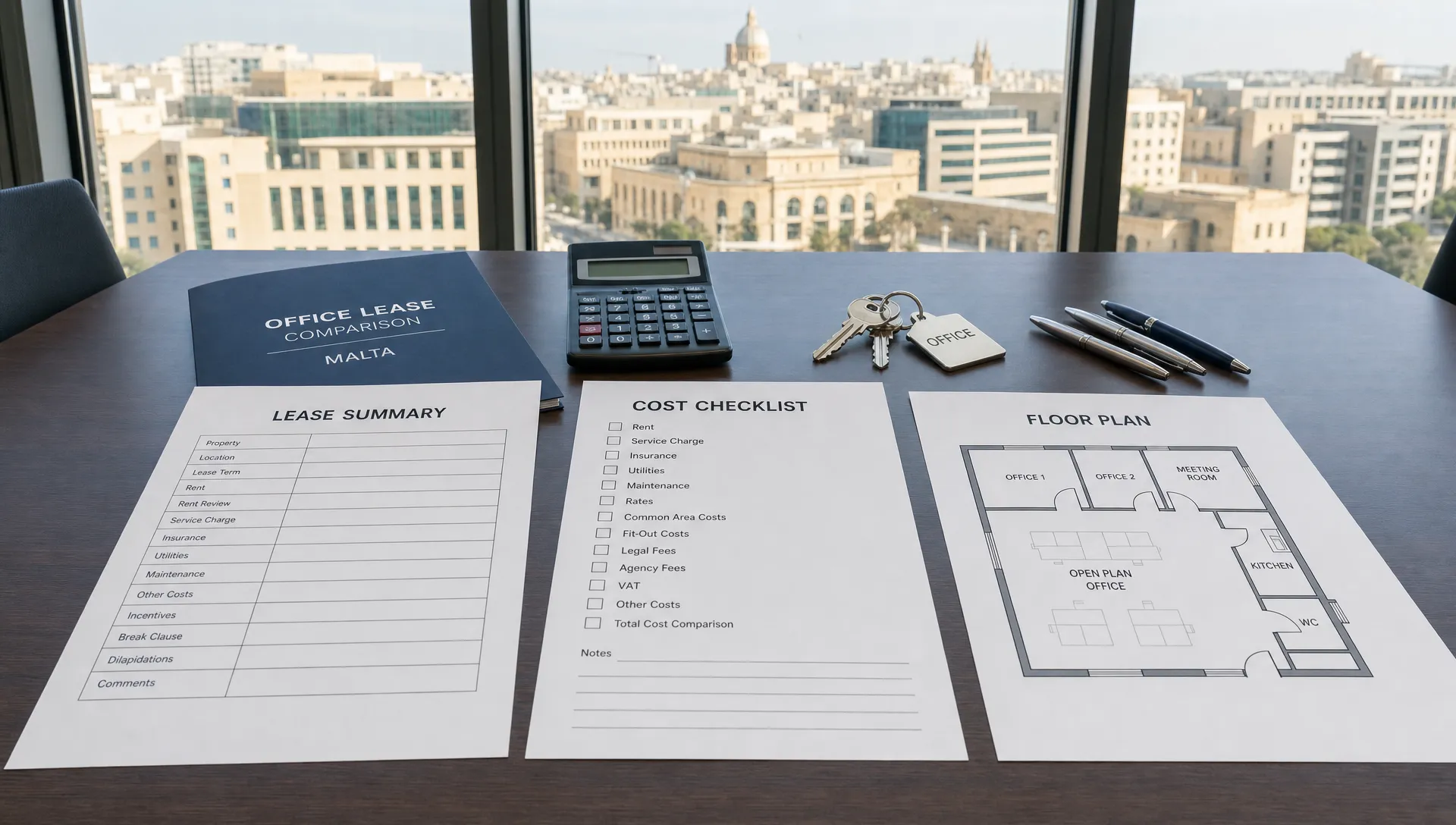
Commercial rent in Malta is rarely just the monthly figure shown on a listing. For most businesses, the real question is broader: what will the office cost to occupy, operate, fit out, maintain and eventually exit?
That distinction matters in Malta because office demand is concentrated in a relatively small market. iGaming companies, financial services firms, legal practices, insurance operators, fintech teams, architects and growing SMEs are often competing for the same well-located, compliant, high-spec space. A rent that looks affordable on paper can become tight once service charges, VAT treatment, parking, connectivity, fit-out and relocation costs are added.
The best budget starts with total occupancy cost, not headline rent.
The commercial rent budget in one sentence
A practical first-year office budget should include base rent, recurring running costs, VAT where applicable, one-off move-in costs and a contingency for negotiation gaps or operational surprises.
Use this simple structure before comparing options:
| Budget layer | What it includes | Why it matters |
|---|---|---|
| Base commercial rent | The agreed rent for the office space itself | This is the headline cost, but not the full budget |
| Building and operating costs | Service charges, common area maintenance, utilities, cleaning, waste, security and shared facilities | These can change the affordability of two similar offices |
| Business-specific costs | Parking, IT, furniture, meeting rooms, access control, signage, insurance and compliance | These depend heavily on your industry and working model |
| Upfront costs | Deposit, rent in advance, agency or professional fees, legal review, fit-out and move costs | These affect cash flow before the office is usable |
| Future costs | Indexation, renewal terms, repair obligations and exit reinstatement | These determine the real cost over the full lease term |
A useful formula is:
First-year office budget = annual rent + recurring occupancy costs + applicable taxes + one-off setup costs + contingency.
For a board, CFO or office manager, this format makes Malta office options easier to compare. It also prevents the common mistake of choosing an office based only on the lowest rent per square metre.
Start with headcount, not the postcode
Before deciding whether Sliema, St Julian’s, Valletta, Gzira, Ta’ Xbiex, Mriehel or Birkirkara is “too expensive”, work out how much space your team actually needs. Two companies with the same number of employees can have very different office budgets depending on meeting rooms, private offices, hybrid work, reception areas and client-facing requirements.
As a broad planning guide, businesses often model space using square metres per person. The right number depends on layout, culture and regulation, but the table below gives a starting point for budgeting.
| Workspace style | Indicative planning approach | Best suited to |
|---|---|---|
| Compact open-plan | Lower square metres per employee, limited meeting space and shared breakout areas | Small teams, startups, hybrid teams with rotating attendance |
| Balanced corporate layout | Moderate space per employee, several meeting rooms, storage and breakout space | SMEs, finance teams, insurance firms, iGaming operations |
| Client-facing or professional office | Higher space allowance, private rooms, reception, boardroom and document storage | Law firms, architects, consultants, family offices |
| HQ or operational hub | Larger floorplates, departments, IT rooms, kitchens, training rooms and expansion capacity | Larger iGaming, fintech, crypto, gaming, insurance and multinational teams |
If you underestimate space, the rent may look efficient in year one but become expensive when the team grows and you need overflow space elsewhere. If you overestimate, you pay for empty desks. The balance is especially important in Malta, where the right floorplate in the right location is not always available exactly when you need it.
Location drives more than rent
Location is one of the strongest drivers of commercial rent in Malta, but it also affects staff retention, commuting, client perception and daily operating costs.
Prime coastal and business areas such as Sliema, St Julian’s, Gzira and Ta’ Xbiex often attract firms that value proximity to hotels, restaurants, international clients, embassies, finance networks and executive housing. These areas can support a premium, especially for modern buildings, sea views, parking and high-quality common areas.
Valletta and Floriana can work well for legal, governmental, cultural, advisory and professional services firms that benefit from prestige and centrality. However, heritage buildings, access, parking and layout constraints should be reviewed carefully before assuming a lower rent means lower total cost.
Mriehel, Birkirkara and nearby central business locations can be attractive for larger teams needing bigger floorplates, better vehicle access or more efficient layouts. They may offer a stronger balance between rent, parking and operational practicality for companies that do not need a seafront address.
More decentralised locations such as Mosta, Naxxar, Qormi, Marsa and airport-adjacent areas can suit cost-conscious SMEs, back-office teams, logistics-linked businesses and firms prioritising road access. The trade-off is usually brand perception, commute patterns and proximity to clients or talent pools.
For a more structured way to weigh these location trade-offs, OfficeSpace.Rent’s commercial office selection guide for Malta is useful before you shortlist viewings.
Serviced office, traditional lease or HQ space?
The type of office you choose can change your budget as much as the location. A serviced office may look expensive per desk, but it can reduce upfront fit-out, furniture, utilities and management costs. A traditional lease may offer better control and long-term value, but it usually requires more cash before move-in.
| Office type | Budget profile | Main advantages | Main watch-outs |
|---|---|---|---|
| Serviced office | Higher apparent monthly cost, lower upfront setup | Speed, flexibility, furniture, shared facilities, shorter commitments | Less control, limited branding, price can rise as headcount grows |
| Traditional lease | Lower headline rent compared with fully serviced space, higher setup cost | Control over layout, branding, privacy and longer-term stability | Fit-out, furniture, utilities, repairs and exit obligations |
| Larger commercial property or HQ | Significant monthly and capital commitment | Scale, identity, operational control, department planning | Longer search, negotiation complexity, compliance and cash flow impact |
| Hybrid arrangement | Mix of core leased space and flexible overflow | Useful for growth, project teams and uncertain headcount | Requires careful planning to avoid duplicated costs |
For businesses relocating to Malta, serviced offices can be a practical bridge while permanent premises are negotiated. For established local firms, a traditional lease may make more sense if the team size is stable and the business wants control over layout, meeting rooms and brand experience.
The key is to compare each option on a like-for-like basis. If one office includes reception, cleaning, internet and furniture, while another quotes only base rent, the cheaper monthly rent may not be cheaper in practice.
Recurring costs businesses often underestimate
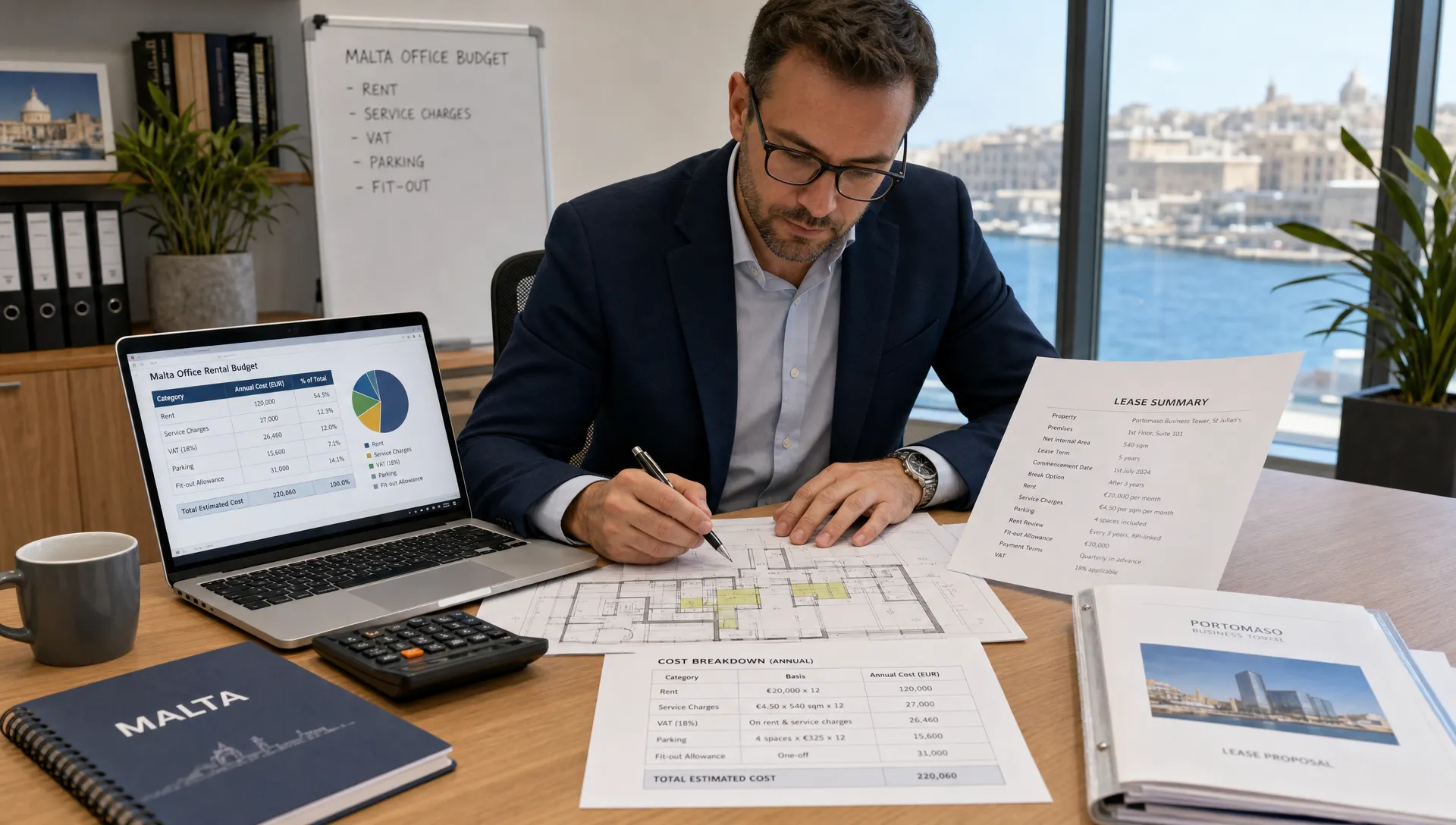
Once the rent is agreed, the recurring budget begins. In Malta, air conditioning, connectivity, parking and common area costs can be especially important because they affect both employee experience and business continuity.
Service charges should be reviewed in detail. Ask what is included, how charges are calculated, whether they are fixed or variable, and whether there is any cap. Common items may include lift maintenance, cleaning of shared areas, building security, reception, landscaping, waste handling, common electricity and general building management.
Utilities are another major consideration. Cooling costs can be meaningful during hotter months, especially in older buildings or inefficient layouts. For regulated, tech-heavy or client-facing businesses, internet redundancy, backup power, access control and secure server or comms areas can add to the monthly budget.
VAT should never be assumed. In Malta, VAT treatment can depend on the landlord, tenant status, property use and how services are invoiced. Ask for written confirmation on whether quoted figures are exclusive or inclusive of VAT, and involve your accountant before signing.
Upfront costs before move-in
The first month in a new office can be cash-intensive. Even if the monthly commercial rent is within budget, the upfront requirement may be a barrier if it has not been planned.
Common upfront items include:
- Deposit and rent in advance, depending on the lease and landlord requirements.
- Professional advice, such as legal review, tax guidance and technical due diligence.
- Fit-out, furniture, cabling, access systems, meeting room equipment and signage.
- Moving costs, including removals, IT migration, storage and staff disruption.
- Temporary workspace if there is a gap between leaving one office and occupying the next.
Fit-out deserves particular attention. A shell or partly fitted office may offer design freedom, but every partition, data point, meeting room, kitchen, lighting upgrade and acoustic solution has a cost. A fully fitted office may reduce setup time, but you should still budget for adaptations, branding and compliance checks.
If senior decision-makers are flying in for viewings, negotiations or board approval, include the cost of reliable travel coordination in your relocation budget. For organisations managing high-stakes executive movement across meetings, hotels and airport schedules, specialist providers such as executive chauffeur services can help keep senior teams on time and focused during decision periods.
Lease terms that change the real budget
The lease wording can turn a manageable rent into a costly commitment. Before signing, review how the agreement handles rent increases, maintenance, service charges, assignment, subletting, termination and reinstatement.
Indexation is particularly important for multi-year budgets. If rent increases annually, your finance team should model the full lease period, not just year one. A break clause may justify a slightly higher rent if it protects the business from overcommitting during uncertain growth. Conversely, a longer fixed term might support better commercial terms if the business is confident about location and headcount.
Repair obligations also matter. Some leases place more responsibility on the tenant than expected, especially for internal maintenance, fixtures, systems or reinstatement at the end of the term. Ask whether you must return the office to its original condition, remove fit-out works, repaint, repair flooring or restore partitions.
To avoid missing hidden items, use a full occupancy checklist like this guide on how to assess office rental costs in Malta before you compare final offers.
Budgeting by business type
Different sectors should prioritise different cost lines. A gaming company, law firm and insurance office may all be looking for commercial rent in Malta, but they rarely need the same office.
| Business type | Budget priorities | Cost risks to check |
|---|---|---|
| iGaming, casino and gambling companies | Large floorplates, staff amenities, meeting rooms, 24-hour access, connectivity and brand presence | Expansion capacity, noise, security, fit-out complexity and transport access |
| Financial services, fintech, crypto and blockchain firms | Compliance, secure meeting rooms, privacy, connectivity, boardroom quality and prestige | Data infrastructure, access control, regulatory expectations and lease flexibility |
| Law firms and architects | Client reception, private offices, document storage, meeting rooms and centrality | Older building constraints, parking, accessibility and refurbishment costs |
| Insurance companies | Customer access, operational teams, meeting space, records, privacy and staff commute | Fit-out, customer parking, signage and ongoing maintenance |
| SMEs and growing local businesses | Affordability, flexibility, manageable deposit and efficient layout | Outgrowing the office, hidden service charges and weak break options |
This is why a single “average rent” can be misleading. The right budget is the one that supports your operations, not just the one that fits a spreadsheet.
How much contingency should businesses allow?
A contingency is not a sign of poor planning. It is a sensible buffer in a market where costs can shift during negotiation, fit-out and move-in.
For early budgeting, many businesses separate contingency into three areas. The first is negotiation contingency, which covers changes between listing, offer and final lease. The second is setup contingency, which covers fit-out variations, furniture gaps and IT changes. The third is operating contingency, which covers utilities, service charge changes and practical needs discovered after occupation.
Rather than applying one vague percentage to everything, assign contingency to the cost lines you are least certain about. If a serviced office includes almost everything, the setup contingency may be lower. If a traditional lease needs significant works, the fit-out contingency should be more conservative.
Red flags in a “cheap” commercial rent
A low rent is not automatically a good deal. It may be excellent value, or it may reflect issues that will cost the business later.
Be cautious if the office has unclear service charges, limited cooling capacity, poor natural light, weak internet options, difficult parking, restrictive access hours, unresolved licensing or planning concerns, unclear VAT treatment, no written breakdown of costs or vague repair obligations.
Also check whether the building suits your employer brand. In sectors such as iGaming, finance, insurance and technology, the office is part of recruitment and retention. A cheaper location that makes hiring harder can be more expensive than a slightly higher rent in a better-connected area.
A practical budget checklist before you sign
Before committing to a Malta office, ask for a written schedule of costs. At minimum, your internal budget should include the rent, lease term, deposit, payment frequency, VAT position, service charges, utilities, parking, internet, insurance, cleaning, maintenance, fit-out, furniture, legal review, move costs, renewal assumptions and exit obligations.
Then compare each shortlisted office using the same structure. This is where many businesses uncover that an apparently more expensive office is actually simpler, faster or cheaper to operate.
A good Malta office budget should answer four questions:
- What will this office cost in the first 12 months?
- What will it cost over the full lease term?
- What cash is required before move-in?
- What risks could increase the cost later?
If you can answer those clearly, you are budgeting properly.
Frequently Asked Questions
What is included in commercial rent in Malta? It depends on the property and lease. Some quotes cover only the office rent, while others may include service charges, furniture, utilities or shared facilities. Always request a written breakdown before comparing offices.
Should businesses budget for VAT on office rent in Malta? Yes, at least as a planning item until confirmed. VAT treatment can vary depending on the landlord, tenant status, property use and services provided, so ask for written confirmation and involve your accountant.
Is a serviced office cheaper than a traditional lease? Not always. A serviced office can cost more per desk but may include furniture, internet, cleaning and shared facilities. A traditional lease may have lower rent but higher upfront and management costs.
How can a business reduce its office rental budget in Malta? Consider flexible layouts, non-prime but well-connected locations, hybrid working, shared meeting rooms, lease negotiation, parking optimisation and careful review of service charges before signing.
When should a company start budgeting for a new Malta office? Start as soon as headcount, location needs and move timing are known. For larger teams or regulated sectors, allow extra time for search, negotiation, legal review, fit-out and IT planning.
Turn your commercial rent budget into a shortlist
Once you know the full budget, the search becomes much easier. Instead of asking “Which office is cheapest?”, you can ask “Which office gives us the best operational fit for the total cost?”
Use OfficeSpace.Rent to compare office listings across Malta, filter by size and location, review serviced and traditional options, and get support with viewings, negotiations, VAT questions and commercial property comparisons.