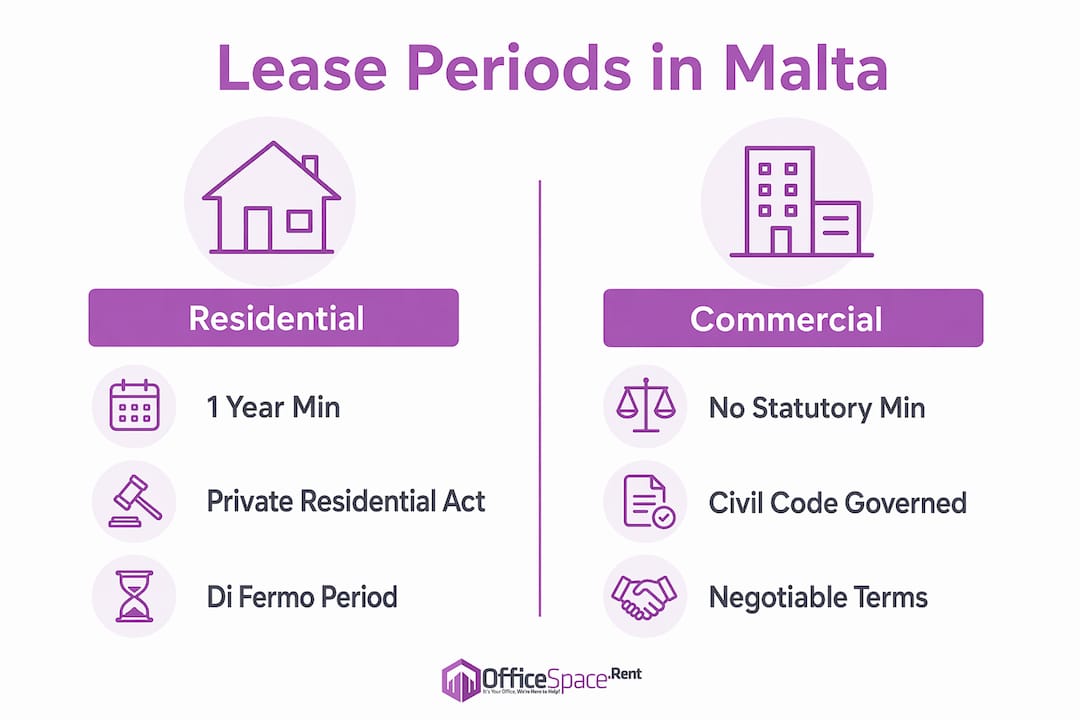
Malta sets a one-year minimum lease period for residential properties, including a six-month di fermo lock-in. Commercial leases have no fixed minimum and are fully negotiable under the Civil Code, requiring written agreements and timely registration. Understanding these rules helps tenants and landlords protect their rights and avoid legal pitfalls.
The minimum lease period in Malta is defined by property type. Residential leases carry a statutory minimum of one year under the Private Residential Leases Act. Commercial leases have no statutory minimum period at all — they are fully negotiable between landlord and tenant under the Maltese Civil Code. This distinction matters enormously for businesses planning their premises strategy. Getting the terms wrong at the outset can expose you to penalties, unenforceable contracts, or unwanted lock-in periods that restrict your operational flexibility.
What is the minimum lease period in Malta for residential properties?
The Private Residential Leases Act sets a one-year minimum term for all residential leases in Malta. This applies regardless of what the landlord and tenant agree verbally. Most long-term residential leases cannot lawfully be contracted for less than one year unless they fall within one of the statutory exceptions.
Within that one-year lease, a six-month di fermo lock-in period applies. During the initial di fermo period, the tenant’s right to terminate is restricted and early termination may trigger the statutory compensation provided by law. This protects landlords from very short occupancies that would leave a property vacant mid-year.
Notice requirements after the di fermo period differ by lease length:
- 1-year lease: one month’s notice required
- 2-year lease: two months’ notice required
- 3-year lease or longer: three months’ notice required
If a tenant terminates before the di fermo expires, the tenant is generally liable for the statutory compensation provided under the Act. Maltese law caps this penalty, so landlords cannot demand more. Notice should be given in the form required by the legislation and the lease agreement, commonly by registered mail or another legally recognised written method.
Short-term rentals of under six months fall outside the Private Residential Leases Act entirely. They are regulated instead by the Malta Tourism Authority. Residential leases must also be registered with the Housing Authority. Failure to register strips tenants of key protections, including capped rent increases and enforceable notice rights.
Pro Tip: Register your residential lease with the Housing Authority immediately after signing. Unregistered leases leave tenants without the statutory protections the Private Residential Leases Act was designed to provide.
What are the lease period norms for commercial properties in Malta?
Commercial leases in Malta are governed by the Civil Code, not the Private Residential Leases Act. There is no statutory minimum lease period for commercial properties. The duration is entirely a matter of negotiation between the parties.

This gives businesses genuine flexibility. A start-up can negotiate a short one-year term with an option to extend. An established firm can lock in a three-year or five-year lease to secure favourable rent and reinstatement terms. The contract governs everything, which makes the quality of that contract critical. Unlike residential tenancies, commercial tenants in Malta have no statutory safety net — every protection must be negotiated and written into the agreement.
Key legal requirements for commercial leases in Malta:
- Written form is mandatory. All commercial leases must be in writing to be valid. Oral agreements have been null and void since 2010.
- Stamp duty registration. Commercial leases must be registered with the Commissioner for Revenue within 15 days of signing. Non-compliance risks penalties for both landlord and tenant.
- Public deed for long leases. Leases exceeding 16 years must be executed by public deed and registered in the Public Registry. Failure to do so renders the lease null and void.
| Lease length | Form required | Registration body |
|---|---|---|
| Under 16 years | Written agreement | Commissioner for Revenue |
| Over 16 years | Public deed | Public Registry |
| Short-term residential (under 6 months) | Written agreement | Malta Tourism Authority |
Pro Tip: Always negotiate break clauses and renewal options into your commercial lease from the outset. Without them, the lease simply ends on the agreed date with no automatic right to renew or extend — and no statutory protection to fall back on.
How do minimum lease terms affect tenant and landlord rights in Malta?
The legal framework creates very different rights depending on whether the lease is residential or commercial. Understanding these differences protects both parties from costly disputes.
For residential leases, the consequences of the di fermo period are concrete:
- Tenant cannot exit early without penalty. During the six-month di fermo on a one-year lease, leaving early triggers a financial penalty capped at one month’s rent plus the notice period.
- Landlord has stability. The di fermo gives landlords a guaranteed occupancy window, reducing vacancy risk during the early months of a tenancy.
- Registered notice is legally required. Tenants must send termination notice by registered mail after the di fermo expires. Verbal notice is not sufficient and carries no legal weight.
- Lease does not auto-renew. Once the minimum term ends and proper notice is given, the lease terminates. Neither party is obligated to continue unless a renewal clause is included in the original agreement.
For commercial leases, the position is markedly different. The lease ends on the agreed date unless the contract contains break clauses or extension terms. Neither party is required to give notice if no renewal clause exists. This means a business can find itself without premises overnight if it fails to negotiate an extension well in advance. Commercial tenants carry more responsibility for protecting their own interests through contract terms, whereas residential tenants benefit from statutory protections built directly into the law.
What should businesses know when negotiating lease periods in Malta?
Negotiating a commercial lease in Malta requires preparation. The absence of a statutory minimum period is an advantage, but only if you use it well. Reviewing lease negotiation strategies specific to Malta before entering discussions gives you a measurable advantage at the table.
The most common mistakes businesses make when leasing commercial property in Malta:
- Relying on verbal agreements. Any oral commercial lease agreement is legally void. Every term must be in writing, and every verbal assurance from a landlord must be replicated in the signed contract before it has any legal effect.
- Missing the stamp duty deadline. Registration with the Commissioner for Revenue must happen within 15 days of signing. Late registration attracts penalties and creates uncertainty about enforceability.
- Neglecting break clauses. Without a break clause, you are committed for the full lease term regardless of how your business changes. A break at year two or three of a five-year lease provides meaningful protection at modest negotiating cost.
- Overlooking the 16-year threshold. Leases beyond 16 years require a public deed executed before a notary and registered in the Public Registry. Businesses planning very long-term occupancy must account for this additional legal step from the outset.
- Confusing residential and commercial rules. The one-year minimum and di fermo period apply only to residential leases. Commercial tenants who assume the same rules apply will misread their obligations and their rights.
Understanding the full rental agreement process in Malta before signing protects your business from avoidable legal and financial exposure.
Pro Tip: For any commercial lease exceeding five years, engage a Maltese advocate or notary before signing. The cost of professional advice is minimal compared to the cost of an unenforceable or poorly structured lease discovered mid-tenancy.
Key takeaways
Malta’s minimum lease period rules divide sharply between residential and commercial property: residential leases carry a statutory one-year minimum with a six-month di fermo lock-in, while commercial leases have no fixed minimum and are governed entirely by contract.
| Point | Details |
|---|---|
| Residential minimum term | The Private Residential Leases Act mandates a one-year minimum for all residential leases in Malta. |
| Di fermo lock-in | Residential tenants cannot exit without penalty during the first six months of a one-year lease. |
| Commercial lease flexibility | Commercial leases have no statutory minimum period and are fully negotiable under the Civil Code. |
| Written form is mandatory | All commercial leases must be in writing; oral agreements are legally void since 2010. |
| Registration deadlines | Commercial leases must be registered with the Commissioner for Revenue within 15 days of signing. |
| 16-year public deed threshold | Leases exceeding 16 years require a public deed before a notary and registration in the Public Registry. |
Officespace’s view on lease period negotiations in Malta
The distinction between residential and commercial lease rules in Malta is one of the most misunderstood aspects of the local property market. Businesses frequently approach commercial leasing with assumptions borrowed from residential experience, and that creates real problems.
The absence of a statutory minimum for commercial leases is genuinely useful. It means a business can negotiate a six-month trial period, a rolling arrangement, or a five-year commitment with structured break points — depending on its needs and negotiating position. The risk is that without statutory protections, every safeguard must be written into the contract. Landlords in Malta’s tighter commercial markets, particularly in Birkirkara and Mriehel, are experienced negotiators. Tenants who arrive unprepared often accept terms that limit their flexibility unnecessarily.
The 15-day stamp duty registration window is the compliance detail that catches businesses most often. It is not a long window, and the consequences of missing it extend beyond a fine. An unregistered commercial lease creates uncertainty about enforceability that neither party wants to test through the Maltese courts.
The most effective approach is to treat the lease negotiation as a legal and commercial exercise simultaneously. Get the break clauses right. Agree reinstatement scope before fit-out works begin. Register promptly. And if the lease runs beyond 16 years, use a public deed and register in the Public Registry from the outset.
— OfficeSpace.Rent
Commercial property listings with Officespace
Officespace provides Malta’s most detailed database of commercial properties available for lease, with listings across prime business locations and full support throughout the leasing process. Whether you are seeking a short-term arrangement or a longer-term commitment, the platform connects you with properties that match your operational requirements and lease term preferences.
Browse commercial real estate in Birkirkara or review Mriehel commercial leases for flexible terms in two of Malta’s most active business districts. Officespace also provides direct access to local agents who understand the legal requirements around lease registration, stamp duty, and contract structuring, so you can move from search to signed agreement with confidence.
FAQ
What is the minimum lease period for residential property in Malta?
The minimum residential lease period in Malta is one year, as set by the Private Residential Leases Act. Within that year, a six-month di fermo lock-in applies during which the tenant cannot exit without a financial penalty. Short-term rentals of under six months fall under Malta Tourism Authority regulations instead.
Is there a minimum lease period for commercial property in Malta?
Commercial leases in Malta have no statutory minimum period. Lease duration is fully negotiable between landlord and tenant under the Maltese Civil Code. The contract governs all terms, making the quality and completeness of that contract the sole source of protection for both parties.
What is the di fermo period in a Maltese residential lease?
The di fermo is a lock-in period during which a tenant cannot terminate the lease without penalty. For a one-year residential lease, the di fermo lasts six months. Terminating early during this period triggers a penalty capped at one month’s rent plus the applicable notice period.
How long does a tenant have to register a commercial lease in Malta?
Commercial leases must be registered with the Commissioner for Revenue within 15 days of signing. Non-compliance risks financial penalties for both landlord and tenant and may create uncertainty about the lease’s enforceability.
Do commercial leases in Malta renew automatically?
Commercial leases in Malta do not renew automatically. The lease ends on the agreed date unless the contract includes a specific renewal or extension clause. Tenants who wish to continue occupation must negotiate and document renewal terms well before the expiry date. There is generally no automatic statutory right of renewal. Whether a lease continues depends on its contractual terms and the conduct of the parties.