The true cost of leasing office space in Malta includes load factors, lease structure, and pass-through charges, not just the headline rate. Tenants often underestimate these costs by only considering the quoted sqm rate and failing to account for additional expenses and hidden fees. Calculating effective rent and normalising costs by usable area helps businesses compare options accurately and avoid costly mistakes.
Office sqm rate is defined as the quoted cost per square metre of office space, but the true cost of leasing is almost always higher once additional charges are factored in. Businesses researching office space in Malta need to go beyond the headline figure. Understanding office sqm rates means accounting for the difference between usable and rentable area, the structure of the lease, and a range of pass-through costs that rarely appear in the initial quote. BOMA provides a useful international reference for understanding usable and rentable area, but Malta leases should always state the actual measurement basis used by the landlord.
How is office rent calculated per square metre in Malta?
The most important distinction in any lease is between usable and rentable square metres. Usable area is the space your team physically occupies. Rentable area adds a proportional share of common spaces such as lobbies, corridors, and plant rooms. The difference between the two is expressed as a load factor, sometimes called a loss factor.

A load factor of 1.25 means you pay for 25% more space than you can actually use. Load factors typically range from 15% to 25% in standard commercial buildings. That gap directly inflates your effective cost per usable square metre, even when the quoted rate looks competitive. In Malta, where landlords apply varying methodologies, two buildings with identical quoted rates can carry materially different real costs depending on how their load factors are calculated. Always ask for the load factor in writing before comparing any two properties.
Key questions to ask before signing any lease:
- What is the usable area in square metres?
- What is the rentable area, and how is it calculated?
- What load factor applies, and is it clearly documented?
- Is the lease priced on usable or rentable area?
Pro Tip: Always request both the usable and rentable area figures in writing before comparing quotes. Normalising costs by usable square metres is the only reliable way to compare spaces across different buildings in Malta.
What hidden costs affect total office space costs in Malta?
Lease structure determines how much you pay beyond base rent. In Malta, commercial leases do not use the formal Full-Service Gross or Triple-Net classification but the practical distinction — whether building running costs are bundled or passed through separately — is directly equivalent and carries the same financial consequences.
- Inclusive rent structures bundle base rent with building running costs including service charges, insurance contributions, and shared utility costs. The landlord absorbs cost fluctuations within the lease term, giving the tenant high cost predictability.
- Variable service charge structures separate base rent from building running costs. Tenants pay their proportional share of maintenance, insurance, and utility recharges on top of the quoted rate. Pass-through costs under variable structures in managed buildings can materially increase the effective cost above the quoted rent.
- Fit-out amortisation is a further cost that many tenants overlook. When a landlord funds a fit-out contribution, the cost is sometimes amortised into the rent over the lease term rather than offered as a transparent one-off sum.
- Service charge true-ups occur when actual building running costs exceed the estimated amounts billed during the year. Service charge reconciliations and amortised fit-outs can add another 15 to 30% to base rent. Requesting two years of reconciliation history from the landlord gives you a reliable basis for forecasting.
Total occupancy cost (sometimes 30 to 50% above base rent) can be substantially higher than base rent once VAT where applicable, service charges, utilities, parking and fit-out costs are included.
Pro Tip: Calculate effective rent by adjusting the quoted rate for any incentives such as rent-free months or landlord-funded fit-out contributions, then add estimated pass-throughs. That single figure gives you an honest comparison across competing properties.
How do market trends shape sqm rates in Malta?
Malta’s commercial property market reflects a pattern visible across European office markets: flight to quality is driving demand towards Class A buildings while Class B stock sees flat or declining absorption. Class A offices command premium rates because they offer modern floor plates, strong connectivity, and building amenities that attract and retain staff. Class B spaces are cheaper per square metre but often carry higher fit-out costs, less favourable lease terms, and greater service charge variability.
Office sqm rates in Malta vary significantly by location, building grade, and lease structure. Key dynamics shaping the market include:
- Supply constraint in prime locations. Districts such as Birkirkara and Mriehel have some Grade A stock and many new up and coming projects, which keeps vacancy rates low and sustains premium pricing. Demand from iGaming, fintech, and international businesses shows no sign of softening in these corridors.
- Amenity embedding. Malta landlords frequently include shared conference rooms, reception services, and building facilities within the rent. This can materially reduce the amount of private space a tenant needs to lease — a building quoting a higher rate per sqm may represent better total value once embedded amenities are factored in.
- Size benchmarks. Average space per worker in 2026 sits at approximately 11 square metres for standard open-plan layouts in Malta. A 10-person team typically requires between 110 and 185 square metres of total space depending on layout density and shared facility requirements.
- Location premium. Valletta, Sliema, and St Julian’s carry the highest rates per square metre. Business parks in Mriehel and Birkirkara offer more competitive pricing with good road infrastructure and parking availability.
Understanding Malta’s office rental market trends before entering negotiations gives you a clear reference point for assessing whether a quoted rate reflects fair market value for the building class and district.
How to assess true office sqm rates in Malta before signing
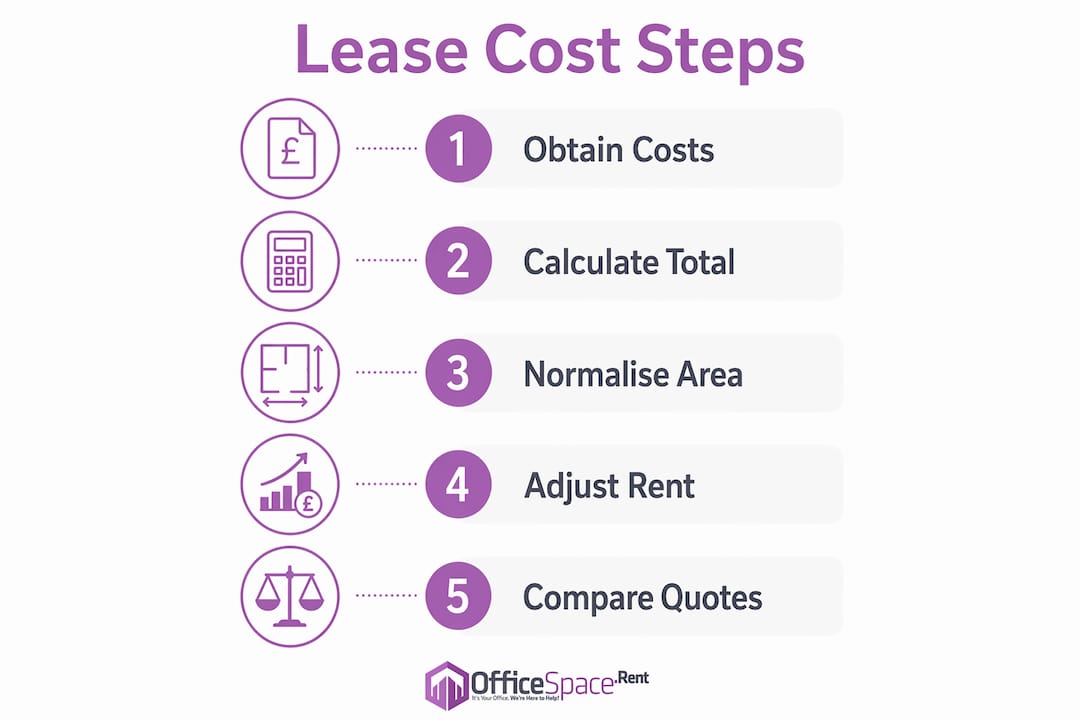
Calculating total occupancy cost is a five-step process that any business can apply before committing to a lease.
Step 1: Obtain the full cost breakdown. Ask the landlord for base rent, service charges, insurance contributions, utility recharges, VAT position, and any amortised fit-out costs as separate line items. Do not accept a single all-in figure without supporting detail.
Step 2: Calculate total annual cost. Add all confirmed charges to produce a single annual figure. Do not rely on the quoted rate alone.
Step 3: Normalise by usable area. Dividing total cost by usable square metres produces a fair cost-per-sqm figure that allows direct comparison across buildings with different load factors.
Step 4: Calculate effective rent. Adjust for any incentives such as rent-free periods or landlord contributions to fit-out. Spread those savings across the full lease term to arrive at the true annual cost.
Step 5: Benchmark against market rates. Use published office space cost analysis for Malta to confirm whether the effective rate sits within the expected range for the building class and location.
A practical checklist for lease evaluation:
- Confirm usable versus rentable area and the load factor applied
- Request two years of service charge reconciliation history
- Identify all pass-through costs and their annual caps
- Clarify which fit-out costs are amortised into rent and over what period
- Assess whether shared building amenities reduce the private space you actually need
- Use the Officespace space calculator to verify your space requirement before comparing listings
| Comparison factor | What to check |
|---|---|
| Quoted rate basis | Usable or rentable sqm? |
| Load factor | Percentage above usable area — request in writing |
| Lease structure | Inclusive or variable service charge? |
| Pass-through costs | Service charges, insurance, utility recharges, VAT |
| Effective rent | Base rate adjusted for incentives and all pass-throughs |
Key takeaways
The true cost of leasing office space in Malta is determined by load factors, lease structure, and pass-through charges — not the headline sqm rate alone.
| Point | Details |
|---|---|
| Load factor inflates cost | A 1.25 load factor means paying for 25% more space than your team uses; always confirm in writing. |
| Lease structure changes total cost | Variable service charge structures add 15–30% above base rent through pass-through charges. |
| Effective rent is the real metric | Adjust for incentives, pass-throughs, and VAT to compare leases accurately across buildings. |
| Normalise by usable sqm | Divide total annual cost by usable area for a fair cross-building comparison in Malta. |
| Malta market varies by grade | Class A stock in prime locations commands premium rates due to limited supply; embedded amenities affect real value. |
The misconception that costs businesses most in Malta
From Officespace’s experience working with businesses across Malta’s commercial property market, the single most common and costly mistake is treating the headline sqm rate as the final price. Tenants arrive at viewings having compared quoted rates across three or four buildings, confident they understand the cost. They rarely do.
The embedded amenity model common in Malta adds a layer of complexity that is easy to miss. A building quoting a higher rate per square metre may include conference facilities, reception services, and shared breakout space. A cheaper quote may require you to lease additional private space to replicate those functions. Evaluating embedded amenities against your actual space needs frequently changes the cost ranking between buildings entirely.
The other pattern worth noting is that headline rent rarely reflects effective rent. Landlords use the quoted figure to attract interest. The effective rent — after incentives, service charge pass-throughs, VAT where applicable, and fit-out amortisation are applied — is the number that matters for budgeting. Businesses that negotiate on headline rate alone leave real value on the table. The data-driven approach, calculating effective rent per usable square metre and benchmarking against published market rates, consistently produces better outcomes in Malta’s market.
— OfficeSpace.Rent
Find verified office listings with transparent pricing in Malta
Officespace publishes detailed commercial office listings across Malta’s key business districts, including offices in Birkirkara and commercial space in Mriehel, with transparent pricing that separates base rent from additional charges. Each listing includes building class, floor plate details, and lease type, giving you the data needed to calculate true occupancy costs before making contact. The platform also provides office lease negotiation guidance specific to the Maltese market, covering service charge reconciliation, fit-out terms, and effective rent calculation. For businesses ready to compare options with full cost visibility, Officespace is the starting point.
FAQ on Understanding office sqm rates
What does office sqm rate mean in Malta?
Office sqm rate is the quoted cost per square metre of office space per year or per month. It is the base figure used to compare leases, but it does not include pass-through service charges, VAT, or the difference between usable and rentable area. Always calculate effective rent before comparing options.
What is a load factor in a Malta commercial lease?
A load factor is the ratio of rentable area to usable area in a building. A load factor of 1.20 means you pay for 20% more space than your team physically occupies, which directly increases your effective cost per usable square metre. Always request this figure in writing from the landlord before signing.
How do I calculate effective rent in Malta?
Effective rent is calculated by taking the total rent paid over the lease term, subtracting the value of any landlord incentives such as rent-free periods or fit-out contributions, and dividing by the number of months. Add estimated service charge pass-throughs and VAT where applicable to arrive at the true monthly cost for accurate cross-building comparison.
What is the difference between inclusive rent and a variable service charge lease in Malta?
An inclusive rent lease bundles base rent with all building running costs into a single figure, giving high cost predictability. A variable service charge lease charges building running costs separately, reconciled annually against actual expenditure — these pass-throughs typically add 15 to 30% above the base quoted rate and can increase year on year without a negotiated cap.
How much office space does a team need in Malta?
Industry benchmarks for Malta place average space per worker at approximately 11 square metres for standard open-plan layouts. A 10-person team typically requires between 110 and 185 square metres of total space, depending on layout density, meeting room provision, shared facilities, and hybrid working patterns.