TL;DR:
- Effective occupancy cost in Malta includes base rent, service charges, load factors, and fit-out costs, often exceeding the headline rent by 30 to 50 percent. Negotiating expense caps, understanding load factors, and choosing appropriate lease terms are crucial to managing long-term office costs effectively. Hidden expenses like management overhead and technology setup can significantly impact overall budgets and should be carefully calculated before signing a lease.
Office rental pricing factors are the combination of base rent, service charges, lease structure, and location attributes that together determine the true cost of leasing commercial space. For businesses evaluating office space in Malta, understanding these factors affecting office rent is the difference between an accurate budget and a costly surprise. The headline rent figure on a listing rarely reflects what you will actually pay. This guide breaks down every component that shapes your total occupancy cost, with specific reference to Malta’s commercial property market.
What are the main office rental pricing factors in Malta?
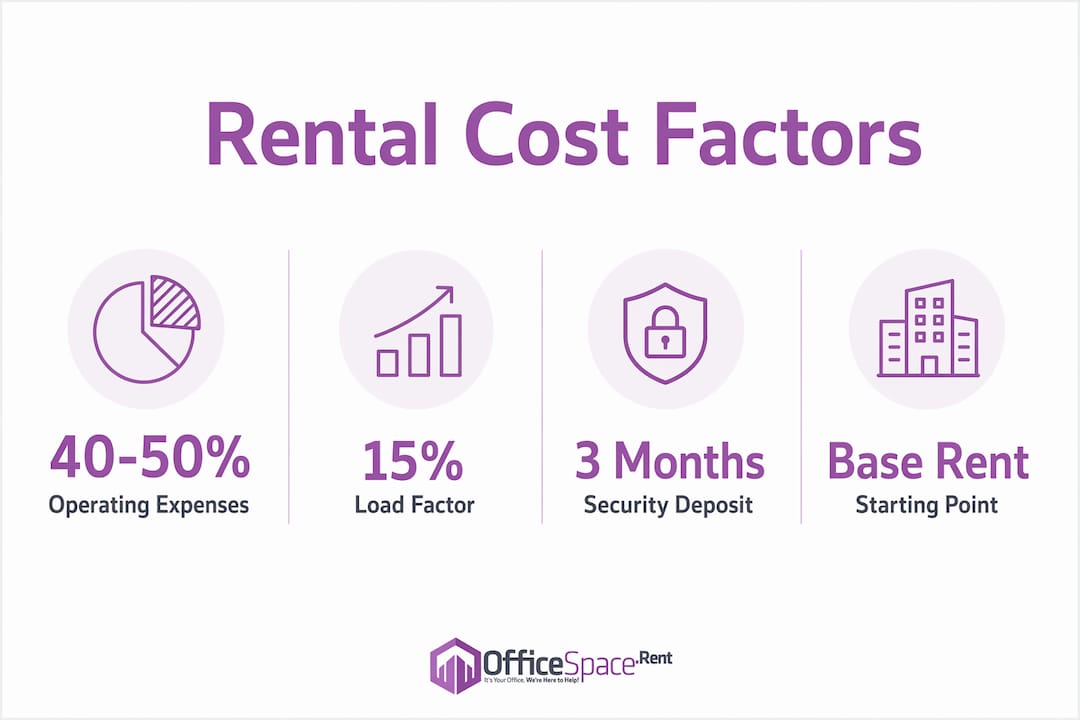
The industry term for the full cost of leasing space is effective occupancy cost, and it routinely exceeds the quoted base rent by a significant margin. Real occupancy costs in Malta run 30 to 50% higher than headline base rent once service charges, building insurance contributions, utility recharges, and VAT are included. That gap is not an anomaly. It is the standard structure of commercial leases in this market.

Base rent and lease structure
Base rent is the starting point, but the lease structure determines what sits on top of it. In Malta, commercial leases do not follow the formal gross, net, or triple-net classification used in other markets. The practical distinction that matters is whether the rent is inclusive of building running costs or whether those costs are passed through separately — either as a fixed service charge, a variable service charge reconciled annually, or a full pass-through of all operating expenses. You should always confirm in writing which expenses are included before comparing two listings.
Service charges and the load factor
Service charges typically cover building maintenance, common area cleaning, shared utility costs, and building insurance contributions. Beyond these, the load factor is a critical pricing variable that many tenants overlook. Rentable square metres include usable office space plus a proportional share of common areas, with a typical add-on of 10 to 20%. This means a unit quoted at 100 square metres of usable space may be billed at 110 to 120 square metres. Always verify the landlord’s stated load factor before signing.
Pro Tip: Ask the landlord for the building’s load factor in writing. A 15% load factor on a 200 sqm usable space adds 30 sqm to your billable area, which compounds across a multi-year lease into a material additional cost.
Fit-out contributions
Fit-out contributions are funds provided by the landlord to adapt the space to your requirements. TI allowances have increased approximately 75% over pre-pandemic averages in major markets, reflecting landlord competition for quality tenants. In Malta, fit-out contribution terms vary by building class and lease length. Longer leases typically attract more generous contributions. Where a landlord does not offer a fit-out contribution, those costs fall entirely to you and must be factored into your first-year budget alongside the reinstatement liability you will carry at lease expiry.
| Cost component | Included in base rent? | Typical impact |
|---|---|---|
| Service charges | Rarely in variable structures | 5–15% above base rent |
| Building insurance contribution | Sometimes | 2–5% above base rent |
| Utility recharges | Sometimes | Varies by building and usage |
| VAT | Separate, landlord-dependent | 18% where applicable and irrecoverable |
| Load factor premium | No | 10–20% extra billable area |
| Fit-out contribution | Negotiable | Can offset upfront fit-out costs |
How do lease terms affect commercial lease costs in Malta?
Lease structure is the second major driver of office space pricing. Two offices with identical base rents can carry very different total costs depending on escalation clauses, deposit requirements, and contract length.
Rent escalations and service charge caps
Annual rent increases in Malta are commonly linked to the Consumer Price Index or set at a fixed percentage. Without a negotiated cap, service charge increases can add significantly to your base rent over a multi-year lease. Negotiating caps on annual operating expense increases of 3 to 5% per year is the most effective way to control long-term cost exposure. This single clause can save a business tens of thousands of euros over a five-year term.
Lease length and flexibility
- Short leases (1–2 years): Higher monthly rates but greater flexibility for growing businesses.
- Medium leases (3–5 years): Balanced pricing with moderate landlord concessions including rent-free periods and fit-out contributions.
- Long leases (5+ years): Lowest per-square-metre rate but reduced ability to scale or relocate, and higher reinstatement exposure at expiry.
Long leases may offer lower monthly rates but reduce flexibility. Startups and growing businesses in Malta often benefit from shorter leases despite the possible premium, particularly given how rapidly headcount can change in the first three years of operation.
Deposits and legal fees
For many standard office leases, security deposits commonly fall around 1–3 months’ rent. Larger, institutional or higher-risk transactions may require a higher cash deposit, guarantee or bank guarantee. Confirm the requirement before commitment. Legal fees for lease review and negotiation with a Maltese advocate typically range from €1,500 to €4,500 depending on lease complexity. Budget for this from the outset — it is not an optional cost on any material commercial commitment.
Pro Tip: Always negotiate the deposit structure before agreeing to headline rent. A three-month cash deposit on a premium Valletta office ties up capital that could fund your first quarter of operations.
Why location and building class shape office rental pricing in Malta
Location is the single most visible driver of office location impact on rent per square metre. In Malta, the primary commercial districts each carry distinct pricing profiles:
- Valletta and Floriana: Premium addresses with the highest per-square-metre rates, suited to professional services firms and licensed financial institutions.
- Sliema and St Julian’s: Strong demand from iGaming, tech, and international businesses, with Grade A stock commanding a significant premium.
- Birkirkara and Mriehel: Malta’s established business corridors, offering competitive rates with good road access and parking availability.
- Attard and Mosta: Lower-cost alternatives with growing infrastructure, attractive to businesses prioritising cost efficiency over prestige address.
Class A vs Class B: what the difference costs you
| Building class | Typical features | Relative rent premium |
|---|---|---|
| Class A (Grade A) | Modern fit-out, full amenities, managed reception, generator, fibre | 20–35% above Class B |
| Class B | Functional space, limited amenities, older stock | Baseline market rate |
| Serviced / business centre | All-inclusive pricing, shared amenities, immediate occupancy | Higher per sqm, lower total commitment |
Class A offices in Malta’s prime locations include features such as raised flooring, fibre connectivity, air handling units, generator backup, and on-site management. These amenities carry a direct cost premium but reduce the indirect costs of fit-out and facilities administration. Class B buildings offer lower headline rents but may require greater upfront investment to reach an equivalent operating standard.
Vacancy remains elevated at over 20% in broader markets, but shrinking inventory and reduced sublease availability mean landlords are becoming more protective of their pricing. Malta’s market reflects a similar selective stabilisation, particularly in Grade A stock in prime districts.
What hidden costs should you budget for beyond base rent in Malta?
The costs that most businesses underestimate are not on the lease summary. They accumulate quietly and distort your true cost per workstation.
- Management overhead: Overseeing a traditional lease can exceed 10 hours per month in management time. In Malta, this includes managing the ARMS utility account, liaising with the landlord on service charge reconciliations, and coordinating maintenance contractors — all at a senior manager’s effective hourly rate that does not appear in any lease document.
- Technology infrastructure: Internet installation and dedicated business connectivity in Malta can range from a few hundred to over a thousand euros per month depending on bandwidth requirements and provider availability in the building. In older commercial stock, infrastructure upgrades may be required before your team can operate effectively.
- Setup contingency: Budget a 10 to 15% contingency for unexpected fit-out costs. Delays, specification changes, Planning Authority requirements, and building-specific constraints regularly push initial setup costs beyond the original estimate.
- Furniture and amortised fit-out: Furniture and fit-out costs are often treated as a one-off capital item, but amortised across a lease term they represent a meaningful addition to your monthly effective cost per square metre. A €60,000 fit-out on a three-year lease adds €1,667 per month before a single service charge is paid.
- Reinstatement liability: In Malta, leases typically require the tenant to reinstate the premises to its original condition at expiry. This cost — often not budgeted until the lease end approaches — can represent a significant additional expense depending on the scope of fit-out works carried out during the tenancy.
Pro Tip: Use the Office Space Calculator on Officespace to model your true monthly cost per workstation, including service charges, fit-out amortisation, and reinstatement contingency, before comparing listings.
Key takeaways
The effective occupancy cost of a Malta office lease is consistently higher than the headline base rent, and the gap is determined by service charges, load factors, lease structure, VAT position, and location class.
| Point | Details |
|---|---|
| Base rent understates true cost | Real occupancy costs run 30 to 50% above base rent once all expenses are included. |
| Load factor adds billable area | A 10–20% load factor premium means you pay for more space than you physically occupy. |
| Cap service charge increases | Negotiate a 3–5% annual cap on service charge escalations to control long-term cost exposure. |
| Location class drives premium | Grade A offices in Sliema or Valletta carry a 20–35% premium over Class B equivalents. |
| VAT adds to effective cost | Where VAT applies and cannot be recovered in full, effective rent increases by up to 18%. |
| Hidden costs compound quickly | Management time, technology, fit-out amortisation, and reinstatement contingency add materially to monthly cost. |
The costs that catch Malta businesses off guard
After working with businesses across Malta’s commercial property market, the pattern is consistent: tenants focus on the monthly rent figure and underestimate everything else. The load factor conversation rarely happens until after heads of terms are agreed. Service charge caps are treated as a secondary negotiation point rather than a primary one. VAT is discovered after the first invoice arrives. And the management overhead of running a traditional lease — ARMS account management, service charge reconciliation reviews, maintenance coordination — is almost never costed into the business case.
The businesses that negotiate well in Malta are those that calculate effective occupancy cost from the start, not after they have committed. They ask for the load factor on day one. Fruthermore, they cap service charge escalations before agreeing to rent. They model three lease lengths and compare the total cost — including fit-out amortisation and reinstatement contingency — not just the monthly figure.
One area where Malta differs from larger markets is the negotiating leverage available in secondary locations. Birkirkara and Mriehel offer genuine value for businesses that do not need a Valletta or St Julian’s address, and landlords in those corridors are more willing to negotiate on deposit structure and fit-out contributions. That flexibility is worth quantifying before you commit to a premium postcode.
The best office space decisions are made with full cost visibility. The worst are made on headline rent alone.
— OfficeSpace.Rent
Find transparent office listings across Malta with Officespace
Officespace publishes detailed commercial listings across Malta’s key business districts, with transparent pricing that includes service charge structures where available. Whether you are evaluating offices in Birkirkara or comparing options in Mriehel, Attard, or Valletta, the platform provides the data you need to calculate effective occupancy cost before you engage a landlord. Officespace also offers direct access to local leasing specialists who support negotiation on service charge caps, fit-out contributions, and deposit structures. Use the listings, the market reports, and the calculator together to build a budget that reflects your actual cost, not just the headline figure.
FAQ
What is effective occupancy cost in office leasing in Malta?
Effective occupancy cost is the total cost of a lease including base rent, service charges, load factor premiums, VAT where irrecoverable, and amortised fit-out and reinstatement costs. It is the reliable metric for comparing two lease proposals on equal terms in Malta’s market.
How much above base rent should I budget for in Malta?
Service charges, insurance contributions, utility recharges, and VAT typically add 30 to 50% above the headline base rent in Malta. Budgeting for this from the outset prevents shortfalls in your first year of occupancy and avoids surprises at annual service charge reconciliation.
What is a load factor and why does it matter in Malta?
A load factor is the percentage added to your usable square footage to calculate the rentable area you are billed for. A typical load factor of 10 to 20% means you pay for significantly more space than you physically occupy. Always request the load factor in writing before comparing any two properties.
How long should a Malta office lease be for a growing business?
Shorter leases of one to three years offer greater flexibility for businesses with uncertain headcount, though they carry a modest monthly premium over longer terms.
Longer leases secure lower rates and may attract fit-out contributions but reduce your ability to scale or relocate and increase reinstatement exposure at expiry.
What legal costs should I budget for when signing an office lease in Malta?
Legal fees for lease review and negotiation with a Maltese advocate typically range from €1,500 to €4,500 depending on lease complexity. This cost is non-negotiable for any commercial lease above a basic arrangement and should be included in your total budget from the outset.