TL;DR:
- Setting up a Malta headquarters is quicker and simpler than many founders believe, often taking just 24 hours for incorporation with proper preparation.
- After registration, companies must complete compliance steps, obtain operational licenses, and establish a physical address to ensure legal and practical readiness.
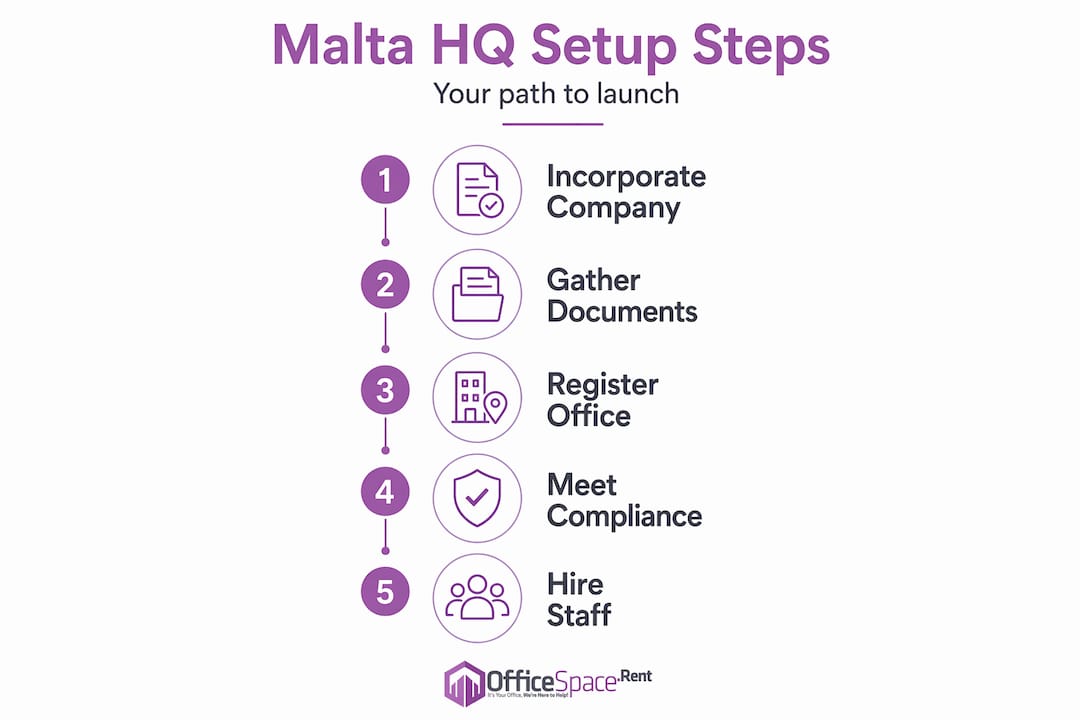
Setting up a headquarters in Malta is far less complicated than most founders assume. In straightforward cases with fully prepared electronic submissions, incorporation may be completed within 24 hours. For non-regulated businesses, the process from incorporation to operational readiness can often be completed within weeks. This Malta HQ setup guide covers every stage in sequence: company formation, compliance registrations, employment obligations, and securing physical premises. Whether you are relocating your existing business or launching fresh in the EU, understanding the correct order of steps is what separates a smooth setup from a costly delay.
Table of Contents
- Key takeaways
- Legal company formation in Malta
- Compliance and operational readiness
- Employment and staffing at your Malta HQ
- Real estate options for your Malta HQ
- My perspective on setting up a Malta HQ
- How Officespace can help you find HQ premises
- FAQ
Key takeaways
| Point | Details |
|---|---|
| Incorporation is fast when prepared | Documents ready before submission can result in a certificate issued within 24 hours. |
| Compliance follows incorporation | VAT, tax, and JobsPlus registrations are separate steps required after the company certificate is issued. |
| Registered office is a legal requirement | A physical Malta address is mandatory; corporate service providers commonly fulfil this at the outset. |
| Employment timing is strict | Engagement forms must be filed on the same day an employee starts, with no flexibility on this deadline. |
| Office location shapes business credibility | The choice between serviced, leased, or purchased premises affects both operational substance and business image. |
Legal company formation in Malta
Malta offers several company structures, but the private limited liability company is by far the most common choice for a foreign-owned HQ. It offers limited liability, a separate legal personality, and a straightforward governance structure suited to most commercial operations.
The core documents you need to incorporate are:
- Memorandum and Articles of Association, which define the company’s objects, share structure, and governance rules
- Proof of identity and address for all directors, shareholders, and the Ultimate Beneficial Owner (UBO)
- A chosen company name, A proposed company name must be approved by the Malta Business Registry and must not conflict with existing registrations
- Appointment of at least one director and a company secretary, both of whom must be identified in the formation documents
- Evidence of share capital: the minimum share capital is approximately €1,165, with at least 20% paid up on incorporation for a private company
One point that catches many applicants off guard: the registered office must be a physical Malta address, not a P.O. box. If your company does not yet have its own premises, a corporate service provider can supply a compliant registered address until you secure your own space.
Company registration in Malta typically takes between 2 and 14 days, depending on document completeness and the method of submission. Electronic submissions with fully prepared documentation consistently hit the shorter end of that range.
Pro Tip: Collect all KYC documents, UBO declarations, and certified identity documents before you submit anything. The registry processes applications quickly once it has everything it needs. Gaps in documentation are the single most common cause of delays.
Compliance and operational readiness
Receiving your certificate of incorporation is a milestone, but it does not mean your HQ is ready to operate. Several registrations must follow before you can trade, employ staff, or issue invoices.
The sequence runs as follows:
- VAT registration: Apply to the Commissioner for Revenue. VAT and tax registration typically takes around one week after the incorporation certificate is issued.
- Income tax registration: The company must be registered as a taxpayer with the Commissioner for Revenue, which is usually processed in parallel with VAT.
- JobsPlus registration: If you intend to hire any employees from the outset, the company must be registered as an employer with JobsPlus before any hiring takes place.
- Sector-specific licences: Regulated industries such as financial services, gaming, and healthcare require additional permits from the Malta Financial Services Authority or other relevant bodies. These timelines vary considerably and should be researched separately.
- Annual compliance calendar: Ongoing duties include annual returns, tax and VAT filings, and corporate governance obligations. Setting up a compliance calendar from day one prevents missed deadlines and the penalties that accompany them.
Pro Tip: Treat incorporation and operational readiness as two separate project phases with different timelines. A company that is legally registered but has not completed its VAT registration cannot lawfully charge VAT on invoices. Plan for this gap explicitly.
Employment and staffing at your Malta HQ
Once your company is registered with JobsPlus as an employer, you can begin engaging staff. Malta has precise rules around employment commencement reporting, and failing to follow them can result in enforcement action.
Key obligations when hiring in Malta include:
- Engagement form submission: Engagement forms are expected to be filed on the employee’s commencement date, and late submissions may trigger penalties or compliance issues This applies to all new hires, including part-time and fixed-term contracts.
- Electronic reporting: Submissions are made through the official JobsPlus portal. Paper submissions are no longer the standard, and electronic filing is the expected route.
- Social security contributions: Both employer and employee contributions must be calculated and remitted monthly. These rates are set by Maltese law and apply from the first pay period.
- Work permits for non-EU nationals: If key personnel are relocating from outside the EU, you will need to account for the appropriate work permit and residency permit timelines, which can extend the overall staffing process significantly.
For entrepreneurs personally relocating to Malta to lead the HQ, the Startup Residence Programme includes minimum investment and eligibility requirements that should be reviewed directly against the latest programme guidelines. This is a structured pathway worth investigating early if physical relocation is part of your plan.
Real estate options for your Malta HQ

There is an important distinction between your registered office and your operational premises. These can be the same address, but they often are not at the outset of a Malta business setup.
| Premise type | Purpose | Typical use case |
|---|---|---|
| Corporate service provider address | Legal registered office requirement | Early-stage or remote HQ setup |
| Serviced office | Operational workspace with flexible lease | Companies testing Malta before committing |
| Leased commercial property | Permanent operational HQ space | Established businesses with headcount |
| Purchased commercial property | Long-term ownership and asset building | Large corporations with capital to deploy |
Choosing the right operational premises involves several factors beyond the rental cost per square metre. Location within Malta affects commute times for staff, proximity to key clients and government bodies, and the overall impression your address makes on counterparties.
Key considerations when searching for Malta HQ space include:
- Location: Areas such as Valletta, Sliema, St Julian’s, and Mriehel each offer different profiles in terms of prestige, cost, and accessibility. A detailed guide to Malta office locations can help narrow down the right district for your operations.
- Lease terms: Malta commercial leases vary in duration, break clauses, and rent review mechanisms. Understanding these before entering negotiations is critical.
- Substance requirements: If your company is subject to substance rules under EU or international tax frameworks, a serviced address alone may not be sufficient. Physical office space with resident employees strengthens your position considerably.
Office spaces in Malta vary widely in cost and terms across districts, and working through a structured search and negotiation process saves both time and money. Reviewing market data before approaching landlords gives you a measurable negotiating advantage.
My perspective on setting up a Malta HQ
In my experience working with the Malta commercial property market, the businesses that set up their HQ most efficiently are the ones that treat the process as a project, not a checklist. I’ve seen founders spend weeks chasing their certificate of incorporation only to realise they have not started VAT registration, or they have hired someone before the company was registered with JobsPlus. Both situations are avoidable with a sequenced plan.
What I find most underestimated is the value of a good local corporate services partner. I’ve seen companies attempt fully remote setups and succeed, but they succeed because they have an experienced local contact handling document notarisation, liaising with the Malta Business Registry, and managing compliance deadlines. The bureaucratic steps are not difficult. They are just specific, and specificity requires local knowledge.
Malta’s position as an EU member state with a competitive corporate tax structure makes it a genuinely strong choice for an international HQ. The advantages are real. But they only materialise when the setup is done correctly and completely.
— OfficeSpace.Rent
How Officespace can help you find HQ premises
Once your company is incorporated and your registrations are in order, securing the right physical space is the final step to a fully functional Malta HQ. Officespace lists a broad portfolio of commercial properties across Malta’s key business districts, from serviced offices for early-stage operations to larger commercial premises in Mriehel and other high-demand locations. For businesses seeking to own rather than lease, Officespace also lists commercial property for sale across the island. The platform provides local market data, pricing transparency, and direct access to agents who understand the requirements of international businesses establishing their HQ in Malta. Explore the full listings at OfficeSpace.Rent.
FAQ on Malta HQ Setup Guide
How long does Malta company registration take?
Incorporation typically takes between 2 and 14 days, with the Malta Business Registry able to issue a certificate within 24 hours when all documents are submitted electronically and in full.
What is the minimum share capital for a Malta private company?
The minimum share capital is approximately €1,165 for a private limited company, with at least 20% required to be paid up at the time of incorporation.
Do I need a physical office to register a company in Malta?
Yes. A physical Malta address is required as the registered office. Corporate service providers commonly supply a compliant address for companies that do not yet have their own operational premises in Malta.
When must I register with JobsPlus as an employer?
Registration with JobsPlus must occur before you hire any staff. Once an employee starts, their engagement form must be filed on the same day as their commencement date. There is no grace period.
What ongoing compliance does a Malta HQ require?
Annual returns, VAT filings, income tax submissions, and corporate governance obligations are all recurring requirements. Regulated sectors carry additional licence renewal and reporting obligations on top of standard company duties.