Malta Office Market Report — Q2 2026
Malta office market Q2 2026
Malta’s office market is highly varied by district and building quality. In Q2 2026, indicative traditional office rents range from approximately €300–€450/sqm/year in St Julian’s, €250–€450 in Sliema, €240–€450 in Ta’ Xbiex and Gzira, €180–€350 in Valletta and Floriana, €150–€350 in Mriehel, and €130–€200 in Birkirkara and San Gwann.
This Malta Office Market Report Q2 2026 examines the figures most relevant to occupiers and investors: district rental bands, demand for modern offices, availability of larger floor plates, current market dynamics and the practical considerations companies should assess before signing a lease.
Jump to section
Market summary
Key takeaways from Q2 2026
| Market factor | Q2 2026 position |
|---|---|
| Prime coastal rents | St Julian’s typically ranges from €300–€450/sqm/year, while Sliema typically ranges from €250–€450/sqm/year. |
| Ta’ Xbiex & Gzira | Both locations typically range from approximately €240–€450/sqm/year, reflecting a mixture of conventional offices and premium modern stock. |
| Mriehel | Approximately €150–€350/sqm/year, spanning conventional office accommodation through to modern Grade A buildings. |
| Lower-cost central options | Birkirkara and San Gwann typically range from approximately €130–€200/sqm/year. |
| Large requirements | Businesses needing large contiguous floors have fewer suitable options than companies requiring small or medium-sized offices. |
| Quality premium | Modern specifications, parking, energy efficiency, floor efficiency and fit-out quality can materially affect rent within the same district. |
2026 benchmarks
Malta office rental rates by district
The Malta office market cannot be represented accurately by one national average. Rental levels vary substantially between localities and between individual buildings within the same locality.
| District | Indicative rent | Midpoint | Typical profile |
|---|---|---|---|
| St Julian’s | €300–€450 | €375 | Prime corporate, iGaming, technology and international business market |
| Sliema | €250–€450 | €350 | Premium coastal district with conventional and high-specification offices |
| Ta’ Xbiex | €240–€450 | €345 | Marina and professional-services market with premium seafront stock |
| Gzira | €240–€450 | €345 | Central market adjoining Sliema with increasingly strong modern stock |
| Valletta / Floriana | €180–€350 | €265 | Historic capital market with restored and conventional professional offices |
| Mriehel / CBD | €150–€350 | €250 | Corporate office district ranging from value stock to modern Grade A buildings |
| Birkirkara | €130–€200 | €165 | Central, cost-efficient market for SMEs and professional businesses |
| San Gwann | €130–€200 | €165 | Central-suburban market with competitive overall occupation costs |
Supply & demand
How the Q2 2026 market is behaving
Demand remains particularly sensitive to quality. Businesses increasingly evaluate total occupancy cost rather than headline rent alone.
A property with strong natural light, efficient floor plates, modern air-conditioning, parking, attractive common areas and a good existing fit-out may command a substantial premium over an older office only a short distance away.
- St Julian’s: strong demand for modern corporate and international office accommodation.
- Sliema: broad demand across conventional, premium and seafront offices.
- Ta’ Xbiex: particularly relevant to financial, legal and professional-services occupiers.
- Gzira: increasingly competitive with neighbouring Sliema and Ta’ Xbiex at the upper end.
- Mriehel: attractive for larger teams, corporate users and businesses prioritising parking and efficient floor plates.
- Birkirkara and San Gwann: important cost-efficient options for SMEs and operational teams.
Very large requirements remain more challenging. Companies seeking several thousand square metres in one contiguous configuration should begin their search earlier than companies looking for standard small or medium-sized offices.
Policy & supply
Urban policy proposals and future office stock
Policy discussions around vacant, unfinished and underutilised buildings could become relevant to Malta’s longer-term commercial property supply.
Measures encouraging renovation and productive reuse could increase the quantity of commercially viable office accommodation without relying entirely on new development.
- Renovation incentives: lower barriers to upgrading older buildings may increase usable office supply.
- Dormant-stock activation: unused or unfinished properties could potentially return to productive commercial use.
- Urban regeneration: improvements to older areas can enhance their attractiveness to office occupiers.
- Mobility improvements: transport and parking remain important factors in business-location decisions.
The eventual effect depends on implementation, timing and the final form of any policy measures. Businesses should therefore treat these as potential future supply factors rather than guaranteed short-term changes.
International context
Malta office costs versus European markets
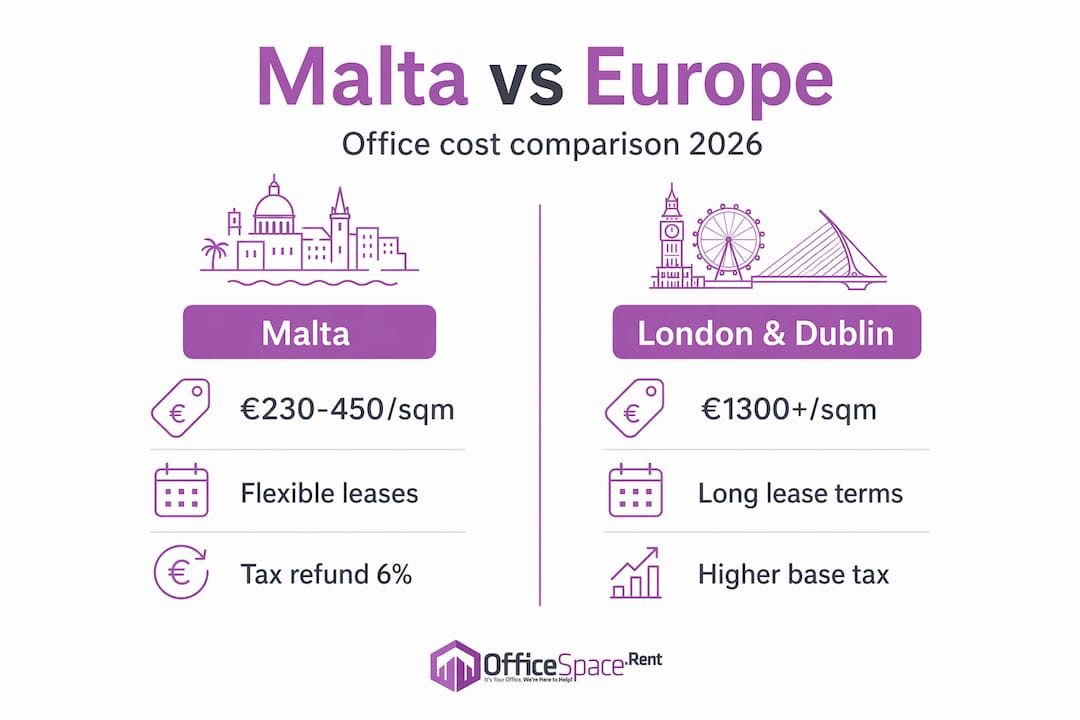
Malta’s office costs remain one part of its appeal as a European business base. However, international comparisons need care because published prime-office statistics in larger cities often relate only to a narrow Grade A market.
| Malta market | 2026 indicative rent | Positioning |
|---|---|---|
| St Julian’s | €300–€450 | Prime coastal corporate location |
| Sliema | €250–€450 | Premium coastal market |
| Ta’ Xbiex / Gzira | €240–€450 | Premium central and marina-side markets |
| Mriehel | €150–€350 | Broad corporate and Grade A office market |
For occupiers, the more meaningful comparison is total business cost. Office rent should be considered together with recruitment, payroll, travel connectivity, fit-out requirements, tax treatment, parking and lease flexibility.

Market constraints
Challenges for large occupiers
- Large contiguous floor plates are less common. Businesses requiring very large single-floor or multi-floor configurations have a narrower shortlist.
- Road congestion affects site selection. Employee commuting patterns can materially influence whether a company prefers Mriehel, a coastal location or another central district.
- Parking varies significantly. Some modern developments provide substantial dedicated parking while dense coastal and historic districts can be more constrained.
- Office quality differs considerably. Malta contains converted residential buildings, historic offices, conventional commercial properties and purpose-built Grade A towers.
- Very large searches need more lead time. Companies requiring several thousand square metres should normally begin their search considerably earlier.
Occupier strategy
Practical leasing considerations for Q2 2026
- Compare like with like. Grade A offices should be compared with genuinely similar Grade A alternatives.
- Use the correct district benchmark. Avoid combining Sliema and St Julian’s into one generic prime-office number.
- Calculate total occupancy cost. Include CAM charges, parking, utilities, fit-out and recurring building costs.
- Compare usable efficiency. A smaller efficient floor can provide better value than a larger inefficient one.
- Review current comparable properties. Active competing stock is often more useful in a negotiation than a broad average.
- Negotiate the entire package. Rent, deposit, fixed period, break rights, rent reviews, fit-out periods and parking should be considered together.
Market perspective
What the 2026 data really shows
The traditional hierarchy between Malta office locations has become less straightforward.
St Julian’s still has the highest typical entry point at approximately €300–€450/sqm/year. However, Sliema, Ta’ Xbiex and Gzira can all reach approximately €450/sqm/year where the individual property warrants that pricing.
Gzira is a useful example. It should no longer automatically be described as a substantially cheaper version of Sliema because its premium modern stock can now compete toward the same upper end of the market.
Mriehel tells a different story. Its €150–€350/sqm/year range is broad because the district combines relatively economical commercial offices with sophisticated modern Grade A accommodation.
Birkirkara and San Gwann remain important at the lower end. Their €130–€200/sqm/year ranges can provide substantial savings for businesses that do not require a prime coastal address.
FAQ
Malta Office Market Report Q2 2026
What are current office rents in Malta in 2026?
Indicative traditional-office rents vary substantially by district. St Julian’s typically ranges from approximately €300–€450/sqm/year; Sliema from €250–€450; Ta’ Xbiex and Gzira from €240–€450; Valletta and Floriana from €180–€350; Mriehel from €150–€350; and Birkirkara and San Gwann from approximately €130–€200/sqm/year.
How much does office space cost in St Julian’s?
Traditional St Julian’s office rents typically range from approximately €300 to €450 per sqm per year.
How much does office space cost in Sliema?
Sliema office rents typically range from approximately €250 to €450 per sqm per year.
How much does office space cost in Ta’ Xbiex?
Ta’ Xbiex traditional office rents typically range from approximately €240 to €450 per sqm per year.
How much does office space cost in Gzira?
Gzira office rents typically range from approximately €240 to €450 per sqm per year.
How much does office space cost in Mriehel?
Traditional Mriehel office rents typically range from approximately €150 to €350 per sqm per year, with an indicative midpoint of approximately €250/sqm/year.
How much does office space cost in Birkirkara and San Gwann?
Both markets typically range from approximately €130 to €200 per sqm per year.
Which Malta office location is most expensive?
St Julian’s has the highest typical starting point at approximately €300/sqm/year. Premium offices in Sliema, Ta’ Xbiex and Gzira can nevertheless also reach approximately €450/sqm/year.
Is Gzira cheaper than Sliema?
Not necessarily. Gzira’s approximate €240–€450/sqm/year range overlaps almost completely with Sliema’s €250–€450 range.
Is Mriehel cheaper than St Julian’s?
At the indicative district midpoints, yes. Mriehel’s midpoint is approximately €250/sqm/year, while St Julian’s is approximately €375/sqm/year. That makes the Mriehel midpoint roughly one-third lower, although individual premium buildings may overlap.
What should companies compare besides headline rent?
Businesses should compare building specification, fit-out, floor efficiency, CAM charges, parking, utilities, accessibility, lease length, break rights and the total annual occupation cost.