TL;DR:
- Flex office space offers flexible, short-term workspace solutions that adapt to changing staffing needs without long-term commitments. It simplifies overheads by bundling services into a single fee and supports hybrid workforces, making it ideal for startups, SMEs, and enterprises seeking scalable operations. Unlike traditional leases, flex arrangements provide on-demand adaptability and cost savings, especially for dynamic or growing companies.
Signing a five-year office lease when your headcount could double or halve within twelve months is a genuine commercial risk. Yet for decades, it was simply the cost of having a professional address. Flex office space changes that equation entirely. This guide explains what flex office space is, how it works in practice, what it costs relative to traditional leasing, and when it makes sense to adopt it. Whether you are a growing startup, an SME managing overheads, or a large company deploying a hybrid workforce, the model has direct relevance to how you structure your physical operations.
Table of Contents
- Key takeaways
- What is flex office space?
- Key benefits of flex office spaces
- Flex vs traditional vs serviced offices
- Flex office space examples in practice
- How flex office space works operationally
- My perspective on flex office adoption
- Find flex office space in Malta with Officespace
- FAQ
Key takeaways
| Point | Details |
|---|---|
| Flexible workspace definition | Flex office space provides short-term, scalable workspace without long-term lease commitments or heavy upfront costs. |
| Cost structure advantage | Rent, utilities, internet, and maintenance are bundled into a single monthly fee, simplifying overhead management. |
| Scalability on demand | Businesses can scale space up or down as staffing levels change, without relocating or taking additional leases. |
| Hybrid workforce support | Flex offices accommodate teams working in-office some days and remotely on others, reducing wasted desk capacity. |
| Broad applicability | Startups, SMEs, project teams, and enterprise satellite offices all use flex space effectively across different sectors. |
What is flex office space?
Flex office space is a category of commercial workspace where occupancy terms, physical layout, and usage are designed to adapt to a business’s changing requirements rather than locking it into fixed conditions. The flexible workspace definition covers a spectrum of arrangements, from hot-desking in a shared coworking environment to a private suite within a managed business centre that can be resized monthly.
Several characteristics distinguish flex office space from conventional leased premises:
- Short-term or rolling contracts — typically monthly, quarterly, or project-based rather than three to five year terms
- Pay-as-you-go usage, where businesses pay only for space used rather than committing to a fixed floor plate
- Hot desking and shared desking, where workstations are allocated on a first-come basis rather than assigned permanently
- Coworking areas shared with other companies or professionals, fostering an open-plan environment
- Private offices and meeting rooms available to book on-demand within the same facility
- Bundled services including internet, utilities, cleaning, and reception, covered within the monthly fee
What are coworking spaces within this context? They represent one specific format within the broader flex office category, typically open-plan shared environments used by freelancers, remote workers, and small teams. Private serviced offices sit at the other end of the spectrum, offering more control and exclusivity while retaining the short-term contract flexibility. The Officespace guide on serviced and flexible offices in Malta covers these distinctions in practical detail.
Key benefits of flex office spaces
The advantages of flexible office space extend well beyond simply avoiding a long lease. They touch financial planning, workforce management, and day-to-day operational efficiency.
- Reduced capital expenditure. Flex offices help startups and SMEs avoid heavy upfront spending on fit-out, furniture, and equipment, freeing capital for core business activities.
- Simplified overhead management. Flexible workspaces reduce overhead by bundling rent, utilities, internet, and maintenance into a single predictable monthly payment, removing the need to manage separate service contracts.
- Scalability without disruption. When a team grows from eight to thirty people over six months, a flex space can be resized without the business needing to relocate or negotiate a new lease mid-cycle.
- Hybrid workforce compatibility. Hybrid workforces benefit particularly from flex offices because attendance patterns are variable. Paying for forty permanent desks when only twenty are occupied on any given day is wasteful. Flex models price for actual usage.
- Community and collaboration. Many flexible workspaces offer shared lounges, networking events, and communal facilities that create a collaborative atmosphere not replicable in a bare leased unit.
- Access to premium locations. Businesses can secure addresses in prestigious commercial districts at a fraction of the cost of a direct lease, which matters for client-facing operations.
Pro Tip: When evaluating flex office costs against a traditional lease, calculate the full cost of occupancy for both options: include fit-out, furniture, IT infrastructure, service charges, and business rates for the traditional route, then compare it to the all-inclusive flex fee. The gap is consistently larger than most finance teams expect.
Flex vs traditional vs serviced offices
Understanding the differences between office types is critical before committing to any arrangement.
| Feature | Traditional lease | Serviced office | Flex office space |
|---|---|---|---|
| Lease term | 3 to 5 years typical | 6 to 12 months typical | Monthly, weekly, or daily |
| Cost structure | Fixed rent plus rates, service charges, fit-out | All-inclusive monthly fee | Pay-as-you-go or subscription |
| Scalability | Very limited without relocation | Moderate, subject to availability | High, adjustable at short notice |
| Amenities included | None by default | Most services bundled | Services bundled, usage-based |
| Upfront costs | High: deposit, legal fees, fit-out | Low to moderate | Low to minimal |
| Best suited for | Established firms with stable headcounts | Growing companies needing predictability | Startups, project teams, hybrid workforces |
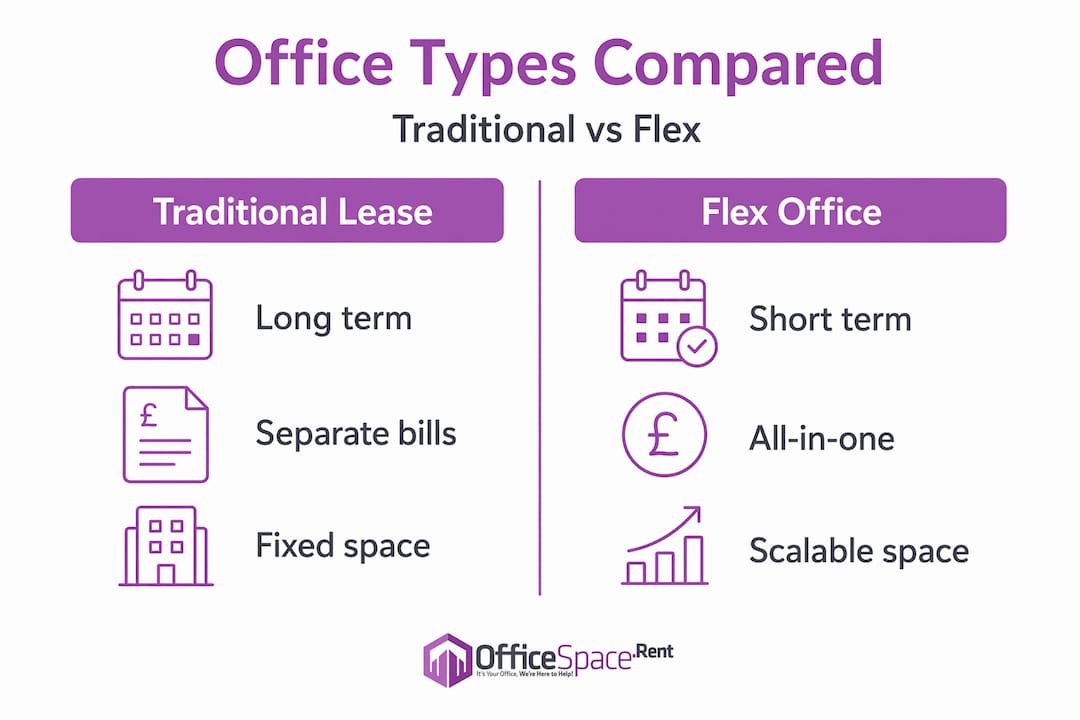
Traditional leases lock companies into terms of three to five years, while flex leases can be structured on a monthly or even daily basis. This table makes the operational implications concrete. A company entering a growth phase with uncertain hiring timelines is materially exposed under a traditional lease in a way that a flex arrangement eliminates.
Flex office space examples in practice
The practical applications of flex office space span company sizes, sectors, and growth stages.
- Scaling startups use flex space to secure professional accommodation during their early growth phase without committing to leases that extend beyond their current visibility of revenue. If a Malta-based fintech doubles its team within a year, it can take additional desks or upgrade to a private suite within the same building.
- Project-based teams operating on a contract or consultancy basis often require a dedicated workspace for three to six months. Flex space provides that without excess commitment. An office in a business centre covers exactly this use case.
- Enterprise satellite offices use flex space to establish a regional presence without the overhead of a full branch set-up. A London-headquartered firm entering the Maltese market can take a flex space in Sliema or Mriehel to test operations before committing to a direct lease.
- Hybrid-first employers allocate a flex office budget so that employees can access professional workspace near their homes on the days they are not working remotely.
Pro Tip: If you are evaluating flex space for a project team, negotiate a right-of-first-refusal on adjacent private offices within the same facility. As the project scales or converts to a permanent operation, you avoid the disruption of moving while retaining contractual flexibility.
How flex office space works operationally
The booking and access models for flex office space are more varied than most first-time users expect.
- Subscription model: A business pays a fixed monthly fee for access to a set number of desks or a private office, with predictable costs and guaranteed availability.
- On-demand access: Desk or room bookings are made via an app or web platform, paying per session or per day. This suits low-frequency users who do not need permanent space.
- Hybrid memberships: Companies purchase a bundle of desk credits used across multiple locations, giving employees access to workspaces nearby without mandating a fixed location.
- Shared resources: Meeting rooms, printing facilities, and video conferencing suites are typically bookable by the hour. Flex offices provide communal and private spaces that adapt to the task at hand.
- Technology-enabled access: Smart card or mobile app entry, cloud-based desk reservation systems, and digital visitor management are standard in modern flex facilities, reducing administrative friction.
- Bundled services: Flex office providers typically include high-speed internet, cleaning, printing, and reception services within the contract, removing the need for separate procurement.
Contract terms in flex space are structured to favour the tenant. Notice periods of one to four weeks are common, and most providers allow capacity adjustments with minimal penalty provided reasonable notice is given.
My perspective on flex office adoption

I’ve seen businesses in Malta hold onto traditional leases long past the point where the arrangement made commercial sense, simply because the process of switching felt complex. In my experience, the decision to move to a flex arrangement is almost always made later than it should be.
What I’ve learned from working in this market is that the real cost of a traditional lease is rarely calculated honestly at the outset. When you factor in fit-out, furniture, ongoing maintenance, and the risk of carrying empty desks through a downturn, the fixed-cost model is far less stable than it appears. Flex space removes that exposure.
My caution to any business exploring this route is to assess the provider’s track record, not just the headline price. A low monthly rate from a poorly managed facility creates more operational disruption than it saves in rent. Prioritise providers with clear contract terms, reliable technology infrastructure, and demonstrably high occupancy, which signals genuine market confidence in the product they offer.
— OfficeSpace.Rent
Find flex office space in Malta with Officespace
Officespace lists commercial office spaces across Malta suited to businesses seeking flexibility without compromising on location or quality. Whether you need a short-term arrangement in a high-demand corridor or a scalable private office within a managed business centre, the platform provides detailed listings with transparent pricing and direct access to local agents.
Browse a Mriehel commercial property suitable for businesses wanting established infrastructure in one of Malta’s primary commercial zones, or review commercial property options across the island to identify the arrangement that fits your headcount, budget, and growth trajectory. For a sea-view office in Sliema, Officespace connects you directly with the listing agent to discuss terms.
FAQ
What is the difference between flex and coworking space?
Coworking space is one format within the broader flex office category, typically an open-plan shared environment. Flex office space also includes private serviced suites, hot-desking arrangements, and hybrid membership models with more occupancy control.
How does flex office space reduce costs?
Flexible workspaces bundle rent, utilities, internet, and maintenance into a single monthly fee, eliminating separate service contracts and the capital expenditure required to fit out a traditional leased space.
Can large companies use flex office space?
Yes. Enterprise businesses use flex office space for satellite offices, project-based teams, and hybrid workforce programmes, allowing them to establish regional presences without the overhead of a full branch operation.
How long is a typical flex office contract?
Flex lease terms range from daily to monthly, with rolling contracts common. This contrasts with traditional commercial leases that typically run three to five years.
Is flex office space suitable for hybrid working?
Flex office space is particularly well-suited to hybrid workforces because it prices for actual usage rather than permanent desk allocation, preventing businesses from paying for unused capacity on remote-working days.