For many businesses, commercial rent in Malta looks simple at first glance: find a location, compare the monthly price, sign a lease. In reality, the number on a listing is only the starting point. The true cost depends on the district, building quality, lease structure, service charges, VAT treatment, fit-out needs, parking, and how flexible the landlord is willing to be.
This guide focuses on office and workspace rent, rather than retail or industrial property. It is written for companies relocating to Malta, expanding locally, or reviewing whether their current office still fits their team. If you are an iGaming operator, financial services firm, legal practice, architecture studio, insurance company, crypto business, or growing SME, the same rule applies: assess commercial rent as a total occupancy cost, not just a monthly rent line.
The short answer: what should businesses expect?
Businesses should expect a varied, location-sensitive market. Prime offices in Sliema, St Julian’s, Valletta and major business hubs generally command higher rents, especially when they offer modern finishes, sea views, strong transport access, or Grade A specifications. Better value can often be found in central inland locations, emerging business districts, or properties that need some fit-out work.
In 2026, the main expectations are straightforward:
- Prime location carries a premium: visibility, staff convenience and client access raise commercial rent.
- Serviced offices cost more per desk, but reduce setup friction: they can include furniture, utilities, reception, meeting rooms and shorter commitments.
- Traditional leases may be cheaper over time, but require upfront planning: fit-out, deposits, furniture, IT and legal review can affect cash flow.
- Landlords care about tenant profile: regulated industries, high-growth companies and new market entrants should be ready to explain business activity, lease use, payment capacity and compliance needs.
The best approach is to compare offices on a like-for-like basis. A lower monthly rent can become expensive if service charges, parking, fit-out and utilities are unclear.
What commercial rent usually includes, and what it may not
Commercial rent in Malta is often quoted as a base rent. Depending on the listing and landlord, it may be shown monthly, annually, or as a rate per square metre. That base rent rarely tells the whole story.
A business should ask what is included before comparing one office with another. Two spaces at the same monthly rent can have very different total costs if one includes shared facilities and the other leaves the tenant responsible for everything.
| Cost item | What to expect | Why it matters |
|---|---|---|
| Base rent | The core amount paid for occupying the office | This is the headline figure, but not the full cost |
| Service charges | Costs for common areas, lifts, security, cleaning, maintenance or building management | These can materially change the monthly budget |
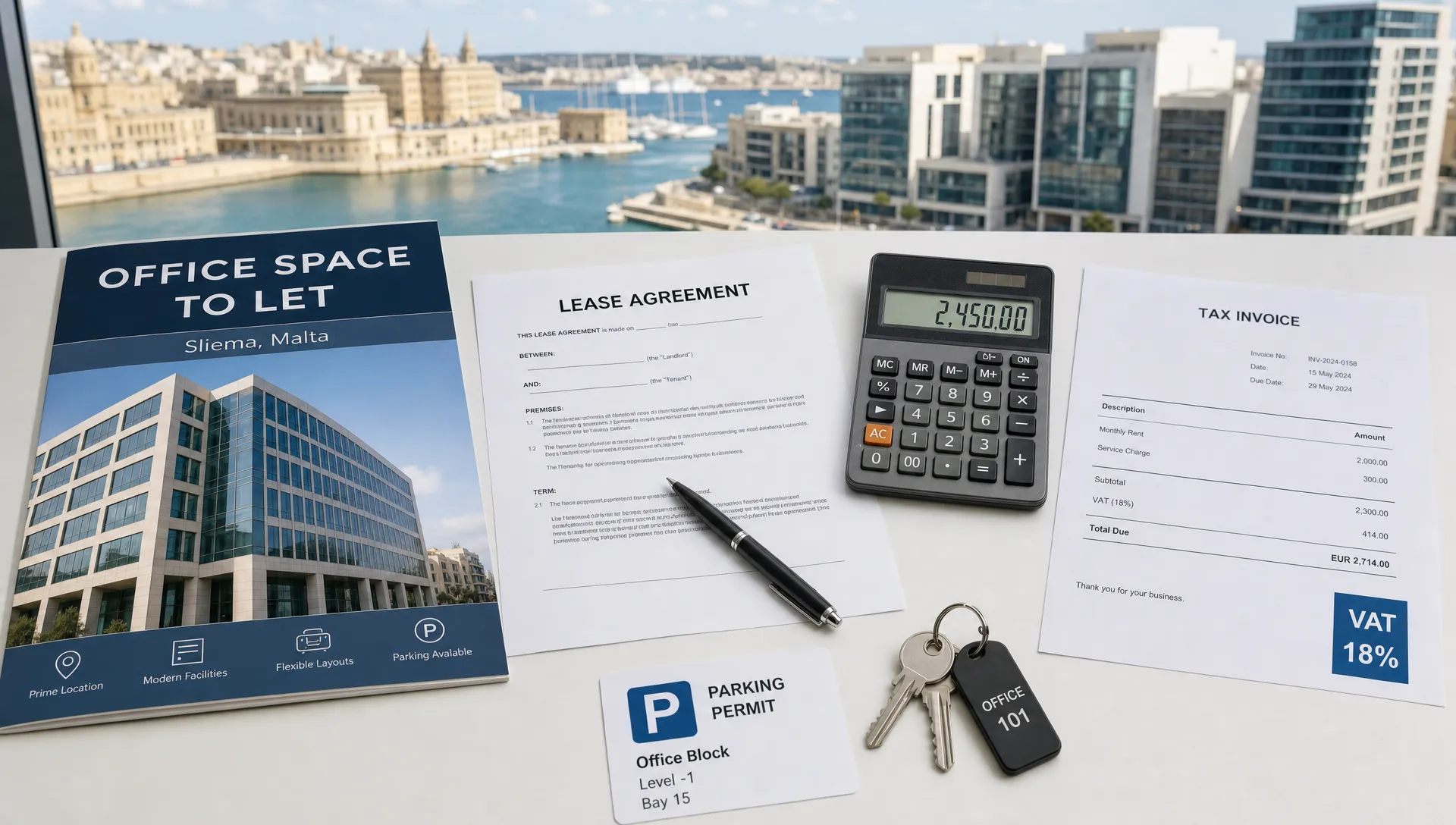
| VAT | Commercial leases may be subject to VAT depending on the landlord, tenant and use | VAT affects cash flow, even where recovery is possible |
| Utilities | Electricity, water, air conditioning and sometimes waste services | Older buildings or inefficient layouts can cost more to run |
| Internet and telecoms | Fibre availability, installation and business-grade connectivity | Critical for iGaming, fintech, crypto, finance and remote teams |
| Parking | Dedicated or nearby parking may be separate | Staff and client access can become a hidden cost |
| Fit-out and furniture | Partitions, desks, meeting rooms, cabling, signage and finishes | A cheaper shell office may need significant upfront spend |
| Legal and professional fees | Lease review, tax advice and technical inspections | Important before signing a multi-year commitment |
For a deeper breakdown of how these costs interact, this guide to office rental pricing factors in Malta is useful when building a proper budget.
Location has the biggest impact on commercial rent
Malta is compact, but office location still matters enormously. A move of only a few kilometres can change the rent profile, commuting experience, parking availability and the type of building stock available.
Prime coastal and business districts often suit companies that need brand presence, recruitment appeal and easy access to clients, hotels, restaurants and professional services. Inland and secondary locations may offer more space for the same budget, which can be attractive for SMEs, back-office teams, call centres, support functions and businesses that do not rely on daily client footfall.
| Area | Common business fit | Rent expectation |
|---|---|---|
| Sliema and St Julian’s | iGaming, finance, technology, international firms, client-facing teams | Usually among the higher office rent areas, especially for modern or waterfront buildings |
| Valletta and Floriana | Legal, professional services, public-sector-facing businesses, consultancies | Strong prestige and accessibility, with varied building types |
| Mrieħel and Central Business District | Larger offices, corporate HQs, financial services, insurance, back-office operations | Competitive for modern floor plates and scalable space |
| Gżira, Msida and Birkirkara | SMEs, tech teams, professional services, hybrid offices | Often more flexible, with good central access |
| Qormi, Marsa, Luqa and southern areas | Logistics-linked offices, operations teams, value-focused businesses | Often better value, depending on specification and transport needs |
| Mosta, Naxxar, Attard and surrounding areas | Local SMEs, professional practices, companies seeking lower congestion | Can offer strong value for teams not tied to coastal hubs |
For macro context, Malta’s National Statistics Office publishes data on property, construction, inflation and employment trends. These broader indicators do not replace live office comparisons, but they help explain why rents can shift over time as demand, labour markets and property costs change.
Serviced office, traditional lease or HQ space?
Commercial rent expectations also depend on the type of workspace you choose. A serviced office and a traditional lease may both satisfy the same team size, but they work very differently financially.
| Office type | Best for | What to expect |
|---|---|---|
| Serviced office | New market entrants, project teams, start-ups, small international teams | Higher cost per desk, but faster move-in, fewer setup costs and more flexibility |
| Traditional office lease | SMEs, professional firms, stable teams, companies wanting control over layout | More responsibility, but often better long-term value if occupancy is predictable |
| Larger HQ office | iGaming, insurance, finance, corporate groups, fast-growing companies | More negotiation scope, longer lead times and greater fit-out complexity |
| Shell or semi-finished space | Businesses with specific design requirements | Lower initial rent may be possible, but fit-out costs and timing must be assessed carefully |
Serviced offices are particularly attractive when timing matters. A company relocating executives, opening a regulated operation, or testing the Maltese market may prefer speed and flexibility over the lowest possible monthly cost. By contrast, a traditional lease may suit a team that expects stable headcount for several years and wants its own meeting rooms, branding and internal security setup.
How much should you budget?
There is no single average commercial rent in Malta that applies to every business. A small serviced office in a central building, a 20-person professional office in Birkirkara and a waterfront iGaming floor in St Julian’s are not comparable products.
Still, it helps to think in budget bands. The ranges below are practical planning categories, not fixed market rates. Actual availability depends on location, condition, lease term, building quality and timing.
| Monthly budget | What businesses may typically find | Key caution |
|---|---|---|
| Up to €1,500 | Coworking desks, small serviced offices, compact private rooms or value-led locations | Check whether meeting rooms, VAT, utilities and internet are included |
| €1,500-€4,000 | Small private offices, hybrid team space, professional suites or smaller central units | Fit-out and parking can change the real cost quickly |
| €4,000-€7,000 | Established SME offices, better finishes, larger layouts or stronger locations | Compare usable space, not just total advertised area |
| €7,000-€10,000 | Larger office units, upgraded premises or more central options | Review service charges, rent review clauses and expansion flexibility |
| Over €10,000 | HQ-style space, larger floor plates, Grade A buildings or prime areas | Negotiation, legal review and technical due diligence become more important |
A useful budgeting formula is:
Total monthly occupancy cost = base rent + VAT where applicable + service charges + utilities + internet + parking + insurance + maintenance + amortised fit-out and furniture costs.
For decision-making, model the cost across the full lease term. A tenant contribution, rent-free period, or lower fit-out requirement can make a more expensive headline rent better value over three years.
Lease terms: what to review before committing
Commercial leases in Malta can vary significantly. Some are short and flexible, especially in serviced offices. Others are multi-year commitments with specific obligations on maintenance, permitted use, reinstatement and rent increases.
Before signing, businesses should pay close attention to the following areas:
- Lease duration and break options: confirm whether you can exit early, and on what notice.
- Rent reviews and increases: check whether rent rises are fixed, indexed, or subject to market review.
- Permitted use: make sure the premises can legally and practically support your business activity.
- Service charges: ask how they are calculated, capped, reconciled and evidenced.
- Fit-out responsibility: clarify who pays for works, who approves them and who owns improvements at lease end.
- Repairs and reinstatement: understand what condition you must maintain and return the office in.
- Assignment and subletting: important if you expect restructuring, growth, downsizing or group-company changes.
A lease is not just an administrative document. It defines your cost exposure, operational freedom and exit options. Businesses should review key clauses in a commercial office lease in Malta before making a final commitment.
VAT, tax and legal expectations
Commercial rent in Malta can involve VAT, but the treatment depends on the facts. Factors can include the landlord’s status, the tenant’s VAT position, how the property is used and whether the arrangement falls within taxable letting rules.
Where VAT applies, the standard rate is commonly relevant, and businesses should assess whether VAT can be recovered. For VAT-registered companies making taxable supplies, recovery may be possible, but this should not be assumed without advice. For exempt or partially exempt businesses, VAT can become a real cost rather than a cash-flow item.
The safest approach is to check the lease wording and obtain advice before signing. This is especially important for financial services, insurance, gaming, blockchain and other regulated sectors where VAT recovery, licensing and premises suitability can be more complex. For more detail, see this guide to the VAT and tax implications of renting in Malta.
This article is general guidance only and should not replace legal, tax or real estate advice for a specific transaction.
What different types of businesses should expect
Different industries evaluate commercial rent differently. The cheapest office is not always the right office, especially if the premises affect licensing, recruitment, data security, client confidence or staff retention.
iGaming and online gambling companies
Gaming companies often prioritise central locations, reliable connectivity, staff amenities and a workplace that supports recruitment. Meeting rooms, breakout areas, access control and room for growth can be as important as the rent figure. Landlords may also ask for clarity on the business activity, group structure and regulatory status.
Financial services, Fintech and insurance firms
Finance and insurance tenants often value professional building management, secure access, parking, client reception areas and a high-quality address. They should pay particular attention to lease duration, business continuity, data infrastructure and whether the premises support internal compliance requirements.
Lawyers, architects and professional practices
Client access, consulting offices, building presentation and location prestige can matter more than raw square metre cost. Valletta, Floriana, Sliema and central town locations can be attractive, but smaller firms may find better value in well-connected inland areas.
SMEs and growing local businesses
SMEs should focus on flexibility. A lease that allows expansion, a layout that works for hybrid teams and predictable service charges may be worth more than a slightly lower rent. For many SMEs, the right office is the one that supports growth without locking the company into excess space.
Blockchain, crypto and emerging technology companies
Crypto and blockchain businesses may need to provide extra comfort around use, compliance, identity, licensing and payment reliability. It is better to address these questions early rather than discover late in the negotiation that a landlord is uncomfortable with the activity.
How long does the rental process take?
A straightforward office search can move quickly if the business has clear requirements and decision-makers are available. A more complex HQ search, regulated-sector move, or office requiring fit-out will take longer.
In practical terms, expect the process to include requirement setting, market review, viewings, shortlisting, offer negotiation, lease review and handover. If the space needs works, add time for design, approvals, contractors, furniture, IT installation and staff move planning.
To keep the process efficient, decide early on your target location, maximum total monthly cost, minimum usable area, preferred lease term, parking needs, fit-out standard and move-in deadline. This prevents wasted viewings and makes negotiation more focused.
Red flags when comparing commercial rent
A low advertised rent is not automatically a bargain. It may reflect limited parking, poor access, uncertain service charges, an awkward layout, older building systems, lack of natural light, restricted use, or substantial fit-out costs.
Be cautious if a landlord or agent cannot clearly answer basic questions about VAT, service charges, building permits, maintenance responsibilities, internet availability, air conditioning, common areas or lease renewal terms. These issues can become expensive after move-in.
Also compare usable space carefully. Some offices have generous total area but inefficient layouts, large corridors, unusable corners or limited meeting room potential. For desk planning, many businesses use indicative space assumptions per employee, then adjust for meeting rooms, quiet rooms, storage, reception and hybrid work patterns. The right layout can reduce the amount of space you need, while the wrong layout can make a cheap office feel expensive.
Frequently Asked Questions
What is the average commercial rent in Malta? There is no reliable single average because rent varies by location, office type, size, fit-out, lease term and whether the space is serviced or traditional. Businesses should compare live listings and total occupancy cost rather than relying on one market average.
Does commercial rent in Malta include VAT? Sometimes, but not always. VAT treatment depends on the landlord, tenant, property use and lease structure. Businesses should confirm VAT treatment in writing and get professional advice before signing.
Are serviced offices more expensive than traditional leases? Usually they cost more per desk or per square metre, but they may include furniture, utilities, reception, meeting rooms and flexibility. For short-term or relocation needs, serviced offices can be cost-effective despite the higher headline rate.
Can businesses negotiate commercial rent in Malta? Yes, negotiation is common, but flexibility depends on demand, location, lease term, tenant profile and the quality of the property. Rent-free periods, fit-out contributions, break clauses and service charge clarity may be as valuable as a lower rent.
How much office space should a business rent? It depends on layout, workstyle and growth plans. A dense open-plan team needs less space than a client-facing practice with private offices and meeting rooms. Always test the floor plan against actual workstation, storage, meeting and breakout needs.
What documents might landlords request? Landlords may ask for company details, business activity, VAT information, proof of authority to sign, financial comfort, references, licences where relevant and details of intended use. Regulated industries should prepare this early.
Ready to compare commercial rent in Malta?
Commercial rent in Malta becomes much easier to assess when you compare real options on the same basis: location, usable space, lease terms, VAT, service charges, fit-out and flexibility.
OfficeSpace.Rent helps businesses browse verified office listings in Malta, compare locations and property types, filter by size and budget, and get support with viewings and negotiations. If you are relocating, expanding or reassessing your current workspace, start by building a shortlist that reflects your total cost, not just the advertised rent.