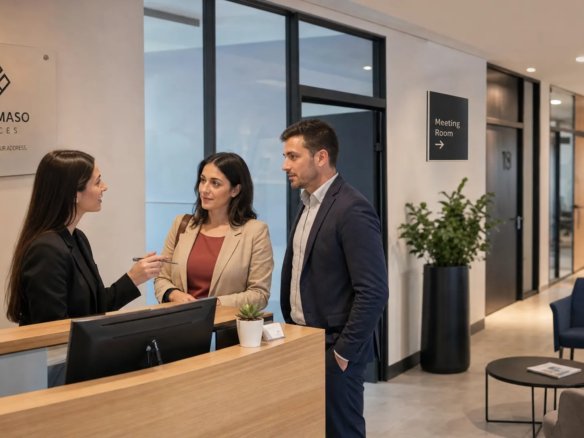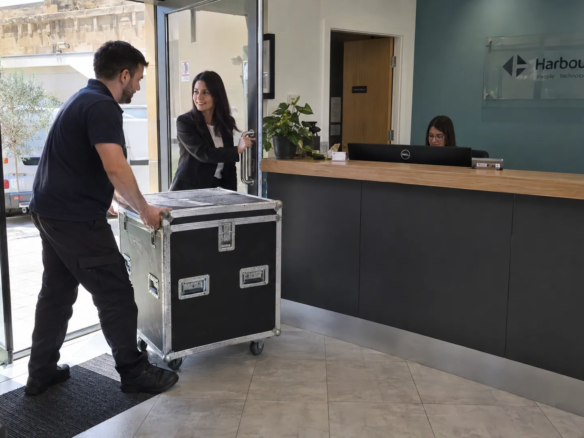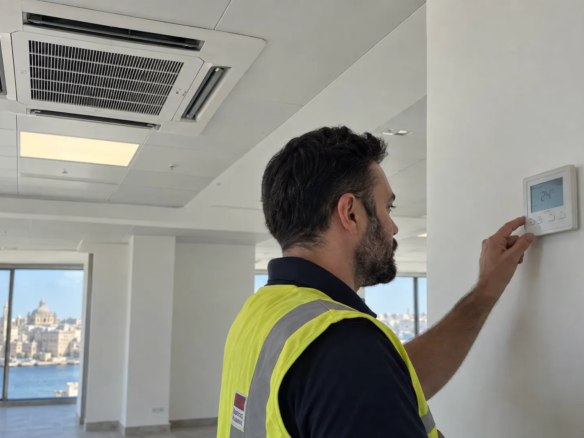
Traditional offices remain the preferred workspace for companies that need full operational control, a permanent brand presence, and an environment built entirely around their own culture. For businesses with stable headcount, client-facing operations, or specialist physical requirements, a conventional leased office delivers what flexible alternatives cannot: complete authority over layout, branding, security, and day-to-day management. Demand across the CEE region remains broadly stable in 2026, with 61% of companies reporting unchanged office space requirements and only 11% expecting to reduce their footprint.
The core advantages of choosing a traditional office include:
- Full environmental control over layout, fit-out, branding, and security
- Permanent business address that signals stability and credibility to clients
- Dedicated infrastructure for IT, utilities, and specialist equipment
- Company culture built through consistent, shared physical space
- Privacy and confidentiality for sensitive client work and internal operations
- Long-term cost predictability once fit-out investment is complete
- Compliance readiness for regulated industries requiring controlled premises
What is a traditional office?
A traditional office, also referred to as a conventional or direct-lease office, is a workspace rented directly from a landlord under a fixed-term agreement. The tenant takes full legal, financial, and operational responsibility for the space. That means managing fit-out, utilities, cleaning, security, IT infrastructure, and maintenance independently, without an operator intermediary.
The defining characteristics of a traditional office include:
- Long-term lease commitments, typically ranging from 2 to 10+ years
- Bare-shell or fully finished, requiring the tenant to either fund and manage all fit-out or choose a fully fitted space
- Dedicated, exclusive space not shared with other companies
- Full branding rights over interiors, signage, reception, and common areas within the demised space
- Tenant-managed services including utilities, internet, cleaning, and facilities
- Capital expenditure model, where furniture and fit-out are upfront tenant costs
This contrasts directly with serviced offices, where an operator provides a fully equipped, managed workspace on a short-term licence, and with managed offices, which offer a middle ground of bespoke fit-out with operator management. A traditional lease suits businesses that want to own their environment completely, rather than occupy space within someone else’s.
Is a traditional office right for your business?
The right answer depends on operational stability, headcount predictability, and the role your physical space plays in your brand. For certain business types, a conventional office is genuinely the most logical choice. For others, the lease commitment creates more risk than value.
Businesses best suited to a traditional office:
- Client-facing operations where the physical environment is part of the service experience, such as law firms, financial advisory practices, and medical clinics
- Regulated industries requiring controlled, auditable premises for compliance purposes
- Companies with specialist physical requirements, including recording studios, showrooms, laboratories, or manufacturing support functions
- Established businesses with stable headcount and high confidence in multi-year growth projections
- Brand-reliant organisations where office design and location are central to market positioning
Hybrid and remote work trends have reshaped demand, but have not eliminated the case for conventional offices. Offices are evolving into collaboration and engagement hubs, with focused individual work shifting remotely. This means the traditional office now functions most effectively as a space for strategic interaction, culture building, and client engagement, rather than a default location for all work.
The risks are real and worth weighing carefully. Traditional leases commit businesses to longer terms, limiting flexibility if headcount changes or market conditions shift. For smaller businesses, personal guarantee clauses can expose founders to liability if the company cannot meet lease obligations. Signing before fully assessing whether the space will justify its cost is one of the most common and costly mistakes in commercial leasing.

Pro Tip: Before committing to a traditional lease, map your projected headcount for the full lease term and stress-test it against a 20% contraction scenario. If the numbers still work, the commitment is defensible.
What features define a traditional office space?
Traditional offices offer a specific set of physical and operational characteristics that distinguish them from flexible workspace alternatives. Understanding what you are actually getting, and what you are responsible for, is essential before signing heads of terms.
Core features of a conventional office:
- Enclosed, private workspace with no shared occupancy or hot-desking
- Customised interior design reflecting company branding, culture, and operational workflow
- Dedicated IT infrastructure, including private server rooms, cabling, and access control systems
- Security systems installed and managed by the tenant, including CCTV, alarm systems, and access control
- Reception and entrance branding with full signage rights
- Defined operational control over temperature, lighting, acoustics, and spatial configuration
- Specialist zones such as private meeting rooms, breakout areas, and client-facing spaces built to specification
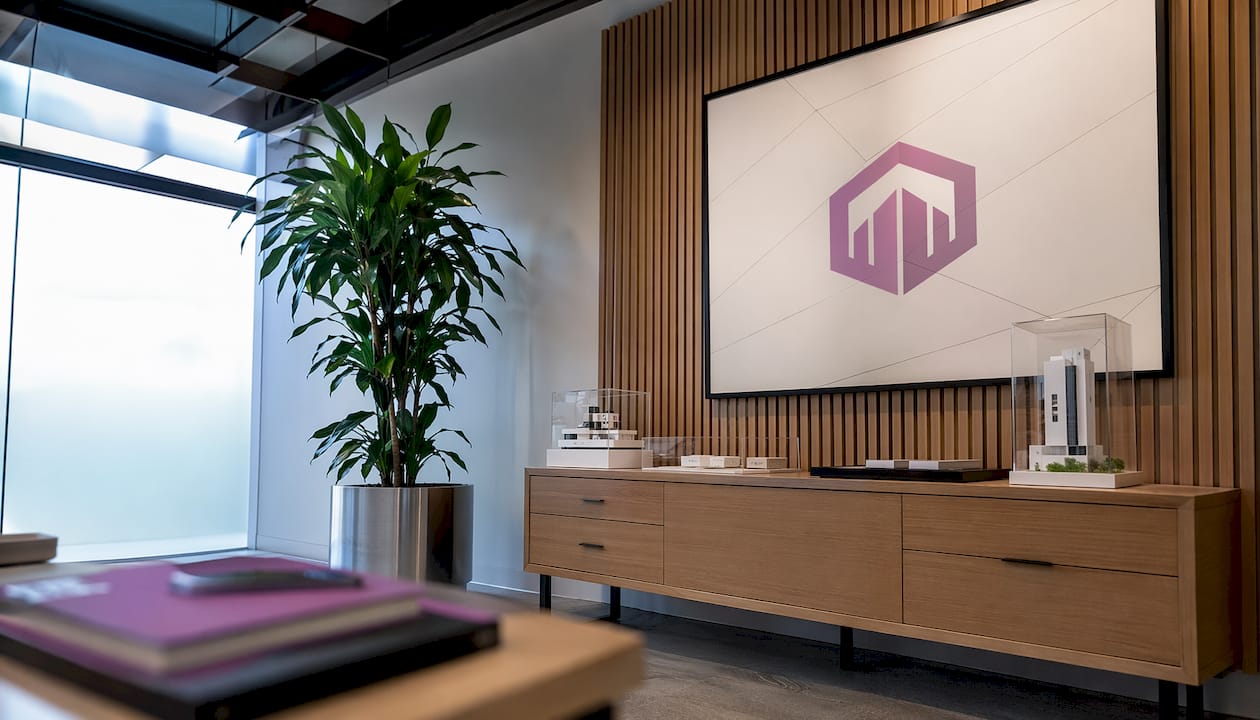
Office design and fit-out are increasingly powerful tools for expressing brand identity and driving performance. In Central Europe, occupiers prioritise well-located, high-quality spaces that support collaboration, employee satisfaction, and ESG compliance. Modern conventional offices in markets such as Budapest and Warsaw increasingly incorporate biophilic design, natural materials, wellness-oriented layouts, and smart building systems. Explore how strategic office design can reinforce your company culture and brand positioning.
What does a traditional office actually cost?
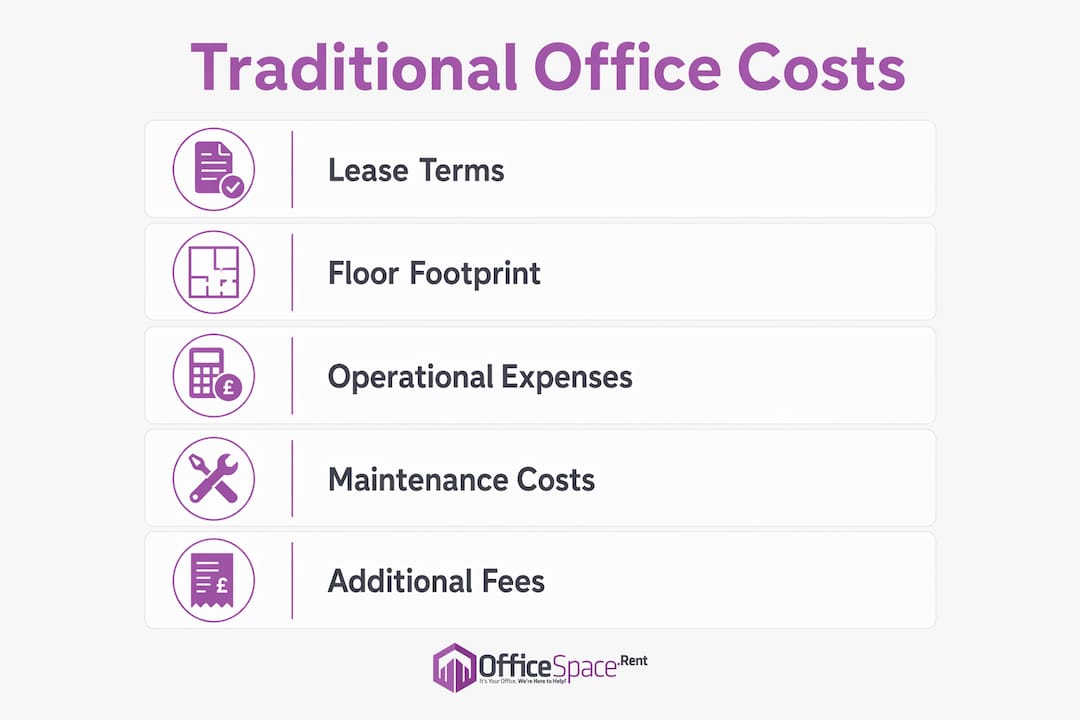
The headline rent figure is the starting point, not the total cost. A traditional lease carries a range of upfront and ongoing expenses that, taken together, frequently exceed what a serviced or managed office would cost on a monthly basis.
Upfront costs:
- Most of the offices are usually offered fully finished in an open plan layout, sometimes previous tenants fit out might need to be adapted to fit your needs
- Furniture and equipment procurement (full capital expenditure by the tenant) unless offered furnished
- Legal fees for lease negotiation
- Deposit or bank guarantee, often equivalent to 3–6 months’ rent depending on covenant strength
Ongoing costs:
- Office rental charge usually between €150-350/sqm/annum
- Service charges covering building maintenance and common area upkeep
- Utilities managed and paid directly by the tenant
- Business rates where applicable
- Cleaning, security, and IT maintenance contracts
One cost that catches many tenants off guard: tenants pay for the full floor footprint, including corridors, lobbies, and shared areas, not just the space they physically occupy. Dilapidations represent another significant hidden liability. At lease end, tenants are contractually required to return the space to its original condition, which can generate substantial unexpected costs.
For practical guidance on managing these expenses, Officespace’s cost-saving ideas for office rental covers the most effective approaches for 2026.
How to find and rent traditional office space in Central Europe
The Central European office market in 2026 is defined by constrained supply rather than excess. According to Colliers’ ExCEEding Borders Office 2026 report, annual completions across the six major CEE capitals fell to just over 200,000 sqm, the lowest level ever recorded. Prime vacancy in Prague has fallen below 6%, and modern well-located buildings in Bucharest frequently report vacancy between 3% and 9%. For occupiers, this means acting decisively and working with agents who have genuine market access.
Practical steps for sourcing a conventional office in Central Europe:
- Define your space requirements precisely before approaching agents: headcount, growth projections, specialist infrastructure needs, and preferred locations
- Work with reputable local agents who have direct relationships with landlords and access to off-market opportunities
- Evaluate lease terms carefully, including break clauses, rent review mechanisms, and dilapidations obligations. The legal considerations for office leases guide covers the key clauses to scrutinise
- Assess ESG credentials of any building under consideration. In Central Europe, modern Class A buildings with BREEAM or LEED certification command premium rents but often carry lower service charges due to energy efficiency
- Inspect service charge structures on older buildings, where charges can reach €5–6.50 per sqm compared with approximately €3 per sqm in modern assets
- Negotiate flexibility provisions such as break options and expansion rights, particularly given current market uncertainty around hybrid working patterns
- Conduct thorough due diligence on the landlord’s financial position and the building’s maintenance history
For businesses evaluating office types and locations across Central Europe, the HOOF business real estate consulting team provides specialist advice on offices as collaboration and engagement spaces. Their office leasing checklist is a practical resource for structuring your evaluation process before entering negotiations.
Pro Tip: In markets where lease renewals dominate, such as Prague and Bratislava, landlords are often more willing to negotiate on fit-out contributions and break clause terms than on headline rent. Prioritise those levers in negotiation.
Choosing a traditional office means transitioning into an operator role. You become responsible for managing vendor contracts, facilities, and compliance obligations that a serviced office operator would otherwise handle. That administrative overhead is a genuine cost, even if it does not appear on the rent schedule. Factor it into your total occupancy cost calculation before comparing conventional and flexible options on a like-for-like basis. Officespace’s guide on choosing the right office type provides a structured framework for that comparison.
Key takeaways
Traditional offices deliver full operational control and brand permanence, making them the right choice for established, client-facing businesses with stable headcount and long-term growth confidence.
| Point | Details |
|---|---|
| Stable CEE demand | 61% of CEE companies report unchanged office space requirements in 2026, with only 11% expecting to reduce their footprint. |
| Total cost complexity | Upfront costs include fit-out, legal fees, and substantial deposits; ongoing costs include service charges, utilities, and dilapidations liability. |
| Supply constraints | Annual completions across the six major CEE capitals were particularly low in 2025, tightening availability in prime locations. |
| Best-fit businesses | Traditional leases suit client-facing, regulated, or brand-reliant organisations with predictable headcount and multi-year revenue stability. |
| ESG and quality gap | Modern Class A buildings carry substantially lower service charges compared to older stock, which narrows the effective cost gap with prime space. |