Choosing a serviced office for rent in Malta is often less about prestige and more about timing. If your business needs a professional workspace quickly, without managing furniture, fit-out, utilities, internet contracts and building operations, a serviced office can be the cleanest route into the market.
But it is not the right answer for every company. A team with stable headcount, specialist technical requirements or a long-term brand-led headquarters plan may be better served by a traditional lease. The key is to look beyond the monthly desk price and ask what the office needs to achieve for the business over the next 6, 12 and 24 months.
This guide explains who should choose a serviced office in Malta, who should think twice, and what to check before signing.
What is a serviced office in Malta?
A serviced office is a ready-to-use workspace operated by a provider rather than managed entirely by the tenant. Instead of taking an empty shell or fitted office and arranging everything yourself, you typically rent a furnished office or suite with shared services included.
In Malta, serviced offices commonly appeal to companies that want speed, flexibility and a low-operational-burden setup. Depending on the provider and building, the package may include:
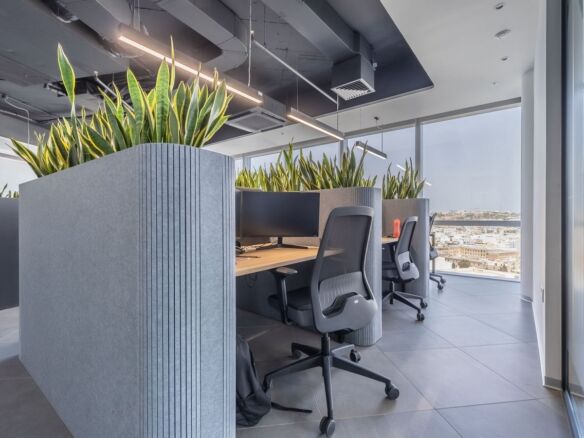
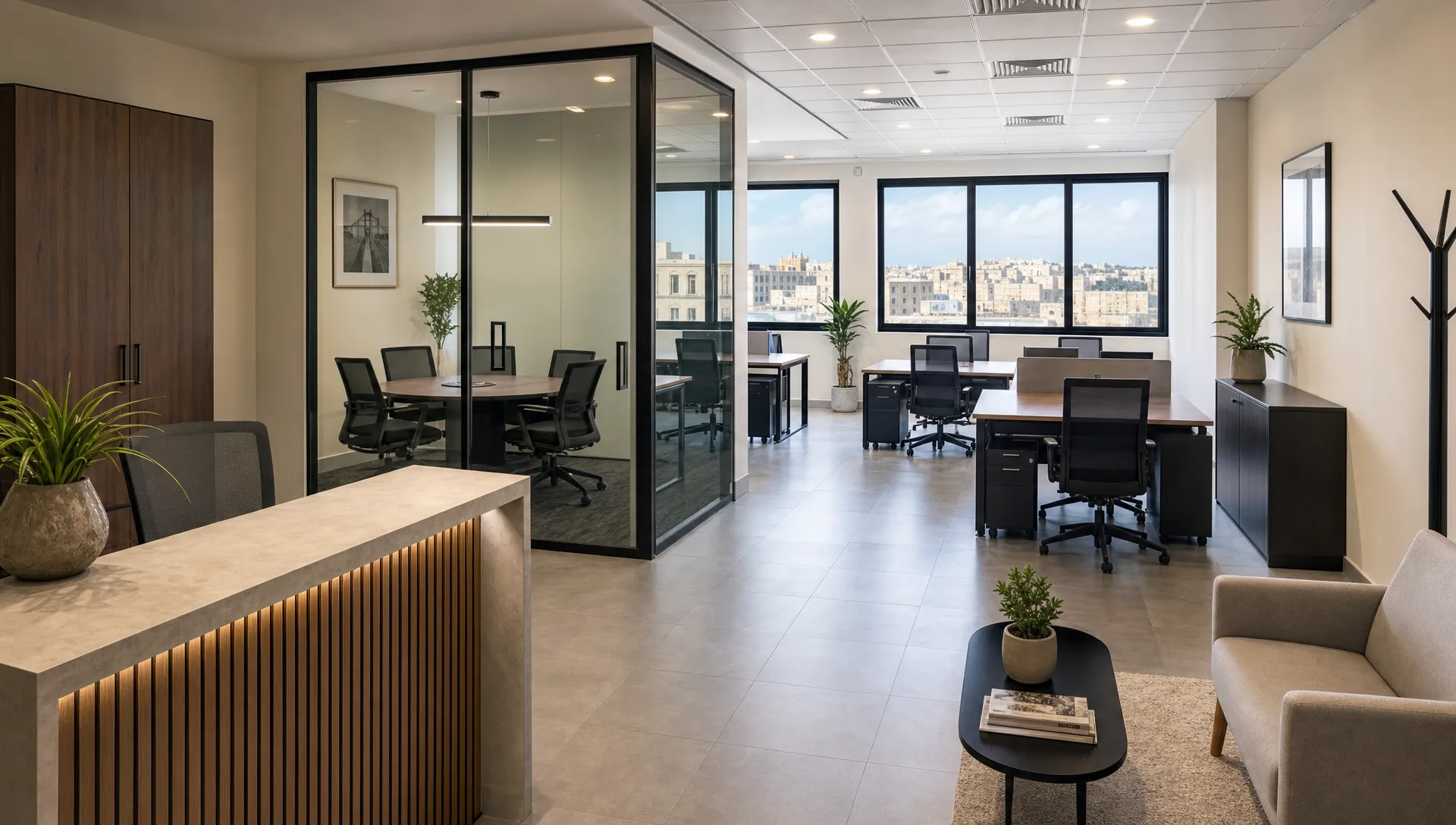
- Furnished private offices: desks, chairs, storage and a fitted workspace from day one.
- Reception and mail handling: useful for client-facing teams and companies setting up locally.
- Internet, utilities and cleaning: usually bundled into the monthly fee, although inclusions vary.
- Meeting rooms and shared areas: available by booking, often with credits or hourly charges.
- Flexible terms: shorter commitments than many conventional office leases, subject to provider policy.
The important point is that “serviced” is a category, not a guarantee. One building may offer a premium private suite with strong IT support, while another may be closer to a shared coworking environment with limited privacy. Always inspect the space, review the contract and confirm exactly what is included.
If you are comparing the overall model against a conventional lease, this guide to serviced vs traditional offices in Malta gives a broader side-by-side view.
Who should choose a serviced office for rent?
A serviced office works best when the value of speed, flexibility and operational simplicity outweighs the premium you may pay per desk. That makes it particularly relevant for companies entering Malta, scaling quickly or managing uncertain headcount.
Companies entering Malta for the first time
For international businesses, Malta can be an attractive base because it offers EU market access, English-speaking business services and a mature ecosystem across gaming, financial services, tech and professional services. A serviced office helps these companies establish a local working base before committing to a larger lease.
This is especially useful if the business is still deciding between locations such as Sliema, St Julian’s, Gżira, Valletta, Mriehel or Birkirkara. Rather than signing a multi-year lease immediately, a serviced setup lets management test commute patterns, client access, staff preferences and hiring plans.
If the workspace will be used for formal company purposes, confirm the registered-office arrangement with your corporate services provider. The Malta Business Registry is the relevant authority for company registration matters, but your legal or corporate adviser should confirm what is suitable for your structure.
Startups and SMEs with uncertain headcount
A young company might have five employees today and fifteen in six months, or it may operate with a hybrid team where only part of the workforce is in the office at once. In this situation, a fixed traditional lease can create either too much unused space or too little room to grow.
Serviced offices are often practical for SMEs because they allow the business to focus on revenue, hiring and client work instead of office setup. The company avoids many upfront decisions around fit-out, furniture, cleaning contracts, internet providers, maintenance and reception cover.
The trade-off is that the per-desk cost can be higher than a traditional lease once the team becomes larger and stable. For a small team, the convenience may be worth it. For a larger team with predictable needs, the economics can shift.
iGaming, fintech, blockchain and digital teams
Malta has strong clusters in iGaming, payments, fintech, crypto-related services and digital operations. These businesses often hire quickly, operate internationally and need office space that can support visiting executives, project teams, compliance meetings and hybrid work.
A serviced office can work well for these sectors when the provider offers reliable connectivity, professional meeting rooms, good building access and enough privacy for sensitive conversations. However, companies in regulated or data-sensitive industries should be more demanding than a generic tenant.
Before choosing a space, check whether the office can support your internal security, compliance and IT requirements. Ask about network arrangements, access control, visitor logging, private meeting areas and whether your team can use its own equipment where needed.
Professional services firms that need a polished client environment
Lawyers, architects, consultants, insurance brokers and advisory firms often need a professional address and meeting rooms, but may not need a large full-time office. A serviced office can provide the right balance: a private workspace for the team, reception support for visitors and bookable meeting rooms for client appointments.
For these firms, the key issue is confidentiality. A serviced office with thin walls, crowded common areas or limited private rooms may not be appropriate. A well-managed private suite within a serviced building, however, can offer a strong client experience without the overhead of a standalone office.
Project teams and temporary expansions
Serviced offices are also useful when a company needs space for a defined period. Examples include a six-month implementation project, a temporary relocation, an overflow team while a headquarters is being refurbished or a market-entry team before a permanent office is selected.
In these cases, paying a premium for flexibility may be rational because the business avoids a long lease, fit-out costs and exit complications.
| Business situation | Why a serviced office may fit | What to check before signing |
|---|---|---|
| New company entering Malta | Fast setup and lower initial commitment | Address use, licence length, deposit and termination terms |
| SME with uncertain headcount | Easier to expand or reduce space | Upgrade options, notice periods and total cost per person |
| iGaming or fintech team | Quick access to professional space in key business districts | IT reliability, access control and private meeting rooms |
| Legal, architectural or advisory firm | Polished client environment without managing a full office | Confidentiality, reception quality and meeting room availability |
| Temporary project team | Ready-to-use space for a defined period | Minimum term, after-hours access and included services |
Who should think twice?
A serviced office is not automatically cheaper or better. It solves operational problems, but it may create limitations if the business needs deep control over the workspace.
Companies with stable long-term headcount should compare the total cost carefully. Once a team reaches a certain size and knows it will stay in Malta for several years, a traditional lease may offer better long-term value, more branding control and more flexibility over layout.
Businesses that need a highly customised headquarters may also find serviced offices restrictive. If you require specialist cabling, server rooms, bespoke client areas, branded interiors, dedicated training rooms or unusual opening hours, a conventional office may be easier to adapt.
Some regulated or privacy-heavy businesses should be cautious too. A serviced office can still work, but only if the provider can meet the company’s standards for confidentiality, physical security and IT separation. Do not assume that a smart-looking building automatically satisfies internal compliance requirements.
Cost and contract points that matter
The biggest mistake is comparing a serviced office and a traditional office only by headline rent. A serviced office may look more expensive per desk, but it may include furniture, utilities, internet, cleaning, maintenance and reception. A traditional lease may look cheaper per square metre, but the tenant often carries more setup and running costs.
For a deeper comparison of how these costs can play out, review this serviced office vs private office cost breakdown for Malta.
When reviewing a serviced office proposal, focus on the all-in monthly commitment and the exit conditions. Also check whether prices are quoted inclusive or exclusive of VAT. Malta’s standard VAT rate is 18%, according to the Malta Tax and Customs Administration, but tax treatment can depend on the structure of the arrangement, so confirm details with your adviser.
| Contract item | Why it matters | Question to ask |
|---|---|---|
| Monthly fee | Determines the visible budget | Is the price per desk, per office or per suite? |
| VAT and service charges | Can change the real monthly cost | Is the quoted price inclusive or exclusive of VAT and other charges? |
| Deposit | Affects cash flow at move-in | How many months are required upfront? |
| Meeting rooms | Can become a hidden cost | Are meeting room hours included or charged separately? |
| Internet and IT | Critical for digital and regulated teams | Is connectivity shared, dedicated or upgradeable? |
| Access hours | Important for international teams | Is the office accessible outside standard business hours? |
| Expansion rights | Helps fast-growing teams | Can the company add desks or move to a larger suite? |
| Exit terms | Protects flexibility | What notice is required and are there early-exit fees? |
Which Malta locations make sense for serviced offices?
Location can be just as important as the office model. In Malta, short distances can still translate into meaningful commute differences because traffic, parking and public transport access vary by district.
Sliema, St Julian’s and Gżira are often attractive to client-facing companies, iGaming teams, tech firms and businesses that value proximity to restaurants, hotels and a lively commercial environment. These areas can offer strong visibility and convenience, but parking and peak-hour traffic should be tested carefully.
Valletta and Floriana may suit professional services, government-facing organisations, legal firms and companies that want a prestigious capital-city setting. These locations can be strong for meetings, but the building type, lift access and parking arrangements need close attention.
Mriehel, Birkirkara, Qormi and nearby central business areas can be practical for companies seeking better road access, larger floorplates or more corporate-style buildings. They may be especially relevant for growing teams that need a balance between accessibility and operational practicality.
Ta’ Xbiex, Msida and Pietà can work for companies that want central access without necessarily being in the most expensive prime districts. As always, the right choice depends on staff location, client visits, parking needs and the image the business wants to project.
If you are still shaping your broader search strategy, the guide to renting an office in Malta covers budget, size, lease duration and technical requirements in more detail.
A simple decision rule
A serviced office is usually the right choice when your business values speed and flexibility more than full control. It is usually the wrong choice when the office is intended to be a long-term, highly customised headquarters with predictable headcount.
Use this quick framework before shortlisting properties.
| Choose a serviced office if… | Consider a traditional lease if… |
|---|---|
| You need to move in within days or weeks | You can wait for fit-out and setup |
| Your team size may change soon | Your headcount is stable for several years |
| You want one provider to handle office operations | You want direct control over suppliers and layout |
| You need a professional Malta base before making a long-term commitment | You are ready to invest in a permanent headquarters |
| You prefer lower upfront setup work | You want stronger branding and customisation |
The best answer may also be a staged approach. Many companies begin in a serviced office, learn how their Malta team actually works, then move to a traditional office once the location, headcount and operational requirements are clearer.
Questions to ask during viewings
A serviced office viewing should be practical, not just visual. A nice reception and modern furniture are not enough. You need to understand how the space performs during a normal working week.
Ask the provider about:
- Total monthly cost: including VAT, meeting room charges, printing, storage, parking and any after-hours fees.
- Privacy: whether calls can be overheard and whether private meeting rooms are available when needed.
- IT setup: internet speed, redundancy, Wi-Fi security, wired connections and whether your own equipment can be installed.
- Growth options: how easily you can add desks, move suites or take additional rooms.
- Contract flexibility: minimum term, notice period, renewal process and penalties.
- Building access: opening hours, visitor process, lift access and security arrangements.
- Client experience: reception quality, signage, waiting areas and the professionalism of common spaces.
It is also worth visiting at different times of day. A building that feels calm at 10:30 may be difficult to access at 08:45, and a location that looks convenient on a map may be frustrating for staff who rely on parking or public transport.
Frequently Asked Questions
Is a serviced office in Malta cheaper than a traditional office? Not always. It can be cheaper upfront because furniture, utilities and services may be included, but the per-desk cost can be higher over the long term. The right comparison is total cost over your expected occupancy period.
Can a serviced office be used as a registered business address in Malta? Sometimes, but it depends on the provider, the contract and your company structure. Always confirm address use with the serviced office provider and your corporate services or legal adviser.
Is a serviced office suitable for iGaming or financial services companies? Yes, it can be, especially for setup teams, project teams and growing departments. However, regulated or data-sensitive businesses should check IT, access control, confidentiality and meeting room privacy carefully.
How long should a company stay in a serviced office? Many companies use serviced offices for a few months to a few years. If your team becomes stable and the office is central to your brand and operations, it may be worth comparing traditional lease options.
What should I prioritise when choosing a serviced office for rent in Malta? Prioritise location, total cost, contract flexibility, privacy, IT reliability and the ability to scale. The best serviced office is not just the most attractive one, but the one that supports your next stage of growth.
Find the right serviced office in Malta
A serviced office can be an excellent choice for companies that need a fast, flexible and professional Malta base. It is particularly strong for market entry, SMEs, project teams, hybrid teams and businesses that want to avoid the workload of setting up an office from scratch.
OfficeSpace.Rent helps businesses compare serviced offices, traditional leases and larger commercial properties across Malta. You can browse location-based listings, use price and size filters, compare options, request viewings and get support with negotiation and shortlist matching.
Start by exploring office space for rent in Malta and shortlist the spaces that fit your team, budget and timeline.