Comparing commercial property for rent in Malta can be deceptively difficult. Two offices may look similar on paper, yet one could save months of fit-out work, reduce staff commuting friction, support licensing requirements, or give you stronger negotiating leverage. Another may appear cheaper until VAT, service charges, parking, reinstatement obligations and delayed move-in dates are included.
For business owners, office managers, gaming operators, financial services firms, law practices and growing SMEs, the goal is not to find the lowest headline rent. The goal is to identify the property that best supports your team, clients, compliance needs and cash flow over the full lease term.
Use the framework below to compare Malta commercial properties in a structured way before you shortlist, view or negotiate.
Start with what the property must achieve
Before comparing listings, define the business outcome you need the space to support. A crypto company hiring quickly has different priorities from an insurance firm with client meetings, and a boutique law office in Valletta will not evaluate property in the same way as an iGaming operator looking for a larger floorplate in the central business district.
Your comparison will be sharper if you write down the non-negotiables first:
- Target move-in date and whether the space must be ready to occupy
- Current headcount, 12 to 24 month hiring plans and hybrid working assumptions
- Required office type, such as serviced office, private office, whole floor or larger HQ premises
- Client access needs, reception quality, meeting rooms and proximity to key partners
- Technical requirements, including connectivity, power, air conditioning and security
- Lease flexibility, renewal options, break clauses and expansion potential
- Any sector-specific needs, such as regulated address requirements, secure rooms or boardroom privacy
This is also the right moment to decide whether you are comparing only offices, or a wider set of commercial spaces such as showroom, retail-office or mixed-use units. For most corporate occupiers, permitted use and layout suitability quickly narrow the field.
Compare Malta locations by business function, not reputation alone
Location is often the first filter, but it should not be treated as a prestige ranking. A prime address is valuable only if it improves recruitment, client access, brand perception or operational efficiency enough to justify the cost.
Malta’s office market is highly location-sensitive because travel time, parking availability and building stock can vary significantly over short distances. For a detailed area-by-area overview, the OfficeSpace.Rent guide to Malta office locations is useful when you want to compare districts before booking viewings.
| Location type | Often suits | Compare carefully |
|---|---|---|
| Sliema, St Julian’s and Gzira | iGaming, fintech, client-facing firms, international teams | Higher demand, parking pressure, traffic at peak times |
| Valletta and Floriana | Legal, advisory, public-sector-facing and professional services | Heritage constraints, accessibility, older building layouts |
| Mriehel, Birkirkara and Santa Venera | Larger teams, back-office operations, HQ-style occupiers | Amenity mix, commute routes, building-to-building quality |
| Ta’ Xbiex, Msida and Pieta | Finance, maritime, advisory and harbour-linked businesses | Traffic flow, parking ratio, building age |
| Luqa, airport and southern areas | Logistics-adjacent firms, value-led occupiers, operational teams | Talent attraction, client perception, public transport access |
A practical comparison question is: will this location make everyday work easier or harder? Ask staff where they commute from. Check whether clients can find the building easily. Test peak-hour travel, not just map distance. In Malta, a smaller distance does not always mean a shorter commute.
Compare the office format and readiness level
The same monthly rent can mean very different things depending on whether the property is serviced, fully finished, partly fitted, shell-form or ready for a complete tenant fit-out. This affects capital expenditure, move-in timing, management workload and lease commitment.
| Property format | Main advantage | Main trade-off |
|---|---|---|
| Serviced office | Fast move-in, flexible terms, bundled facilities | Higher cost per desk and less control over branding |
| Finished traditional office | Good balance of control and speed | Quality depends on previous fit-out and maintenance |
| Shell or partly finished space | Custom layout and brand control | Fit-out cost, permits, project delays and landlord approvals |
| Whole floor or HQ office | Privacy, identity, security and room to scale | Usually requires stronger commitment and deeper due diligence |
| High street commercial unit | Visibility for client-facing or showroom uses | May not be ideal for office layout, access or permitted use |
If you need an operational base within weeks, a serviced office may outperform a cheaper traditional lease once management time and fit-out cost are included. If you are building a long-term Malta HQ, a conventional lease with a stronger fit-out may be more efficient over several years.
The key is to compare properties by their total readiness. A property that is technically available today may still require air conditioning upgrades, partitioning, furniture, data cabling, compliance checks or landlord works before your team can use it.
Calculate the total occupancy cost
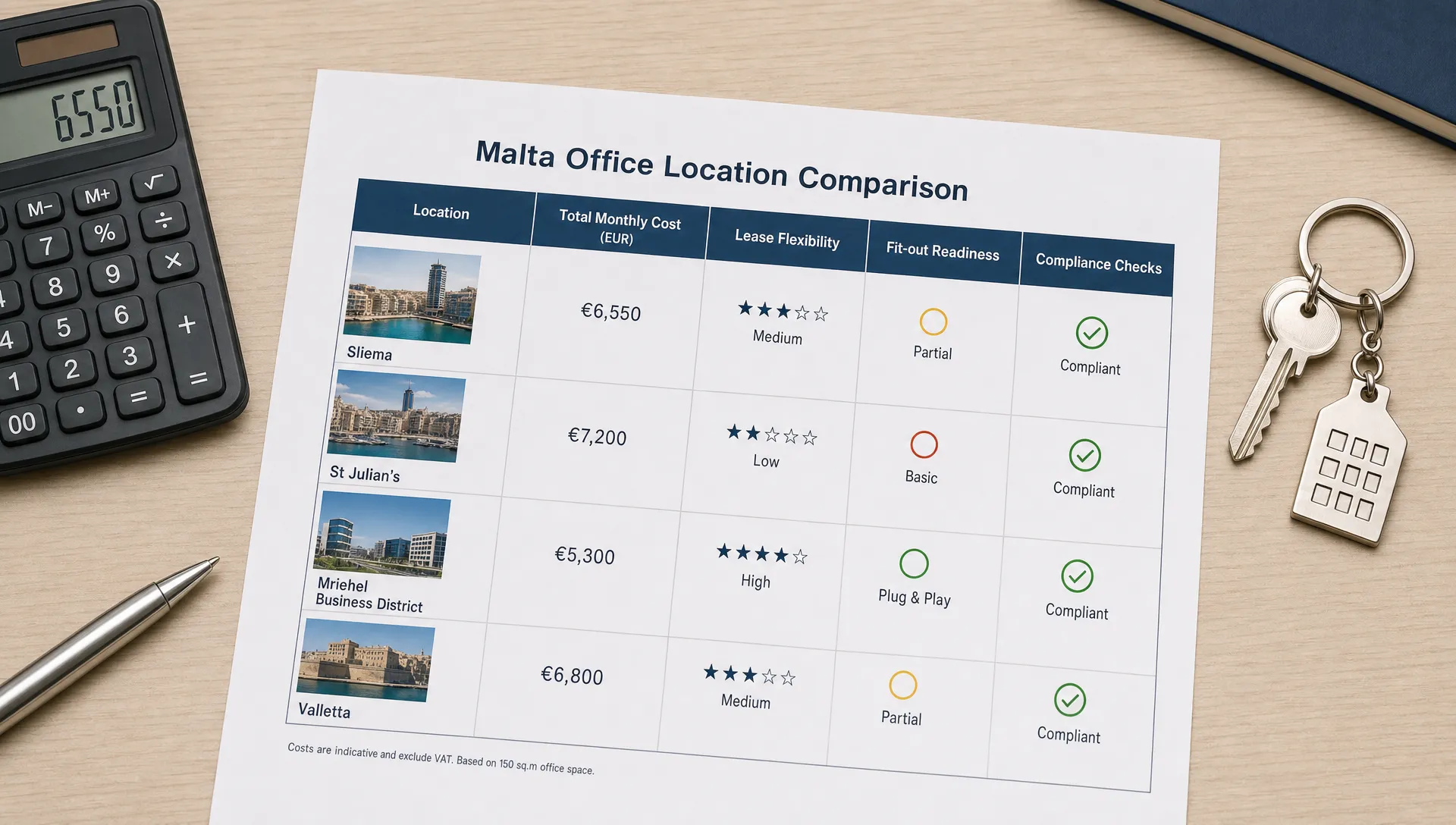
Headline rent is only one part of the commercial decision. To compare commercial property for rent properly, estimate the total monthly and upfront cost of occupying each option.
A simple formula is:
Total occupancy cost = base rent + non-recoverable VAT + service charges + utilities + parking + connectivity + amortised fit-out and moving costs + professional fees.
Not every component applies to every property, but you should ask the same questions for each shortlisted option.
| Cost item | Why it matters when comparing |
|---|---|
| Base rent | Gives the starting point, but should be compared against usable space and lease term |
| VAT | May affect cash flow and recoverability depending on your business and lease structure |
| Common area or service charges | Can materially change the effective monthly cost |
| Utilities | Older or inefficient buildings can cost more to run |
| Internet and telecoms | Delays or weak connectivity can disrupt regulated and tech-led businesses |
| Parking | A low rent can lose appeal if staff or directors need paid off-site parking |
| Fit-out and furniture | Should be spread across the expected lease term to compare fairly |
| Deposits or guarantees | Affects working capital and cash flow at the start of the lease |
| Repairs and reinstatement | Can create future costs if obligations are unclear |
VAT deserves particular attention. Commercial leases in Malta can involve VAT considerations, and the impact depends on the landlord, tenant status and structure of the transaction. If the numbers are significant, review the VAT and tax implications of renting in Malta before you commit.
Compare usable space, not just square metres
A property’s quoted size does not always tell you how efficiently your team can use it. Two 250 m² offices can perform very differently if one has awkward columns, deep corridors, poor natural light or an inefficient reception area.
During viewings, look beyond the floor area and ask how many productive work settings the space can support. Consider desks, focus rooms, meeting rooms, collaboration space, kitchen, storage, reception, server or IT space and any secure areas your business needs.
For hybrid teams, avoid assuming you can simply reduce space in line with attendance. You may still need meeting rooms, quiet zones and peak-day capacity. For regulated sectors, senior management, compliance and finance teams may need private rooms or controlled access. A creative or architecture practice may prioritise open studio space, while a law firm may need more enclosed rooms and client confidentiality.
A useful comparison metric is cost per effective workstation rather than cost per square metre. If a cheaper property fits fewer people comfortably, it may not be cheaper in practice.
Assess building quality and operational resilience
Building quality is where many poor comparisons happen. A well-presented lobby can distract from weak air conditioning, limited lift capacity, insufficient power, poor drainage, noise, access issues or slow landlord response times.
At minimum, compare the following during or immediately after each viewing:
- Air conditioning age, zoning and maintenance responsibility
- Lift availability, capacity and maintenance history
- Fibre availability, backup connectivity options and telecoms provider access
- Electrical capacity for your equipment, including server rooms or trading floors if relevant
- Natural light, ventilation, acoustics and noise from roads or neighbouring tenants
- Accessibility for employees, clients and suppliers
- Fire safety equipment, exits, signage and emergency procedures
- Security, access control, CCTV, reception and after-hours access
These are not secondary details. They affect staff satisfaction, business continuity and the real cost of running the office. For iGaming, financial services, insurance and other regulated businesses, downtime or weak access control can be more expensive than a higher rent.
Scrutinise lease terms before ranking options
You cannot compare two commercial properties fairly until you understand the lease terms attached to each. A more expensive property with a flexible break clause may be less risky than a cheaper property with a long fixed commitment and strict reinstatement obligations.
Ask for the commercial heads of terms early. The most important points to compare are lease length, renewal rights, break options, annual rent increases, deposit or bank guarantee requirements, maintenance responsibilities, subletting or assignment rights, fit-out permissions, signage rights and handback obligations.
In Malta, lease terms can vary widely depending on landlord type, property condition and tenant profile. Larger or higher-quality premises may offer better long-term stability, but they can also involve more detailed legal review. Do not leave the legal and commercial comparison until after you have emotionally committed to a building.
If you need a broader decision checklist, the commercial office selection guide for Malta covers key criteria such as location, budget, scalability and compliance in more detail.
Verify planning, licensing and permitted use
Commercial property must be suitable not only physically, but legally. For office occupiers, planning use is a core due diligence point. Many office premises in Malta fall under business and office use categories, but you should never assume that a unit is correctly permitted simply because it is advertised as an office.
Before signing, confirm permitted use, landlord authority to lease, any restrictions on signage, shared access rights and whether your intended activity fits the premises. The Planning Authority is the official reference point for planning matters, and many tenants also involve an architect, lawyer or property adviser to confirm the position.
This is especially important if you are comparing unusual commercial property, such as a converted townhouse, ground-floor unit, mixed-use space or property in a heritage area. A space can look perfect and still create problems if the intended use is not properly supported.
Regulated firms should also confirm whether the office meets any operational, record-keeping, security, governance or licensing expectations relevant to their sector. This applies particularly to financial services, gaming, insurance, crypto, payments and professional advisory businesses.
Use a weighted scorecard for shortlisting
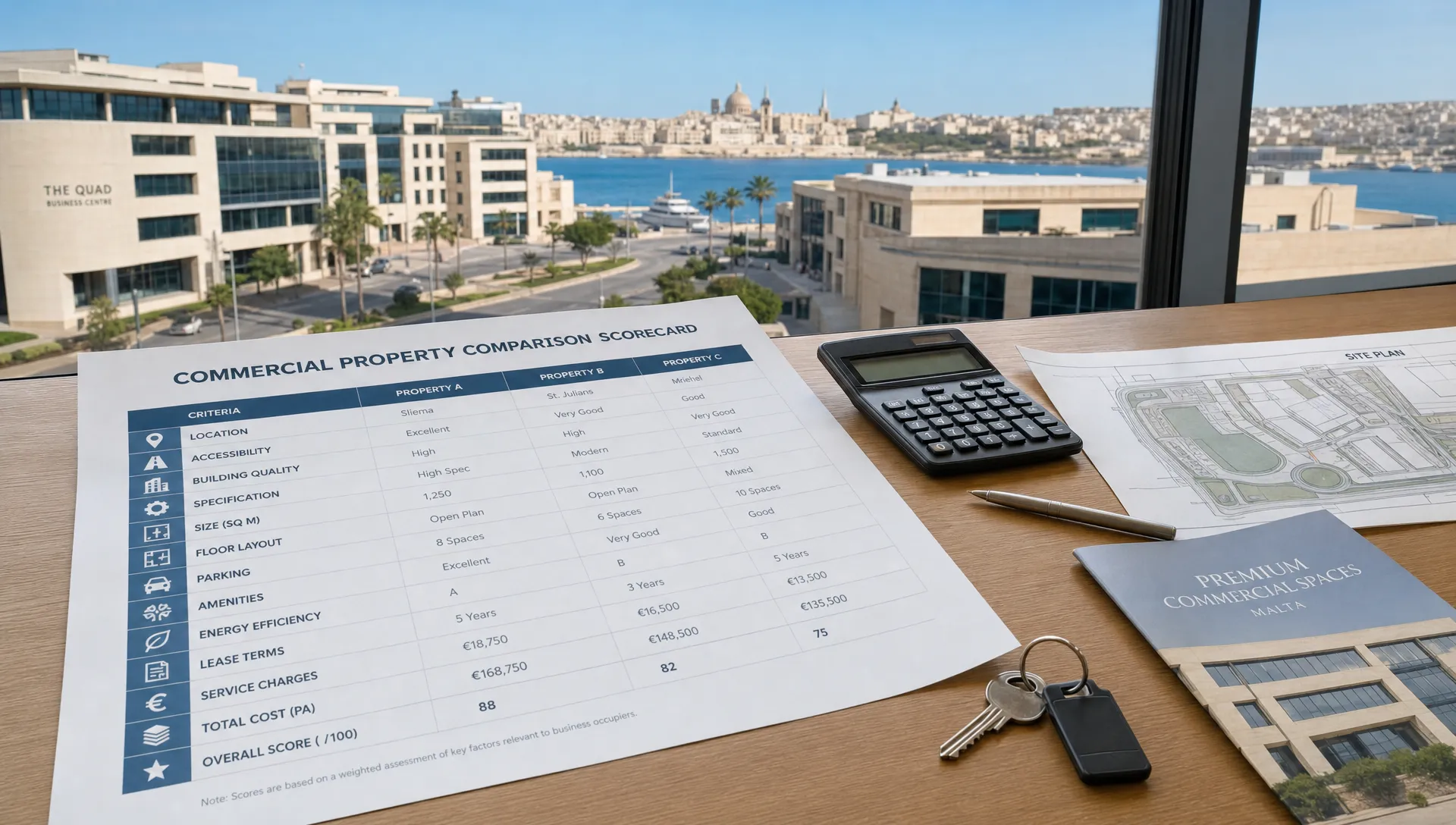
Once you have viewed several properties, avoid relying on memory. Score each option using the same criteria and weightings. Adjust the weights based on your business, but keep the scoring method consistent.
| Criteria | Suggested weight | What to score |
|---|---|---|
| Location fit | 20% | Staff commute, client access, brand, nearby amenities |
| Total occupancy cost | 20% | Rent, VAT, charges, parking, utilities, fit-out and cash flow |
| Space efficiency | 15% | Layout, meeting rooms, growth capacity and natural light |
| Lease flexibility | 15% | Term, break clauses, renewal, assignment and rent reviews |
| Building quality | 10% | HVAC, lifts, access, security, maintenance and resilience |
| Compliance and permitted use | 10% | Planning status, landlord documentation and sector requirements |
| Scalability | 5% | Ability to expand, contract or reconfigure |
| Landlord readiness | 5% | Responsiveness, clarity, negotiation approach and works timeline |
A scorecard will not make the decision for you, but it exposes trade-offs. If the preferred property scores low on compliance or total cost, you know exactly what to investigate or negotiate before proceeding.
Watch for comparison red flags
Some problems are not immediately obvious in listings or during a quick viewing. Treat the following as reasons to slow down and ask for more evidence:
- The landlord or agent cannot clearly confirm permitted use
- The quoted rent excludes major cost items that are only mentioned later
- The floor area is vague or cannot be reconciled with the layout
- The property requires works, but no clear timeline or responsibility is agreed
- VAT treatment is unclear or inconsistent across documents
- The lease term is presented as standard, but key clauses are missing
- Parking, access or delivery arrangements are impractical for daily operations
- The building looks ready, but technical services have not been tested
A red flag does not always mean you should reject the property. It means the risk should be priced, clarified or negotiated before you rank the option as viable.
Frequently asked questions
What is the best way to compare commercial property for rent in Malta? Compare each property using the same scorecard. Look at location, total occupancy cost, usable space, lease flexibility, building quality, permitted use and move-in readiness, not just headline rent.
Is a serviced office better than a traditional lease in Malta? A serviced office can be better if you need speed, flexibility and lower setup effort. A traditional lease may be better for larger teams, long-term branding, custom fit-out and stronger control over the workplace.
How much office space should a Malta business rent? It depends on headcount, hybrid working, meeting room needs, storage, privacy and future growth. Compare cost per effective workstation as well as cost per square metre.
Does VAT apply to commercial property rent in Malta? VAT may apply depending on the lease structure, landlord and tenant circumstances. Since VAT can affect cash flow and recoverability, review the position with a qualified adviser before signing.
What should I check before making an offer? Confirm permitted use, total costs, lease terms, service charges, building systems, internet availability, landlord works, access arrangements and any sector-specific requirements.
Compare Malta commercial properties with more confidence
The strongest property decision is rarely the one with the lowest rent. It is the one where location, cost, lease terms, compliance, building quality and growth potential align with your business plan.
OfficeSpace.Rent helps companies compare office and commercial property options across Malta, including serviced offices, private offices and larger HQ-style spaces. You can browse listings by location, size and price, use pricing guidance, shortlist suitable options and get support with viewings and negotiations.
Start your search with OfficeSpace.Rent and compare Malta office options with a clearer view of the real costs, risks and opportunities behind each listing.