TL;DR:
- Renting office space in Malta involves understanding total occupancy costs beyond base rent, including service charges, building insurance contributions, and variable landlord pass-throughs.
- Effective lease negotiation and thorough pre-move verification are essential to avoiding unexpected expenses and operational delays.
Renting office space is defined as entering a commercial lease agreement that binds a tenant to specific premises, financial obligations, and operational conditions for a fixed term. The process extends well beyond selecting a floor plan and signing a document. In Malta’s commercial property market, the true cost of occupation includes base rent plus service charges, building insurance contributions, utility costs, and any variable expenses passed through by the landlord — charges that can add materially to total monthly costs above the quoted base rent alone. Understanding that gap before you commit is the single most important step any business can take when preparing to lease commercial premises in Malta.
How to rent office space: defining your requirements and budget
Before you search a single listing, you need a clear picture of your space requirements and financial ceiling. Start by mapping your current headcount, projected growth over the lease term, and the functional zones your team needs, such as private offices, open workstations, meeting rooms, and server or storage areas.
Costs to model upfront include:
- Base rent (quoted per square metre annually or monthly)
- Service charges covering shared building maintenance, cleaning, and security
- Building insurance contributions where passed through by the landlord
- Utility costs including electricity, water, and air conditioning where metered or recharged separately
- VAT where applicable, depending on the landlord’s registration status and property classification
- Fit-out or refurbishment costs if the space requires adaptation before occupation
In Malta, the structure of cost pass-throughs varies between landlords and buildings. Some landlords quote an inclusive rent covering all outgoings; others charge base rent with a variable service charge reconciled annually. Understanding which model applies — and what it actually costs — requires a detailed written breakdown before any commitment is made. Resources such as Officespace listings and the office rental costs guide published by Officespace provide reliable benchmarks for Malta specifically.
Pro Tip: Align your space calculation with your technology infrastructure. A business running server racks or specialist equipment needs higher electrical capacity and cooling, both of which affect which buildings qualify and what fit-out costs you will face. In older commercial stock across Valletta, Sliema, and Gzira, power capacity constraints are a practical risk worth verifying early.

What are the main lease structures and how do they affect costs?
Lease structures differ primarily in who bears operating expense risk and how transparently costs are billed. In Malta, commercial leases do not follow the formal US or UK categorisation of gross, net, or triple-net structures. Instead, cost responsibility is defined by the individual lease agreement, and the distinction that matters in practice is whether the rent is inclusive of building running costs or whether those costs are passed through separately.
| Lease structure | Who pays building running costs | Cost predictability | Typical tenant risk |
|---|---|---|---|
| Inclusive rent | Landlord absorbs all outgoings | High | Low |
| Rent plus fixed service charge | Tenant pays a fixed annual sum | Medium-high | Low to medium |
| Rent plus variable service charge | Tenant pays actual building costs, reconciled annually | Medium | Medium |
| Rent plus full pass-through | Tenant pays all operating costs directly | Low | High |
| Serviced office | All costs bundled into one monthly fee | Very high | Very low |
Inclusive rent structures provide cost certainty but typically carry a higher base rent because the landlord absorbs expense risk. Variable service charge structures shift operating expense fluctuations directly to the tenant, meaning a year of rising maintenance costs or insurance premiums lands on your balance sheet. For businesses prioritising budget predictability, an inclusive or fixed service charge structure is generally preferable. For tenants with strong negotiating leverage, a variable structure can offer a lower entry rent if annual caps are negotiated correctly.
How do you calculate the true cost of an office lease in Malta?
Base rent alone can significantly understate total tenant cost once service charges, insurance contributions, utility recharges, and VAT are included. That gap is not a rounding error. It represents a material budget shortfall for any business that plans solely around the headline rent figure.
To model true occupancy cost accurately, separate each expense component and apply the correct escalation rate to each. Service charges split into controllable costs such as cleaning, landscaping, and management fees, and non-controllable costs such as utilities, insurance, and structural maintenance. Controllable costs are negotiable and cappable. Non-controllable costs are not, which is why landlord service charge estimates are starting points rather than fixed figures. Plan for annual reconciliations and budget a contingency of 10 to 15% above the landlord’s estimate.
The table below illustrates how costs compound over a three-year term on a hypothetical 200 sq m lease in Malta with a variable service charge structure:
| Cost component | Year 1 | Year 2 (+3%) | Year 3 (+3%) |
|---|---|---|---|
| Base rent | €36,000 | €37,080 | €38,192 |
| Service charge | €6,000 | €6,180 | €6,365 |
| Insurance contribution | €1,200 | €1,236 | €1,273 |
| Utility recharges | €3,200 | €3,296 | €3,395 |
| Total | €46,400 | €47,792 | €49,225 |
The three-year total in this example exceeds the base rent total by over €28,000. That differential is the figure most tenants fail to account for when signing.
Pro Tip: Request the landlord’s actual service charge reconciliation statements from the previous two years before signing. These documents reveal the real trajectory of building running costs far more accurately than any estimate.
What are the key negotiation points for a favourable lease in Malta?
Starting negotiation 60 to 90 days before your target signing date, armed with current market data, maximises your leverage and the concessions you can secure. Rushing this process is the most common and costly mistake tenants make. In Malta, where many landlords are private individuals managing their own properties, early and well-prepared engagement consistently produces better outcomes than last-minute negotiation.
Focus your negotiation on these points in order of financial impact:
- Fit-out contribution. Landlord contributions to fit-out costs vary widely depending on the condition of the premises and the length of the lease being offered. Negotiate not just the headline amount but also which costs qualify, the payment mechanism, and what happens to any unspent sum.
- Service charge caps. Negotiating an annual cap on service charge increases protects you from unpredictable building cost escalation. Distinguish between a straight annual cap and a cumulative cap, as the cumulative version provides stronger long-term protection.
- Rent-free periods. A landlord offering one to two months of free rent on a three-year term is effectively reducing your average annual cost. In Malta’s current market, rent-free periods are available on longer leases, particularly where fit-out works are required.
- Escalation clauses. Fix annual rent increases to a specific percentage rather than leaving them open-ended or tied to an uncapped index.
- Renewal options. Secure the right to renew at a defined rate or formula, with the option exercise date stated precisely in the lease.
Every negotiated term must appear in the signed agreement with exact figures and dates. Verbal commitments from landlords carry no legal weight in Malta. The Officespace lease negotiation guide provides a Malta-specific checklist covering each of these points in detail.
Pro Tip: Treat any landlord fit-out contribution as a financial instrument, not a goodwill gesture. Track every eligible expenditure against the agreed sum in a separate record. Contributions frequently go unrecovered through unclear cost tracking and missed reimbursement deadlines.
How to prepare your business before moving into rented office space in Malta
Operational readiness before your lease start date prevents costly delays and disputes over the building’s condition. During your final viewing and at handover, verify the following:
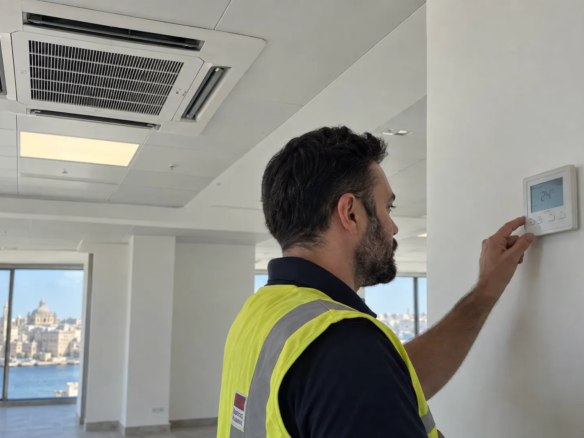
- Air conditioning and ventilation: Test cooling and ventilation systems in all zones. Pre-move testing of core building systems is the most reliable way to avoid post-occupancy operational failures. In Malta’s climate, air conditioning performance is a material operational issue, not a comfort preference.
- Electrical capacity: Confirm the available load matches your equipment requirements, particularly if you run servers, specialist machinery, or high-density workstations. Power capacity constraints are common in older commercial buildings across Valletta, Sliema, and Gzira.
- Internet and telecoms: Test fibre or broadband connectivity and confirm lead times for any upgrades before your team moves in. Provider availability varies by building and district in Malta.
- Planning Authority use classification: Confirm that the premises holds the correct Planning Authority permit for your intended business activity before signing. A Class 4A office permit does not automatically cover all business categories, and a change-of-use application takes time and is not guaranteed.
- Safety systems: Check fire alarms, emergency lighting, and any suppression systems are certified and operational.
- Documentation: Conduct a formal walk-through with the landlord or agent, photograph every defect, and record the agreed condition of the space in writing at handover. This schedule of condition is your primary protection against disputed reinstatement claims at lease expiry.
Coordinate your lease commencement date with your fit-out programme. If the landlord is completing works before handover, build a buffer of two to four weeks between the contractual handover date and your planned move-in date. Delays in construction are common, and your team cannot operate from a building site.
Key takeaways
Renting office space in Malta successfully requires modelling total occupancy cost, not just base rent, and securing every negotiated term in a precisely worded signed agreement.
| Point | Details |
|---|---|
| Model total occupancy cost | Base rent understates true cost once service charges, insurance, utility recharges, and VAT are included. |
| Understand the lease structure | Inclusive rent offers cost certainty; variable service charge structures offer lower entry rent but higher financial risk if uncapped. |
| Negotiate fit-out contributions and service charge caps | These two terms have the greatest long-term financial impact beyond the headline rent figure. |
| Document everything in writing | Verbal agreements are unenforceable in Malta; exact figures and dates must appear in the signed lease. |
| Test the building before handover | Verify air conditioning, electrical capacity, internet, and planning classification before committing to occupation. |
What Officespace has learned from watching tenants negotiate
The most consistent pattern Officespace observes across Malta’s commercial leasing market is tenants who focus almost entirely on monthly rent and overlook the compounding effect of service charge escalations and uncontrolled operating expense pass-throughs. By year three of a five-year lease with a variable service charge, the gap between what a tenant budgeted and what they are actually paying can be substantial — and at that point there is very little recourse.
The second pattern is equally avoidable: negotiated concessions that never make it into the final lease document. A landlord agreeing verbally to a rent-free period or a fit-out contribution means nothing if the signed lease does not reflect those terms with precise figures and dates. Officespace consistently advises tenants to treat the lease review stage — not the verbal negotiation — as the moment where value is either secured or lost.
The current Malta office market does offer genuine tenant leverage in certain submarkets, particularly for mid-size floor plates in secondary locations. Tenants who arrive prepared with market data, a clear cost model, and a prioritised negotiation list consistently secure better outcomes than those who rely on goodwill and a handshake. The office lease negotiation tips available on the Officespace platform reflect exactly this approach.
— OfficeSpace.Rent
Find your next office space with Officespace
Officespace connects businesses across Malta with verified commercial listings, transparent pricing data, and expert leasing support. Whether you are a start-up securing your first premises or an established company expanding into a larger floor plate, the platform provides the market intelligence and agent access you need to lease with confidence. Browse Mriehel commercial properties for a strong selection of grade A and B offices in one of Malta’s most active business districts. The Officespace team supports tenants through every stage of the process, from initial search and cost modelling through to lease review and handover, with no obligation to engage until you are ready to proceed.
FAQ
What does renting office space actually involve?
Renting office space involves signing a commercial lease that defines your premises, term, rent, and cost obligations. In Malta, the process includes identifying your requirements, understanding how building running costs are structured, negotiating lease terms, and verifying the building’s condition and planning classification before handover.
Why is base rent not the full cost of an office lease in Malta?
Base rent frequently excludes service charges, building insurance contributions, utility recharges, and VAT where applicable. These additional costs can add materially to monthly occupancy expenses, particularly in buildings where running costs are variable and reconciled annually.
How early should you start negotiating a commercial lease in Malta?
Negotiation should begin 60 to 90 days before your target signing date. Starting early gives you time to gather market data, compare alternatives, and secure concessions such as rent-free periods and fit-out contributions before the landlord’s position hardens.
What is a fit-out contribution and why does it matter?
A fit-out contribution is a landlord payment towards the cost of adapting the premises for the tenant’s use. Negotiating the eligibility criteria, payment mechanism, and timing is as important as the headline amount. Contributions frequently go unrecovered through poor cost tracking and missed reimbursement deadlines.
What should you check before moving into rented office space in Malta?
Test air conditioning, electrical capacity, and internet connectivity before your lease commences. Confirm the Planning Authority use classification of the premises. Document the building’s condition in a formal walk-through and photograph all defects to establish a clear handover record.