TL;DR:
- Reducing office rental costs in Malta involves optimising total occupancy expenses, including utilities, service charges, and maintenance, not just headline rent.
- Effective strategies include right-sizing space based on usage data, negotiating flexible lease terms, and managing operational costs through energy efficiency and hybrid work policies.
Reducing office rental costs means cutting total occupancy cost, not just the headline rent figure. Total occupancy cost includes base rent plus utilities, maintenance, service charges, and any variable building costs passed through by the landlord — charges that can add materially to what a business actually pays each month. Tenants who focus only on the quoted rent routinely underestimate their true rental burden by 30 to 40%. The most effective cost-saving strategies for office rental in Malta in 2026 combine right-sized workspaces, flexible lease structures, and data-driven decisions to reduce that full cost figure without compromising operational performance.

1. Right-size your office using utilisation data
Right-sizing is the process of matching your floor plate to your actual occupancy patterns, and it is the single highest-impact lever available to most businesses. Most offices operate at 40 to 60% utilisation before any consolidation work is done. That means you are paying for roughly half your space to sit empty on any given day.
The practical approach is to collect occupancy data before signing or renewing any lease. Sensor systems such as Density or Spacewell, combined with desk-booking platforms like Robin or Condeco, give you accurate seat-by-seat utilisation figures within four to six weeks. Once you have that data, you can target a post-consolidation utilisation rate of 65 to 80%, which is the range where space feels active without becoming overcrowded.
- Shift from fixed personal desks to shared collaboration zones and focus booths
- Eliminate permanently assigned desks for roles that are regularly remote or travelling
- Target a desk-to-employee ratio of 0.6:1 to 0.8:1 for hybrid teams
Eliminating underused space and redesigning for collaboration reduces cost per seat by 20 to 40%. In Malta’s market, where quality office space in districts such as St Julian’s, Ta’ Xbiex, and Gzira commands a premium, this saving is particularly material.
Pro Tip: Run your utilisation audit across a full four-week period that includes at least one public holiday week and one peak trading week. A single-week snapshot will skew your data and lead to poor space decisions. Malta’s public holiday calendar is dense enough to distort a short sampling window significantly.
2. Negotiate lease terms that protect your budget
Lease negotiation is where most tenants leave the largest sums on the table. The goal is not simply to lower the headline rent. It is to control every variable that affects your total cost over the lease term. In Malta, where many landlords are private individuals and lease terms are negotiated directly, there is often more room to negotiate than tenants assume — provided the approach is well-prepared and early.
- Cap service charge increases. Negotiate annual caps on service charge and building cost increases of 3 to 5%. Building running costs in Malta have risen since 2021, and an uncapped lease exposes you to unpredictable annual increases with no contractual ceiling.
- Secure break clauses and contraction rights. A break clause at year two or three of a five-year lease gives you an exit if your headcount changes. Contraction rights allow you to hand back a portion of your floor plate without breaking the full lease.
- Request rent-free periods and fit-out contributions. Landlords in Malta will often offer a rent-free period of one to two months on a three-year lease, particularly where the space requires significant fit-out work before occupation. Fit-out contributions reduce your upfront capital requirement and should always be explored.
- Include subleasing rights. If your team shrinks, the ability to sublease surplus space converts a liability into partial cost recovery. Ensure this right is documented explicitly in the lease rather than assumed.
Pro Tip: Always request the right to inspect the landlord’s service charge calculations annually. Reviewing service charge reconciliations regularly uncovers billing errors that tenants would otherwise absorb silently. This clause costs nothing to negotiate but can recover significant sums over a lease term.
You can find a detailed breakdown of Malta-specific negotiation tactics in Officespace’s office rental negotiation guide, which covers break clauses, service charge structures, and landlord incentives in the local market.
3. Choose the right office type for your cost profile
The choice between a traditional leased office, a serviced office, and a co-working space is not purely a matter of preference. It is a financial decision with measurable consequences. Malta’s commercial property market offers all three formats across its key business districts, and the cost dynamics between them are meaningful.
| Office type | Cost structure | Flexibility | Typical overhead |
|---|---|---|---|
| Traditional lease | Lower per sq m, higher operational overhead | Low (2–10 year terms) | Utilities, fit-out, maintenance separate |
| Serviced office | Bundled all-inclusive fee | High (monthly to 2 years) | 30–40% lower overhead vs traditional |
| Co-working space | Desk or suite membership | Very high (daily to monthly) | Minimal; ideal for teams under 10 |
Serviced offices bundle utilities, cleaning, and furniture into a single monthly fee, which simplifies budgeting and removes the capital cost of fit-out. For businesses with headcounts below 25 or with uncertain growth trajectories, the all-inclusive model reduces overhead costs significantly compared to a traditional lease in the first year. This is especially relevant in Malta, where fit-out costs and reinstatement obligations at lease expiry add to the true cost of a conventional tenancy.
Co-working spaces suit start-ups and project teams that need a professional address without committing to a fixed floor plate. The per-desk cost is higher than a traditional lease on a per-sq-m basis, but the absence of service charges, fit-out costs, and long-term liability makes them genuinely cost-effective for early-stage businesses.
Officespace provides a clear explanation of serviced office benefits in the Maltese context, including typical pricing and what is included in standard packages.
4. Manage operational costs within your existing space
Reducing office rental expenses does not stop at the lease. Operational decisions made inside the space directly affect your total occupancy cost.
- Prioritise energy-efficient buildings. Buildings with modern air conditioning systems, good insulation, and energy-efficient lighting lower utility costs meaningfully. When evaluating properties in Malta, request the Energy Performance Certificate and ask for an indication of utility costs from the landlord or building manager. In older commercial stock across Sliema, Gzira, and Valletta, energy costs can be significantly higher than in modern purpose-built offices.
- Adopt desk-sharing and flexible furniture. Modular furniture systems allow you to reconfigure space as team sizes change, avoiding costly refits. Suppliers such as Steelcase and Herman Miller offer systems designed for hybrid office environments.
- Deploy booking and wayfinding technology. Hybrid work and desk-sharing require technology investment, but that investment drives measurable cost efficiency and improves employee satisfaction. Tools like Envoy or OfficeRnD manage desk allocation and reduce wasted space.
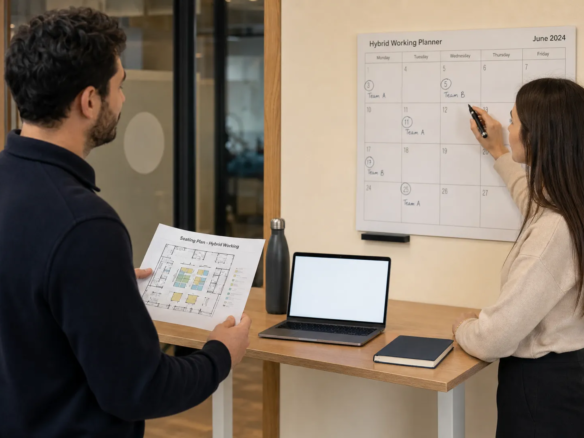
- Encourage structured hybrid working. A three-day in-office policy for a team of 30 can reduce your required floor plate by 30 to 40% compared to a full-time attendance model, directly reducing the space you need to lease.
The combination of energy efficiency, flexible furniture, and hybrid scheduling addresses the operational layer of office costs that many tenants overlook entirely when calculating their rental budget.
5. Model consolidation scenarios before committing
Data-driven scenario modelling is the professional standard for office cost optimisation, yet most small businesses skip it entirely. Modelling multiple consolidation scenarios before signing a lease prevents costly assumptions from becoming locked-in liabilities — particularly relevant in Malta, where lease terms of three to five years are common and exit penalties can be significant.
- Build three scenarios. A conservative scenario assumes 10% space reduction. A moderate scenario assumes 25% reduction. An aggressive scenario assumes 40% reduction with full hot-desking. Each scenario should include a full total cost of occupancy calculation covering rent, service charges, VAT where applicable, fit-out, and reinstatement.
- Calculate cost per seat, not cost per sq m. Cost per seat accounts for utilisation and gives you a comparable figure across different office types and locations. A serviced office at a higher per-sq-m rate can still deliver a lower cost per seat than a traditional lease at a lower headline figure.
- Factor in non-financial variables. Employee commute distance, parking availability, collaboration quality, and client accessibility all affect productivity and retention. In Malta’s compact geography, location decisions carry particular weight. A 40% cost saving that increases staff turnover by 15% is not a net gain.
Pro Tip: Track your actual post-consolidation costs monthly for the first six months and compare them against your model. This discipline reveals where your assumptions were wrong and gives you the data to negotiate better on your next lease.
Short-term leases of one to three years with renewal and break clauses balance cost and flexibility most effectively for businesses that are still refining their space requirements. Locking into a long lease before you have reliable utilisation data is the most common and most expensive mistake in office cost management.
Key takeaways
Reducing total occupancy cost in Malta requires right-sizing, lease negotiation, and operational discipline applied together, not as isolated measures.
| Point | Details |
|---|---|
| Right-size with data | Use sensor and booking tools to target 65–80% utilisation before committing to a floor plate. |
| Negotiate beyond headline rent | Cap service charges, secure break clauses, and always include inspection rights over annual reconciliations. |
| Match office type to growth stage | Serviced offices reduce overhead by 30–40% in year one; co-working suits teams under 10. |
| Model before you sign | Build conservative, moderate, and aggressive scenarios using cost per seat, not cost per sq m. Include VAT and reinstatement in every model. |
| Manage operations actively | Energy efficiency, desk-sharing, and hybrid scheduling reduce the operational layer of total occupancy cost. |
The case for flexibility over the lowest headline rent
From Officespace’s perspective, the most consistent mistake we observe among tenants in the Maltese market is optimising for the lowest possible monthly rent figure while ignoring the total cost of occupancy. A Grade B office at a low per-sq-m rate with uncapped service charges, no break clause, and a reinstatement obligation will almost always cost more over the lease term than a serviced office with bundled costs and a two-year break option — even when the headline rent is higher.
The businesses that manage office costs most effectively treat their workspace as a variable, not a fixed overhead. They collect utilisation data, model scenarios, and negotiate flexibility clauses before they need them. Consolidation done well is not downsizing. It is redesigning space to better support how your team actually works, which makes the savings sustainable rather than temporary.
The advice to simply find a cheaper office misses the point entirely. The goal is to pay the right amount for the right amount of space under terms that protect you when your business changes. That requires preparation, data, and a willingness to negotiate every clause — not just the rent.
— OfficeSpace.Rent
Find budget-friendly office space in Malta with Officespace
Officespace lists serviced offices, traditional leases, and co-working spaces across Malta’s key business districts, including Valletta, St Julian’s, Sliema, and Mriehel. Each listing includes transparent pricing, floor plate details, and lease term information so you can compare total occupancy cost before making contact. You can review current office rental prices in Malta to benchmark your budget against live market data. For businesses that need support beyond the search, Officespace provides direct access to local agents who can advise on negotiation strategy, break clause structures, and service charge norms specific to the Maltese market. Explore the full listing catalogue at OfficeSpace.Rent.
FAQ
What is total occupancy cost in office rental?
Total occupancy cost covers base rent plus utilities, maintenance, service charges, and any variable building costs passed through by the landlord. In Malta, these additional charges vary significantly between landlords and building types, which is why comparing full costs rather than headline rent is essential.
How much can I save by right-sizing my office?
Right-sizing to eliminate underused space reduces cost per seat by 20 to 40%, depending on your current utilisation rate and the office type you move to. In Malta’s premium districts, where per-sq-m rates are highest, the saving is most significant.
Are serviced offices cheaper than traditional leases in Malta?
Serviced offices reduce operational overhead by 30 to 40% compared to traditional leases in the first year, primarily by bundling utilities, furniture, and maintenance into a single fee and eliminating fit-out capital costs and reinstatement obligations at lease expiry.
What lease clauses protect me from rising costs in Malta?
Annual caps on service charge increases of 3 to 5%, break clauses, contraction rights, and the right to inspect annual service charge reconciliations are the four clauses that provide the most meaningful cost protection in the Maltese market.
How long should my office lease be in Malta?
A lease of one to three years with renewal and break options balances cost efficiency with flexibility, particularly for businesses that have not yet established stable headcount or utilisation patterns. Longer terms may be appropriate where the space is purpose-fitted and the landlord offers meaningful incentives in return.