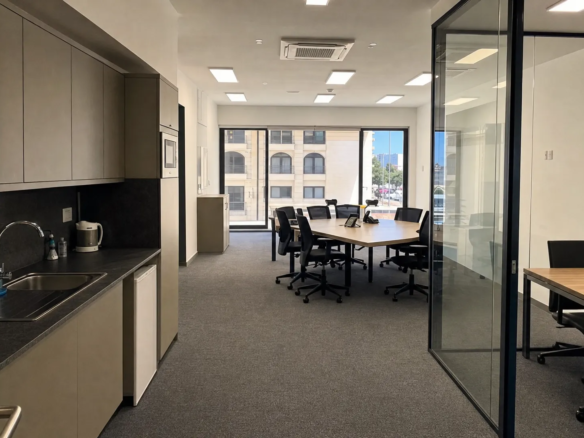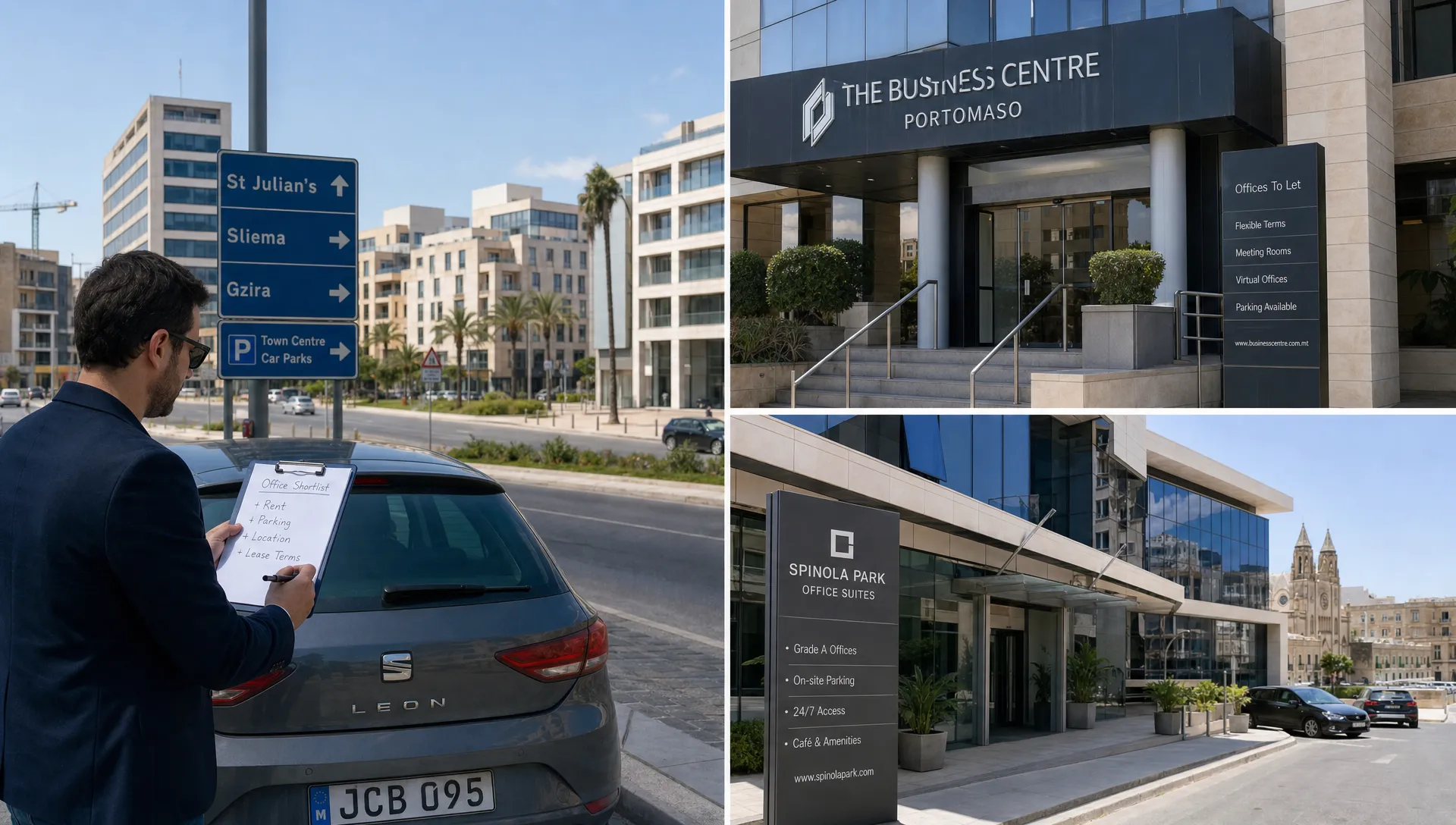
Comparing business property for rent in Malta is not just a matter of finding the lowest monthly rent. For most companies, the better question is whether a space supports hiring, client access, regulatory needs, operational continuity and future growth without creating unnecessary cost or lease risk.
That matters in Malta because the office market is compact, location-sensitive and shaped by very different business clusters. A private office in Sliema, a corporate floor in Mriehel, a serviced office in St Julian’s and a quieter professional suite in Birkirkara can all look attractive on paper, yet serve very different business needs.
This guide gives you a practical comparison framework for evaluating business property for rent in Malta, especially if you are an SME, iGaming company, financial services firm, professional practice, insurance company, tech operator or international business setting up locally.
Start with the business outcome, not the property
Before you compare listings, define what the property must achieve. Many office searches go wrong because teams begin with square metres and rent, then realise later that the location, layout or lease does not fit the business.
A useful brief should answer five questions:
- What team size must the property support on day one?
- How much growth should it accommodate over the lease term?
- Will clients, regulators, suppliers or candidates visit the office regularly?
- Does the company need a prestigious address, high staff accessibility, privacy or technical resilience?
- Is speed of occupation more important than long-term customisation?
For example, a law firm or architecture studio may place more value on a central, client-facing office with meeting rooms and nearby parking. An iGaming, fintech or blockchain company may prioritise talent access, IT infrastructure, flexible layouts and proximity to similar operators. A growing SME may prefer a serviced or semi-fitted option to avoid upfront fit-out costs.
Once you define the business outcome, comparing properties becomes much clearer.
Compare Malta locations by workforce, clients and operating model
Location is often the biggest differentiator in Malta. Distances may look short on a map, but commuting routes, parking availability and peak-hour congestion can affect daily productivity.
The main office areas each have distinct advantages. Sliema and St Julian’s are popular for companies that want a strong commercial address, hospitality nearby and access to an international workforce. Gzira can offer good central connectivity and may appeal to teams seeking proximity to the harbour area without always paying the highest premium. Mriehel is Malta’s established business district, often suited to larger office footprints and corporate operations. Valletta works well for firms that value government, legal or institutional proximity. Birkirkara, Mosta, Naxxar, Qormi and other central areas can suit SMEs that need practical access and better value.
If you are still deciding between districts, a data-led overview of Malta office locations can help you understand how different areas compare before committing to viewings.
When comparing locations, do not rely only on prestige. Consider how the address affects day-to-day operations. A premium location may help with recruitment and client perception, but it may also increase rent, parking costs and commuting friction. A less central location may reduce costs, but only if it does not make hiring or client visits harder.
A simple location comparison should include:
- Staff commute patterns and public transport access
- Parking availability for employees, directors and visitors
- Proximity to clients, regulators, banks or professional partners
- Nearby amenities such as cafés, gyms, hotels and childcare
- The image the address gives to clients, investors and recruits
For international companies relocating to Malta, location can also influence first impressions. Senior hires and visiting executives often judge the office environment as part of the company brand.
Compare the total occupancy cost, not just rent
The advertised monthly rent is only one part of the real cost of a business property. Two offices with similar rent can have very different financial implications once common area charges, VAT treatment, utilities, fit-out, furniture, parking and lease obligations are included.
This is especially important when comparing serviced offices with traditional leases. A serviced office may appear more expensive per desk or per square metre, but it can include furniture, internet, reception, shared meeting rooms and maintenance. A traditional lease may offer better long-term value, but it often requires more upfront investment and management time.
| Cost item | What to compare | Why it matters |
|---|---|---|
| Base rent | Monthly or annual rent, usually tied to size and location | Sets the headline budget |
| Service or common area charges | Cleaning, shared areas, building management and maintenance | Can materially change the monthly cost |
| VAT treatment | Whether VAT applies and how it affects cash flow | Important for budgeting and recoverability |
| Utilities | Electricity, water, internet and cooling | Varies by building efficiency and usage |
| Fit-out | Partitions, flooring, lighting, cabling, furniture and branding | Can create a large upfront cost |
| Parking | Included spaces, paid spaces and visitor options | Critical for directors, staff and clients |
| Dilapidations or reinstatement | End-of-lease repair or reinstatement obligations | Can create future liabilities |
| Moving cost | Relocation, downtime, IT setup and professional fees | Often underestimated in office moves |
To compare properties fairly, build a 12-month and 36-month cost view. A cheaper office that needs heavy fit-out may be more expensive than a higher-rent space that is ready to occupy. Similarly, a serviced office may be the right financial choice for a 6 to 18 month growth phase, even if a longer lease becomes more efficient later.
OfficeSpace.Rent includes price and size filters as well as pricing guidance, which can help you narrow down options before deeper financial comparison.
Compare office type against your growth stage
Not all business property for rent in Malta serves the same stage of company growth. The right property type depends on how stable your headcount is, how much control you need and how quickly you must move.
Serviced offices are usually best when speed, flexibility and low setup effort matter. They can be useful for overseas companies entering Malta, project teams, start-ups, regulated firms waiting for licensing milestones or businesses that want a professional base without managing an entire office.
Traditional leased offices are better suited to companies with stable headcount, defined operational requirements and a longer-term commitment to Malta. They typically allow more control over layout, branding and internal processes, but require more planning and upfront capital.
Larger commercial properties or headquarters-style spaces can suit established businesses, especially in sectors such as iGaming, insurance, financial services and corporate administration. These properties need more due diligence because building services, access control, staff capacity and lease terms become more complex.
If your team is also considering whether ownership would make more sense, the rent vs buy office decision in Malta is worth reviewing before you commit to a rental search.
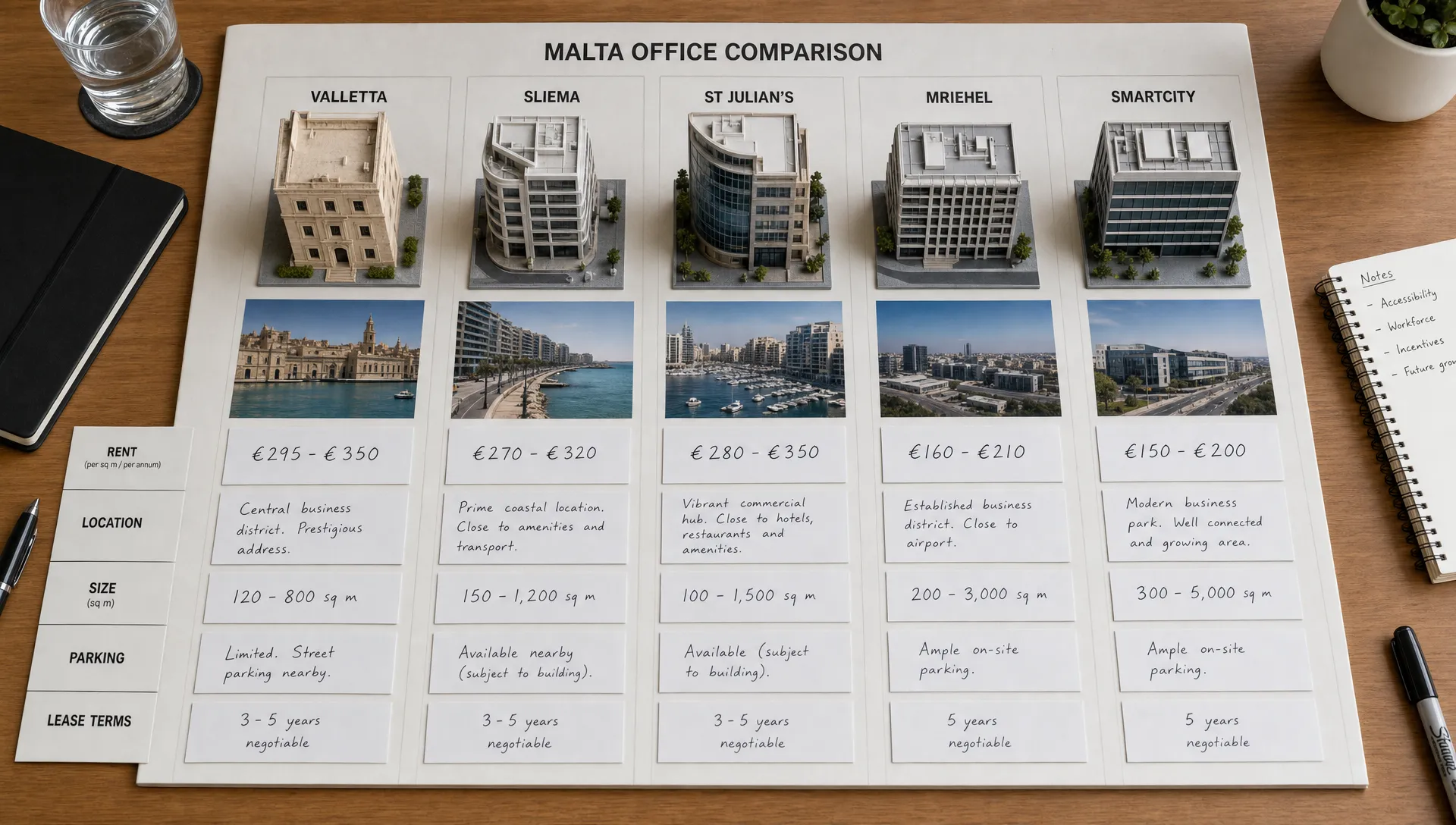
Assess the building specification and operational readiness
Once a property fits your budget and location, look closely at whether it can support your operations from the first month. Many comparison mistakes happen because decision-makers focus on the office floor itself and overlook the building, services and practical constraints.
For office-based companies in Malta, the most important specification points usually include layout efficiency, natural light, air-conditioning, lift access, internet readiness, power capacity, bathrooms, accessibility, meeting rooms and kitchen facilities. For larger teams, the number and quality of entrances, lifts and shared areas can affect daily flow.
Technology-heavy companies should pay close attention to connectivity and redundancy. Ask whether the building can support your preferred internet provider, whether cabling is already installed, where server or network equipment can be located and whether cooling is sufficient for IT equipment. Even if your systems are cloud-based, poor connectivity or weak building infrastructure can disrupt productivity.
For client-facing firms, the reception experience matters. A property may have the right square metres but still feel unsuitable if visitors struggle to find it, parking is unclear or shared areas are poorly maintained.
It is useful to walk through the property as if it were a normal working day. Where do employees arrive? Where do couriers go? Can clients wait comfortably? Is there space for confidential meetings? Can managers take private calls? Are there enough quiet zones for focused work?
Check planning use, permits and sector requirements
Commercial property in Malta must be suitable for the activity you plan to operate. For office occupiers, planning use is a key point to verify before signing. A property that looks like an office may still require confirmation that its permitted use matches your intended business activity.
The Malta Planning Authority is the relevant body for planning matters, and official guidance should be checked where there is uncertainty. In practice, you should ask the landlord, agent or advisor to confirm permitted use and whether any changes, signage or fit-out works require approvals.
Regulated sectors should be especially careful. Financial services, insurance, iGaming, legal, corporate services and crypto-related businesses may need to consider licensing expectations, record-keeping, data privacy, access control and client confidentiality. The property does not need to solve every compliance issue, but it should not create avoidable problems.
Important checks include:
- Whether the property has the correct commercial use for office occupation
- Whether signage, alterations or fit-out works require consent
- Whether the building supports confidential work and access control
- Whether lease terms allow your specific business activity
- Whether VAT and tax treatment have been reviewed by a qualified advisor
Do not leave compliance checks until the final draft lease. If a property fails a basic use or licensing requirement, you may lose negotiation time and professional fees.
Compare lease terms with the same care as the premises
A good office can become a poor business decision if the lease terms are too rigid. In Malta, the commercial lease structure, duration, notice provisions, deposit, renewal rights, rent reviews and repair obligations can significantly affect risk.
When comparing properties, create a lease comparison table alongside the financial comparison. Look at the full package, not just the rent.
| Lease factor | Comparison question | Risk if ignored |
|---|---|---|
| Lease term | How long are you committed? | You may outgrow the space or be locked in too long |
| Break option | Can you exit early under agreed conditions? | Less flexibility if headcount or strategy changes |
| Rent increases | How are increases calculated? | Future costs may exceed forecasts |
| Deposit | How much cash is tied up? | Impacts working capital |
| Repairs | Who maintains what? | Unexpected maintenance disputes |
| Assignment or subletting | Can you transfer or share the space? | Limits options if your needs change |
| Fit-out approvals | What changes are allowed? | Delays or restrictions on customisation |
| Reinstatement | What must be restored at exit? | Potential end-of-lease cost |
Fast-growing companies should pay particular attention to break options, expansion rights and assignment. A space that fits today may not fit in 18 months. More mature companies may be comfortable accepting a longer commitment if the property supports brand, stability and operational efficiency.
Negotiation is not only about lowering rent. You may create more value by negotiating fit-out contributions, rent-free periods, parking arrangements, phased occupation, service charge clarity or more balanced exit provisions.
View properties with a structured scoring system
Property viewings are emotional. A bright office with sea views can feel compelling, while a more practical option may be underestimated. To keep decisions objective, score every property using the same criteria.
A simple scoring model can help leadership teams compare options without losing sight of priorities.
| Criteria | Suggested weighting | What a high score looks like |
|---|---|---|
| Location fit | 20% | Easy for staff, clients and partners |
| Total cost | 20% | Affordable over the full lease period |
| Size and layout | 15% | Efficient space with room for planned growth |
| Building specification | 15% | Reliable, comfortable and operationally ready |
| Lease flexibility | 15% | Terms match business uncertainty and growth plans |
| Compliance suitability | 10% | Appropriate use, permissions and sector fit |
| Brand value | 5% | Supports recruitment and client confidence |
Adjust the weighting for your business. A boutique legal practice may give more weight to brand value and client access. An iGaming operator may prioritise workforce location, floorplate and technical readiness. A small consultancy may put cost and lease flexibility first.
The point is not to turn the decision into a spreadsheet exercise. The point is to make trade-offs visible. If everyone agrees that one property scores lower on rent but higher on recruitment, the board can make a deliberate decision rather than arguing from instinct.
Shortlist only properties that can realistically work
A strong shortlist usually contains three to five properties, not 15. Too many options slow the process, while too few can weaken your negotiation position.
Before adding a property to the shortlist, confirm the fundamentals: budget range, approximate size, availability date, lease expectations, parking, fit-out condition and permitted use. If any of these are clearly wrong, remove the property early.
The commercial property search workflow for Malta offers a more detailed process for moving from requirements to shortlist, viewings and negotiation without losing momentum.
During viewings, bring the right people. A CEO may assess strategic fit, but an office manager, finance lead or IT manager may spot operational issues. For regulated businesses, legal or compliance input may be needed before heads of terms are agreed.
After each viewing, record notes immediately. Memory fades quickly when properties are similar. Capture practical details such as lift access, noise, natural light, nearby parking, landlord responsiveness and any visible maintenance issues.
Negotiate after comparing real alternatives
Negotiation is stronger when you understand the market and have credible alternatives. If a landlord knows you have only one viable option, your leverage is limited. If you can show that similar properties are available at comparable terms, you can negotiate more confidently.
The most effective negotiation points depend on the property and landlord, but common areas include rent, deposit, lease length, break clauses, fit-out period, rent-free period, service charge transparency, parking and handover condition.
Do not negotiate in isolation. A lower rent may not be worthwhile if the landlord refuses flexibility or leaves you with high fit-out obligations. Equally, a slightly higher rent may be justified if the property is ready to occupy, reduces downtime and includes better terms.
If you are comparing business property for rent while relocating to Malta, plan extra time for company setup, banking, licensing, VAT review and staff logistics. A space that is technically available next week may still not be practical if your business is not ready to occupy.
Common mistakes to avoid
The most common mistake is comparing rent without comparing total occupancy cost. This can make a property look cheaper than it really is.
Another mistake is choosing a location based on directors’ preferences rather than staff accessibility. In a tight hiring market, commute convenience can influence retention and recruitment.
Some businesses also underestimate fit-out time. Even modest works can take longer than expected if approvals, contractors, materials or landlord permissions are involved.
Finally, do not assume every attractive commercial property is suitable for your activity. Planning use, lease restrictions and sector requirements should be checked early, not after negotiations are almost complete.
Frequently Asked Questions
What is the best way to compare business property for rent in Malta? Compare properties using the same criteria: location, total occupancy cost, size, building specification, lease flexibility, compliance suitability and growth potential. A weighted scoring model helps keep the decision objective.
Should I choose a serviced office or a traditional lease in Malta? A serviced office can be better for speed, flexibility and lower setup effort. A traditional lease can suit companies with stable headcount, longer-term plans and a need for more control over layout and branding.
Which Malta locations are best for office-based businesses? It depends on your team and clients. Sliema, St Julian’s and Gzira are popular for central commercial activity, Mriehel suits larger corporate requirements, Valletta works for institutional access, and central towns can offer practical value.
What costs should I check beyond monthly rent? Check service charges, VAT treatment, utilities, fit-out, furniture, internet, parking, insurance, moving costs and end-of-lease obligations. These can materially change the real cost of occupation.
How many properties should I view before deciding? Most businesses should shortlist three to five realistic options after filtering by budget, size, location and lease requirements. Viewing too many properties can slow the process, while viewing too few can weaken negotiation leverage.
Compare Malta office options with confidence
Finding the right business property for rent in Malta is easier when you compare more than rent. The best choice is the one that fits your people, budget, operations, compliance needs and growth plans.
With OfficeSpace.Rent, you can browse office listings across Malta, filter by location, price and size, compare serviced and traditional options, and get support with viewings and negotiations. If you are relocating, expanding or simply looking for a better workspace, start with a clear brief and compare every property against the same business criteria.