
TL;DR:
- The Malta rent index measures average rental prices across property types and localities, using data from the Malta Housing Authority and the Central Bank. It reveals market trends by tracking genuine rent movements through registered contracts and hedonic regression adjustments. This index helps tenants and investors evaluate price levels, monitor trends, and make informed decisions in Malta’s rental market. This residential rent index should not be used as a direct benchmark for office rental prices
The rent index in Malta is a statistical measure of average rental prices across property types and localities, compiled primarily by the Malta Housing Authority and the Central Bank of Malta. Understanding this index is the starting point for any tenant, landlord, or investor making decisions in the Maltese rental market. The index tracks price movements over time, making it far more useful than a single advertised figure. Whether you are negotiating a lease in Sliema or assessing commercial viability in Birkirkara, the rent index gives you a factual baseline.
What is the rent index in Malta?
The rent index in Malta is defined as a composite measure of median and average rental prices, calculated from registered lease contracts and adjusted market data. It is not simply an average of advertised rents. The Malta Housing Authority and the Central Bank of Malta each produce distinct but complementary versions of this index, drawing on different methodologies and data sources. Together, they form the most authoritative picture of Malta’s rental market available to the public.
The index serves as a trend indicator. A rising index signals that rents across the market are increasing in real terms, not just in specific postcodes. A stable or falling index points to supply catching up with demand, or to broader economic cooling. For tenants, this context shapes negotiation. For investors, it shapes timing.
How is the Malta rent index calculated?
The Malta Housing Authority compiles rental data from registered rental contracts, which represent a wider and more accurate segment of the market than agent listings or publicly advertised prices alone. This registered data reduces the selection bias that skews headline figures upward, since advertised rents tend to reflect aspirational pricing rather than agreed transaction prices.
The Central Bank of Malta applies hedonic regression models to its rental price indices. Hedonic regression controls for property attributes such as size, location, and condition, isolating genuine price change from shifts in the mix of properties being rented. This produces a more reliable measure of rent movements over time, independent of whether the market is suddenly leasing more luxury flats or more modest units.
Key data inputs used in the Malta rent index calculation include:
- Registered lease contracts from the Malta Housing Authority, covering active agreements across all localities
- Hedonic regression adjustments by the Central Bank of Malta to control for property quality and features
- Quartile breakdowns (25th, 50th, and 75th percentile) providing a nuanced view beyond simple averages
- Supplementary listing data, including adjusted figures from platforms such as Facebook Marketplace, to cross-reference advertised versus transacted rents
Pro Tip: When using the Malta Housing Authority’s rent calculator, always check the lower quartile figure alongside the median. The median alone can be pulled upward by a concentration of high-value leases in a locality, making the market appear more expensive than it is for the majority of renters.
What are the current rent trends across Maltese localities?
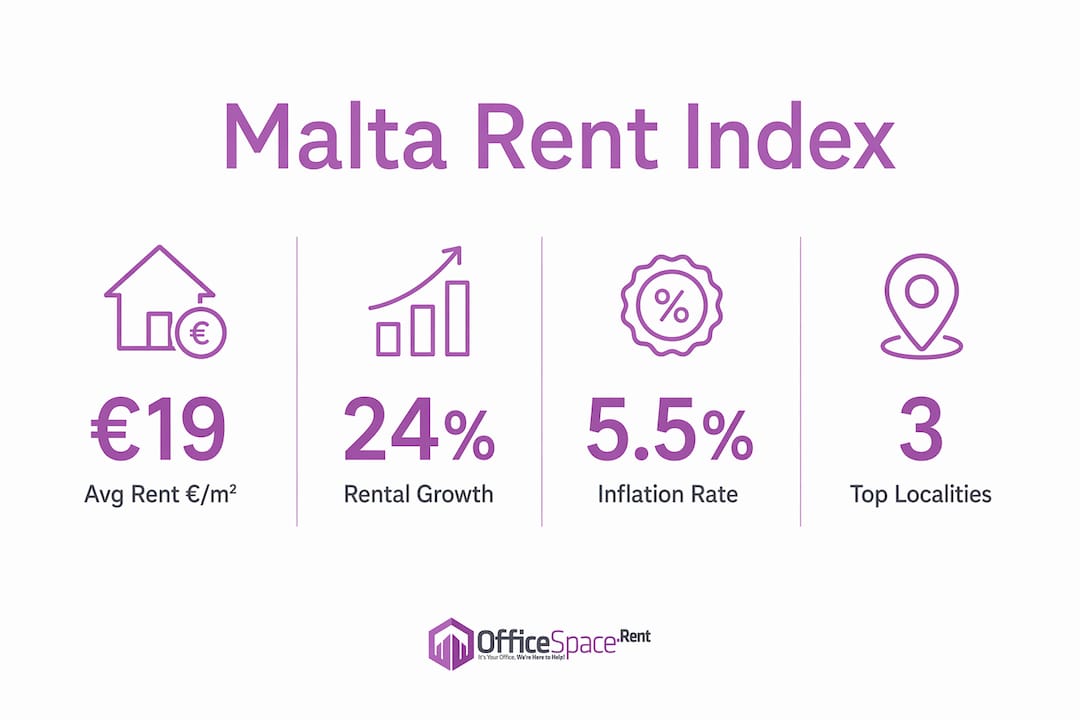
Third-party estimates suggest that the average rent per square metre in Malta stands at approximately €19 per month as of January 2026. Premium seafront areas command significantly more. Sliema and Ta’ Xbiex reach €22–€26 per square metre, reflecting sustained demand from expatriates and corporate tenants. This residential rent index should not be used as a direct benchmark for office rental prices.

For two-bedroom apartments, the most expensive localities are Ta’ Xbiex, Valletta, and Sliema, with median rents around €1,000–€1,050 per month. Gozo, Rabat, and Mqabba sit at the opposite end of the scale, offering considerably lower entry points for budget-conscious tenants.
| Locality | Approx. median rent (2-bed) | Rent per sq. metre |
|---|---|---|
| Ta’ Xbiex | €1,000–€1,050/month | €22–€26/sq. m |
| Sliema | €1,000–€1,050/month | €22–€26/sq. m |
| Valletta | €1,000–€1,050/month | €22–€26/sq. m |
| St Paul’s Bay | Mid-range | Market average |
| Gozo / Rabat | Below average | Below €19/sq. m |
Rental contracts in Malta increased by 24% year-on-year by mid-2025, with the majority being long-term leases for two and three-bedroom dwellings in Sliema, St Paul’s Bay, and Msida. That volume of registered contracts strengthens the statistical reliability of the index considerably.
Rental price inflation has moderated. Growth slowed to 5.5% in the first half of 2025, down from 6.9% in the preceding six months. The Harmonised Index of Consumer Prices (HICP) for housing rentals in Malta reached 102.23 in march 2026, measured against a 2025 baseline of 100. This confirms that rental inflation remains positive but is decelerating, a signal of gradual market stabilisation rather than a sharp correction.
How does the rent index compare to other Malta property indicators?
The rent index is one of three key measures that together describe the Maltese property market. Each measures something distinct, and confusing them leads to poor decisions.
| Indicator | What it measures | Primary users |
|---|---|---|
| Rent Index (Housing Authority / CBM) | Average and median rental price levels and trends | Tenants, landlords, policymakers |
| Residential Property Price Index (RPPI) | Changes in the sale prices of residential properties | Buyers, sellers, mortgage lenders |
| HICP (Housing rentals component) | Consumer price inflation attributable to rents | Economists, policymakers, EU reporting |
The Residential Property Price Index tracks purchase prices, not rental costs. A rising RPPI does not automatically mean rents are rising at the same rate, as supply dynamics and lease durations differ significantly between the sales and rental markets. The HICP rental component, produced for EU-wide comparability, uses a different weighting methodology than the Housing Authority’s dashboard, which is why the two can diverge in any given quarter.
For tenants and investors, the rent index is the most directly applicable tool. The RPPI matters when assessing whether to buy rather than lease. The HICP is most relevant for understanding Malta’s position within broader European inflation trends.
How can tenants and investors use the Malta rent index?
The Malta Housing Authority’s rent calculator and dashboard provide locality-level data broken down by property type and quartile. Using this tool effectively requires a clear process:
- Select the correct property type. The index separates apartments, maisonettes, and houses. Comparing apartment data to house data produces misleading conclusions.
- Read the quartile range, not just the median. The lower and upper quartile statistics reveal whether a quoted rent sits in the bottom quarter of the market or the top. A rent at the 75th percentile is not overpriced; it reflects a premium segment.
- Track the index over consecutive quarters. A single data point tells you the current level. Three or four quarters of data tell you the direction of travel, which is what matters for contract negotiation and investment timing.
- Cross-reference with the HICP rental component. If the HICP is rising faster than the Housing Authority median, it may indicate that lower-cost properties are being withdrawn from the market, pushing the average upward compositionally rather than through genuine price growth.
- Acknowledge data limitations. The index reflects registered contracts. Short-term holiday lets and informal arrangements are excluded. In tourist-heavy localities, this can understate effective market rents during peak seasons.
Tenants and investors in Malta increasingly rely on official granular data rather than agent-provided listings alone. This shift towards transparency benefits both sides of a lease negotiation, as both parties can reference the same authoritative baseline.
Pro Tip: Set a quarterly calendar reminder to check the Housing Authority dashboard. Rental markets in Malta can shift meaningfully within six months, and a contract negotiated on stale data may cost you significantly more than the current market rate.
Key takeaways
The Malta rent index is the most reliable tool for understanding rental price levels and trends across the island’s localities, and reading it correctly requires quartile data, not just median figures.
| Point | Details |
|---|---|
| Definition of the rent index | A composite measure of median and average rents compiled from registered lease contracts across Malta. |
| Calculation methodology | The Central Bank of Malta uses hedonic regression; the Housing Authority uses registered contract data and quartile breakdowns. |
| Current market level | Average rent stands at approximately €19 per sq. metre nationally, rising to €22–€26 in premium areas like Sliema and Ta’ Xbiex. |
| Inflation trajectory | Rental price growth slowed to 5.5% in the first half of 2025, indicating gradual market stabilisation. |
| Practical application | Use the Housing Authority’s rent calculator with quartile data to assess whether a quoted rent is fair for its locality and property type. |
Officespace’s view on Malta’s rental data evolution
The shift towards registered contract data in Malta is one of the most significant improvements the rental market has seen in a decade. For years, the gap between advertised rents and actual transacted rents created a persistent information asymmetry. Landlords with access to agent networks had a structural advantage. That gap is closing. This residential rent index should not be used as a direct benchmark for office rental prices.
What strikes us most is how the quartile data changes the conversation. Tenants who know that a quoted rent sits at the 75th percentile for their locality can negotiate from a position of knowledge rather than assumption. Landlords who understand the lower quartile can price competitively without underselling. The index does not tell you what to pay. It tells you where you stand.
The one area where the data still falls short is short-term and informal rentals. In localities like St Julian’s and Paceville, the registered contract data captures only part of the market. Investors targeting those areas should supplement the index with direct market observation and current office rental prices data where commercial use is a consideration.
How Officespace supports your Malta property search
Understanding the rent index gives you a factual foundation. Acting on it requires access to the right properties at the right price points. Officespace specialises in commercial real estate across Malta, with listings spanning established business districts and emerging localities. The platform provides transparent pricing data alongside each listing, so you can assess how a quoted rent compares to the broader market index. For businesses evaluating space in high-demand areas, the commercial real estate in Birkirkara listings offer a practical starting point, with options across a range of sizes and lease structures. Officespace also covers offices across Malta to let and for sale, giving you a full view of the commercial market in one place.
FAQ
What is the rent index in Malta?
The rent index in Malta is a statistical measure of average and median rental prices across property types and localities, compiled from registered lease contracts by the Malta Housing Authority and the Central Bank of Malta.
How often is the Malta rent index updated?
The Malta Housing Authority updates its rental dashboard on a regular basis using newly registered contracts. The Central Bank of Malta publishes periodic working papers refining its hedonic index methodology.
Which localities have the highest rents in Malta?
Ta’ Xbiex, Valletta, and Sliema consistently record the highest median rents, with two-bedroom apartments reaching approximately €1,000–€1,050 per month.
What is a hedonic regression model in the context of rent?
A hedonic regression model isolates genuine rent price changes by controlling for property attributes such as size, location, and condition, producing a more accurate index than a simple average.
How does the rent index differ from the Residential Property Price Index?
The rent index tracks rental transaction prices, while the Residential Property Price Index (RPPI) tracks the sale prices of residential properties. The two can move in different directions depending on supply and demand conditions in each market segment.