A commercial lease can shape your hiring, cash flow, client experience and operational flexibility for years. In Malta, where prime business districts are compact and demand varies sharply by area, comparing commercial property for rent is not simply a matter of choosing the lowest monthly rent.
For an iGaming operator, a financial services firm, a law practice or a growing SME, the better question is: which property gives the best total value for the way the business actually works?
That means comparing location, size, layout, lease terms, fit-out condition, compliance risk, parking, technology readiness and the real cost of occupying the space. The goal is not to find a perfect office. It is to find a property that supports the business today without trapping it tomorrow.
What comparing commercial property really means
Commercial property for rent in Malta can include serviced offices, private offices in business centres, traditional leased offices, retail units, showrooms, mixed-use premises and larger HQ-style commercial buildings. Each option has a different cost structure and level of responsibility.
A serviced office may look more expensive per desk, but it can reduce upfront cost and move-in time. A traditional office may offer better control and branding, but you may need to budget for furniture, utilities, internet, maintenance and fit-out. A larger commercial property may give long-term value, but only if the lease terms and layout suit your growth plan.
Before comparing listings, separate two ideas: the rent you pay and the business outcome you get. A property that is 10 percent cheaper can become more expensive if it requires major works, creates staff commute problems or limits future hiring.
Start with a clear business brief
The strongest property comparisons begin before you view anything. A written brief helps your team, agent and landlord understand what you are trying to solve. It also prevents decision-making based on first impressions alone.
Your brief should cover the fundamentals: current headcount, expected headcount over the lease term, number of private rooms, meeting room needs, client access, regulatory requirements, parking, accessibility, brand image and whether hybrid work will affect occupancy.
For example, an insurance company with frequent client meetings may prioritise visibility, reception quality and parking. A blockchain or crypto company may need strong connectivity, secure meeting areas and a landlord comfortable with the business activity. A legal or architectural practice may place more weight on client confidence, document storage and proximity to courts, authorities or professional networks.
You should also define what is negotiable and what is not. A smaller meeting room may be acceptable. Poor internet options, insufficient air conditioning or the wrong planning use may not be.
Compare locations by function, not reputation
Malta’s office market is highly location-sensitive. Sliema, St Julian’s, Valletta, Ta’ Xbiex, Gzira, Mriehel and other business areas can all make sense, but not for the same reasons.
Instead of asking which area is best, ask what the location needs to do for your company. Does it need to attract international talent? Impress clients? Reduce commute friction? Provide parking? Keep rent predictable? Offer quick access to the airport, courts, banks, regulators or hospitality venues?
A prestige address can help client-facing companies, especially in finance, legal, consultancy and corporate services. A more cost-efficient district may be better for back-office operations, call centres, tech teams or larger headcount. If your team relies on in-person collaboration, staff commute patterns can matter as much as the rent itself.
If you are still deciding between districts, this guide to the best areas for offices in Malta gives a useful starting point for comparing business locations, pricing context and market positioning.
Normalise the cost before you compare
The advertised rent is only one line in the budget. To compare commercial property for rent properly, convert every option into a comparable monthly and annual occupancy cost.
Start by confirming whether the rent is quoted as a monthly total, per square metre per year, excluding VAT, excluding common area charges or excluding other running costs. Then add the expenses needed to make the office usable.
Typical cost categories include:
- Base rent and any annual rent increases
- VAT treatment, where applicable, with professional advice if needed
- Common area charges or service charges
- Utilities, internet, cleaning and waste collection
- Furniture, fit-out, partitioning and signage
- Maintenance responsibilities and repairs
- Parking spaces and access arrangements
- Deposit, agency fees, legal review and moving costs
- Reinstatement obligations at the end of the lease
A fair comparison should also factor in timing. If one office is ready to occupy and another needs months of works, the cheaper option may delay revenue, hiring or operational continuity. For a more detailed cost framework, review the guide to office rental costs in Malta.
Compare property types side by side
Different types of commercial property suit different stages of business. The table below shows how to think about the trade-offs.
| Property type | Best suited to | Main advantage | Main point to check |
|---|---|---|---|
| Serviced office | Startups, project teams, relocating companies | Fast setup and flexible occupancy | What is included in the monthly fee |
| Traditional leased office | Established SMEs, finance, legal, insurance, iGaming | Control over layout, branding and operations | Lease length, fit-out cost and maintenance |
| Larger HQ-style office | Scaling companies and corporate teams | Space for growth and stronger identity | Long-term cost, parking and expansion flexibility |
| Retail or showroom unit | Client-facing businesses needing visibility | Footfall, frontage and customer access | Planning use, signage, loading and parking |
| Mixed-use commercial space | Businesses combining office, storage or customer areas | Operational convenience | Suitability of layout and landlord permissions |
This is where many companies make mistakes. They compare a serviced office to a traditional lease using only headline rent, even though the responsibility split is completely different. A serviced office may bundle furniture, reception, utilities and cleaning. A traditional lease may offer more space for the money but require more management.
Use a scoring matrix, not memory
After three or four viewings, properties start to blur. A simple scoring matrix keeps the decision objective. Rate each property from 1 to 5 against the same criteria, then add comments while the viewing is still fresh.
| Criteria | What to assess | Why it matters |
|---|---|---|
| Location fit | Staff access, client access, parking, amenities | Affects hiring, punctuality and client experience |
| Total cost | Rent, charges, utilities, fit-out, VAT, deposits | Protects cash flow and budget accuracy |
| Layout efficiency | Workstations, rooms, circulation, storage | Determines usable capacity, not just square metres |
| Lease flexibility | Term, break options, renewals, increases | Reduces risk if the business changes |
| Building quality | lifts, common areas, air conditioning, access | Influences daily comfort and brand impression |
| Operational readiness | Internet, power, security, furniture, move-in timing | Determines how quickly the space can support work |
| Compliance and permissions | Permitted use, landlord approvals, licences | Reduces legal and operational risk |
Keep your comments practical. Instead of writing good location, note that senior staff can reach the office in 20 minutes, clients have nearby parking and lunch options are within walking distance. That level of detail makes comparison easier when emotions fade.
Look beyond the floor area
Square metres matter, but usable layout matters more. Two offices with the same size can feel completely different. A narrow layout, excessive corridor space, awkward columns or poor natural light can reduce practical capacity.
When viewing, ask how many desks the current layout can realistically support without overcrowding. Check whether meeting rooms are the right size, whether noise will travel, whether there is space for confidential calls and whether the reception area suits your client profile.
For regulated or trust-based sectors such as financial services, insurance and legal work, layout can also affect confidentiality. For iGaming, technology and crypto companies, collaborative areas, breakout zones and reliable infrastructure may be just as important as private rooms.
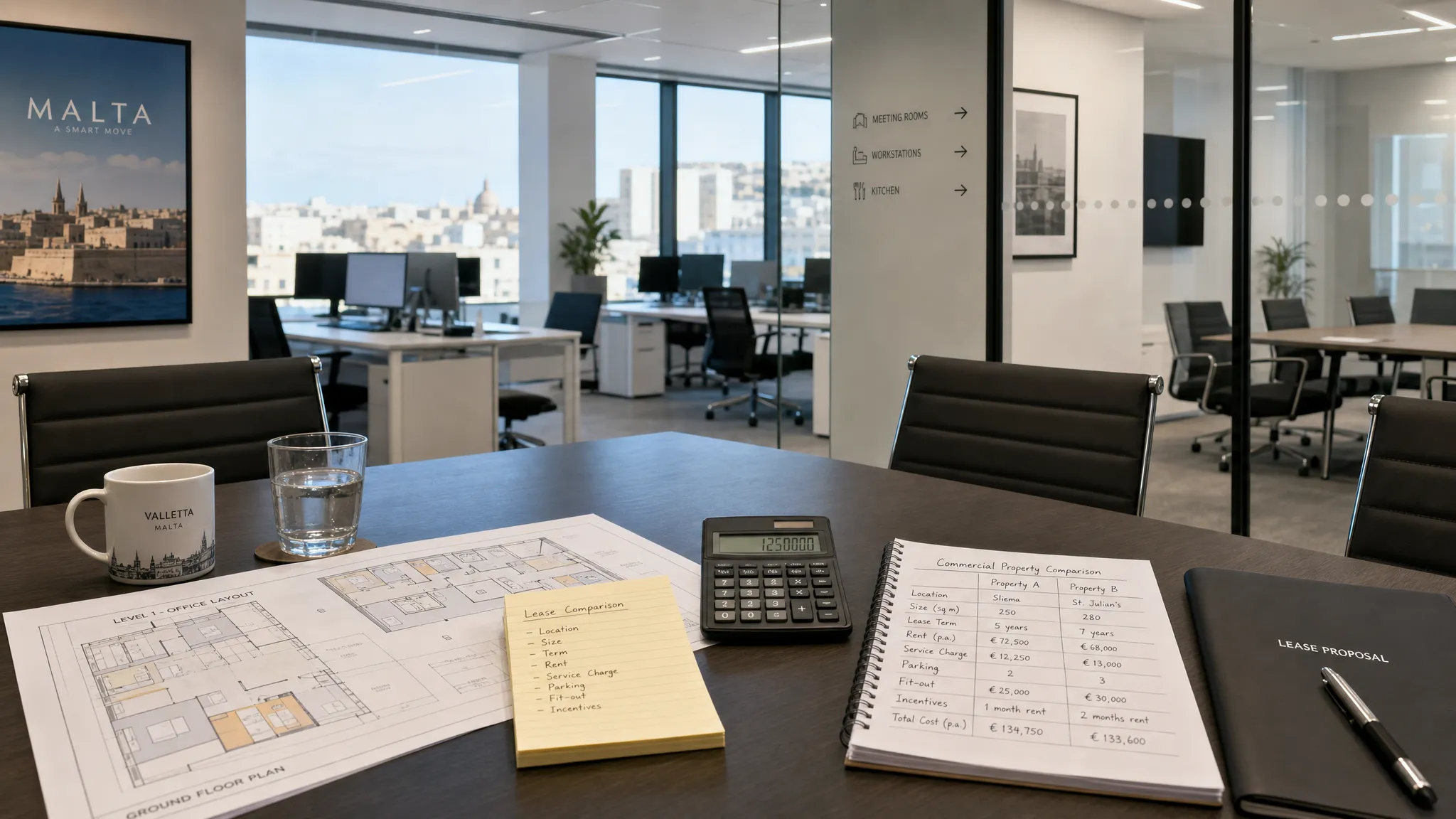
Compare lease terms before you fall in love with the space
A beautiful office with restrictive terms may be a poor business decision. Before making an offer, compare the legal and commercial terms with the same discipline you apply to rent and location.
In Malta, lease discussions often include terms such as fixed periods, renewal rights, notice periods, deposits, rent review mechanisms and responsibilities for repairs. The exact wording matters, so legal review is important before signing.
Key terms to compare include the lease duration, break options, rent increases, deposit amount, payment frequency, permitted use, subletting or assignment rights, fit-out permissions, maintenance obligations and end-of-lease reinstatement. You should also clarify who pays for repairs to air conditioning, lifts, common areas and building systems.
If your company is growing quickly, flexibility may be worth paying for. A slightly higher rent with a realistic break option or expansion route can be safer than a cheaper lease that locks you into the wrong space. Before negotiating, read these practical tips on office lease negotiation in Malta.
Check building infrastructure and daily usability
Commercial property is not only an address. It is a working system that your team will use every day. During viewings, inspect the practical details that affect productivity.
Check air conditioning, ventilation, natural light, lifts, staircase access, toilets, kitchenette areas, power points, server or networking options, mobile signal and internet availability. Ask about building access outside normal office hours if your team works with international time zones, which is common in iGaming, finance and tech.
Parking deserves special attention. Some buildings advertise parking nearby, while others include dedicated spaces. Clarify what is included, what costs extra and whether visitor parking is realistic. For client-facing businesses, a lack of parking can quickly become a daily frustration.
A move also depends on digital readiness. If your office manager is reviewing collaboration, cloud storage, booking or knowledge base tools as part of the relocation, independent resources such as Online Tool Guides can help compare software options alongside the property decision.
Do due diligence before committing
Once you have a preferred property, slow down and verify. Commercial leases can involve planning, tax, fit-out and operational issues that are not visible during a quick viewing.
At minimum, confirm that the landlord has authority to lease the property, the permitted use matches your activity, and any planned alterations are allowed. If signage, client reception, after-hours access or specialist equipment matters to your business, get approvals in writing.
You should also review whether the building has any known water ingress, lift issues, access restrictions, neighbour disputes or recurring maintenance problems. Ask for clear information on service charges and what they cover. If a landlord cannot explain costs or responsibilities clearly, treat that as a warning sign.
For VAT, legal structure and lease obligations, use qualified professional advice. This is especially important for foreign companies relocating to Malta, regulated businesses and companies signing longer commitments.
Compare timing and business disruption
The best property on paper may not be the best property for your timeline. If your current lease is ending, a delayed handover can create costly disruption. If you are relocating staff from overseas, timing affects HR, onboarding and morale.
Compare each option by move-in readiness. Is the office furnished? Are utilities connected? Is the internet live? Are partitions already in place? Does the landlord need to complete works? Are there planning or fit-out approvals required?
For a company under time pressure, a serviced or partly fitted office can be the most sensible bridge. For a company planning a long-term Malta headquarters, it may be worth waiting for the right traditional office, provided the lease terms justify the investment.
Red flags when comparing commercial property for rent
Some issues do not automatically disqualify a property, but they should change how you negotiate or whether you proceed.
Watch for vague cost information, unclear permitted use, poor building maintenance, unrealistic occupancy claims, missing parking details, unexplained service charges, no written confirmation of fit-out permissions, weak internet options and pressure to sign before legal review.
Also be cautious if the landlord or agent avoids basic questions. A good commercial property decision depends on transparency. If important details are unclear before signing, they are unlikely to become easier afterwards.
A practical comparison process
A simple process can save weeks of back-and-forth. First, define your business brief and budget. Then shortlist properties that meet the non-negotiables. View the strongest options in the same week where possible, score them using consistent criteria and request full cost information for the top two or three.
After that, compare lease terms and negotiate. Only then should you move to legal review, deposit payment and operational planning. This sequence keeps you from committing emotionally before the commercial facts are clear.
OfficeSpace.Rent helps businesses compare verified office and commercial property options across Malta, with filters for location, price, size and office type. For companies relocating, expanding or replacing an existing workspace, structured shortlisting and viewing support can make the search faster and less risky.
Frequently Asked Questions
What is the best way to compare commercial property for rent in Malta? Start by normalising the total cost, then compare location, layout, lease terms, building quality, move-in readiness and compliance. Do not rely on rent alone, because two properties with similar rent can have very different operating costs.
How many properties should I view before choosing an office in Malta? Most businesses benefit from viewing at least three strong options. If your requirements are specialised, such as a large HQ, regulated financial office or high-capacity iGaming workspace, you may need a wider shortlist.
Is a serviced office cheaper than a traditional lease? Not always. Serviced offices can cost more per desk, but they often include furniture, utilities and shared services. Traditional leases may be cheaper per square metre, but they usually require more setup, management and commitment.
What lease terms matter most when renting commercial property in Malta? Focus on lease length, break options, rent increases, deposit, maintenance responsibilities, permitted use, fit-out permissions, renewal rights and end-of-lease obligations. Always obtain legal advice before signing.
Should foreign companies get local advice before renting in Malta? Yes. Local advice helps with lease structure, VAT considerations, planning use, negotiation norms and practical issues such as viewings, deposits and landlord expectations.
Ready to compare Malta office options?
If you are comparing commercial property for rent in Malta, start with a structured shortlist rather than scattered enquiries. OfficeSpace.Rent can help you review suitable listings, compare locations and costs, arrange viewings and approach negotiations with clearer market context.
The right property should support your people, clients and growth plans. Compare carefully before you commit, and you will reduce risk long before the lease is signed.