In this article we explore how hybrid offices in Malta combine dedicated desk space with flexible collaboration zones to support teams working part-time in the office and part-time remotely. In 2026, the right hybrid office is sized to peak concurrent occupancy — not total headcount. Expect to pay EUR 130–550 per m² per year depending on location. Search over 3,850 hybrid-compatible listings on OfficeSpace.Rent to find the right fit for your team.
Last updated: March 2026 | By OfficeSpace.Rent This article explores the latest trends and insights on Hybrid Offices.
Hybrid offices have become the dominant workplace model for businesses in Malta. Globally, Gallup research shows that 52% of remote-capable employees now work hybrid schedules. In Malta, the shift is equally visible. Companies across iGaming, fintech, and professional services run hybrid teams daily. However, many still occupy offices designed for a different era. This guide explains how to choose, size, and lease hybrid offices in Malta in 2026. It draws on data from over 3,850 active listings on OfficeSpace.Rent and 12 years of local commercial real estate experience.
What Are Hybrid Offices?
Hybrid offices are workspaces designed to support teams that split their time between working on-site and working remotely. Unlike a traditional office — where every employee has a fixed desk — hybrid offices are built around peak concurrent occupancy. That means the number of people in the building at any one time, not total headcount.
Furthermore, these workspaces prioritise collaboration over individual desk space. They typically include a mix of workstations, meeting rooms, breakout areas, and technology infrastructure that supports seamless video conferencing. The result is a leaner, smarter footprint that reduces costs and improves the in-office experience for staff.
According to McKinsey & Company, 87% of employees offered flexible work arrangements take them up. Consequently, businesses that fail to adapt their office strategy face higher staff turnover and lower attendance. In Malta, the best workspaces solve this problem directly.
Why Hybrid Offices Matter in Malta (2026)
Malta’s compact geography makes hybrid working unusually practical. The island measures just 316 km². Most employees live within 30 minutes of any major business district. Additionally, Malta ranks in the EU’s top 10 for fixed broadband speeds. The European Commission’s Digital Decade Country Report confirms this. Strong connectivity supports reliable remote working island-wide.
At the same time, Malta’s office market is evolving. Landlords are responding to demand for flexibility. Therefore, businesses searching for flexible office space in Malta find more suitable options than ever before. OfficeSpace.Rent tracks over 3,850 commercial listings across 31 localities. Enquiries specifying hybrid team requirements have increased significantly across 2025 and into 2026.
The sectors driving this shift are clear. The iGaming industry contributes approximately 12% of Malta’s GDP. The Malta Gaming Authority (MGA) reports over 300 licensed operators on the island. These companies operate large, distributed teams. So does the financial services sector.
How to Size Hybrid Offices in Malta
Sizing is the most important decision when leasing this type of office. Get it wrong and you either pay for empty desks or struggle with overcrowding on busy days.
The standard rule for traditional offices is 10–12 m² per person based on total headcount. Hybrid offices use a different calculation. Start with your peak concurrent occupancy — the maximum number of staff in the office on any single day. Apply 10–12 m² per person to that figure instead.
Hybrid Office Sizing Example
| Total Headcount | Hybrid Split | Peak Concurrent Occupancy | Recommended Size | Traditional Size Required | Annual Saving (at EUR 240/m²/yr) |
|---|---|---|---|---|---|
| 10 people | 50% hybrid | 5–6 people | 60–72 m² | 120 m² | ~EUR 14,400/yr |
| 20 people | 50% hybrid | 10–12 people | 120–144 m² | 240 m² | ~EUR 28,800/yr |
| 50 people | 60% hybrid | 20–22 people | 240–264 m² | 600 m² | ~EUR 86,400/yr |
Savings are indicative based on mid-range Sliema/St Julian’s rents. Use our office space calculator for your specific requirements.
Additionally, allow for a 10–15% buffer above peak occupancy. Attendance spikes occur around company events, all-hands meetings, and client visits. Planning for these peaks avoids a cramped experience on your busiest days.
Hybrid Office Layout: What to Prioritise
A hybrid office that functions well looks different from a traditional one. The layout must serve two distinct needs: focused individual work and collaborative group activity. Moreover, it must accommodate variable attendance without feeling empty on quiet days or overcrowded on busy ones.
Based on our experience advising businesses across Malta, the most effective hybrid office layouts follow a 60/40 split:
- 60% workstations and focused zones — hot desks, quiet booths, individual workstations with good ergonomics and natural light
- 40% collaboration and meeting space — meeting rooms, breakout sofas, informal areas and a well-equipped kitchen or social space
Additionally, meeting rooms carry more weight in these setups than in traditional offices. When half the team is remote, every meeting room becomes a broadcasting studio. Consequently, each room needs high-quality audio and a wide-angle camera. The screen must be large enough for remote participants to feel present. A pixelated thumbnail in the corner defeats the purpose entirely.
Finally, consider wayfinding. On a busy hybrid day, staff need to find an available desk quickly. Simple desk booking systems remove friction entirely. Many integrate with Microsoft Teams or Slack. They make shared desking work in practice, not just in theory.
Technology Requirements for Hybrid Offices in Malta
Hybrid offices depend on infrastructure more than traditional offices do. When your team is split between the building and remote locations, connectivity becomes operational risk. These are the non-negotiables:
- Fibre broadband — dedicated symmetric fibre, not shared broadband. Malta’s main providers include Melita and Epic. Confirm line speeds and SLA guarantees before signing any lease.
- Back-up generator — essential for any business where a power cut means half the team loses access to the office network
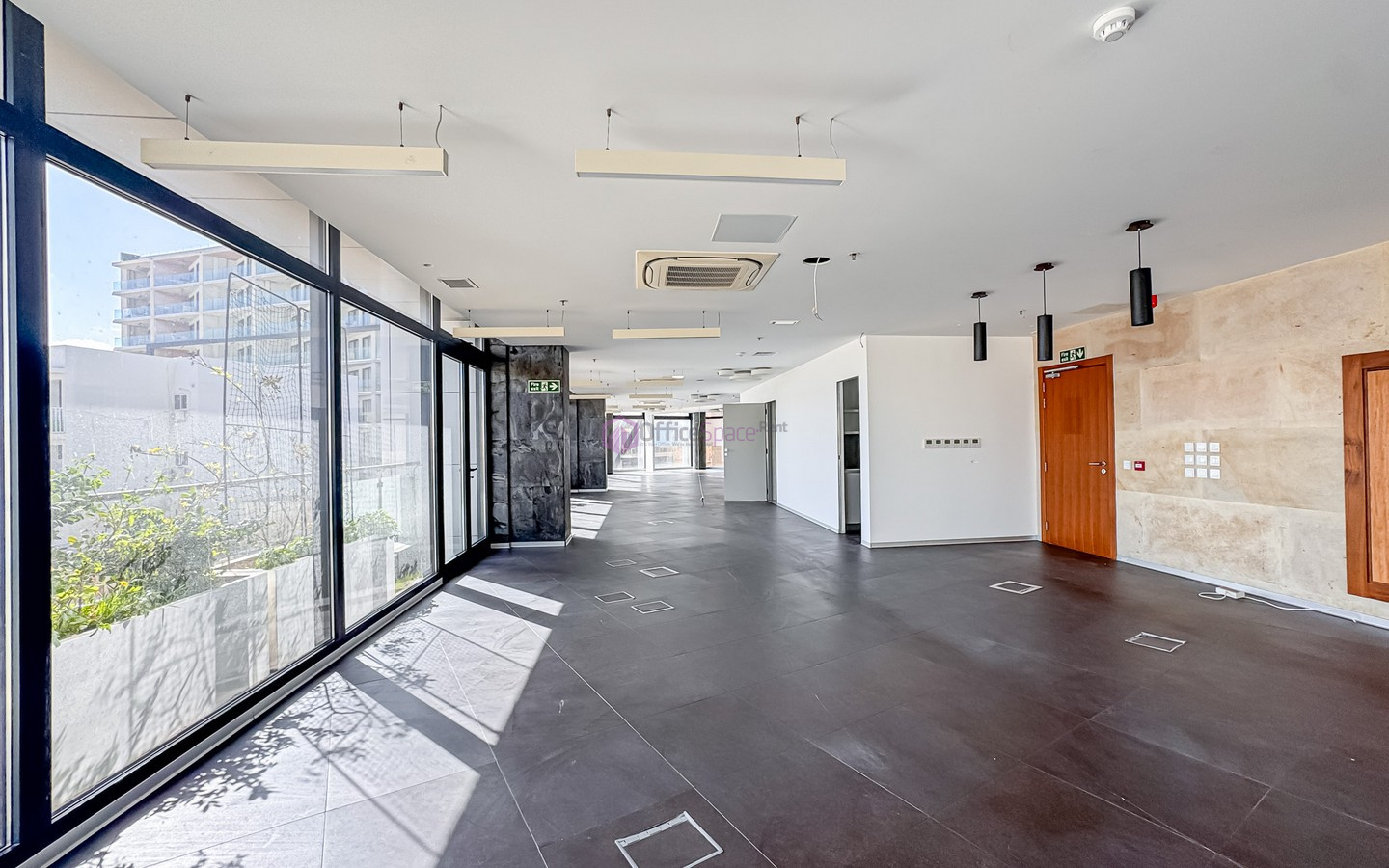
- Raised access flooring — allows clean cable management and easy reconfiguration as your layout evolves
- Video-conferencing hardware in meeting rooms — at minimum, a mounted screen, external camera, and ceiling or table microphone array
- Wi-Fi throughout — including breakout areas and social spaces, not just at desks
When viewing any office in Malta for a hybrid team, ask directly about network infrastructure. Buildings with raised flooring and dedicated fibre are significantly better suited to hybrid operations. Many modern business centres in Mriehel CBD and St Julian’s include these as standard.
Best Locations for Hybrid Offices in Malta
Location affects how many staff actually show up. In a traditional office, attendance is mandatory. In a hybrid model, the commute becomes a genuine factor in whether people choose to come in. Therefore, choosing the right location for your hybrid office directly affects the quality of your in-office days.
Below is a breakdown of Malta’s key office areas and their suitability for hybrid teams.
| Location | Rent (EUR/m²/yr) | Transport Links | Parking | Best For |
|---|---|---|---|---|
| Sliema | EUR 220–550 | Excellent — bus hub, ferry | Limited, paid | Prestige address, client-facing teams |
| St Julian’s | EUR 250–475 | Very good | Limited, some underground | iGaming, fintech, tech companies |
| Ta’ Xbiex | EUR 220–450 | Good | Street + nearby | Financial services, professional firms |
| Gzira | EUR 200–400 | Good — near Sliema | Moderate | SMEs, budget-conscious coastal teams |
| Mriehel CBD | EUR 150–300 | Good arterial road access | Generous, often included | Larger hybrid teams, corporate HQs |
| Birkirkara | EUR 130–200 | Good | Good | Cost-efficient hybrid setup |
| Naxxar | EUR 130–185 | Car-dependent | Excellent | Back-office, logistics-adjacent |
Pricing is indicative as of March 2026. See our full office rental pricing guide for a detailed breakdown.
Notably, Mriehel CBD and Birkirkara deliver the strongest value for larger hybrid teams. Both areas offer modern, well-equipped business centres with generous parking. This matters when staff drive in two or three days a week. Furthermore, Mriehel’s arterial road network means employees from across the island can reach it in under 20 minutes. Read our full Mriehel CBD guide for more detail.
In contrast, Sliema and St Julian’s suit hybrid teams where a prestigious client-facing address matters. The premium is real, but so is the benefit for businesses where the office is part of the brand. See all available offices in Sliema and offices in St Julian’s.
Hybrid Offices vs Serviced Offices: Which Is Right for You?
Many businesses confuse these two concepts. They are related but distinct. A serviced office is a type of product — fully furnished, all-inclusive, short-term. A hybrid office is a way of working — it describes how your team uses the space, not the product itself.
That said, serviced offices are often an excellent fit for hybrid teams. The all-inclusive model removes the management overhead that becomes burdensome when your office is half-full three days a week. Additionally, the flexibility of short-term contracts suits the evolving space requirements of hybrid operations.
| Factor | Hybrid Office (Traditional Lease) | Hybrid Office (Serviced) |
|---|---|---|
| Monthly cost | Lower long-term | All-inclusive, higher per desk |
| Lease flexibility | Medium (1–5 years) | High (3–12 months) |
| Layout control | Full — design your own | Limited — provider’s layout |
| Time to occupy | 2–8 weeks (fit-out required) | Immediate |
| Best for | Established teams, 15+ people | Startups, new market entrants, small hybrid teams |
For a full comparison, see our article on serviced vs traditional offices in Malta.
Lease Terms for Hybrid Offices in Malta
Hybrid working and shorter leases have arrived together — and that is not a coincidence. When your space requirements depend on headcount fluctuations and evolving work patterns, a five-year lease feels like a significant risk. Consequently, many Malta landlords now offer more flexible arrangements than they did five years ago.
According to data from OfficeSpace.Rent’s active listings as of March 2026, lease terms across Malta’s office market break down as follows:
- Traditional leases: 1, 2, 5, 6, or 9 years, with break clauses typically available after year 3 of longer commitments
- Serviced offices: 3 to 12 months, some with month-to-month options
- Hybrid-optimised traditional leases: increasingly available at 12–24 months for quality tenants
For hybrid teams specifically, we recommend negotiating a break clause at year 2 on any lease longer than three years. This protects you if your hybrid model evolves. You may grow and need more space. Alternatively, you may contract and need less. Additionally, confirm that the lease permits desk-booking systems and any minor internal alterations needed for hybrid fit-out.
For more on lease trends in 2026, see our article on why more businesses are renting shorter leases.
Always have a qualified Malta-based lawyer review any lease before you sign. Commercial lease law in Malta protects both parties, but the details matter significantly. Never sign without independent legal advice. The legal fees are modest. The financial exposure of a multi-year commitment is not.
Class 4A Permits and Hybrid Offices
Any property used as an office in Malta — including hybrid offices — must hold a valid Class 4A permit from the Malta Planning Authority. This is a legal requirement. Operating from premises without the correct permit can result in enforcement action and complications with your lease.
The Class 4A permit is typically held by the landlord, not the tenant. However, as a tenant, you must verify it is in place before signing any lease agreement. Request a copy of the permit documentation directly from the landlord or agent. Do not rely on verbal assurances.
For a complete walkthrough of the permit process, read our dedicated Class 4A permit guide.
Cost of Hybrid Offices in Malta (2026)
The total cost of a hybrid office depends on location, office type, size, and lease length. The table below provides indicative annual cost ranges for a 10-person hybrid team (peak occupancy 5–6 people, approximately 60–72 m²) across Malta’s main business districts.
| Location | Annual Rent (Traditional) | Annual Rent (Serviced, per desk) | Parking Included |
|---|---|---|---|
| Sliema | EUR 13,200–39,600 | EUR 18,000–57,600 (5 desks) | Rarely |
| St Julian’s | EUR 15,000–34,200 | EUR 18,000–57,600 (5 desks) | Sometimes |
| Ta’ Xbiex | EUR 13,200–32,400 | EUR 18,000–48,000 (5 desks) | Sometimes |
| Mriehel CBD | EUR 9,000–21,600 | EUR 15,000–36,000 (5 desks) | Usually |
| Birkirkara | EUR 7,800–14,400 | EUR 12,000–24,000 (5 desks) | Usually |
All figures are indicative and exclude VAT. Traditional office costs exclude fit-out. For current market pricing, see our full pricing guide or contact our team.
Additionally, factor in these one-time and ongoing costs when budgeting:
- Security deposit: typically 2–3 months’ rent, held by the landlord
- Fit-out costs: EUR 200–500 per m² for traditional offices requiring refurbishment
- Agency fee: typically 10% of first year’s annual rent — see our agency fee guide
- Video-conferencing equipment: EUR 1,500–5,000 per meeting room depending on specification
- Desk booking software: EUR 3–8 per desk per month for most platforms
Step-by-Step: Finding the Right Office
- Calculate peak concurrent occupancy. Count the maximum number of staff in the office on any given day. This is your sizing number, not total headcount.
- Add a 10–15% buffer. Allow for busy days, client visits, and all-hands meetings.
- Define your collaboration requirements. Estimate how many meeting rooms you need. One room per 8–10 concurrent occupants is a useful starting point.
- Choose your location. Map where your team lives. Choose a location that minimises the average commute. Use the location table above as a starting point.
- Decide: serviced or traditional. Teams under 15 people often benefit from serviced offices first. Teams above 15 — or those with specific layout needs — suit traditional leases better.
- Set your total budget. Include rent, deposit, fit-out, equipment, and agency fees.
- Search and shortlist. Search OfficeSpace.Rent and shortlist 5–8 properties. Use our desk-based office search to filter by team size.
- View in person. Photographs do not show noise levels, natural light, or neighbourhood character. View at least 3–5 properties.
- Verify the Class 4A permit. Always request documentation. Do not rely on verbal confirmation.
- Negotiate terms and get legal advice. Aim for a break clause at year 2. Have a lawyer review the lease before signing.
Frequently Asked Questions:
What Is a Hybrid Office?
A workspace designed for teams that split their time between working on-site and working remotely. This type of office is sized to peak concurrent occupancy — not total headcount — and prioritise collaboration space alongside individual workstations.
How Much Does This Type of Office Cost in Malta?
Traditional offices for hybrid teams in Malta cost EUR 130–550 per m² per year depending on location. Serviced options cost EUR 300–800 per desk per month. A 10-person hybrid team (peak 5–6 people) can expect to pay EUR 7,800–39,600 per year in rent, depending on area. Use our office space calculator for a more precise estimate.
Which Malta Location Suits a Hybrid Team Best?
The best location depends on your team’s commute and your brand requirements. Sliema and St Julian’s suit client-facing businesses that need a prestige address. Mriehel CBD and Birkirkara suit larger hybrid teams that prioritise value, parking, and practical infrastructure. See our best areas for offices in Malta guide for a full comparison.
Do These Offices Need a Class 4A Permit in Malta?
Yes. Any premises used as an office in Malta must hold a valid Class 4A permit from the Malta Planning Authority, regardless of how frequently the team is in the office. Always verify the permit is in place before signing a lease. Read our Class 4A guide for full details.
Are serviced offices suitable for hybrid teams?
Yes — particularly for smaller hybrid teams or companies entering the Malta market for the first time. Serviced offices offer flexible terms, all-inclusive pricing, and professional infrastructure without the commitment of a long-term traditional lease. For a full comparison, see our article on serviced vs traditional offices in Malta.
How Do I Find Flexible Office Space in Malta?
Use OfficeSpace.Rent’s advanced property search to filter by location, size, price, and features. Use the desk-based search to find offices matched to your team size. If you need personalised guidance, contact our team directly — we specialise exclusively in office space across Malta.
Ready to find your hybrid office in Malta? Search 3,850+ listings on OfficeSpace.Rent — Malta’s largest office space marketplace. For personalised guidance on hybrid office sizing, location, and lease terms, contact our team. Follow OfficeSpace.Rent on Facebook for market updates and new listings.